

Weasel askos
The following texts and images are the results of a training exercise to go from the pictures of a museum piece to the creation of a 3D restored version of it. It’s a documentation on some processes and constructions. These particular models are the result of hypothesis that resulted in a certain amount of artistic licence, making them artistic renders and not scientific restorations.
Today, let’s explore one of the cutest expression of archaic Apulian’s ceramics’ production.
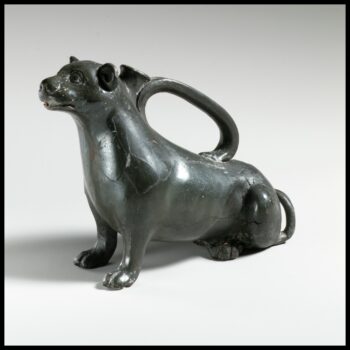
Title: Terracotta askos in the form of a weasel
Datation: 4th century BCE
Provenance: Greek, South Italian, Campanian
Dimensions: H. 12.4 cm
Media: Terracotta; black-glaze
Source: Metropolitan museum of Art
Description
Historical context
Askos are vessel used to pour small quantities of liquids such as oil. Though most often discovered in funerary contexts, their uses are still debated among archaeologists.
The Classical Art Research Centre (CARC) of Oxford University mentions that the “Greek word askos refers to the bags made of animal-skin that were used to carry wine […]. Its modern application to this pottery-shape originates in the supposed similarity of some examples to animal-skins”. Now, you know.
Black, shiny vessels were frequently used as an imitation of -pricey- metal, like bronze.
Also, it has cute ears and tail and a happy face ! Who wouldn’t like that ?
The Metropolitan museum’s collection has two pieces of the same period and of similar style: this animal, identified as a weasel and a boar. Their cartels describe them as such: “With keen observation, utmost economy, and masterful sensitivity, the Campanian artists have rendered a weasel and a boar as they sit in charmed submission.”
There are others examples of animal shaped askoi from the same period, all more or less coming from the Italian peninsula, most of them showing the same naturalistic and simplified modelling techniques. Most of them were probably moulded and produced at large scale.
- an Apulian boar in the Louvre Museum
- a life like Etruscan rooster in the Metropolitan Museum
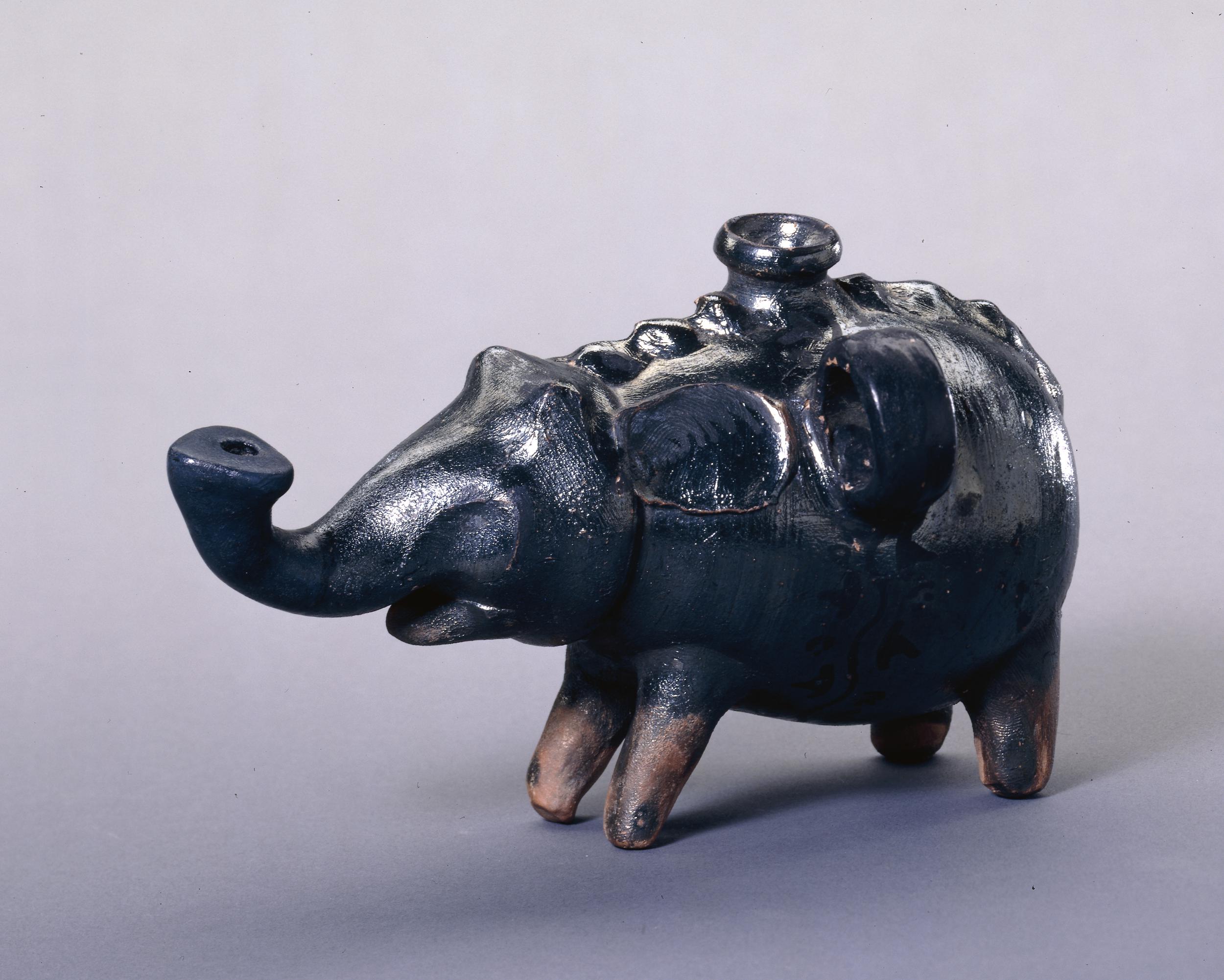
- a slightly later dated astonishing elephant in the British Museum
Cousins !
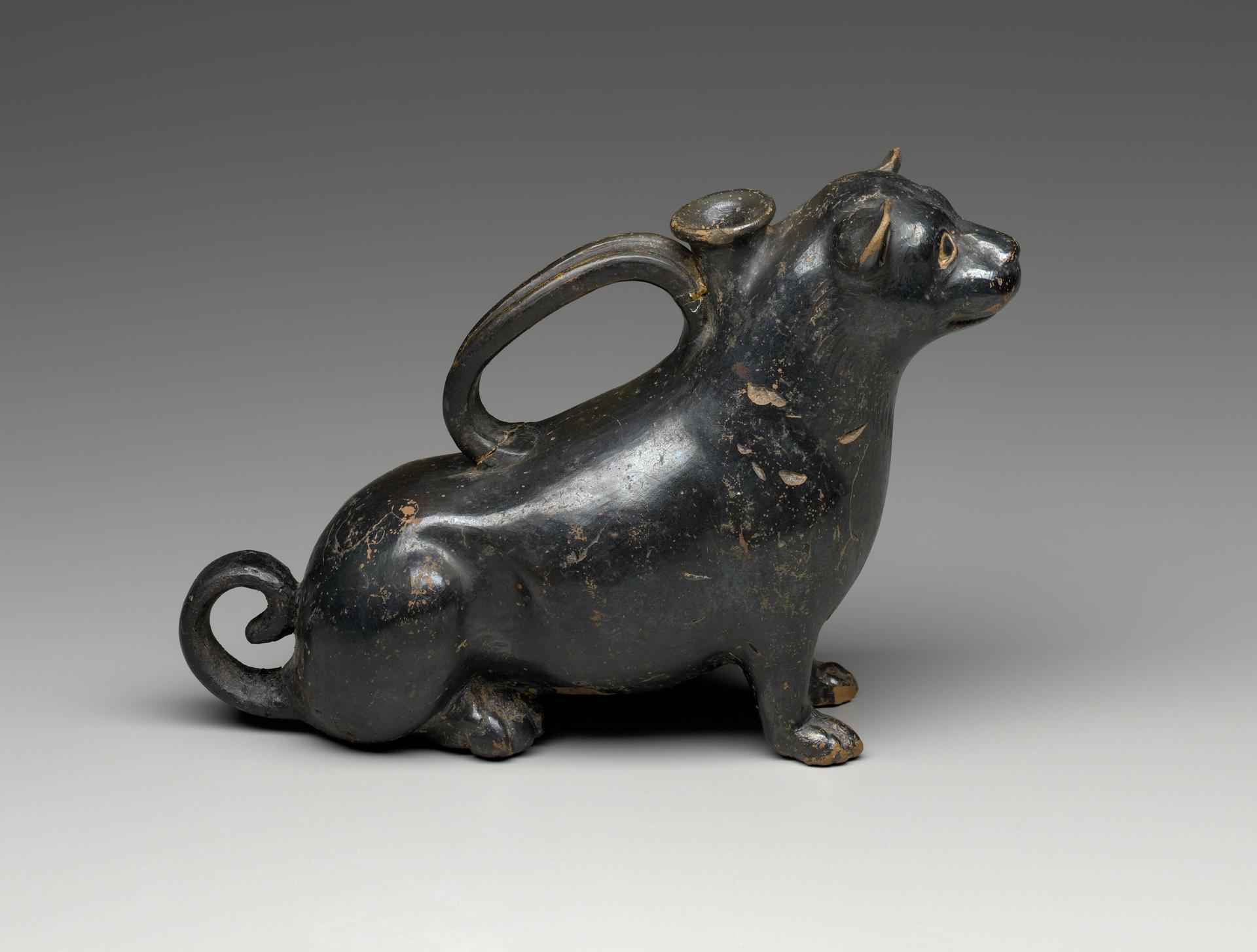
Among this delightful bestiary, we can also find cousins to our piece. Yale University Art Gallery has a Ferret version. If the difference between a ferret and a weasel is not known to you, do be reassured: you are not alone. Throw a stoat in the mix, and I’m completely lost. This page may help you !
TL;DR: they’re visually close enough that the identification of ceramic vessel mimicking one will be tricky.
Back to our ceramic ferret vessel, now.
Its shape is very similar, almost identical to the Metropolitan’s weasel. It seems that only a few details change, like the tail. One could suppose that similar moulds were used, then handmade tweaks were added. It is hard to say without being able to compare the pieces directly. This is a well documented technique of antique potters to keep a steady production going.
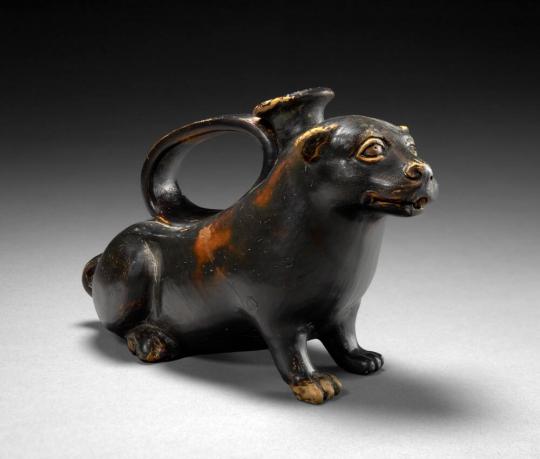
©The Museum of Fine Arts, Houston
I was about to conclude this part when I stumbled upon this piece from the Houston Museum of Fine arts.
Does it remind you of anyone ? Same stumpy legs, same coy expression, similar implantation of the spout and handle on the back, same rounded ears: the only difference is that it is identified as a dog this time.
From that we can conclude that fine arts curators and conservators are rarely zoologists too ! I have no doubt that the Apulian potters had a specific animal in mind, but I’m at a loss as to what it was.
Visible condition report
A restored piece
The piece has seen better days. Its was broken in multiple pieces and has been reconstructed. The cracks lines are clearly visible. The surface, though battered and worn on prominent parts and extremities, still shows the soft and lustrous black with silvery undertones this ceramic production is known for.
It is interesting to note that the white parts may be added after the first black slip is polished. I think, but I’m not sure, that a simple slip using the same clay as the clay body would give this result.
Despite having lived through tough times, our little buddy keeps the incredible details the potter gave it, up to the slightly puffed cheeks creating two masses on the muzzle. The clay that was used to append the forelegs has been pushed high up and outlines the beginning of the shoulder girdle. A closer inspection of the piece would, I’m sure, deliver numerous other occurrences of the artist’s craftsmanship.
Parts recognition
If I had to guess, I’d say the body was created first, maybe moulded at least in parts like the head (the different examples show a remarkable similarity). I was not able to find a definitive answer to the techniques used in the scientific surveys and books I consulted. I found one mention of a moulding technique for Apulian red figures ceramics, which is why I think this could be applied to our little friend.
I found information on older askoi looking different but not for this very production. If you have more information on the subject, please share !
Once the body is shaped, the ears, oil spout on the back, handle, feet and tail can be added.
In the already cited publication, the author mentions the beige to orangey tint of the fired clay bodies. That is also what we can see on the other examples of askoi, where the slip has been removed.
Once the clay is leather hard, the black slip is put on and most probably burnish to a fine lustre. This slip is a late emanation of the red figure technique. The coloured slips (white, red) were then added.
The piece is then fired in one go on a wooden kiln. As this is terracotta, the clay body does not vitrify therefore the piece is still susceptible to water logging despite the dampening effect the slip can have. If the piece was buried, and chances are it was, the surface alterations can be partially explained by exposition to salts, using water as solvent. Some silvery grey parts and the white scales all over may be the results of that.
Let’s try to “map” the other sides and parts we need to create in order to have a goal when it’s time to sculpt. As is now usual in this exercise, we only have one reference to work with and other pieces to make educated guesses.
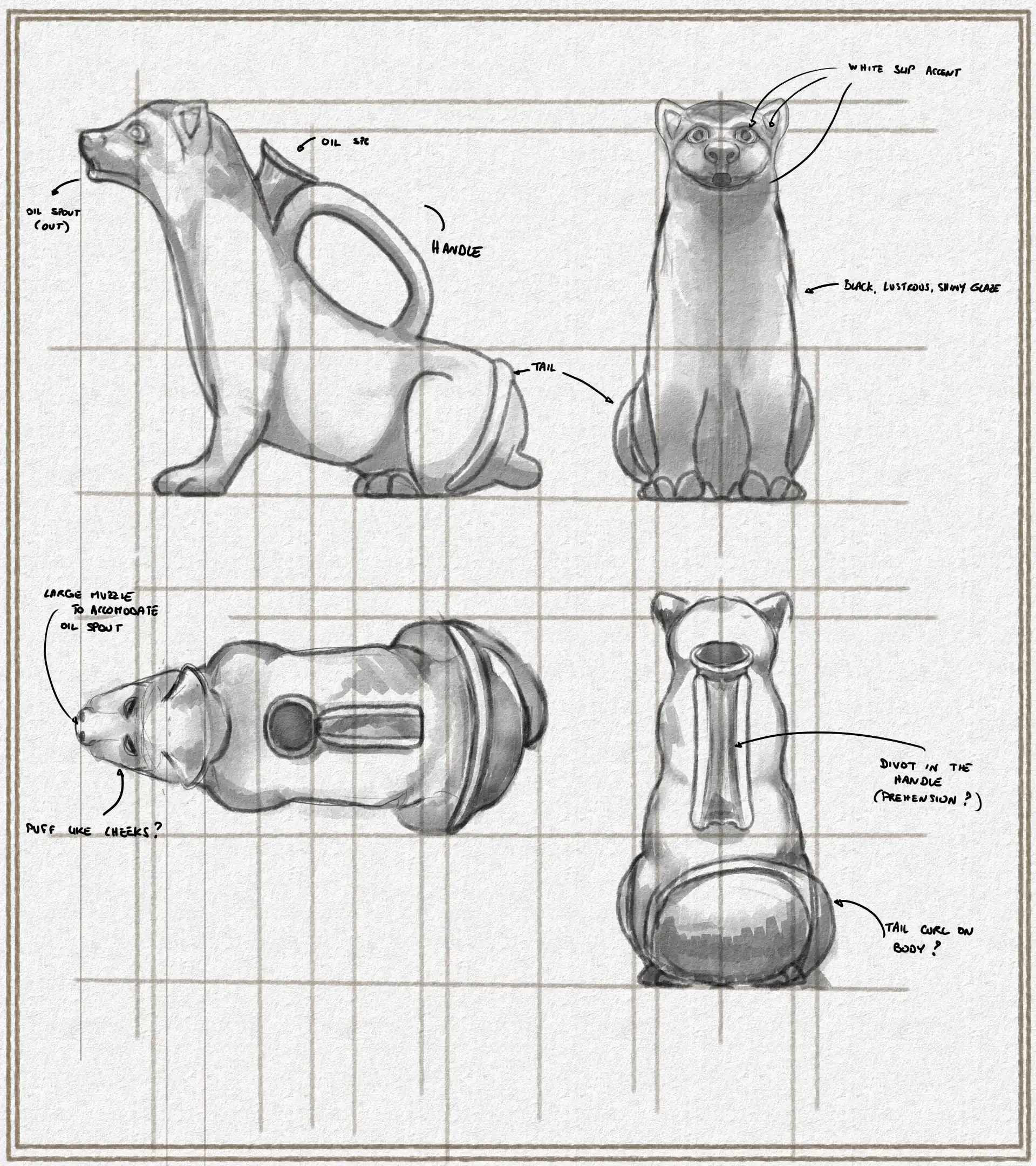
3D notes
Disclaimer : this is an exercise, shown for documentation purposes only
Model the shape
Modelling the shape require a regular back and forth with the reference we have, and use the sketches we created as guidelines for the basic shape.
Putting a view in the modelling app in the same position as the picture helps to try to stay as close as possible to the shape. However, it is hard to be certain of things like distances and sizes using a single photographic reference. The camera’s optic necessarily skews the shapes. The overall body’s length can only be estimated using the height the museum’s notice makes a reference of (12.5cm).
The tail, weirdly, is rarely seen on pictures of similar artefacts. The only one showing it has a very different version of it. That actually makes me wonder if the tail on our model isn’t a “recent” addition. Anyway, we have to make an educated guess ! Weasels have long tails so let’s go with that.
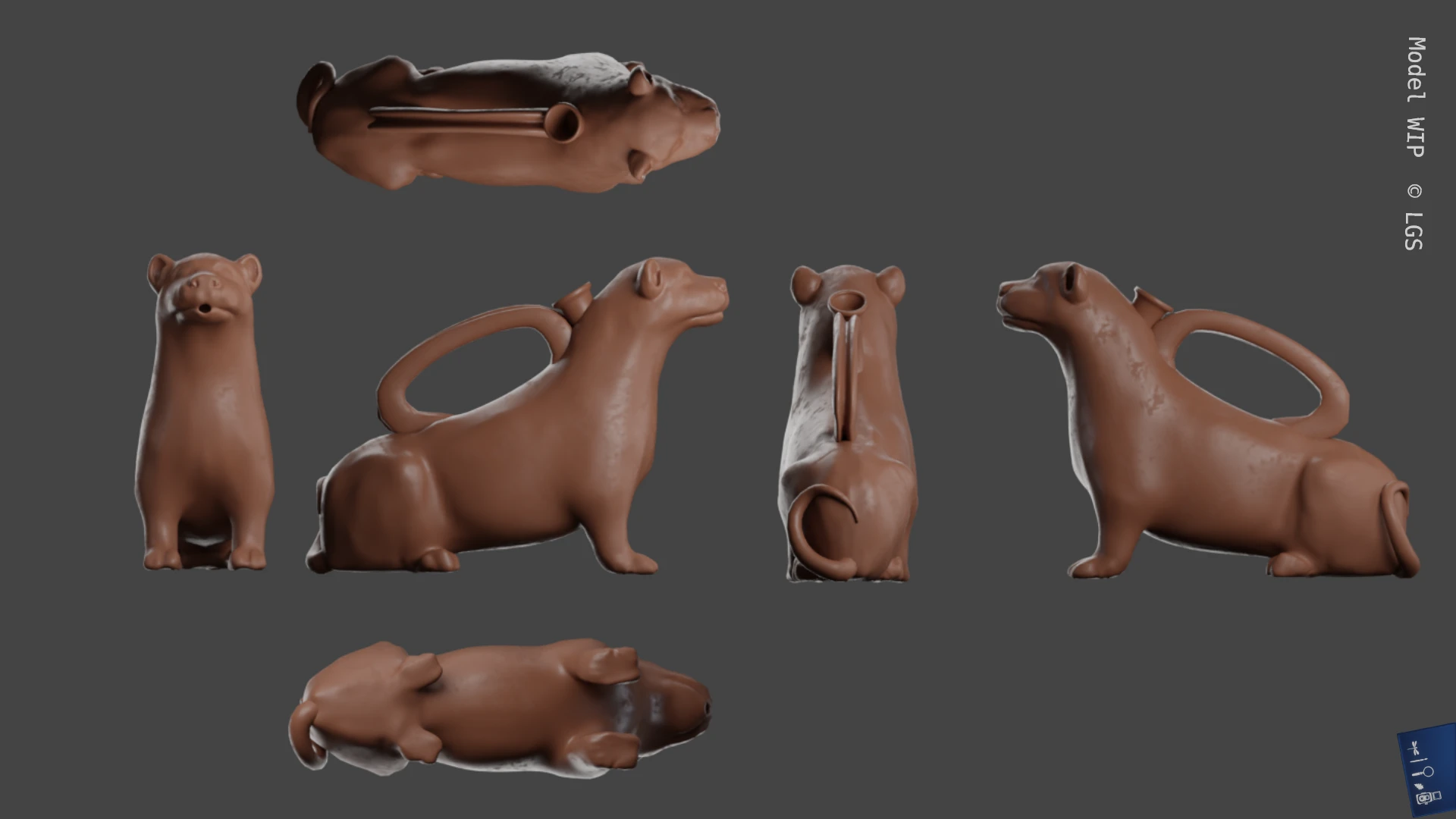
I’m still not sure about the muzzle, and I think the legs could be thinner. Thing is, the piece then looks weird when I slim them down !
Texture the shape
The texture of the askos is a smooth lustrous black with, I’m guessing, the occasional kiln defects (flaming, soot marks etc.). Because we know a little more about the process, we can construct what I hope is a convincing material !
First, the base: a lightly coloured clay body.
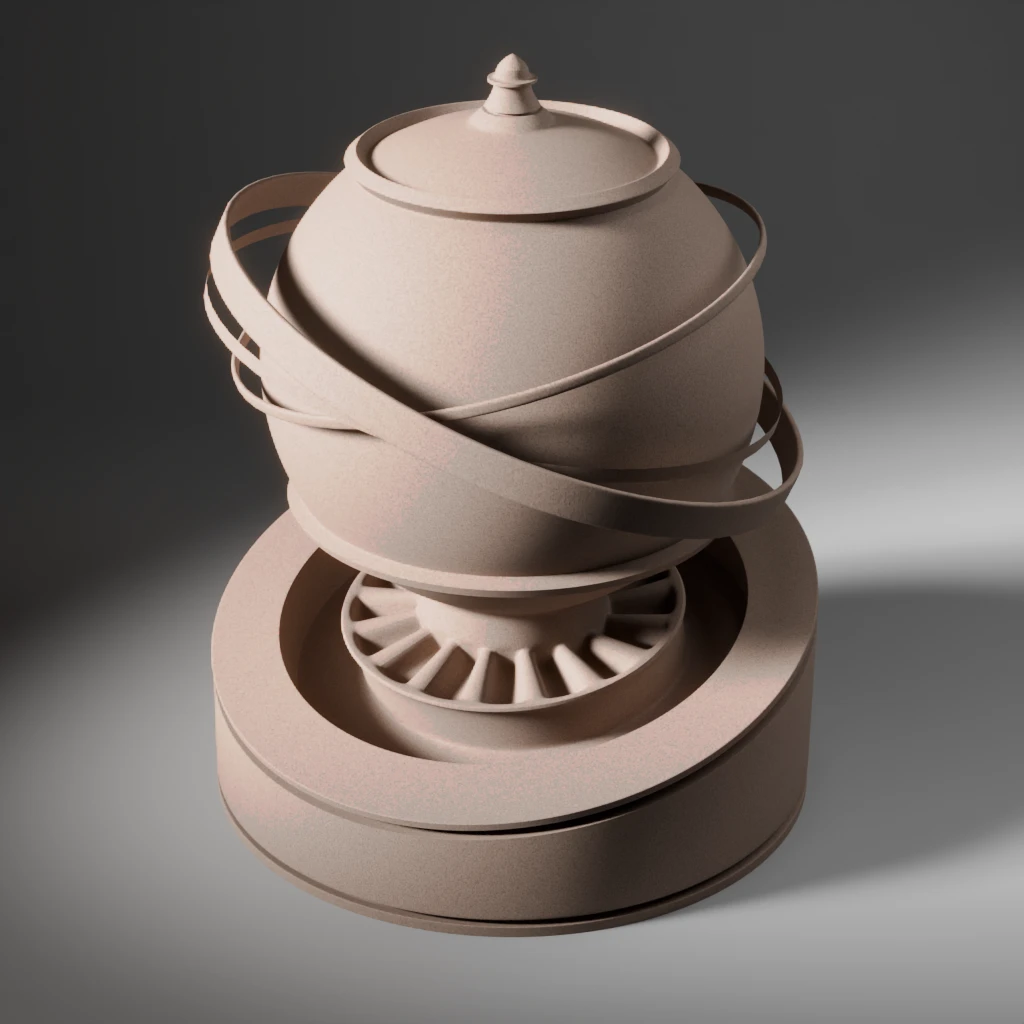
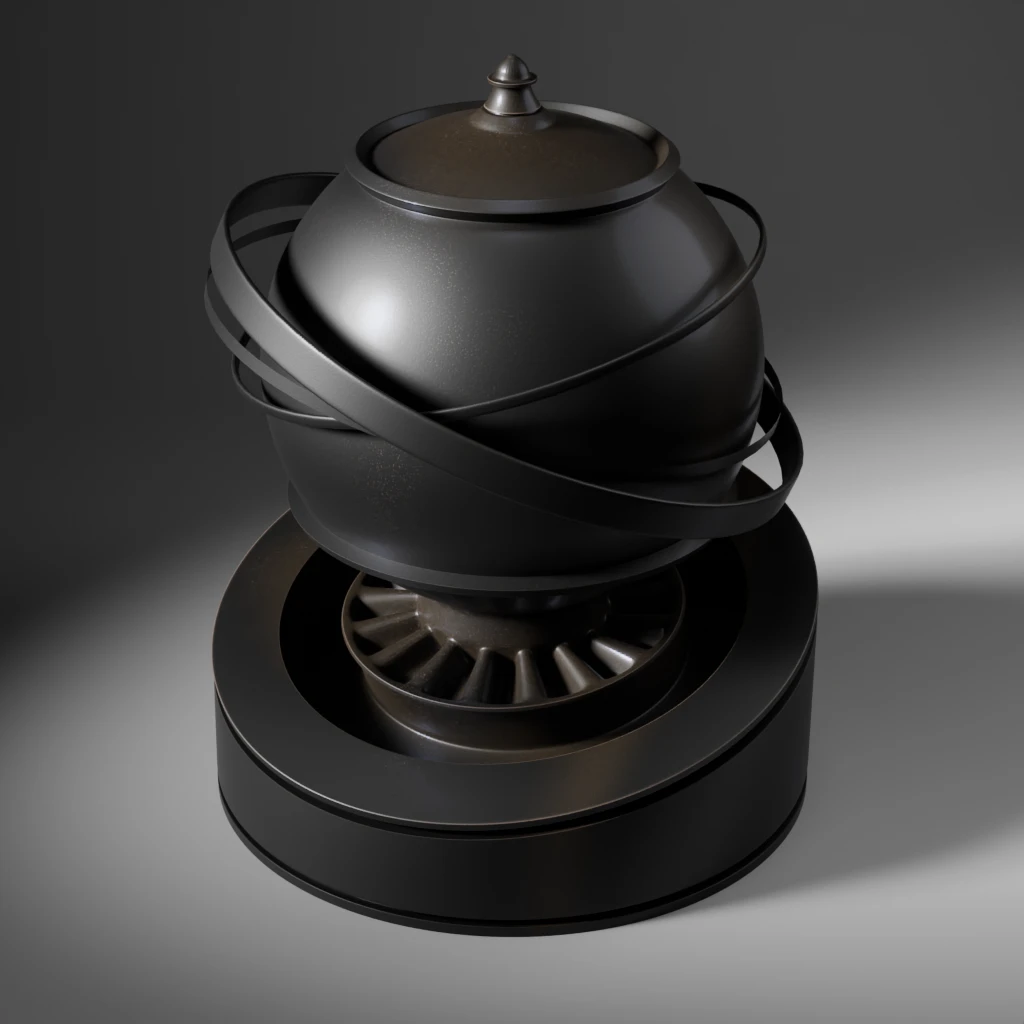
The dark slip is applied to the piece, either by dipping or brushing. If the piece is being polished before firing, the brush marks would be erased. Just as well, they are not visible on the reference. I added a detail I’m not certain is accurate. If you look closely, the edges of the test object are showing a little more of the underlying clay body. This is a common occurrence in ceramic glazes. I’m not sure Apulian slips would do that; slips are basically a watered down clay with additives. To not keep this option out, I choose to use it only on very steep edges, as I’ve witnessed on other pots of this era.
Notes: I’m using the pointiness output of the Geometry nodes in Blender to do that, I then contrast the result with a Colour Ramp node. Yes, I do use this node extensively. Yes, I know a map range is a better option. But for whatever reason, I understand a colour ramp node better.
We can also create an altered version of the material, taking into account all we learned from the piece itself and the other pieces of the same production.
Add abrasions and cracks on the surface, a little glaze missing on some part, let the fired clay body surfaced, sprinkle a touch of silvery blue tint from ground salts diffusing on the buried artefact and voilà. We have a makeshift material to age the new digital artefact !
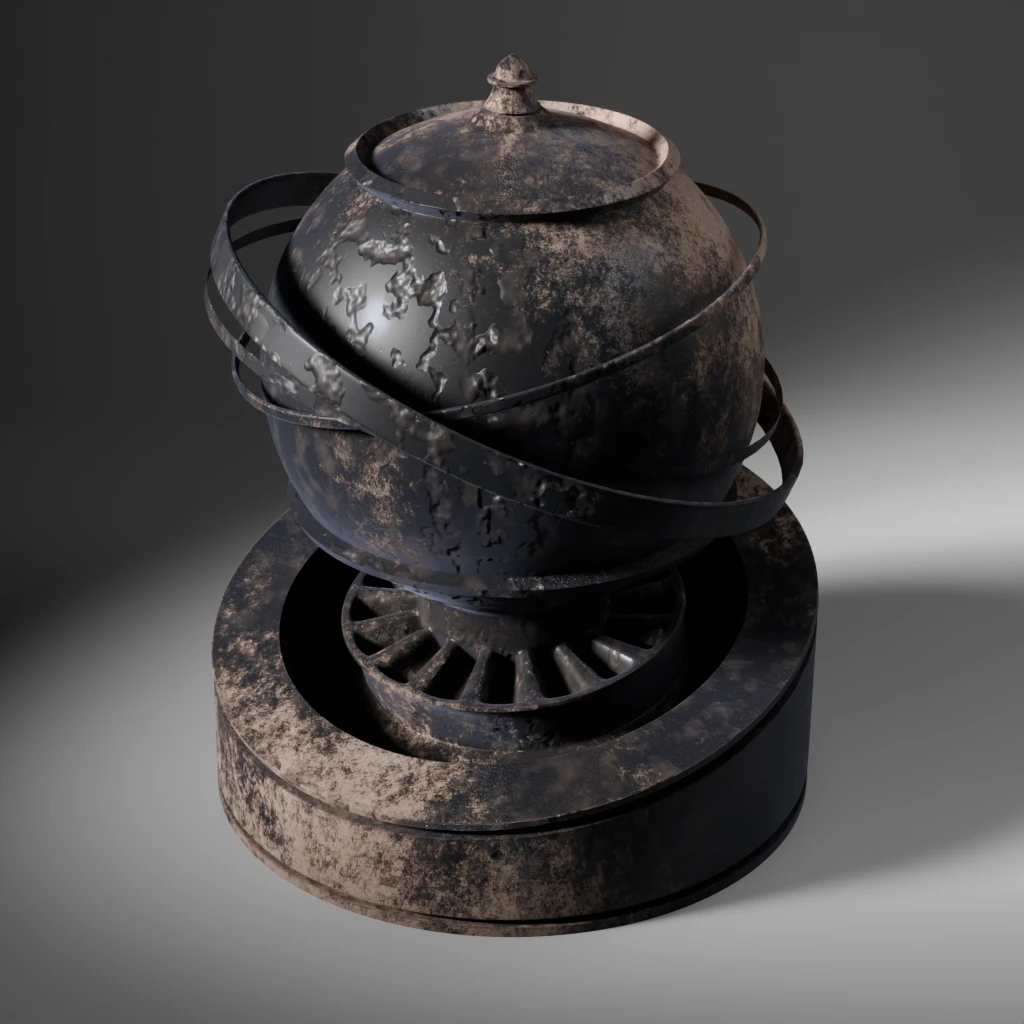
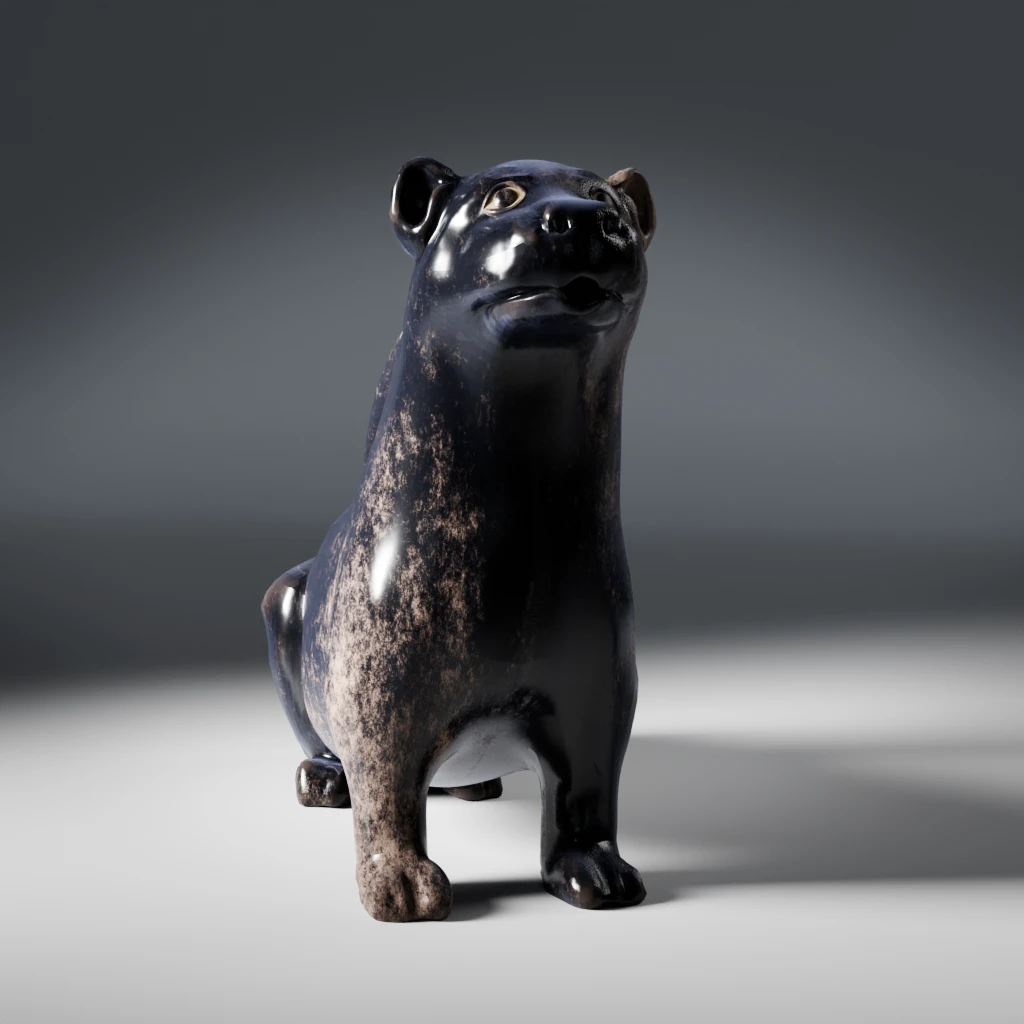
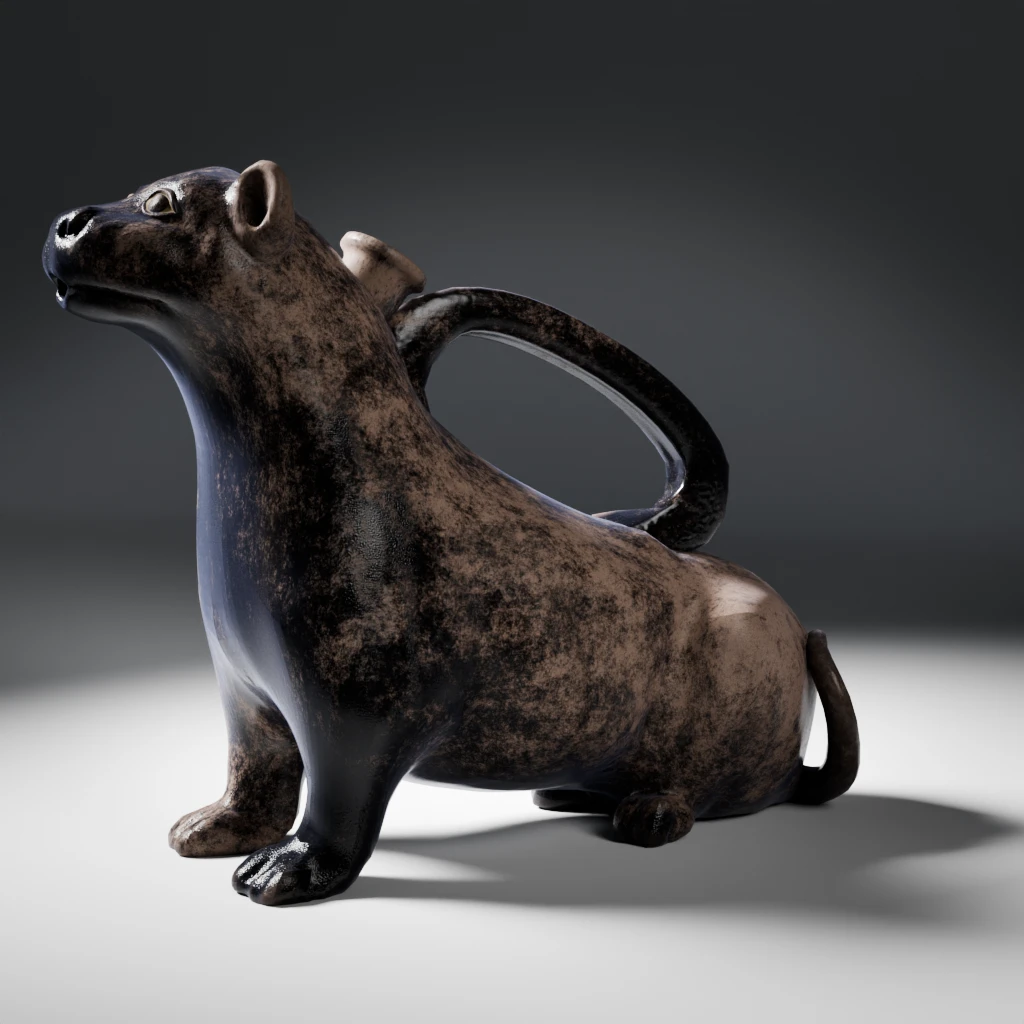
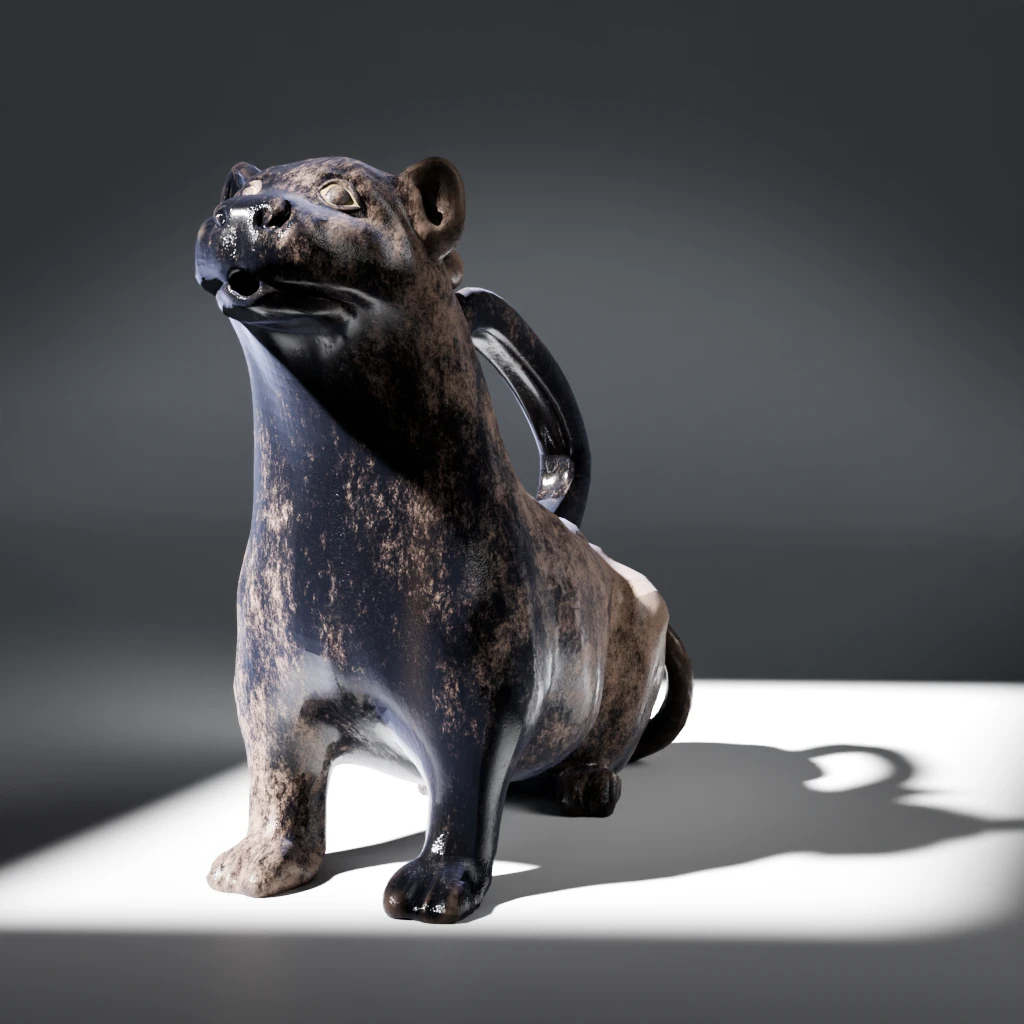
Shine a little light: stills renders
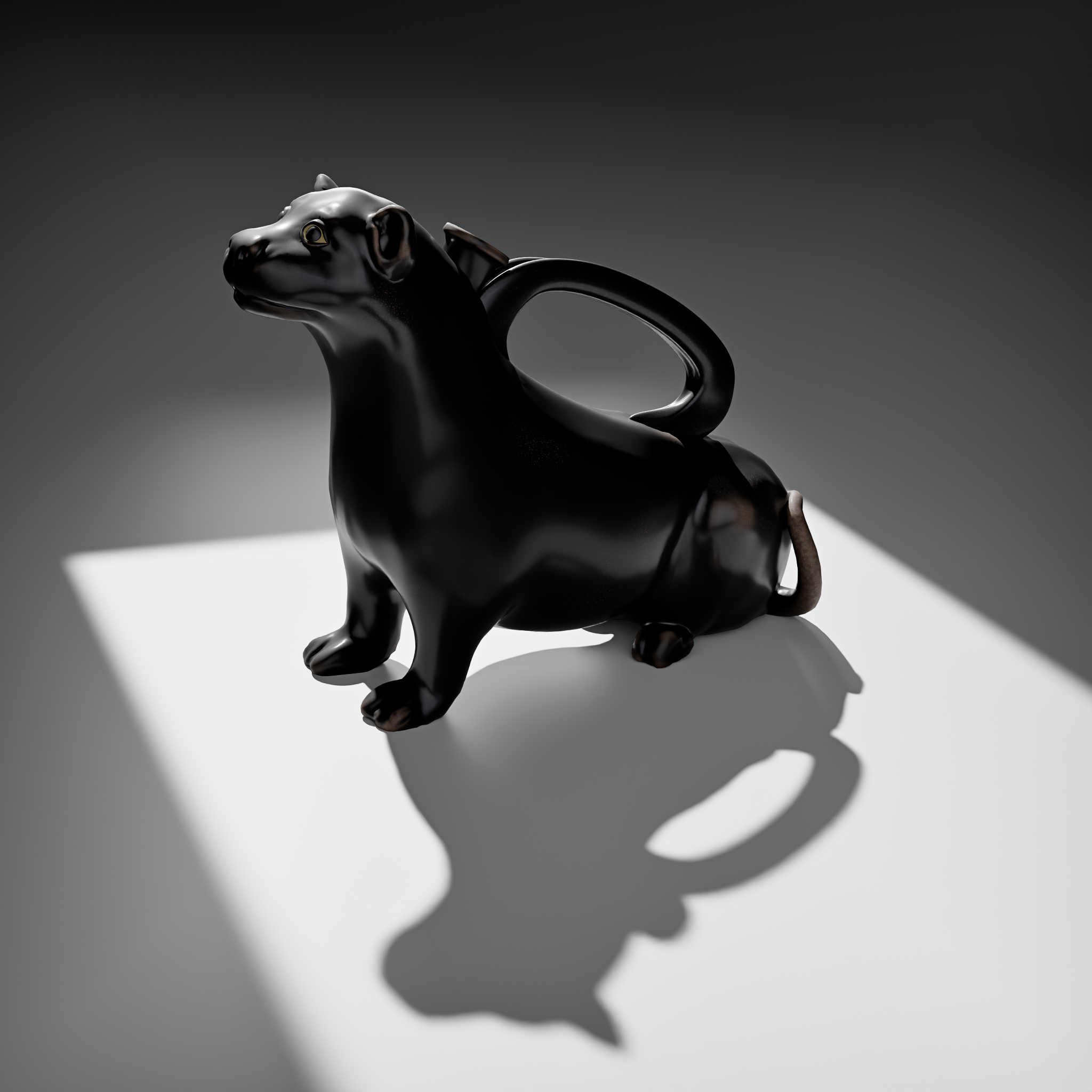
First, let’s see what a “pristine” (and theoretical!) black slip might look like.
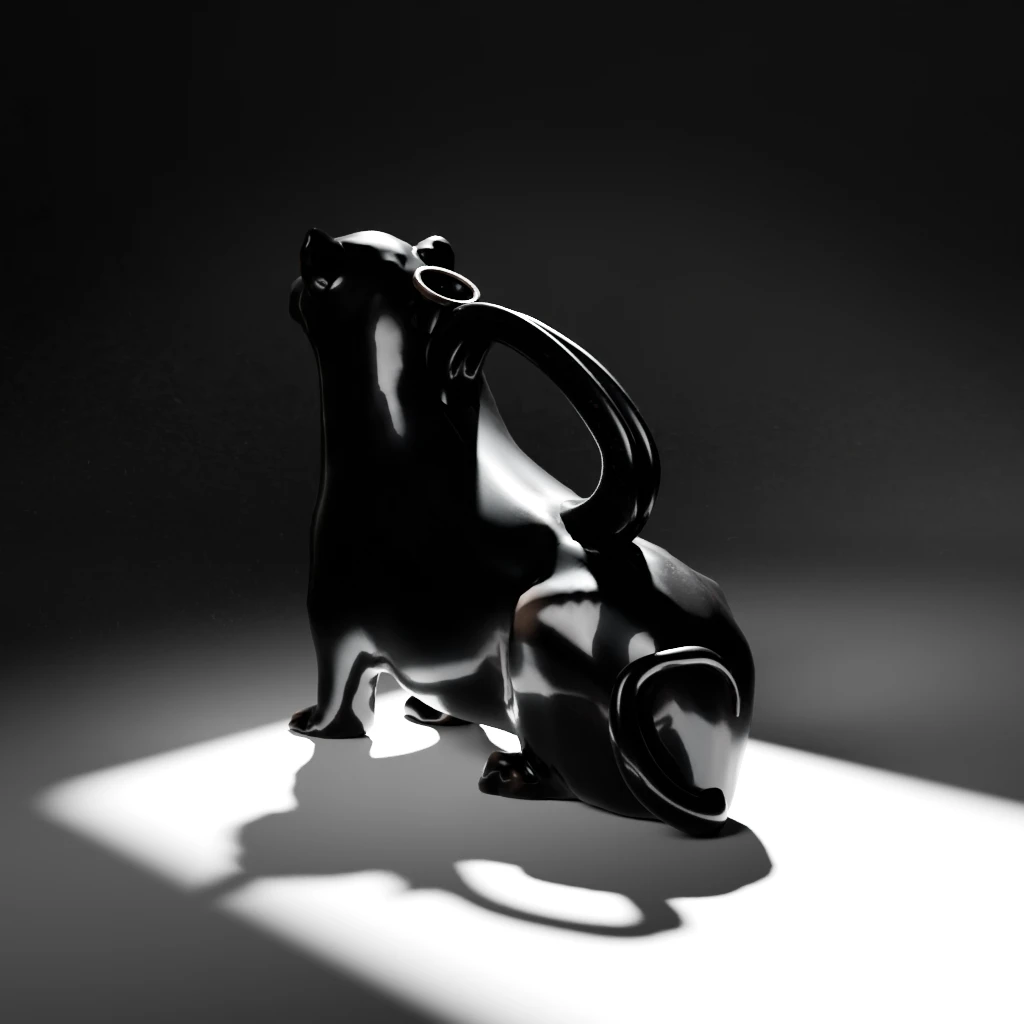
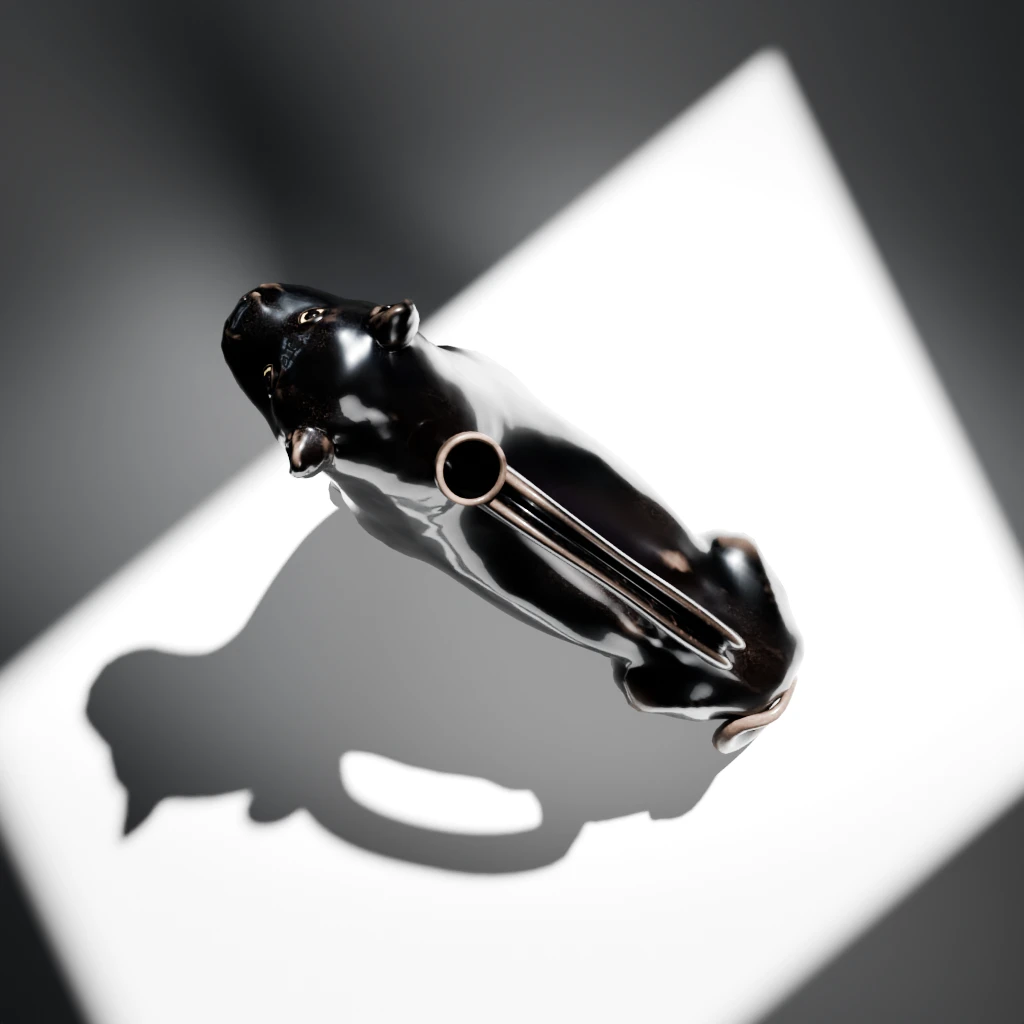
We can also use our pre-made material to create an altered version of the piece.
3D view
Disclaimer : technical limitation to material render in web app can let artefacts show, particularly in zoomed views.
Now, I know some of you want to manipulate and explore the piece for themselves. Careful though: it’s a heavy model and depending on your device and your internet connection, it can take a while to load.
See the full screen view (this will open a new tab in your browser).
Credits
Bibliography
Jentel Marie-Odile, Les gutti et les askoi à reliefs étrusques et apuliéns: Essai de classification et de typologie. 2 vols., Université Pierre Laval, Québec, 1976,available on the Internet Archives Library.
Images
Black Glaze pourer (askos) in the form of an elephant, © The Trustees of the British Museum
Black-glazed askos in the form of a sitting ferret, 4th B.C.E., Apulian, Yale University Art Gallery
Askos in the shape of a dog, 320-390 BCE, INV n°2010.1847, Public domain, Photograph © The Museum of Fine Arts, Houston