

Fishes and hairdo
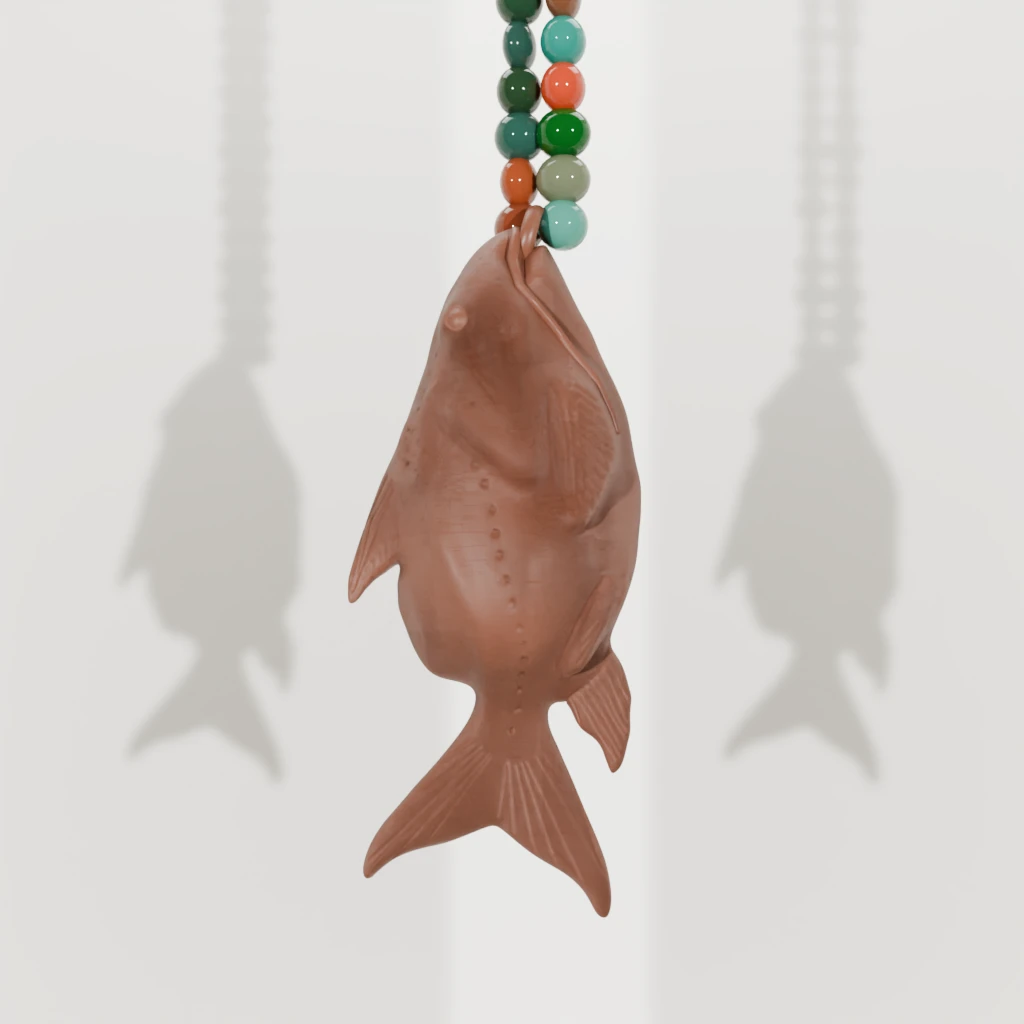
The following texts and images are the results of a training exercise to go from the pictures or the description of an artefact to the creation of a 3D digital double, sometimes restored version of it. The process and the documentation of it, as well as the references, are shown for educational purposes only. If you wish to know more about the process, explanations are in A journey into learning a (3D!) restoration process workflow article.
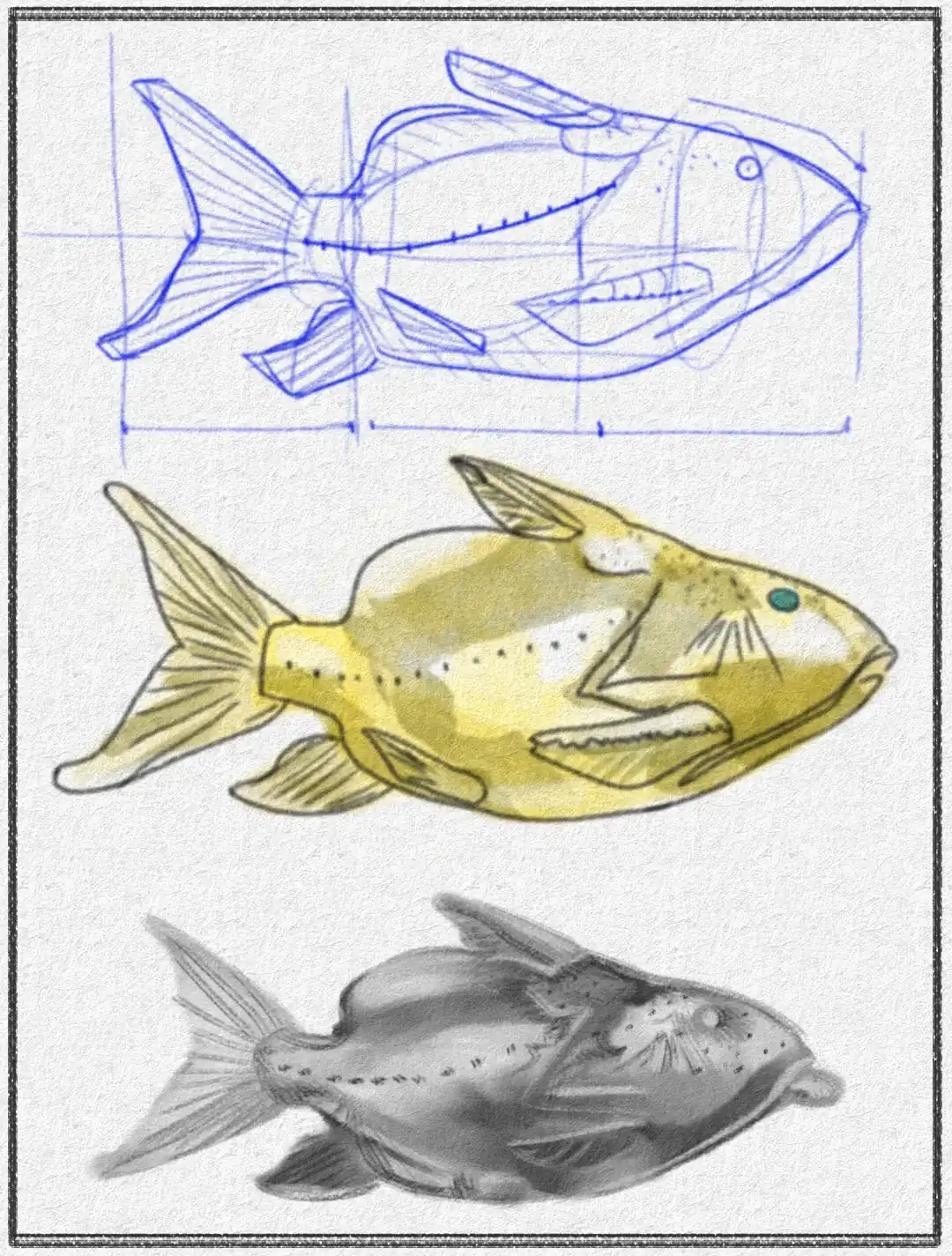
Title: Sketches of Gold pendant depicting an upside-down catfish, part of set of 5.
Datation: 12th Dynasty, c.1880-1750 BCE (Late Middle Kingdom)
Provenance: Tomb 72, Cemetery A, Haraga, Egypt
Dimensions: 3cm
Media: Gold on copper alloy?, core unknown
Source image: Original piece can be seen at National Museums Scotland
While researching a textile motif for another project, I stumbled upon this antique Egyptian artefact. As a training exercise, I decided to try my hand at modelling it.
A fish and a half
After a quick sketch study, from which the above drawing is extracted, I modelled it directly. As usual with old hands work, the shape is deceptively simple. The decor is subtle yet gives a lifelike impression.
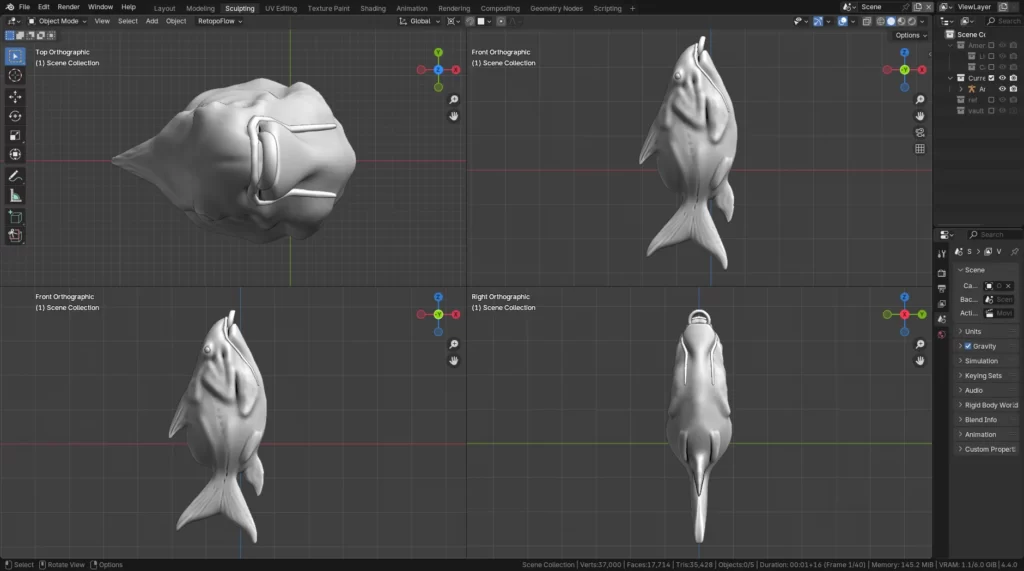
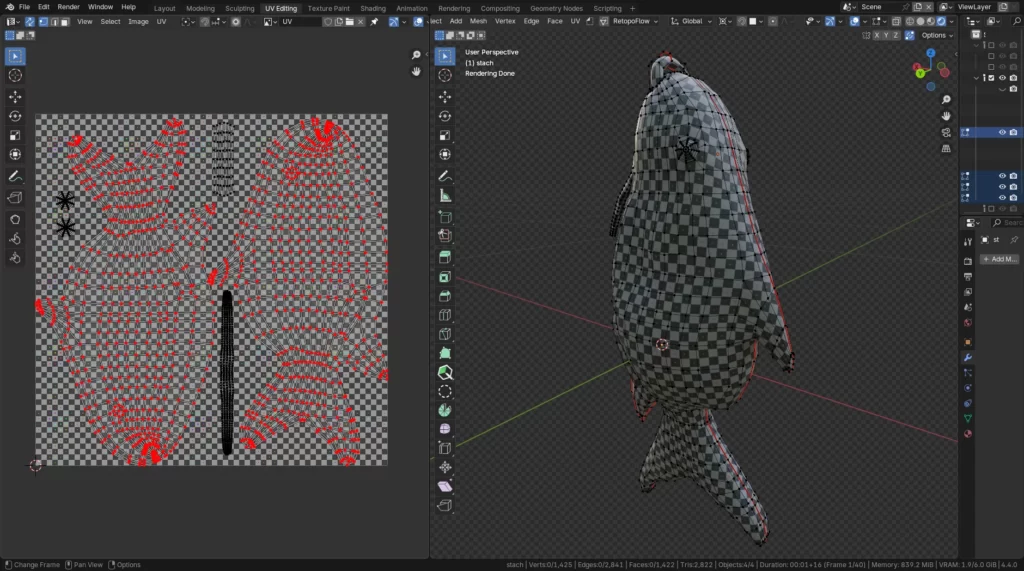
You’ll notice I did not show you the original reference pictures, nor will I texture the piece with an identical metallic looking shader. Why is that ? I’m trying very hard to keep my work fully respectful of copyrights. There is obviously no copyrights nor author’s claim on a 4000 years old piece (and don’t let anyone tell you otherwise).
However, there are some on images and pictures taken of said pieces. All in all, trying to decipher the rules for a specific piece equals to you having to read very long and dry legal documents, ask questions that are never answered and mostly being doubtful. Some institutions have a clear policy on things, be it full prohibition from use, full authorization or anything in between. Some, well, not so much.
What we are doing here can be considered private research work and falls under scientific fair use. But this is not a straightforward definition, it is a per court and per country appreciation process.
Here, the museum structure preserving the piece do not have a clear policy on these matters. You have to go up to the UK government stance on exceptions to copyrights. As such, a non-departmental public body should follow the same guidelines, but I’m not a specialist.
So, dear reader, in order to avoid issues, I’m sticking to “homemade” representation of the piece and variations from the original while encouraging you to go check it out for yourself.
Therefore, I chose to give my representation of the piece a red clay texture in its close up form. I like the clay sculpting process and I feel it gives vivacity and depth to a piece.
Also, I made it move.
Disclaimer : technical limitation to material render in web app can let artifacts show, particularly in zoomed views.
See the full screen view (this will open a new tab in your browser).
But what’s a magician to do ?
Fish pendants are common in Ancient Egypt, with variations in designs and materials. This one is part of a larger ensemble found in a middle kingdom young girl’s sepulture. According to the museum’s curator article on the subject, the biggest fish might have been a royal gift and the other ones were ordered as complements afterwards.
The author also mentions a tale, the third story of the Westcar papyrus, about a very bored king having to go to great depths to find such a fish amulet. During a leisure/boredom-curing sailing trip on a lake, one of the female nubile rowers of the boat loses her favourite turquoise fish amulet in the waters. As it is very dear to her heart, she and her crew refuse to continue rowing until it is retrieved. Because a pharaoh’s work is never done, even the richest amulet from the treasury as a replacement won’t do. What is a king to do ? Well, ask a magician, of course ! One that will have to separate the waters of the lake to be able to find the lost pendant. As one do. I mean, it might not be the easiest of ways and one certainly would have to face some very upset crocodiles, but it worked.
The magician puts the waters back and is richly rewarded for his deed. Now, from what I could gather, the tale does not give much else information. What was the girl’s reaction when her amulet is finally retrieved? What was her future as a pharaoh’s order defiant, royal oar bearer ? Who had to deal with the crocodiles recriminations ?
Sadly, we might never know.
As an aspiring folklorist, I know this is not the point of tales. As a curious person, I’m piqued. A young girl ? A fish pendant ? Have they found the tomb of the girl from the tale ? Spoiler alert: No, of course they did not. But my imagination does not need much to go on exponentially.
What is interesting is that these amulets were maybe so common they made it to literature !
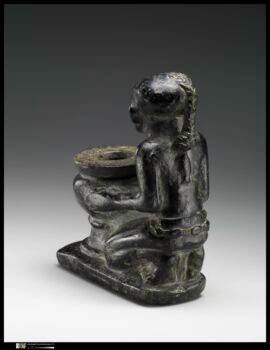
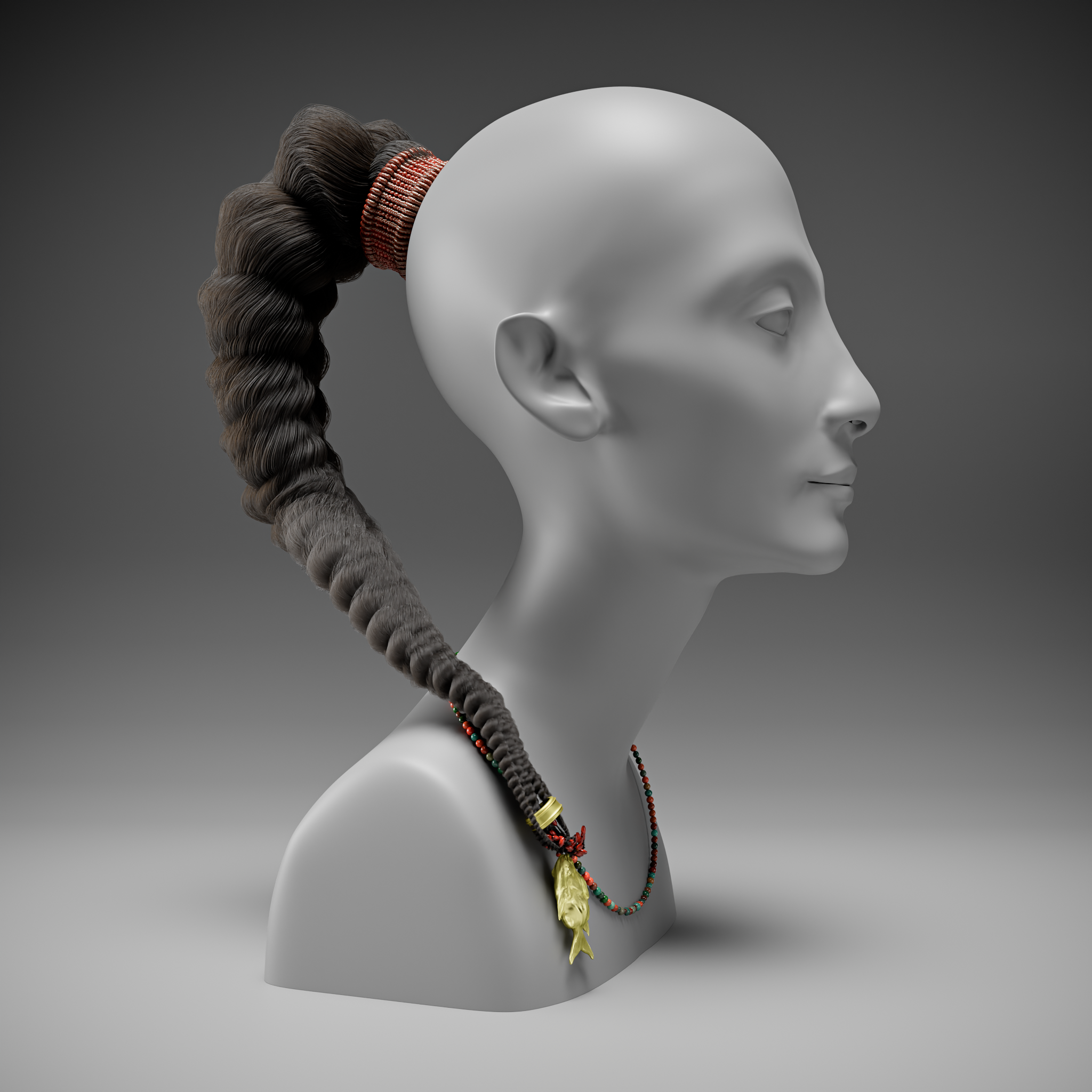
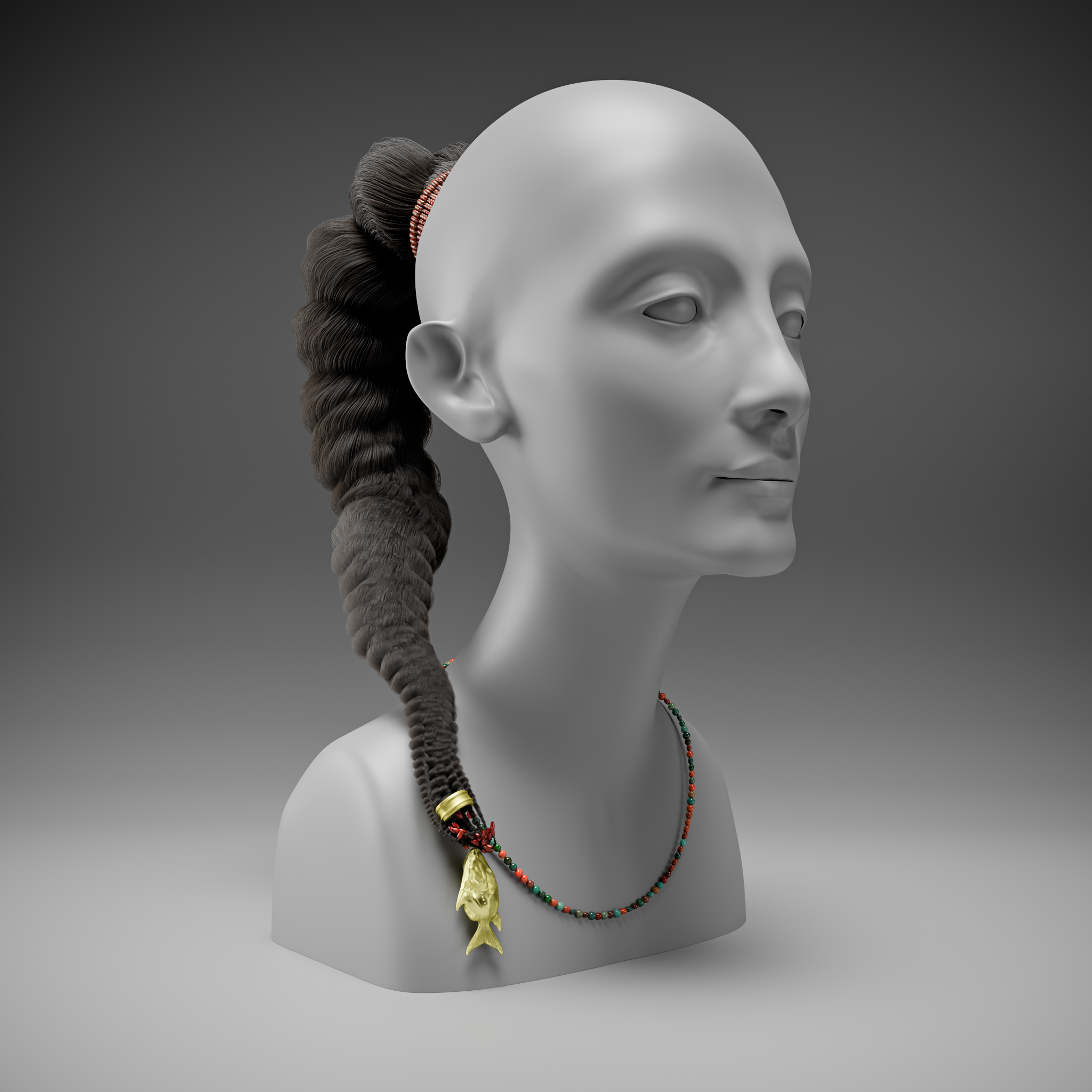
As a westerner, I first assumed pendants of this nature were worn as necklaces. Thankfully, I know better than that and a little digging is always a good idea. Turns out, some of them probably were; but, it may not have been their only uses. As depicted on a sculpture from the same 12th dynasty as our fish pendant, they could also have been hairdo ornaments.
So, obviously, I love it.
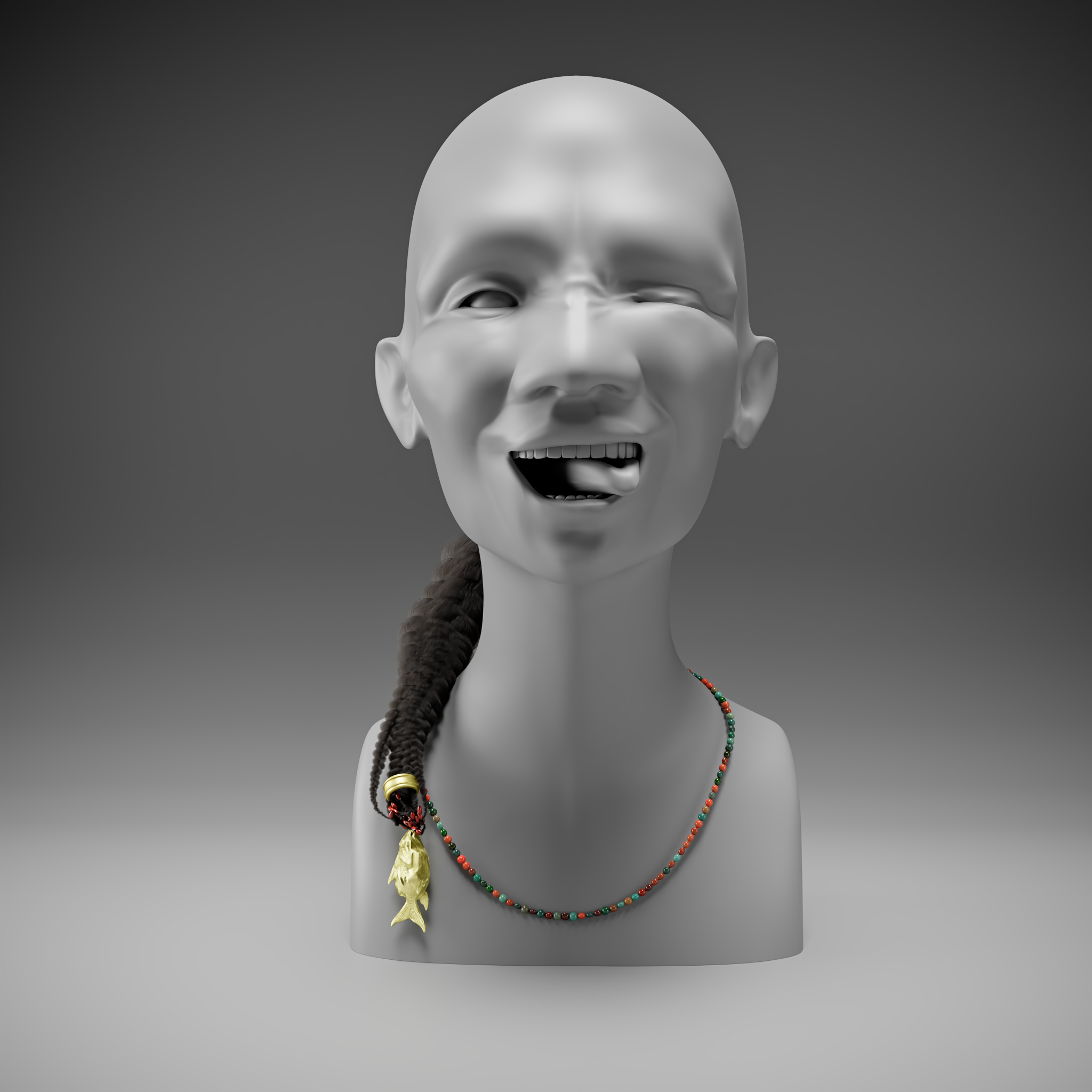
And of course I’m going to try to render this out.
The hair system for the plait is done using Blender’s default nodes; the beaded hair ornaments and necklace are geo nodes generated.
Contact
If any of you, dear reader, want to further the conversation, you can do so on Mastodon or Pixelfed.
Credits
Unless otherwise mentioned, all images credits to LGS.
Iconography
Gold pendant depicting an “upside-down catfish”, with an unknown core (possibly copper alloy) and a ring for suspension in its mouth, excavated in Tomb 72, Cemetery A: Ancient Egyptian, Middle Egypt, Haraga, Late Middle Kingdom, 12th Dynasty, c.1880-1750 BC, ref A.1914.1079, National Museums of Scotland.
Girl with a plait with a fish pendant, holding a cosmetic jar, 12th dynasty, 1985-1795 BCE, Middle Kingdom, Thebes, steatite, Asset n°1613328654, British Museum, image © The Trustees of the British Museum. Shared under a Creative Commons Attribution-NonCommercial-ShareAlike 4.0 International (CC BY-NC-SA 4.0) licence.
Bibliography
“The Upside-down catfish”, Stünkel Isabel, Perspectives section, context of “Ancient Egypt Transformed: The middle Kingdom” exhibition at the Metropolitan museum, October 12, 2015–January 24, 2016, New-York, USA, 7th of December 2015, available online, noticed 01/25
“Treasure from Harageh Tomb 72 at National Museums Scotland”, Margaret Maitland, 30th of September 2014, National museums Scotland blog, available online, viewed 01/25.