

Lustrous ravens
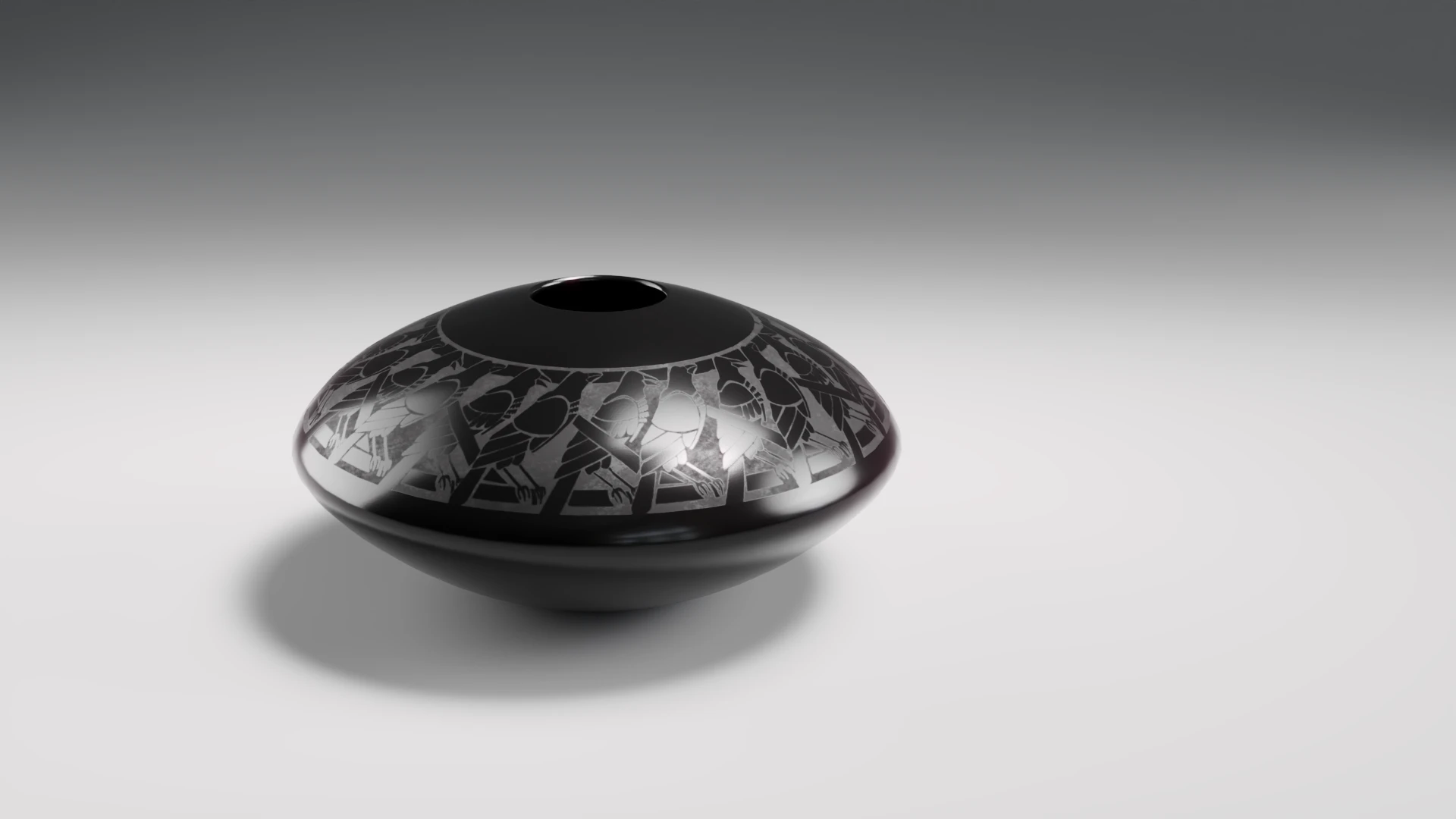
It’s #potteryTherapy today. Short version: a potter without a studio but 3D abilities is a terrible thing.
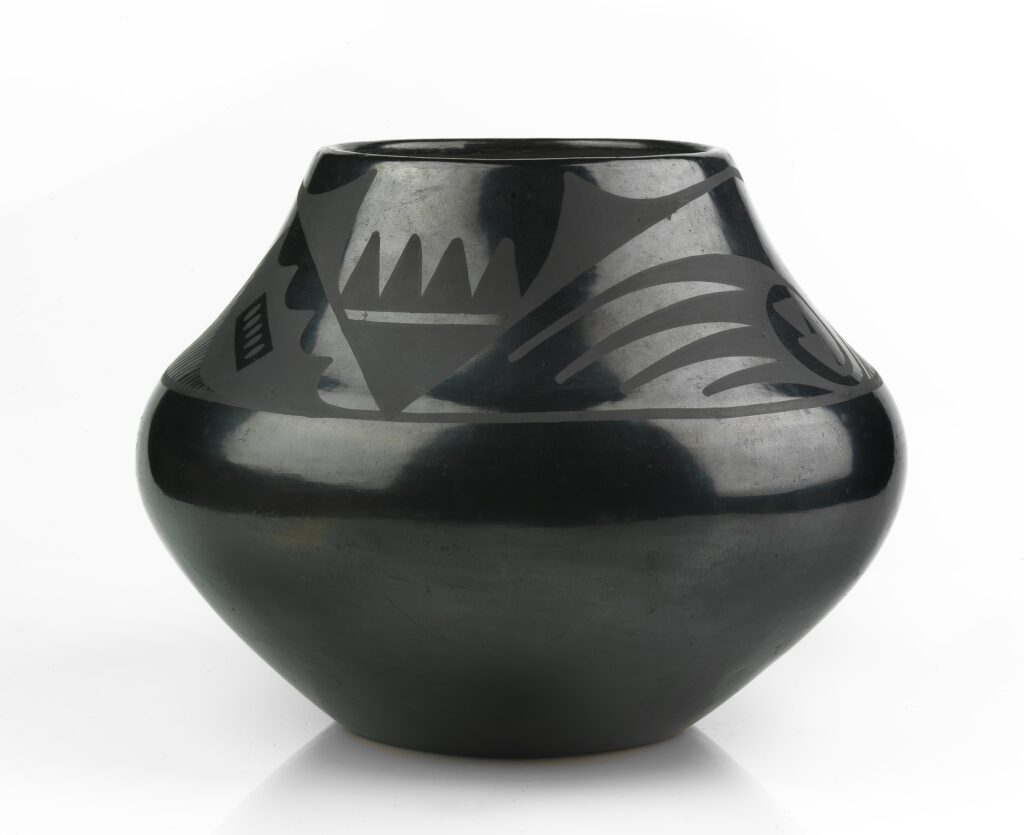
Inspired by the stunning “Jar with Feather motif” from Tewan ceramic artists Maria Poveka Montoya Martinez and Popovi Da, let’s try our hands at rendering Puebloan black on black ware pottery.
The depths of black luster
Black-on-black ware
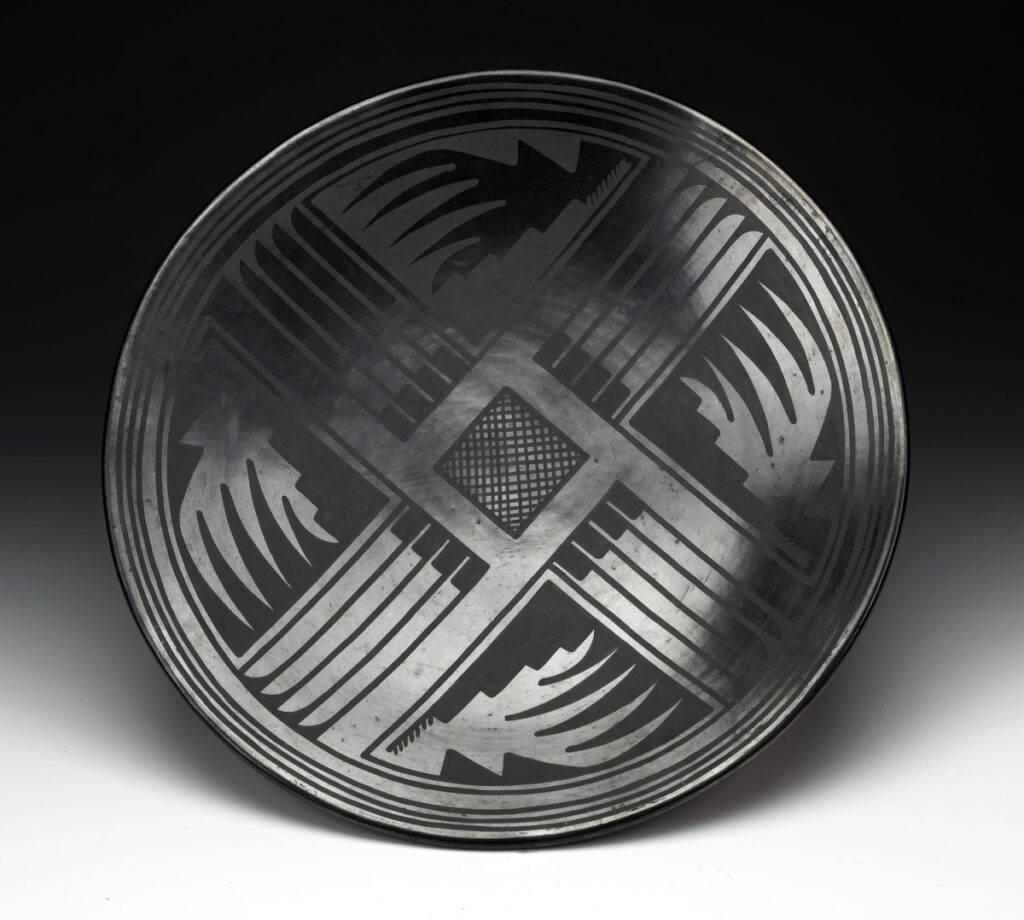
Black-on-black ware pottery is a Puebloan technique that produces biscuit ware pieces with a rich iridescent deep black decor, alternating matte and glossy motifs.
The technique is a modern variation on Puebloan traditional black ware. The creation of polished earthenware black pots using a reduction atmosphere while firing is a common occurrence around the world, as in the Egyptian Black-topped pots or the roman black-burnished wares. It theoretically requires only simple elements: an iron-rich clay, the most common kind, and a firing method that involves a reduction phase, a very common practice. It entails being able to control both the clay and slip quality, the polishing phase as well as conduct an appropriate firing to ensure the results will be consistent throughout the pieces. This is no small feat by any means. It involves mastering very highly skilled operations only practice ultimately will provide.
The work Maria Montoya, her husband and their extended family did was pushing the limits of the technique, using what material was available to them. The results are pots whose surface are as mesmerizing as watching the light plays on a raven’s feathers.
Sublimation of the commons
But enough poetry, we need facts !
First, the -literal- nitty-gritty: the clay. It is a red, iron rich, clay with at least added white volcanic ash paste, making it on the coarser side.
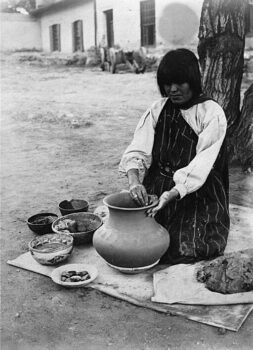
The shape is hand made, pinched from a puki formed base and coiled or patched up. Once completed, smoothed and dried, the outside of the pot is covered with a slip. This slip is then immediately polished to a near mirror finished, using a smooth stone. There is a very small window of time to do so: the slip needs not to have dried too much. Slip decor is then applied with a small brush. As these lines will not be polished, they will create the matte parts.
The firing is open earthed, pots stacked on a single layer and fuelled with juniper wood and cow dung. The reduction atmosphere is created by smothering the fire with dried horse manure and ashes. The pots are removed from the hearth as soon as the final glossy finish is obtained. Leaving them too long would risk making them dull.
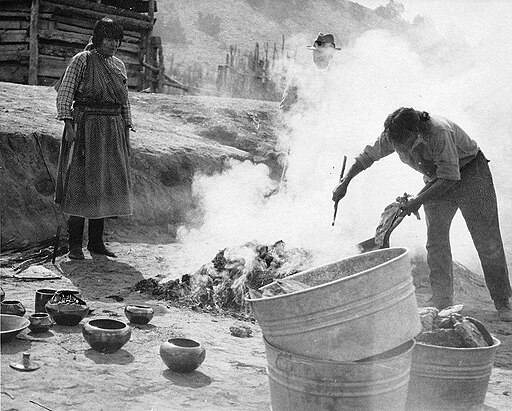
Being earthenware, fired under 900 °C, the pots will remain porous. The application of slip and the polishing process partially remedy to that: they can be used as everyday items, though most black-on-black pieces produced by Maria Martinez and her family were for sold for decorative purposes.
A video documentary from Nora Eccles shows Maria Martinez working from the creation of the clay paste to the firing of her pots.
Because this a digital project, what can we take from these information that can be of help ?
First, the nature of the clay is more or less fully covered by the black slip. Moreover, the fine slip and the heavy polishing will visually remove any major imperfections or discrepancies in the coarse paste. It is therefore not worth taking the time to create a digital version of the clay body.
I initially thought the beautiful black glossy shine would be the real conundrum. Turns out, with enough noise and variation to the surface to make it just a bit imperfect, it is mostly homogenous in texture which is relatively easy for us to render. The sheen with its lustrous almost metallic but quite-not-so aspect is a little more tricky. Its reflection has an anisotropic quality that is only in-par related to the shape. Thankfully, playing tricks with the metallic function of shaders can give a nice compromise. The luminous, warm, almost glowing warm feeling the texture gives might be the hardest part to render.
The tricky part, as it turned out, is the matte texture. For those of you, dear reader, that never used clay slip, here’s how it works. Slip is nothing more than extra fine clay and water slurry. Once applied, it “dries” both ways. There is a very faint “regular” evaporation of its water content, but the most part is done by this water being ”sipped” into the dry porous clay body below. It is happening really fast and the surface layer is seemingly dry in just seconds.
The two key points for us here are:
- The process leaves the brush marks visible ! Looking at such pieces, you can actually see the potter’s brushwork and the direction it went. They will remain visible, albeit softened, after firing.
- The layering goes glossy first and matte on top.
That is what we need to emulate !
3D notes: A simple pot and many birds
Model the shape
We need a shape on which to try our 3D black-on-black glaze. There are so many to choose from ! I think I’ll go for a seed jar. These are specific vessels used to store seeds from one growing season to the next. They are rotund shapes with a relatively small opening.
I am not certain of it, but I think this shape might be specific to the larger Mesoamerican area. I can’t recall seeing similar shapes with that purpose linked to other areas of the world. If you have more information on that particular topic, please, please, please, make yourself known. I’d love to nerd out with you on that subject !
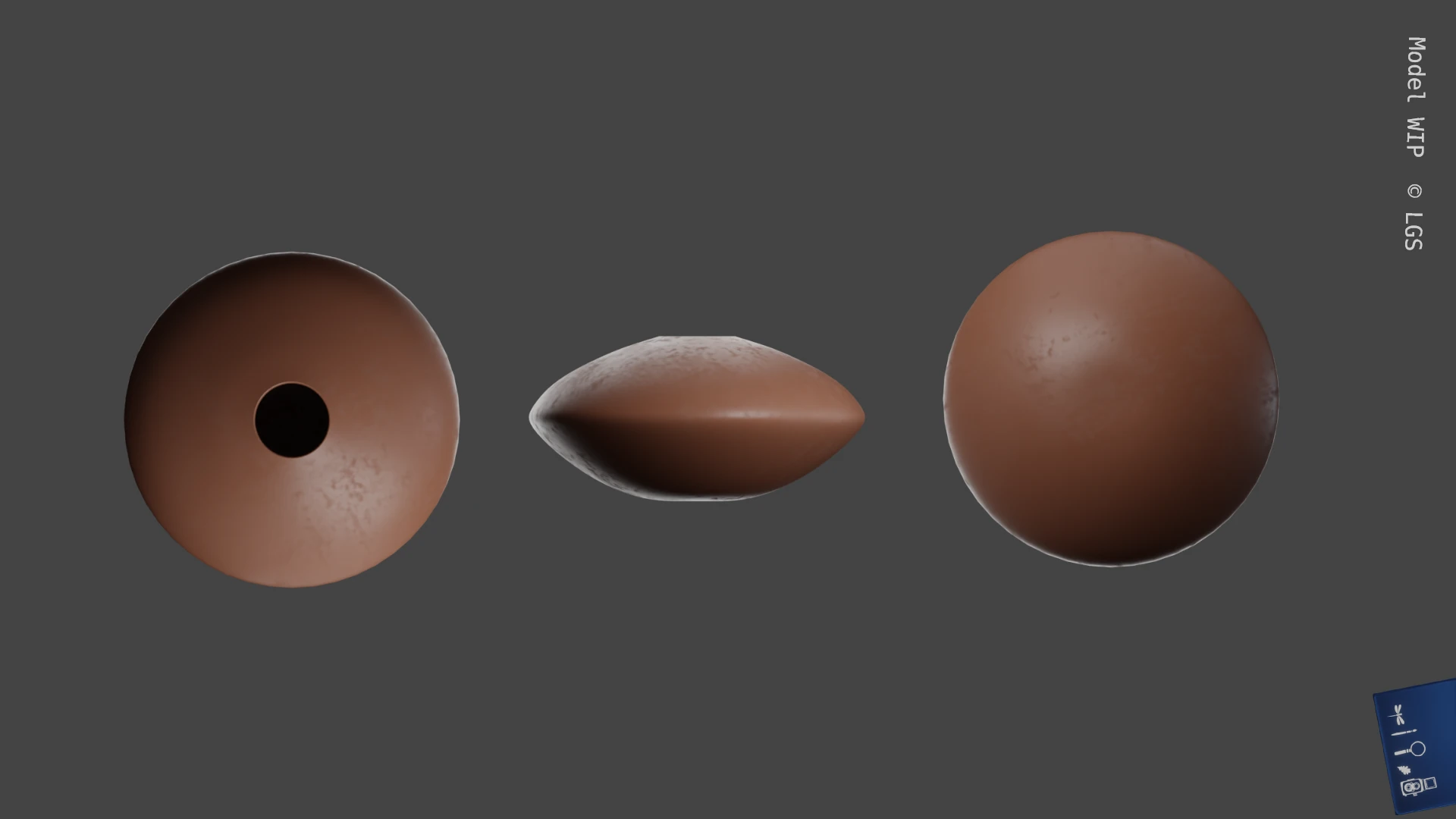
Texture the shape
The most fickle thing with this project is to try emulating the rich, lustrous black decor of the pots. It’s shiny yet not bright, it’s warm and soft. It almost creates a warm glow around the pieces.
As this is complex, let’s try to break it down. What do we need ?
- A clear separation of shiny and matte parts, the latter being slightly prone.
- A way to allow for brush marks to be seen on the matter parts.
- A deep rich black colour with a mute dark, reddish undertone, with a shine somewhere between a dull metal and the iridescence of obsidian.
All compiled into nodes, that may give us something to use a base to improve upon.
The grey Gabor noise node generated rough parts are simulacrum for the hand painted decor. Maybe we can use it to perfect the brush strokes effect.
This is a simple enough base. It will be more efficient to make to further building the material on the model itself.
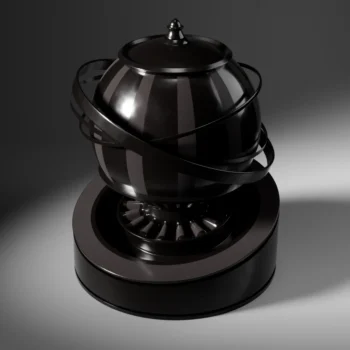
Now for the all important decor.
I won’t try to imitate the Puebloan geometric patterns and complex decors, or the work from the Martinez’s clan. I don’t know enough about any of them yet. My bibliography and experiences on the subject are limited and, in these troubled times we live in, I have limited access to some scientific material. If any of you, dear readers, know some verified sources of information, please let me know !
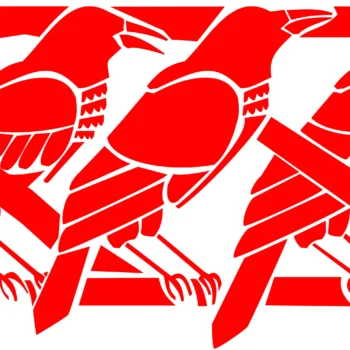
For many reasons, I like the raven allegory. I think I’ll try to cheekily mix in my decor a bit of Art Nouveau style, maybe something inspired by this piece from Eugene Grasset.
We can separate the crow silhouettes and then insert it into a tree background, keeping some sort of geometric balance to respect the material and make it tillable. Then, to keep the black-on-black motif simplification and to grab the subtle brushstroke effect, the easiest is to paint it all in Krita !
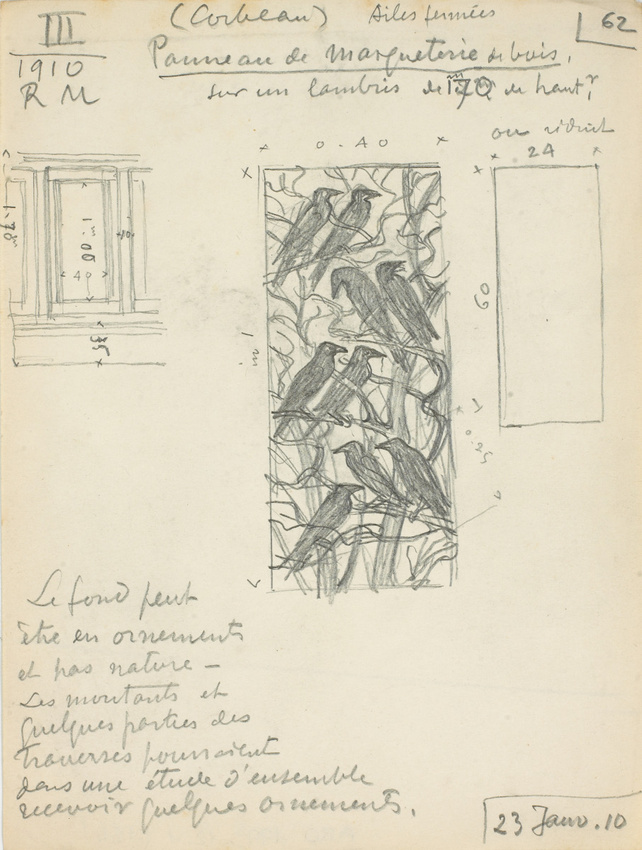
H. 20,5 ; L. 15,5 cm., INV n°ARO 1993.12.1.164, Musée d’Orsay, Dist. RMN-Grand Palais.
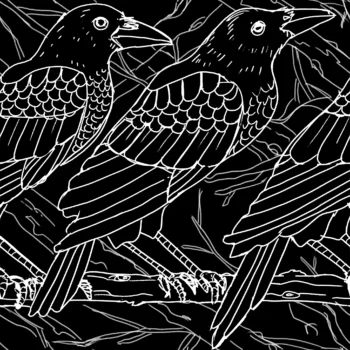
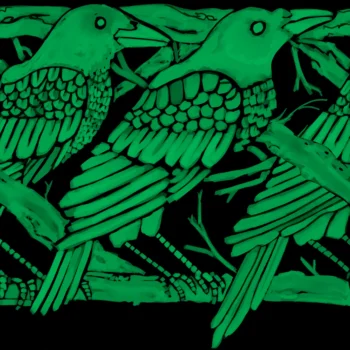
The real magic comes with mixing it all together and let Blender deals with the sizing of the motifs around the pot. This is done using UV borders and, to my surprise, very few topographic tweaks along the X axis.
The core of the texture idea is using the decor as two mask to switch between the glossy and matte parts. The first is the above decor, the second is UV based to restrain the decor to certain parts. It allows for more flexibility.
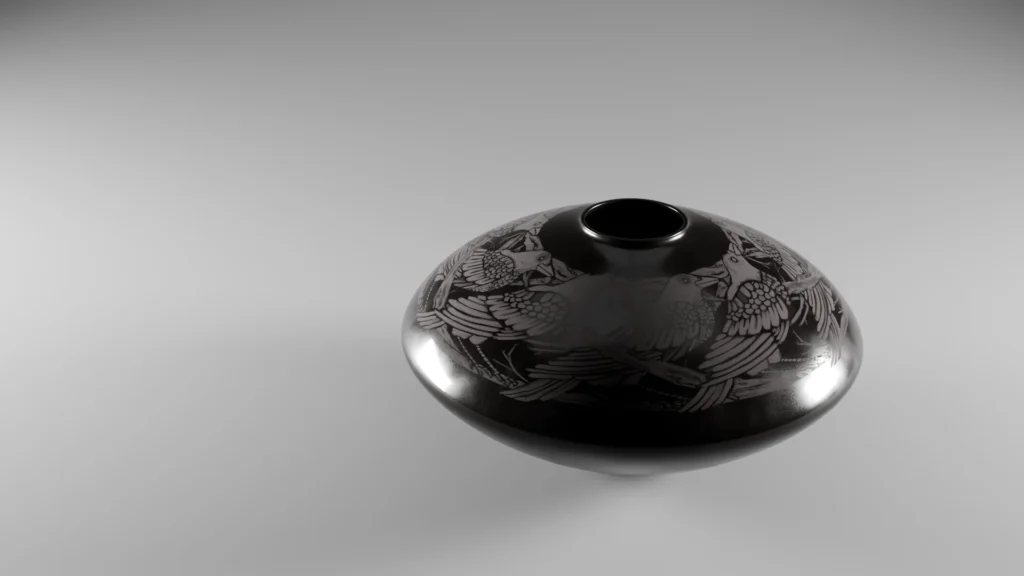
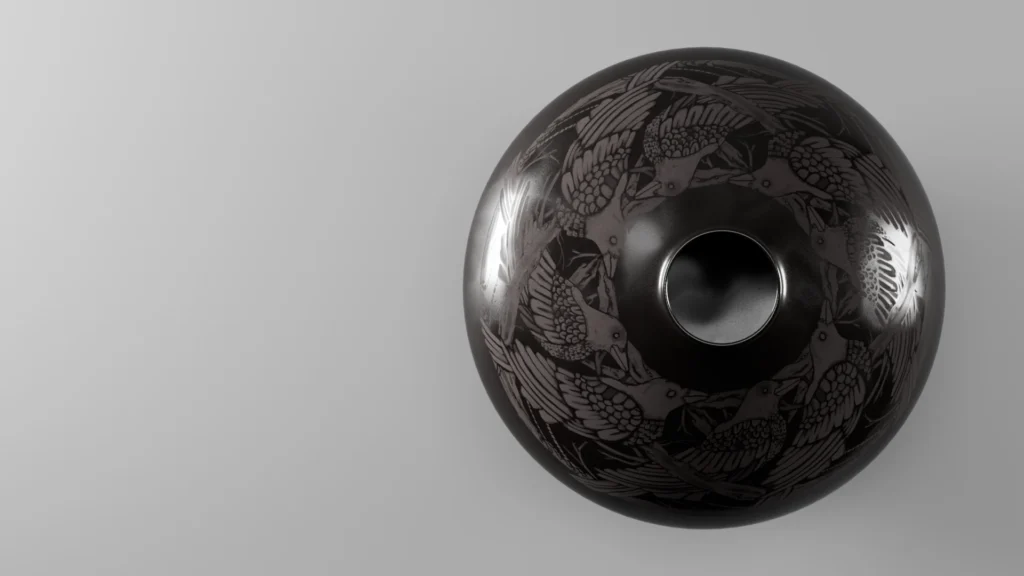
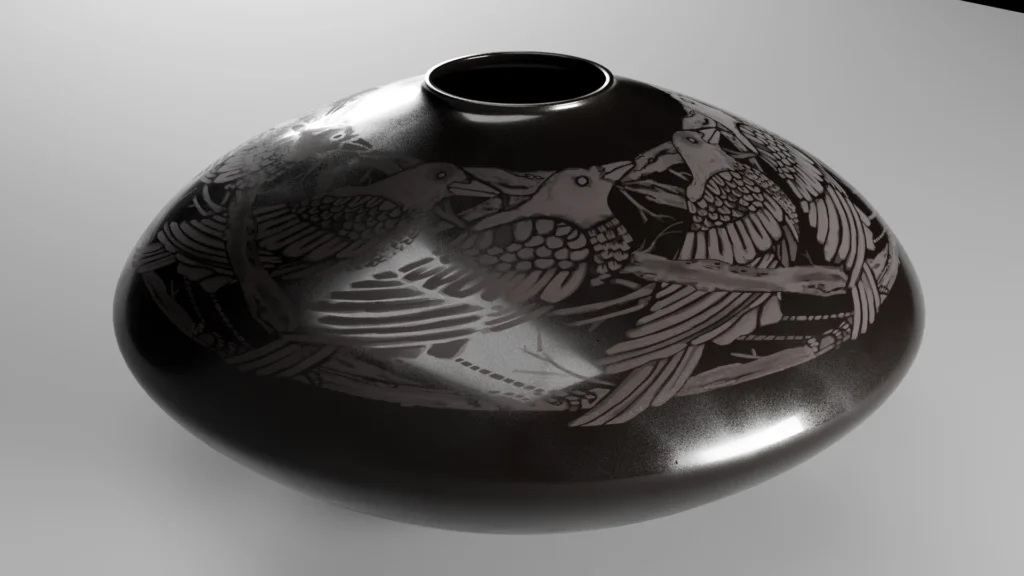
Interesting but we’re not there yet. First the motif is a bit too big. Then it should be inverted: black-on-black ware uses negative spaces to emphasize the decor.
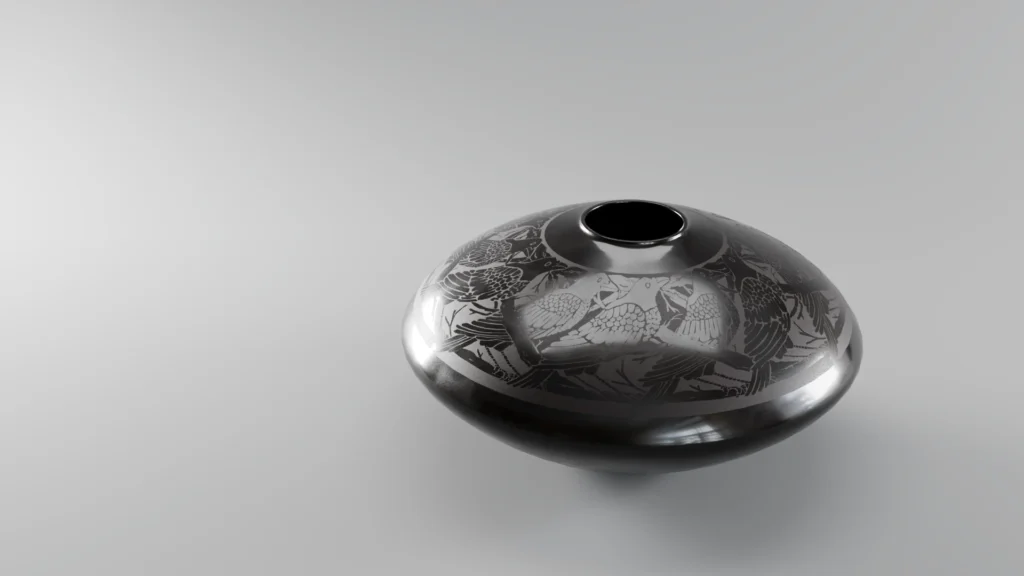
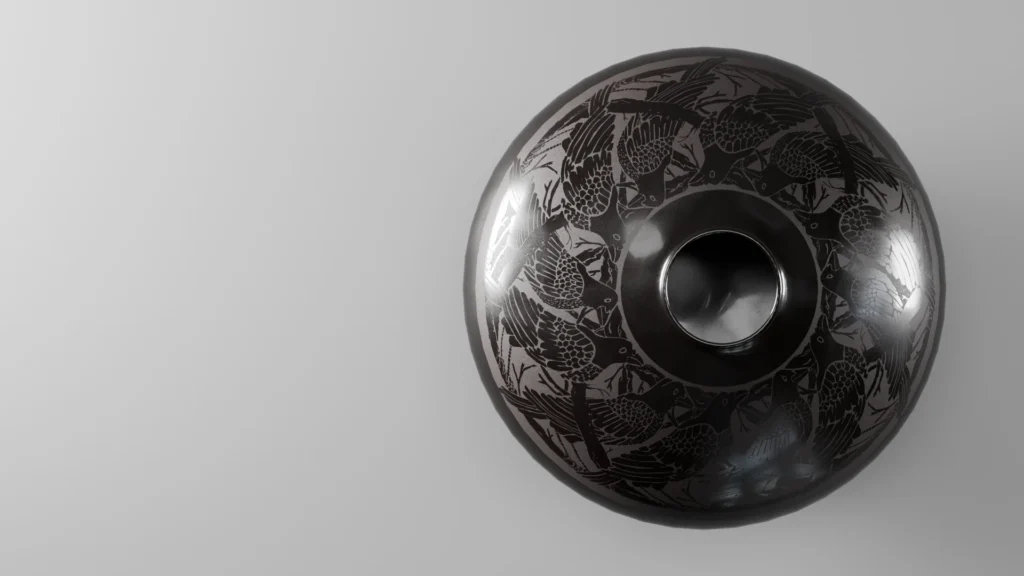
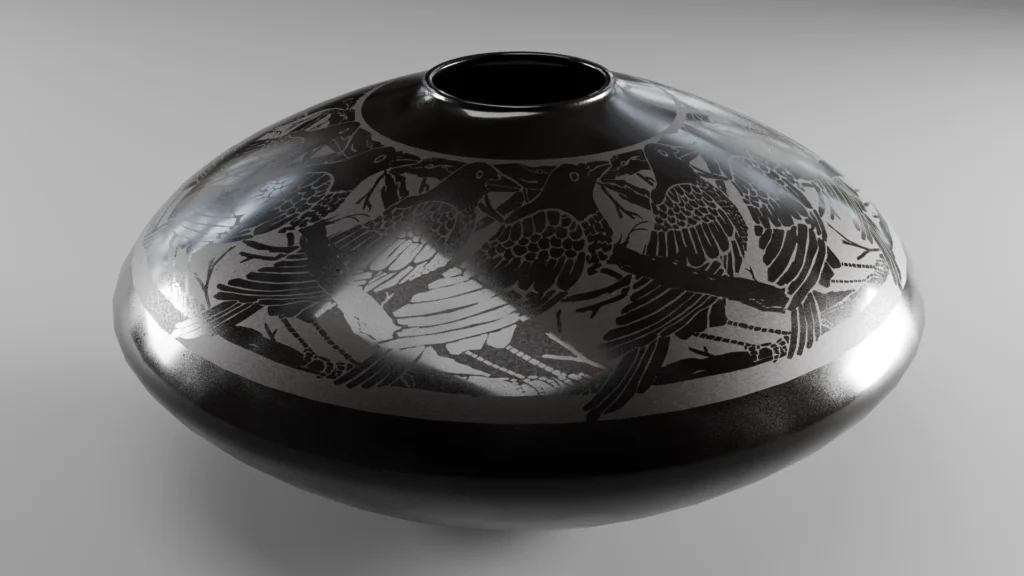
The motif is maybe too figurative. I can’t do what the Puebloan potters do, but I can probably simplify my design a bit. As this is essentially being used as a mask, it is a good idea to create a vectorial version of it, using Inkscape. The technique give very clean lines, this allows us to reproduce them easily. As this also means I’ll lose the paint pattern, I should probably stick to a procedural set up for it.
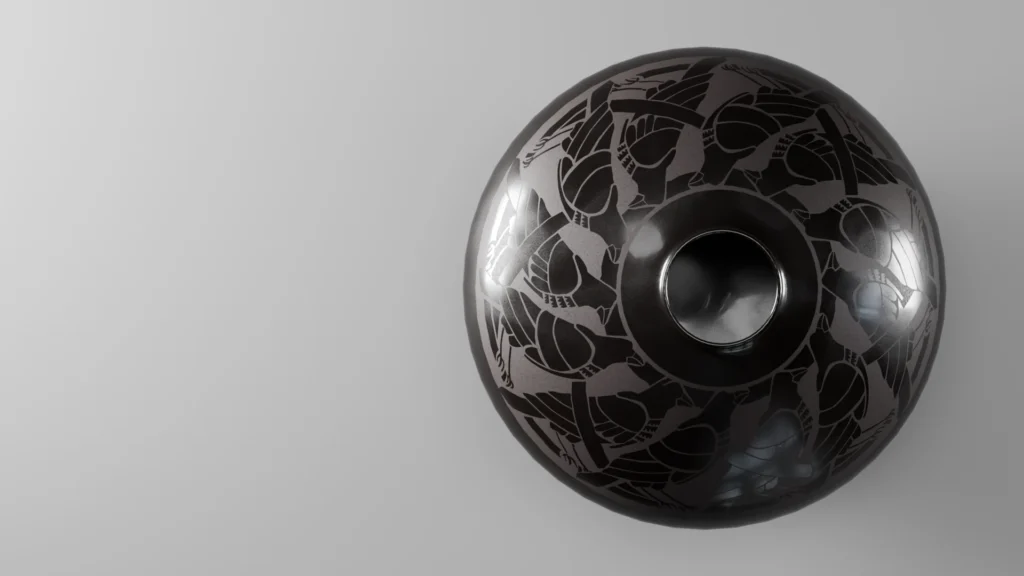
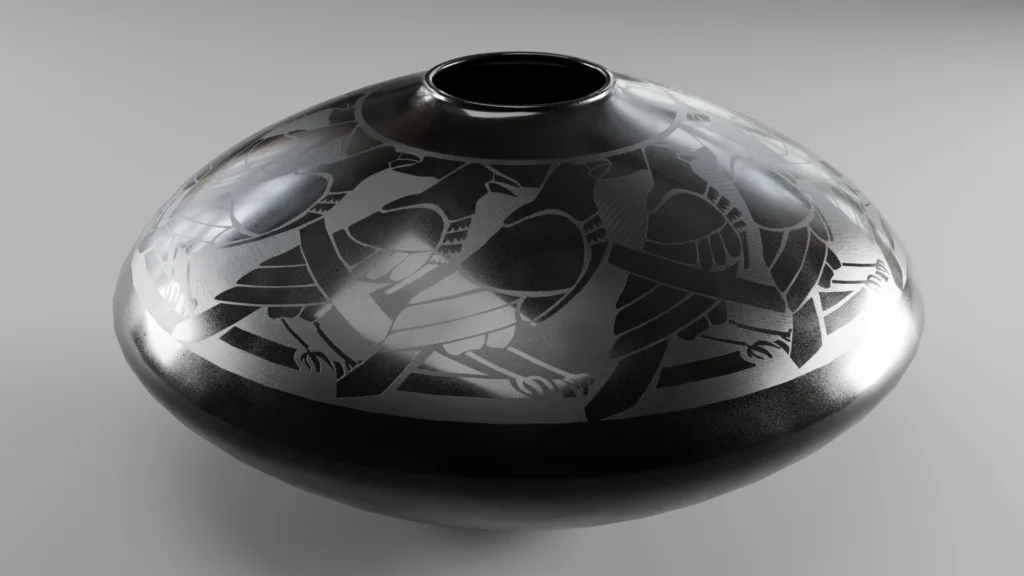
We’re getting there. I’m not really convinced by the matte parts yet, though. The textures are wrong. Let’s modify the setup a bit using a brush like effect
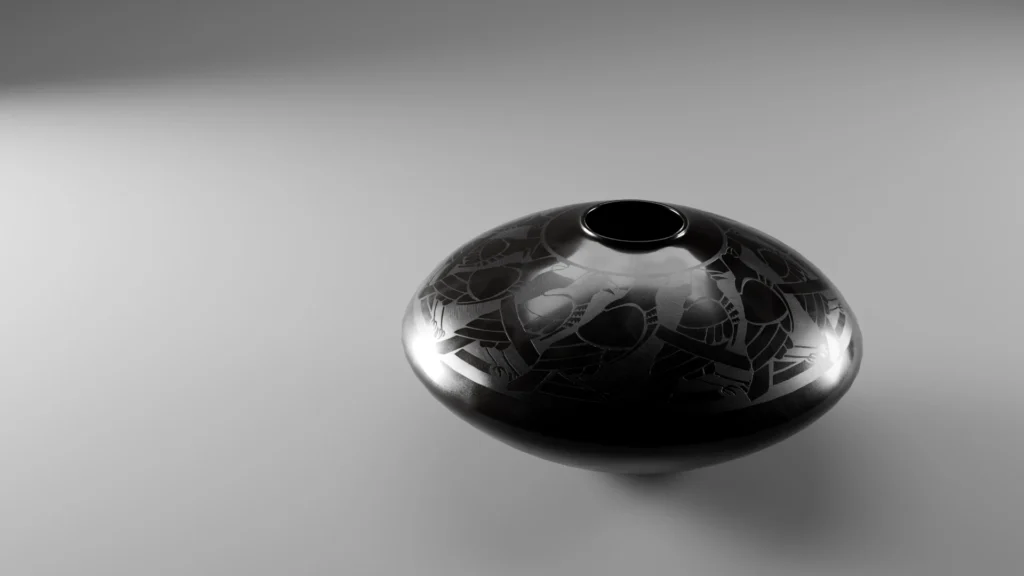
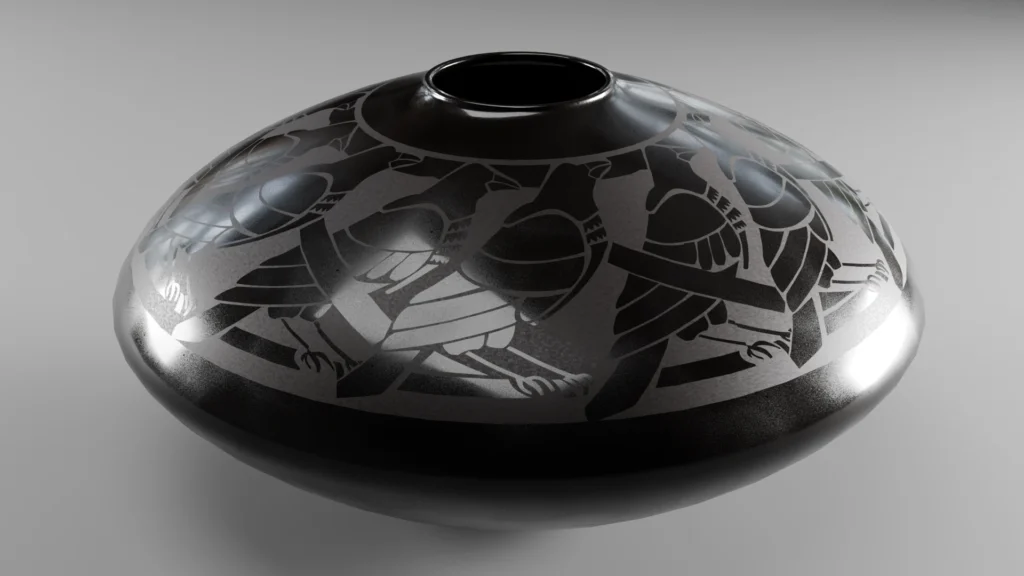
Better, the texture is a tad too mechanical though. I also think it needs more birds!
I went and added some details using Mari. I also slightly modified the shape once again. The neck was creating a shadow that I did not like on the piece. Besides, as this is “supposedly” a hand built piece, that small neck does not make much sense. It would have been fiddly and a weaker part of the structure.
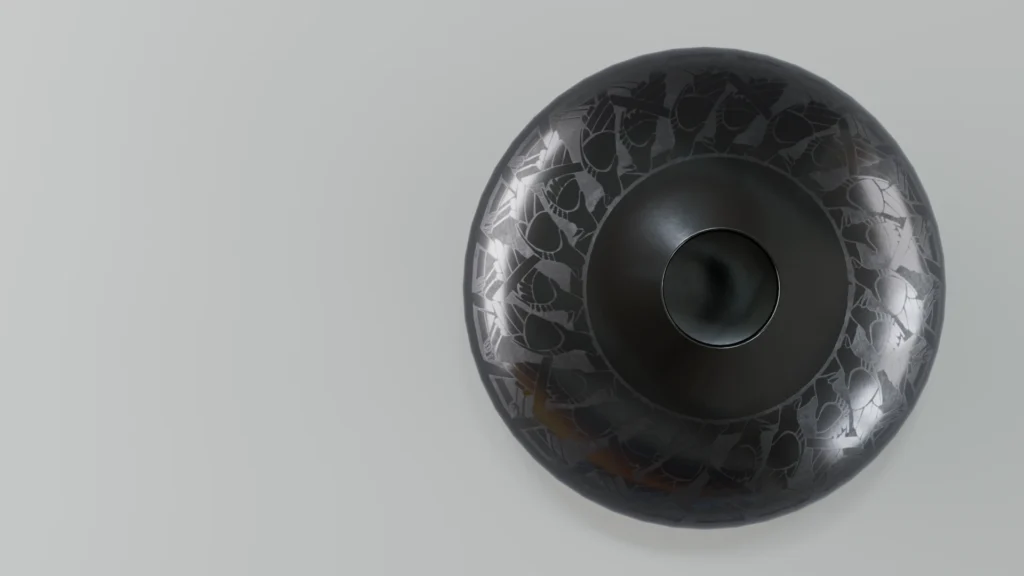
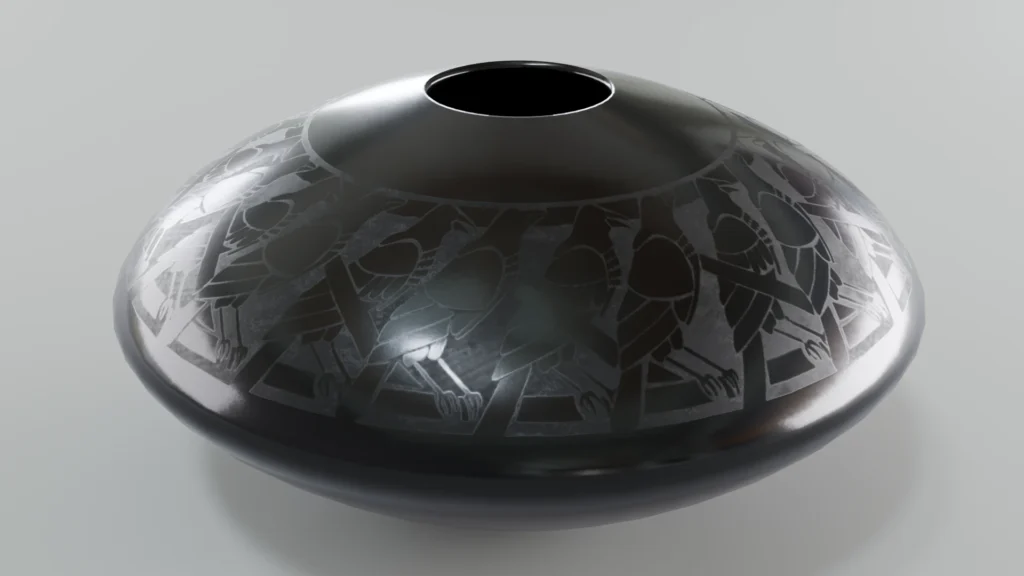
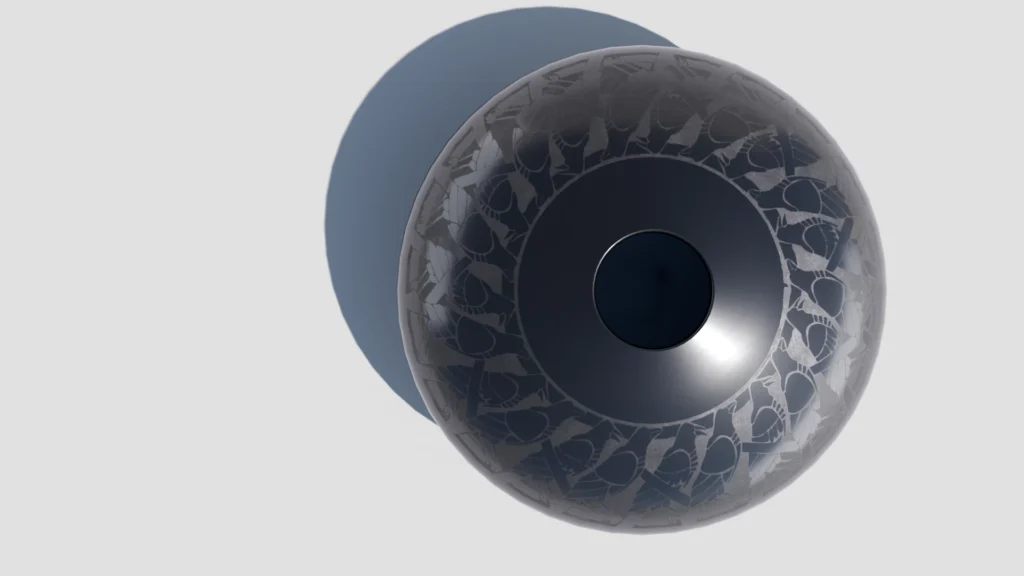
3D view
Disclaimer : this is a simplified, web-friendly version. Technical limitation to material render in web app can let artifacts show, particularly in zoomed views.
)See the full screen view (this will open a new tab in your browser).
Contact
If any of you, dear reader, want to further the conversation, you can do so on Mastodon or Pixelfed.
Credits
Unless otherwise mentioned, all images credit to LGS.
Iconography
Maria Martinez, Julian Martinez, Bowl, n.d., blackware, 6 3/4 x 9 1/2 in. (17.2 x 24.2 cm) diam., Smithsonian American Art Museum, Gift of International Business Machines Corporation, 1966.27.14
Julian Martinez, Maria Martinez, Plate, ca. 1930s, blackware, 1 7/8 x 14 5/8 in. (4.8 x 37.2 cm) diam., Smithsonian American Art Museum, Gift of International Business Machines Corporation, 1966.27.15
Jar with Feather motif, Maria Montoya Martinez, 1956-71, Pueblo de San Ildefonso, New Mexico, Art Institute of Chicago, INV n°1979.1439.
Black seed Jar, Joseph Lonewolf, 1974, Pueblo de Santa Clara, New Mexico, Art Institute of Chicago, INV. n°2008.181.
“Maria Martinez: the potter of San Ildefonso”, documentary, 1952, Nora Eccles and Walt Treadwell, Nora Eccles Harrison Museum of Art. available online
Maria Martinez making a pot, 1912, Poley, H. S. (Horace Swartley), Public domain, via Wikimedia Commons, negative on glass, original preserved at the Denver Public Library
María and Julián Martinez pit firing blackware pottery P’ohwhóge Owingeh (San Ildefonso Pueblo), New Mexico (c.1920), Courtesy of the Palace of the Governors Photo Archives, Via Wikimedia Commons
Portait of Maria Martinez, San Ildefonso pottery maker, 1925, Wesley Bradfield, Public domain, via Wikimedia Commons
Motif de corbeaux pour un panneau de marqueterie en bois, 1910, Eugène Grasset, pencil,
H. 20,5 ; L. 15,5 cm., INV n°ARO 1993.12.1.164, Musée d’Orsay, Dist. RMN-Grand Palais.
Bibliography
Recap about Maria Martinez’s life and work: https://mariamartinez.home.blog/
Hewett, E. L. (Edgar Lee)., Harrington, J. Peabody., Dutton, B. P. (Bertha Pauline). (1945). “The Pueblo Indian world: studies on the natural history of the Rio Grande Valley in relation to Pueblo Indian culture”. Albuquerque: University of New Mexico Press, available online