

A scarab’s work is never done
The following texts and images are the results of a training exercise to go from the pictures or the description of an artifact to the creation of a 3D digital double, sometimes restored version of it. If you wish to know more about the process, every explanations are in A journey into learning a (3D!) restoration process workflow article.
Because of the specificities of the piece described here, I have asked for the help of an Ancient Egypt specialist. This article is written with her help and under her supervision !
The 3D piece this work is base upon is preserved at the Royal Ontario Museum in Toronto.
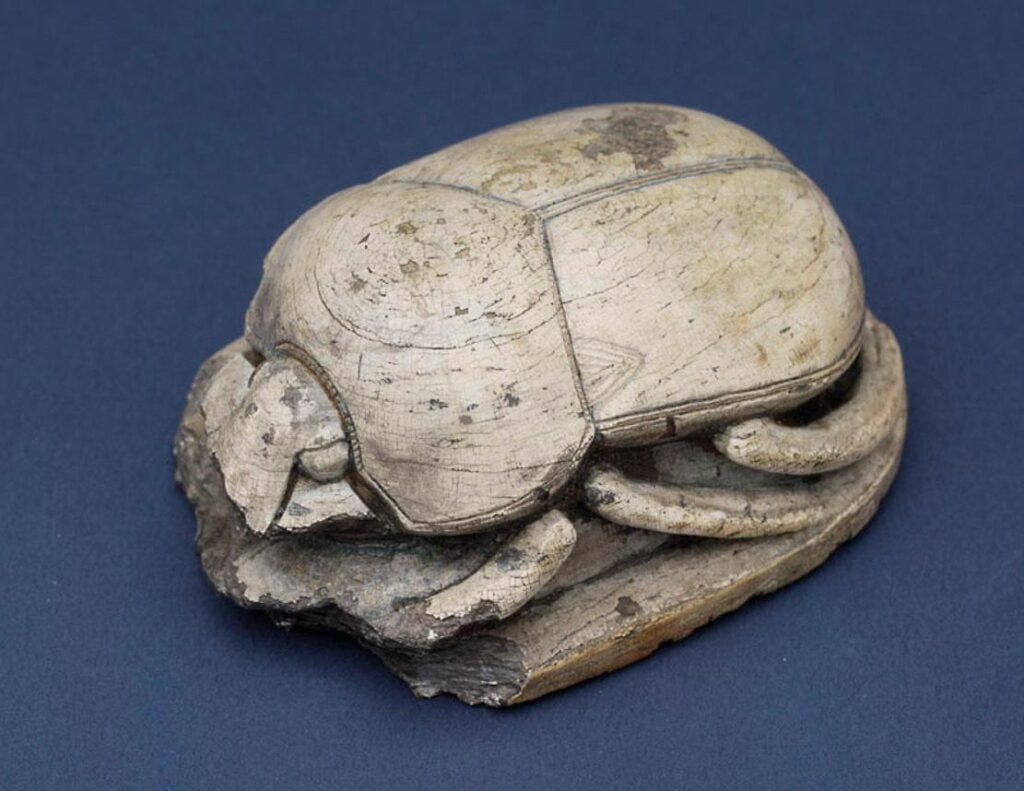
Title: Commemorative scarab of King Shabaka
Datation: c. 716-702 BC, Reign of Shabaka, 25th Dynasty, 3rd Intermediate Period
Provenance: Royal Ontario Museum (INV n°910.28.1)
Dimensions: 9.25 x 6.65 cm
Media: Steatite (talc-schist), carved and fired
Description
Historical context
Whoever has been visiting Egypt or seen an Egyptian exhibition in a museum has seen scarabs figurines sold in the gift shops. In fact, this whole project was triggered by the restoration of such an item.
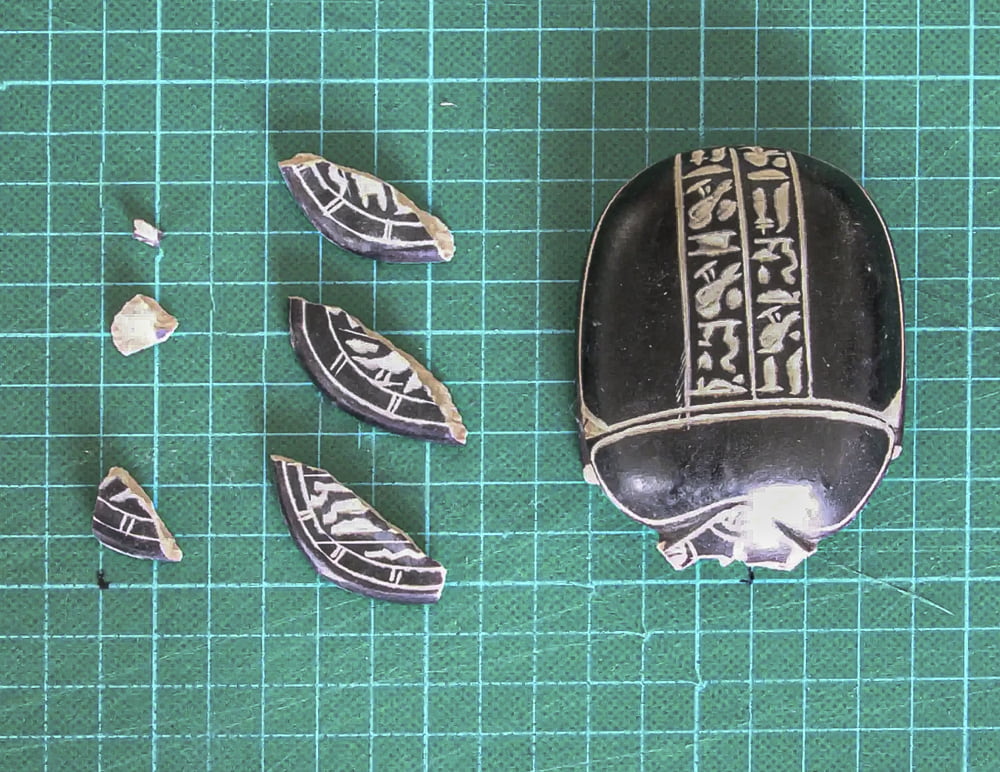
But the scarab trend is not new !
Numerous and varied examples
Their popularity seems to have grown since the middle kingdom and, well, never stopped.
There are numerous examples all around from different periods and also different countries. The production trend reaching up to cities near the Black Sea in the later periods.
There are two-ish types of scarabs: amulets (including seals) and commemorative ones. Amulets are small, colourful, and worn on an everyday basis as rings, bracelets, belt ornaments, necklaces etc. They are sold as trinkets or created as seals with a specific signature, intended to be used with ink, clay, or wax. Scarab-shaped pearls are also included in jewellery and produced in semi-precious stones.
Commemorative ones are different both in style and size. The higher the ranks of the patron, the bigger and pricier the scarab.
Big scarabs are rare. Some pieces, like one on display at the British Museum, are a meter high and a thousand kilos. Definitely not necklace material !
Their role is as honorific as it is diplomatic, like a sort of PR system for the leading class: the shape is symbolic, the text is what matters.
The piece we’re looking at is one of the in-betweens. It has cousins such as this one dated 1600 BCE from the Musée d’Aquitaine or this one dated closer to ours during the third intermediate period from the Metropolitan museum collection.
Maspero’s controversy: small insight inside the time when European egyptomania met Scientific archeology or “this piece is the real deal, you dim-witted philistines”
Our little buddy was the main subject of a controversy at the time of its “discovery”. Grab your pith-helmet and hold on to your breeches, we’re off to the treacherous land of the XIXth century egyptomania where rich western collectors met scientific archaeology.
The following story is based on one article written in 1958 by the archeologist Jean Yoyotte, available on JSTOR. The title is “Plaidoyer pour l’authenticité du scarabée historique de Shabako” (Biblica, vol 37, n°4, pp 457-476); roughly translated to “Advocacy for the authenticity of Shabako’s scarab”. There are also added notes on the same subject entitled “Sur le scarabée historique de Shabako, “Note additionnelle” (same author, Biblica, Vol. 39, No. 2 (1958), pp. 206-210).
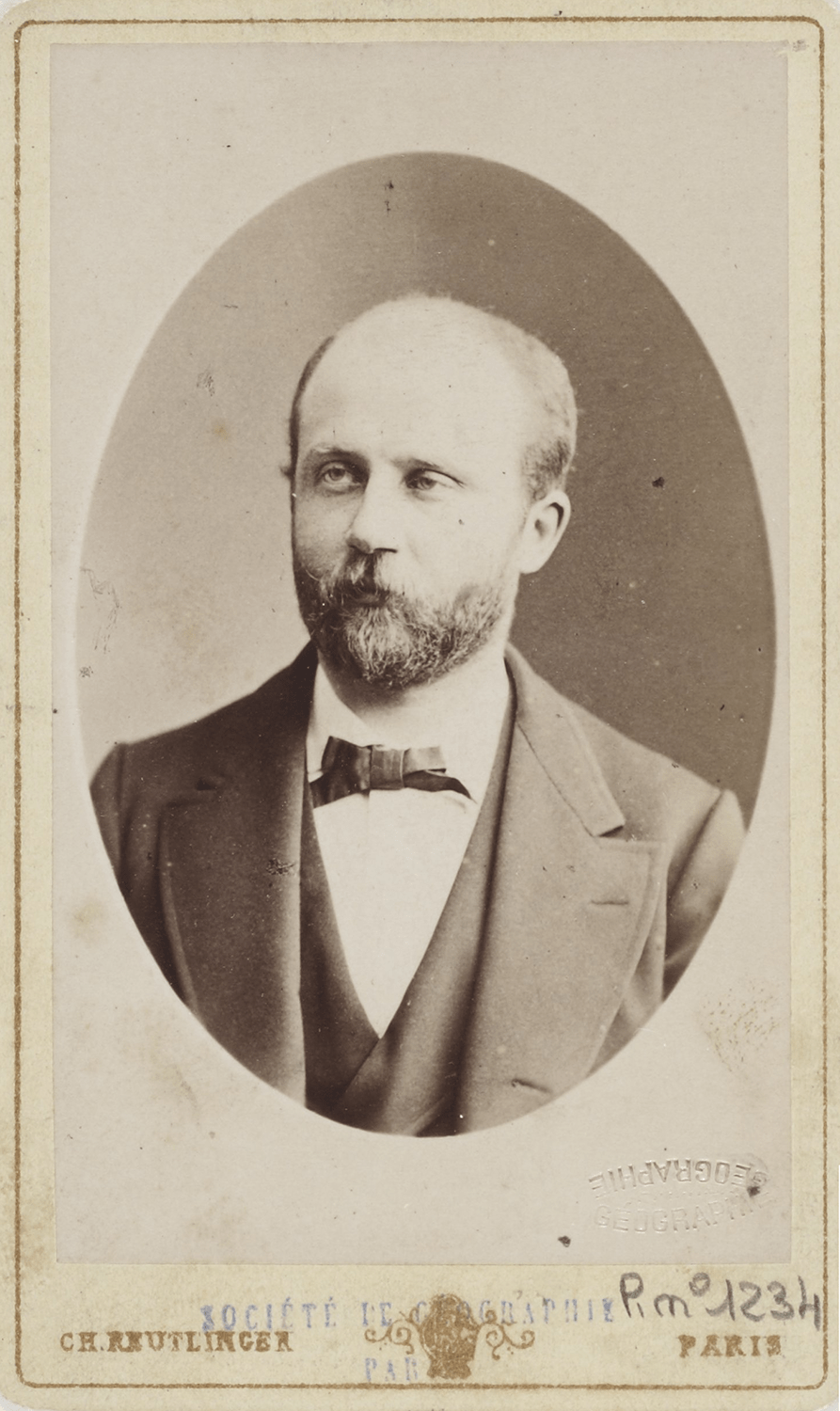
It all starts in 1906 with a mention from the Cairo Antiquities director, Gaston Maspero.
The Egyptologist received a stone rubbing of the inscription on the scarab. Being cautious, he mentions his doubts and underlines the importance of being able to see the object before drawing conclusions.
A little context is maybe necessary here.
The beginning of the 20th century is the moment in history where egyptomania, triggered by the Napoleonic campaigns of the 19th century, has allowed for unruly treasure hunts to be replaced with “modern” scientific methods in excavations and diggings. For a century, the western and oriental world interests in the antique Egyptian pieces fuelled a hunger for new discoveries . A plethora of individuals have scurried all along the Nile valley in search for treasures from the antique temple sites and the pharaohs’ burial grounds, including, but not limited to, the famous Valley of the Kings.
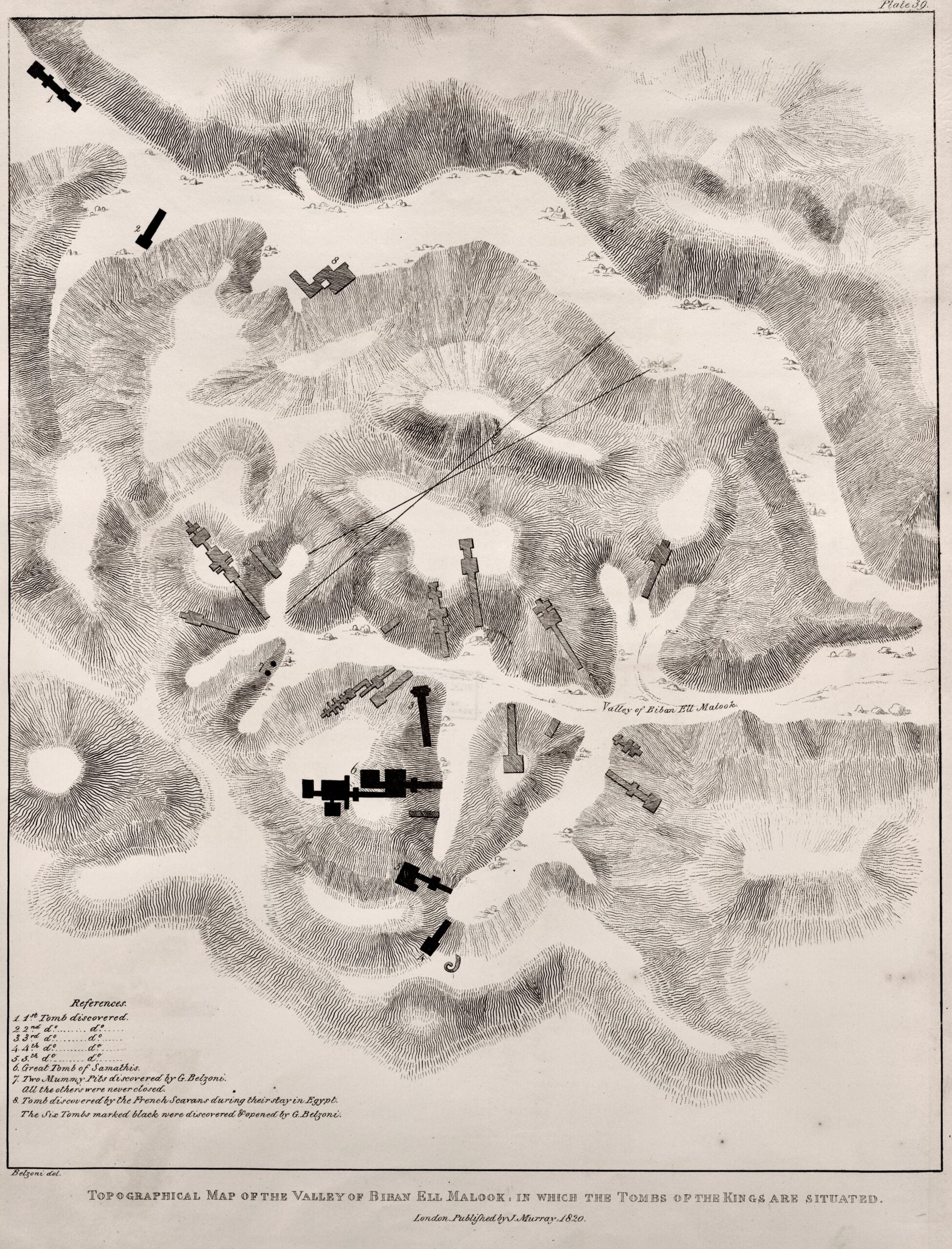
The treasure hunting parties were soon challenged by western funded scientific expeditions and the creation of a state controlled department, culminating in important discoveries like King Tut’s tomb in 1922. This is an over simplification of a really complex and fascinating period of history. It is the subject of numerous works, both scientific and fictional, that still have an echo nowadays.
Bottom line is: a century of Egyptian antiques’ madness also triggered a very profitable business of fakes, sold with a hefty profit to unscrupulous yet poorly informed clients all around the world. The affairs burst out in the press, feeding more than stopping the frenzy, everything being draped in the quasi mystical aura of Ancient Egypt.
As head of the department that also manages the Cairo Antique Egyptian museum, Maspero knows that all too well, hence his caution about an object he has never seen.
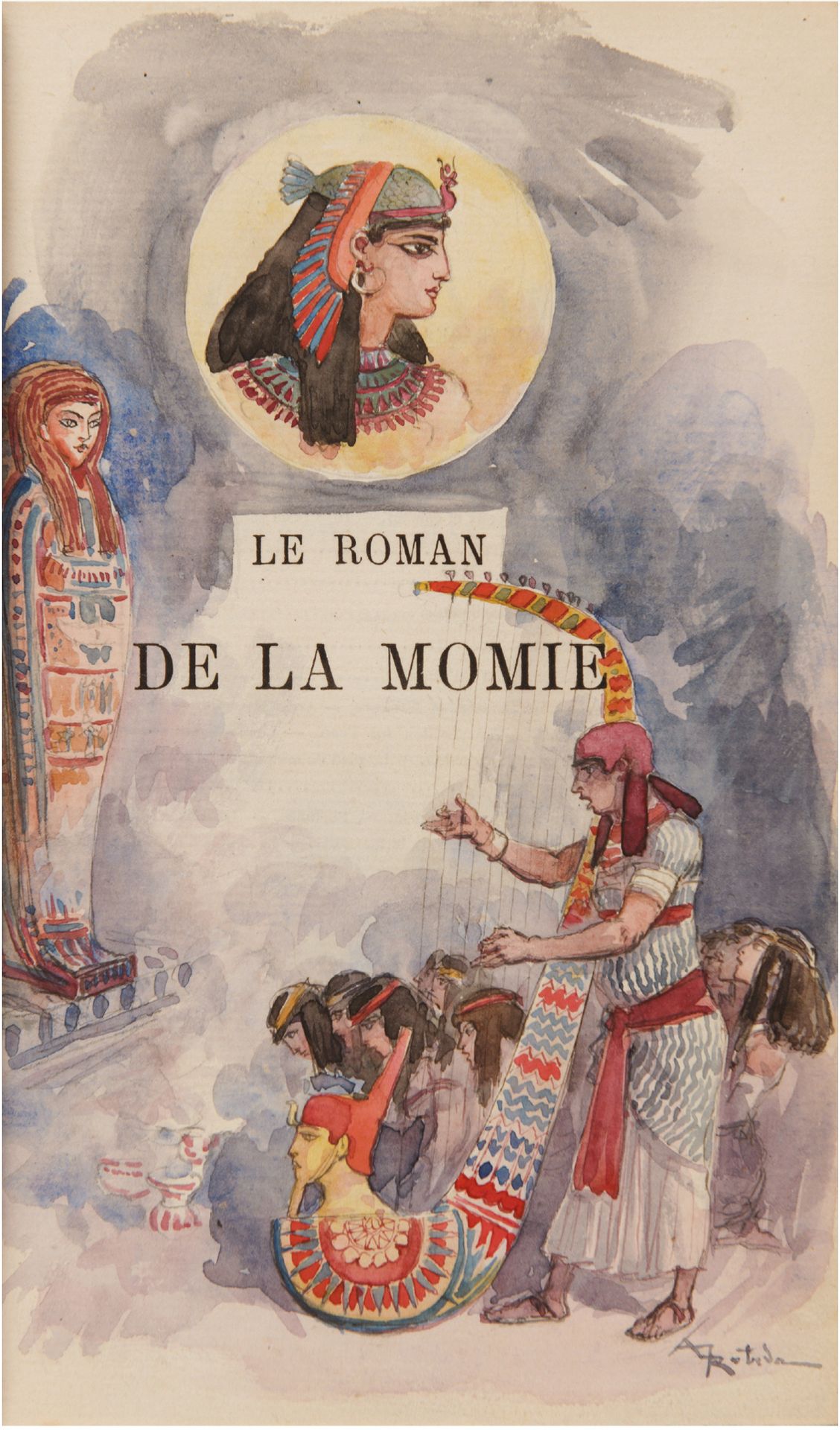
In 1908, yet another fake artefact scandal bursts: the Bouriant’s scarabs affair. What makes this umpteenth story about fakes interesting for us is that it stems from the archaeology community itself. Urbain Bouriant was a renown Egyptologist, collaborator of Maspero. After his death in 1903, his son Pierre sold two scarabs said to have been in his father’s collection. It turns out they were fakes, of very good craftsmanship. The epigraphy was the very element that allowed scholars to discover the truth. Though Pierre found a way to imitate the form of a credible scarab, his knowledge of epigraphy was not as acute as his father’s. Made up from real antique sources, the text was not grammatically correct. If you’re interested in the subject, this compilation of texts on the subject of Egyptian archaeological fakes makes for a very informative reading.
Our little scarab is bought by Charles Currelly around 1910 in Jerusalem for the Royal Ontario Museum. That is to say, almost at the same time !
According to Yoyotte, in this context, it’s an article from Max Muller in 1914, “Ein historischer Text des Aethiopenkönigs Schabako”, containing a description and a sketch that initiates the controversy about our little bugger.
The dimensions, the style, and the epigraphy are put under scrutiny. Maspero’s words of caution are seen as foreboding. Europeans specialists do not hesitate to conclude the scarab is a fake antique.
While, it seems, never having seen the piece, only hand made reproductions of the text and written descriptions of it. Other scholars, having seen the piece, did not see it as fake.
It is now 1916. Europe is at war and the controversy dies down.
In 1917, Flinders Petrie catalogue of Scarabs and cylinders do not mention it.
In 1958, Jean Yoyotte uses all his will and knowledge to, as he cheekily puts it, make a thoroughly researched and informed decision before “excluding the piece from the scientific catalogue of known antique scarabs”. Which is academic slang for “this piece is the real deal, you dim-witted philistines”.
Let’s leave the last word (so far) to him:
“…
- La condamnation du scarabée historique de Shabako n’avait été précédée d’aucune instruction véritable de l’affaire.
- Le cas de cet objet est sans analogie manifeste avec le cas des scarabées de Néchao. La mise en œuvre de la matière, I’élaboration de I’écrit et la psychologie de I’auteur différent profondément. Si I’on retient en définitive la présomption de faux, on admettra que le faussaire était d’une érudition et d’une habileté bien supérieures à celles du neveu d’Urbain Bouriant, le scarabée de Toronto étant alors, sans conteste, d’une fabrication infiniment plus parfaite que celle d’aucun des faux épigraphiques jusqu’à présent publiés.
- Deux expertises de laboratoire n’ont décelé aucun détail suspect.
- Dans I’état présent de la documentation, ni les dimensions, ni le lieu d’apparition de la pièce sur le marché ne peuvent paraitre aberrantes.
- Les caractéres typologiques du scarabée paraissent parfaitement normaux pour la XXVe dynastie.
- Les caractères épigraphiques de l’inscription semblent également normaux, quand ils ne sont pas typiques de cette période.
- L’analyse philologique du texte le situe fort bien parmi les inscriptions historiques des rois koushites; et ne permet pas d’établir que le récit ait été artificiellement composé par un scribe moderne.
- Les meilleurs éléments de comparaisons, tant pour la forme du scarabée que pour le détail épigraphique et la composition du texte, ont été tirés jusqu’à présent de documents connus bien après l’apparition du scarabée sur le marché…”
This roughly translates to:
- There was no real full scientific analysis of the scarab to conclude it was fake.
- It is not the same as with the Nechao (Bouriant) scarabs. The craftsmanship and the author’s psychology are different. If it is indeed fake, then the forger’s erudition and skills are well above Urbain’s Bouriant’s nephew. It is truly one of the utmost perfect faux ever produced.
NB: Here, Yoyotte mentions Bouriant’s nephew, though other articles about the case mention his son. If any of you, dear reader, knows more about that, please contact us !
- Two lab analysis didn’t conclude to anything suspicious about the piece.
- As far as sources go, neither the dimensions nor the place the piece was bought in are surprising.
- The hieroglyphs’ typology is coherent with the XXVth dynasty
- Epigraphy is regular, albeit from the period.
- Philology is coherent with the kush’s kings inscriptions ; nothing suggests a modern composition.
- Comparison’s elements, whether the shape, the epigraphy, or the text, can be taken from pieces discovered after the scarab was known.
Shape, decor, and colours
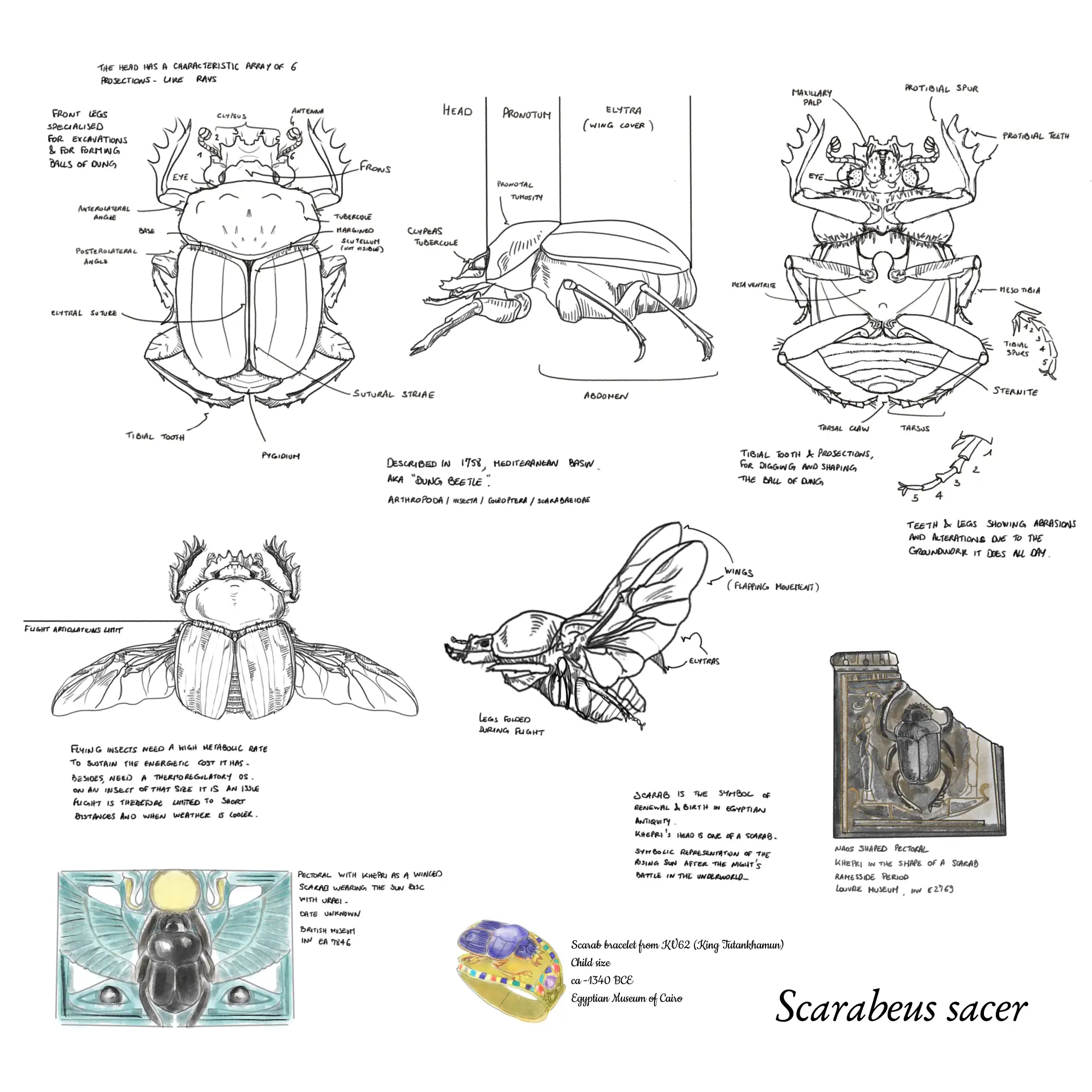
Natural references: Quick notes on how to describe a beetle
The antique Egyptian pantheon uses dung beetles such as Scarabeus sacer as the inspiration for the face of the god Khepri, the morning sun. It is that god, that embodies renewal, that the scarabs artefacts represent.
This species has been largely documented over the years and there are a lot of scientific papers on them. Though archaeology scholars are still hesitant as to why the beetle was chosen as the image of the god, all the zoology data will help in identifying the different element of the object and better understand its shape. Antique Egyptian artists were keen observers of their surroundings and extremely skilful modellers. Therefore, we’re going to need all the help we can get to limit the faux-pas !
Here’s a quick study, compiling what seemed relevant:
Steatite and glazing
The scarab is made of steatite. Steatite, or sometimes soapstone, is a very soft talc-schist that dehydrates into enstobalite and cristobalite compound when heated above 950°C. The newly formed material is now almost as hard as granite.
Most antique ovens were hardly able to sustain that temperature and above for a long period of time. Remember that wood was a rare commodity in Egypt, and artisans had to make do with other fuels for their fires. Therefore, most of the time only the outer layers are hard.
The steatite can be glazed. It seems antique Egyptian pieces made in steatite are glazed as early as the pre-dynastic period era. These glazes are made of powdered quartz, with added metallic elements as needed depending on the expected colour. For example, powdered copper gives a blue-green shade, reminiscent of Egyptian faience. But it doesn’t seem to be the case here: the glaze looks a yellowing white.
Or is it ?
Visible condition report
We can only conduce a visual assessment of the condition the piece is in through the specimen documentation, as can be found on the ROM Museum website page for the object.
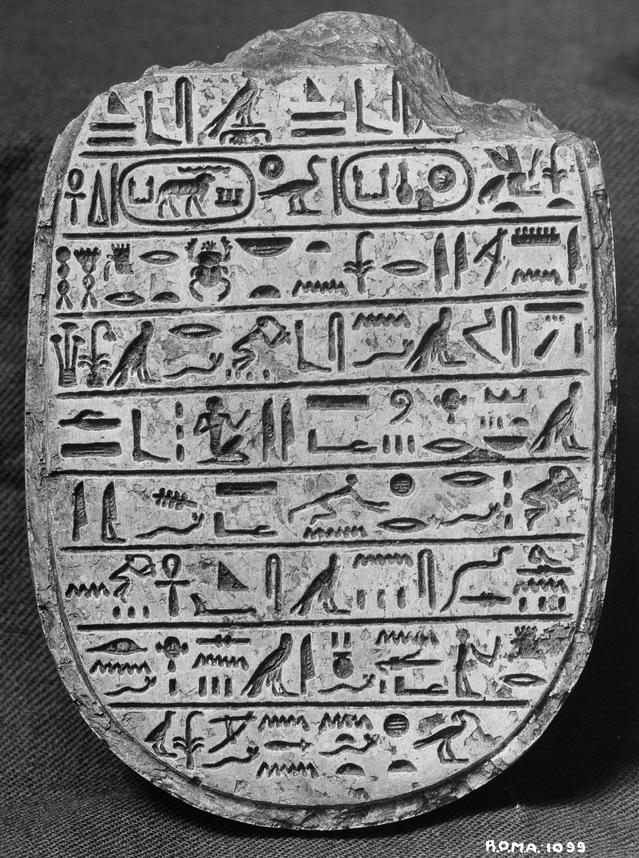
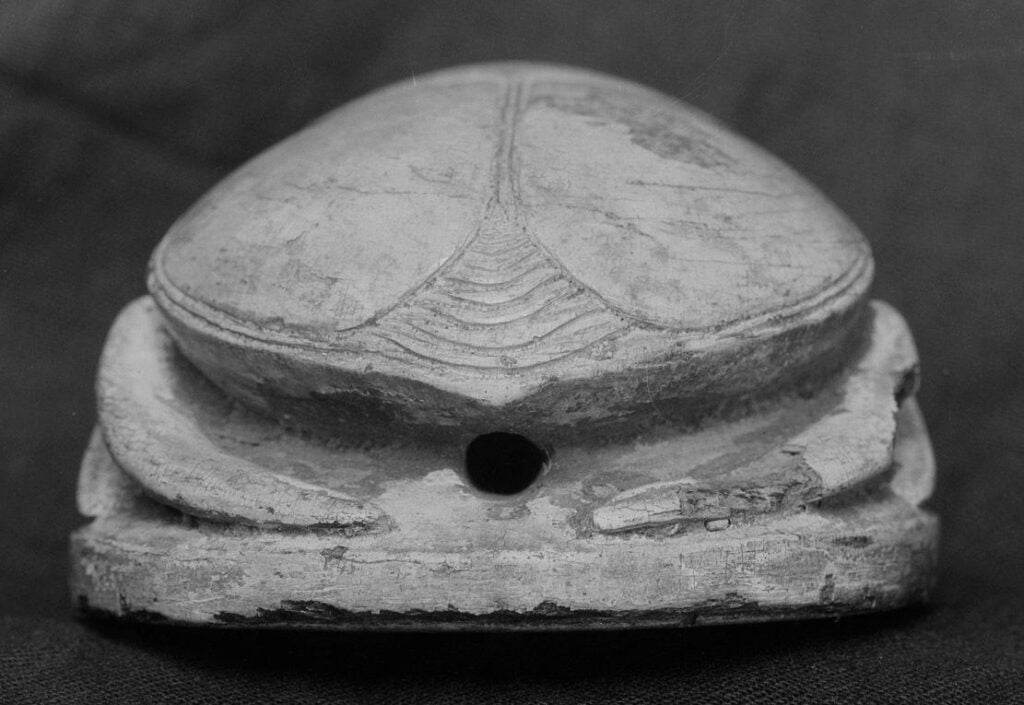
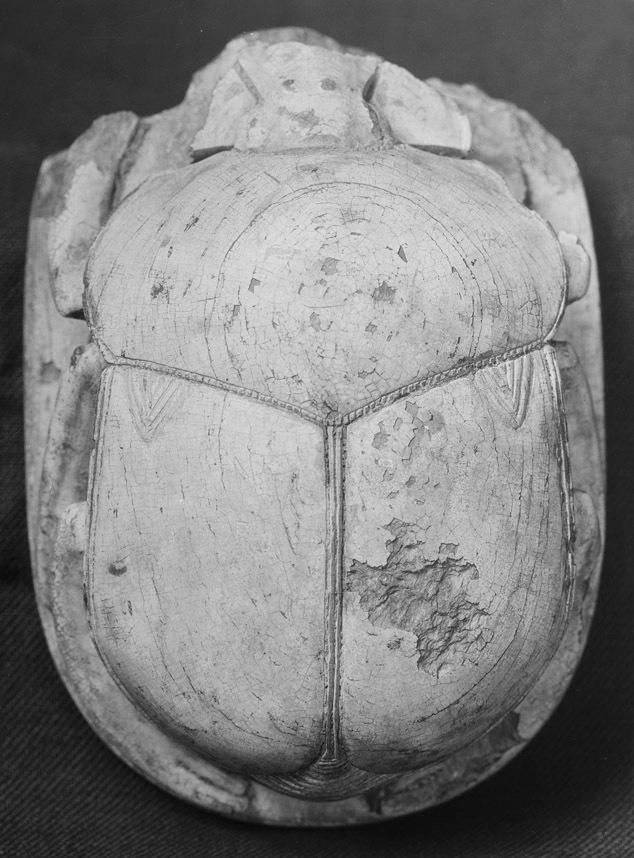
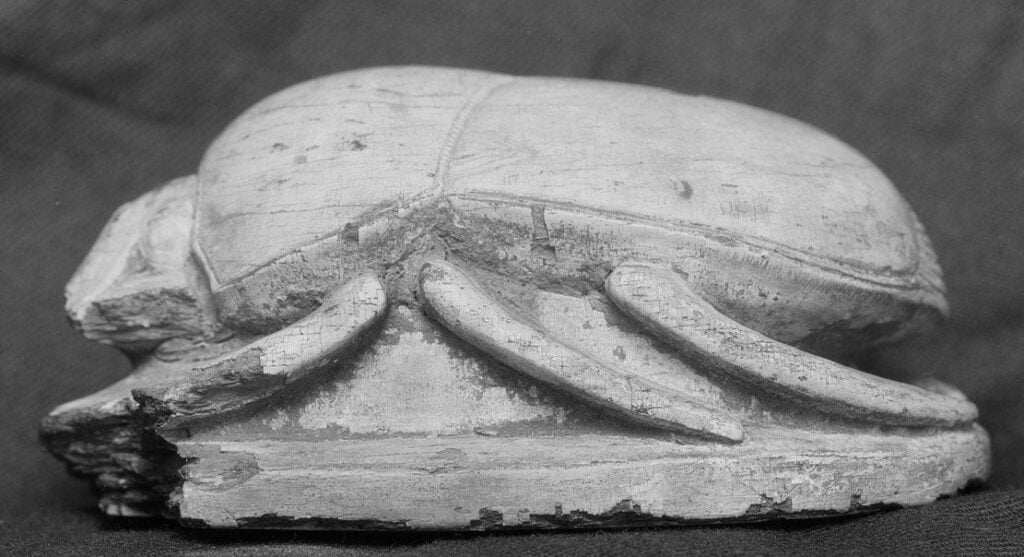
The piece represents a dung beetle on an oval slab, figuring hieroglyphs on the underside.
The scarab is missing the front part of its shape: the teeth of the clypeus, the horns as well as the characteristic teethed protibias are gone. The slab under it is missing, too; as a result, so is the upper and upper left part of the hieroglyphic inscription.
The photographs we have of it show a worn down, yellowed surface. The glazing shows cracks and flakes. There are important scratches all over the surface, some seemingly going into the stone strata. It is clearly visible in the middle of the right elytra. The lower right leg is devoid of glaze on a third of its lower part.
3D Restoration
Disclaimer : this is an exercise, shown for documentation purposes only
What to do : digital restoration choices
Miss Needler to the rescue
In order to know what to do, we need to find an accurate description of the piece itself by people who actually held the piece. Primary sources and all that.
Winnifred Needler, curator at the Royal Ontario Museum, wrote to Jean Yoyotte while he was writing the aforementioned article on the scarab and communicated with him the results of the assessment she herself conducted. That includes a spectrographic analysis as well as the results of the scientific analysis of the piece she has ordered from the Boston Museum of Fine arts laboratory.
Missing parts and beetles limbs
Needler’s assessment of the scarab mentions:
«…The form and style of the scarab are possibly for the 25th Dynasty. The 25th Dynasty heart scarabs from El-Kuruw resemble it quite closely; the larger of these is exactly the same size, with the same number of lines of inscription. Many smaller scarabs of the late period are similarly naturalistic (e. g. NEWBERRY, Scarab-shaped Seals n. 36301, 25th. Dyn. and n. 36292, 22th Dyn., and Hatt, B. M. Royal Scarabs n. 2485, 25th, Dyn.), Beading can also occur on late scarabs (e. g. Brooklyn Mus. Glass and Glazes, 1948, n. 29)…».
So, it seems the missing part can be completed using zoological references such as protibial teeth and ridged clypeus.
As with all digital double process, we must use other related pieces as references.
Here’s a snapshot of my ever-evolving Pureref board:
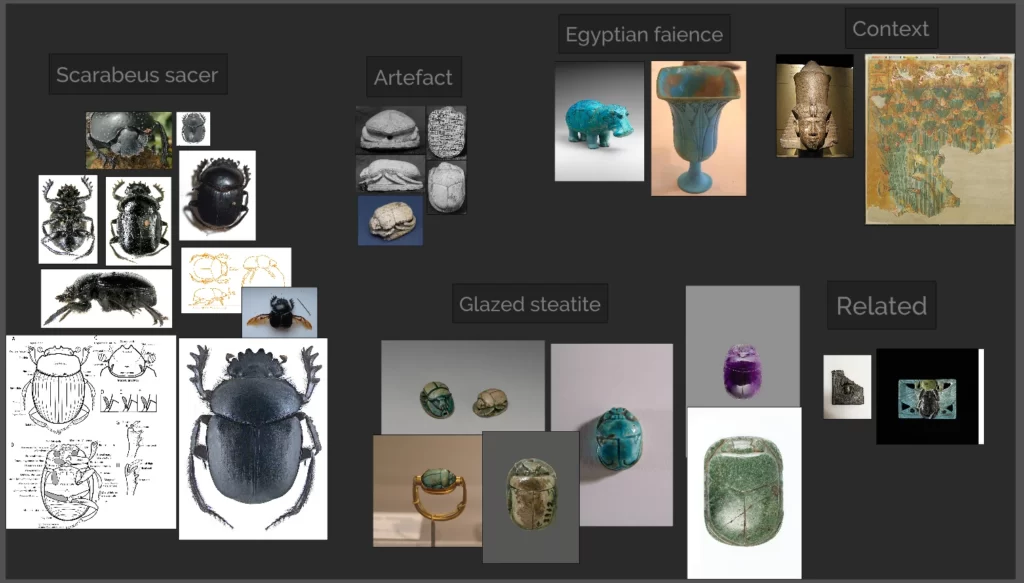
You’ll notice it’s restrained. It’s a voluntary method where elements deemed irrelevant during the creation process are savagely evicted to maintain a minimum of clutter. Past the first stage of building a base reference following the “you can’t have too many” rule, I noticed that it was more effective to build upon it and make it change with oriented, scalpel sized researches. The image data pool available is so vast that one can get lost in it.
It has its drawbacks, and I’ve been known to put back items I’ve taken away. I feel that, for now, it allows me to work faster than to have to deal with an unmanageable pool of conflicting references. It forces me to make educated choices.
Missing colours and Egyptian hues
According to Miss Needler, the results of the spectrographic analysis are as follows:
«I have had two samples from the scarab analysed spectrographically in the laboratories of the Ontario Department of Mines:
1) a sample of the blue friable substance.
2 ) a sample of the hard, light yellowish surface.
In the results given below H (high) = 10 to 20% ; M (medium) = 1 to 10% ;L (low) = 1 to 0.1% ;T (trace) = Jess than 0.1%
[NB: (1) -first letter(s)- blue substance (2) -second letter(s)- hard surface) ]Aluminium M L ; Antimony T none detected ; Calcium MH L ; Chromium none detected T ; Copper MH L ; Tron L LM ; Lead TL T ; Magnesium M H ; Manganese T T; Nickel T L; Silicon H H; Sodium L-M L; trontium T none detected; Tin LM T; Titanium L T
This is favorable evidence for our scarab, and the composition of the hard surface material is particularly significant, since it indicates the presence of glaze no longer visible to the ordinary eye».
You read the lady.
Despite the photographs showing a yellow-white tint, chances are the final layer was, in fact, the colour of Egyptian faïence. We need a blue-green hue with transparency, as in the following pieces!
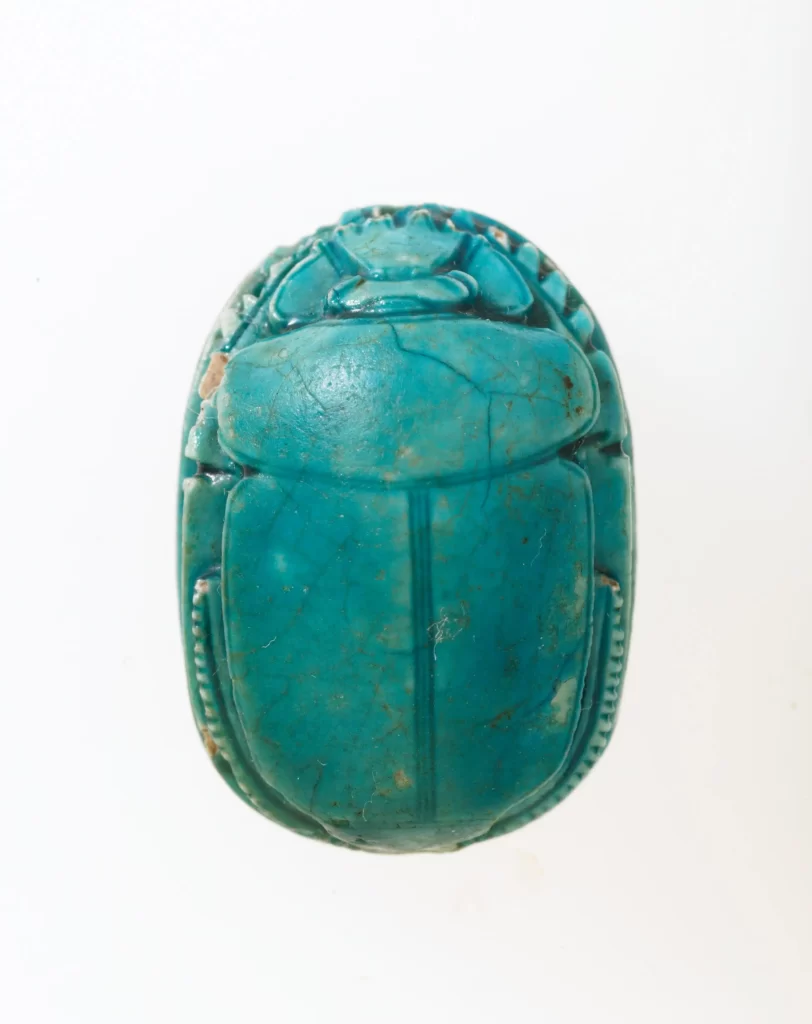
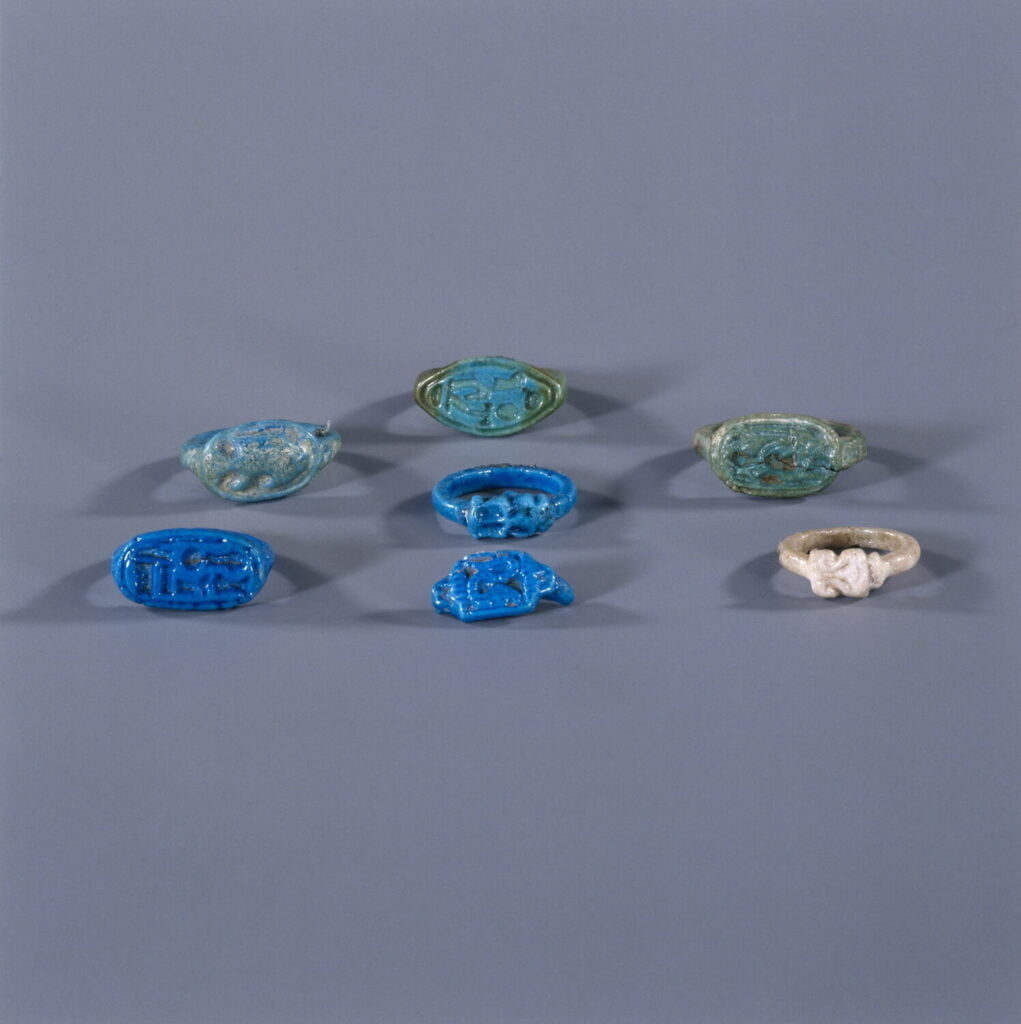
In her assessment, Miss Needler adds:
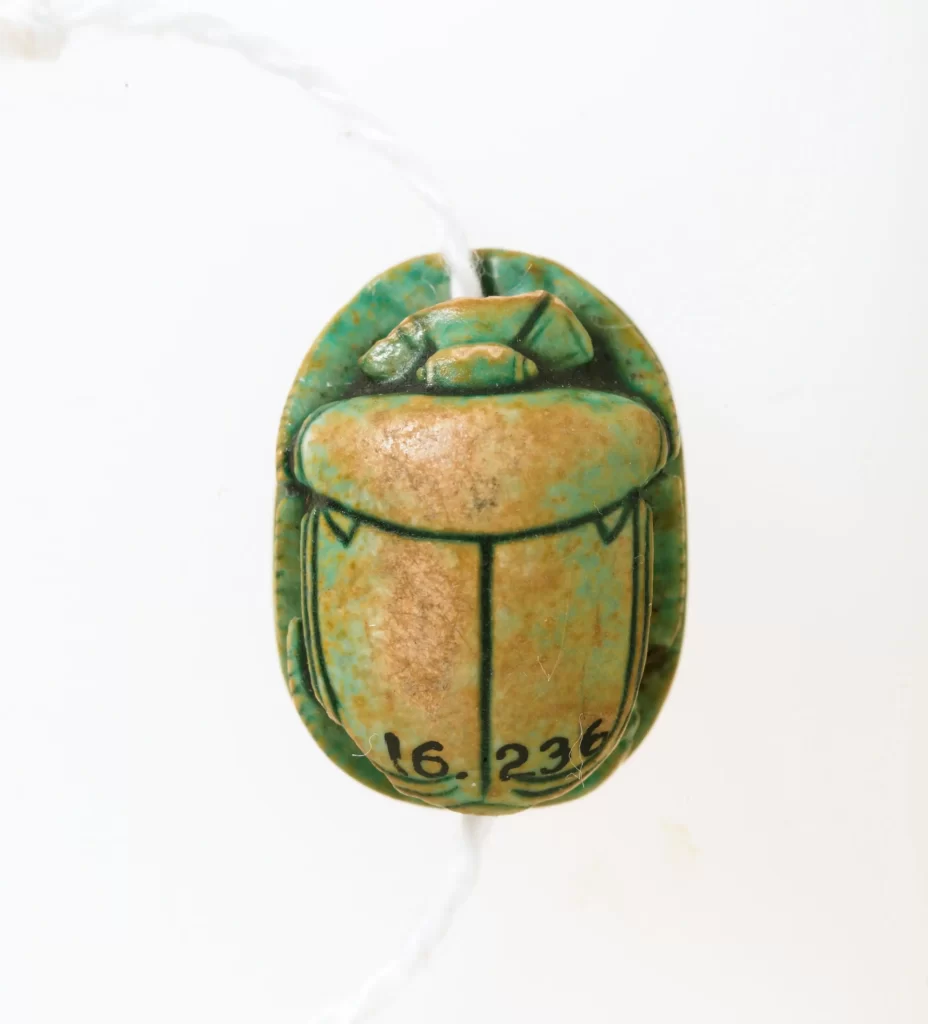
«The object seems genuine to me in spite of puzzling features, such as the perforation (which is almost cylindrical). The steatite is weathered and cracked. All surfaces seem to be ancient. There are remains of soft, powdery blue substance in the hollows of the upper surface. This is the right colour for Egyptian blue glaze, and is of a friability sometimes seen in decomposed faïence and in blue frit and which is more rarely seen on glazed steatite. The rest of the surfaces, including the inscribed side, are shiny light yellowish brown, The soft blue surface is beneath a deposit of reddish brown dirt. The surfaces of the stone are much harder than the interior, which can still be easily cut with a pen-knife. There is no visible trace of the blue friable substance in the hollows of the hieroglyphs, which, as can be seen in the photograph ( pl. II, D], are carefully cut and have incised detail on their grounds; they are partially filled with a soft black sooty substance, quite different from the above mentioned reddish brown dirt in the hollows of the upper surfaces, and not appearing elsewhere on the object. This sooty substance seems to lie over a hard surface similar to that of the rest of the object ».
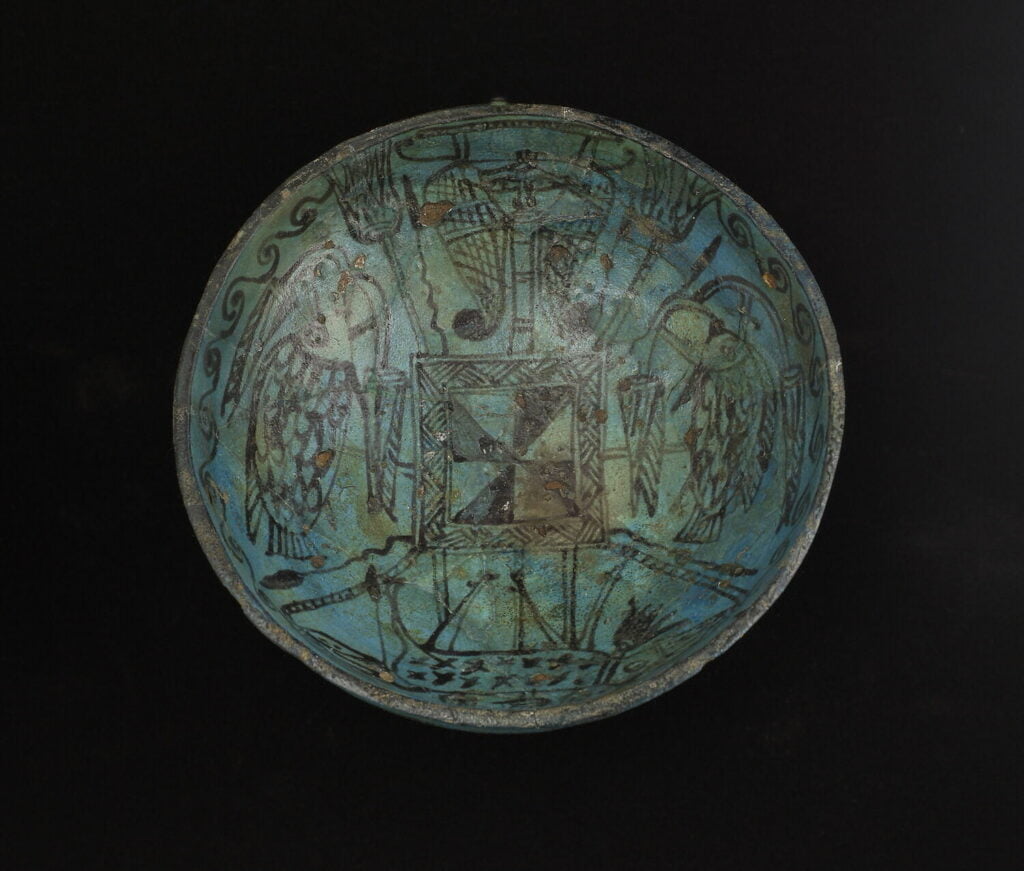
The “soft blue” description and the fact that so few traces of it remains on the piece would suggest a more subtle colouring, maybe along the lines of these pieces, minus the alterations:
The hieroglyphs’ conundrum, first part
You may have noticed Needler’s description above mentions the hieroglyphs of the inscription incised in the base of the scarab as “filled with a soft black sooty substance “.
In his article, Yoyotte tells about the epigraphic qualities of the text and mentions the striations inside some of them. He considers it important as it is reflecting a naturalistic treatment also seen in other pieces of the same era.
This is something I didn’t see coming. Granted, my epigraphy lessons are long gone, and it was just a uni intro anyway !
But more than that, I had identified the lines inside the reliefs of the hieroglyphs as made by the tools of the artist carving them. Without this acknowledgement, I would have made a mistake by rendering a generic noise effect inside the shapes and erased a part of the identification process.
See ? Told you restoration was more than just material, even for digital versions !
That is why I’ve asked for help from a specialist to make sure my rendering of the writings is as accurate as can be. Because, well, it has to be for the restoration to not be a failure on that point.
Spoiler alert, this is where most of the online 3D pieces available on the web fail, particularly photogrammetry based, even the very few retopologized ones.
On antique Egyptian artefacst, the hieroglyphs are most of the time blurry at best. On a jewel-like piece like this, I feel it would belittle the rest of the piece. So, no pressure.
Note :
Of course, there are examples of hieroglyphs rendering that are as precise as the stylus that made them, like the King’s chamber project done for the Epigraphic Survey & The Oriental Institute of the University of Chicago.
For in-depth explanations on the epigraphy issues when digitized, the digital epigraphy website is a rich source of information.
How to do it: a 3D reconstitution process
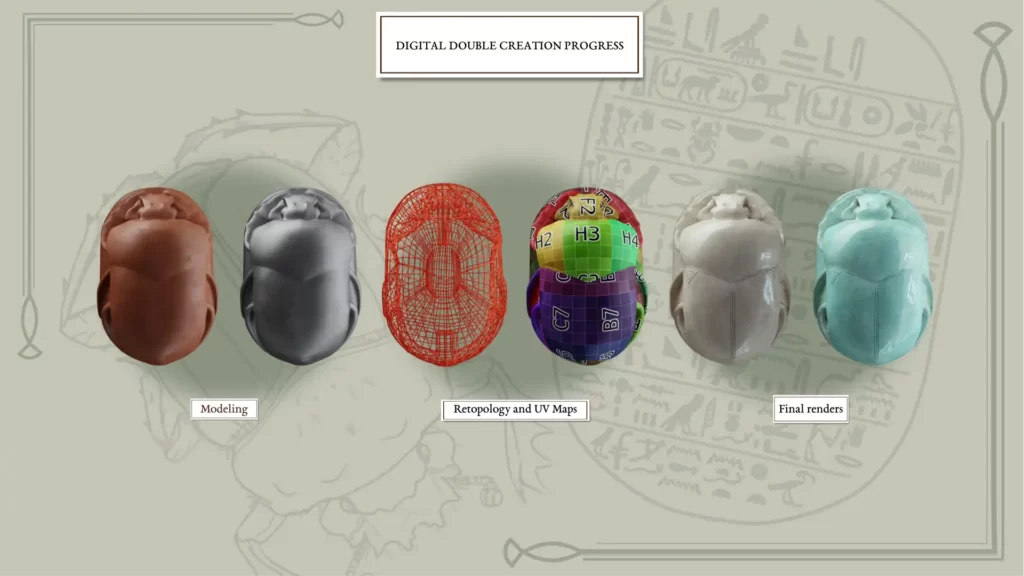
Model the shape
Shape completion: horn or no horn, that is the question.
The photographic material provides us with enough reference to model 3/4th of the shape without too many issues.
Using the references gathered for the missing head part, we can try a reconstructed version, making as much educated guesses as possible.
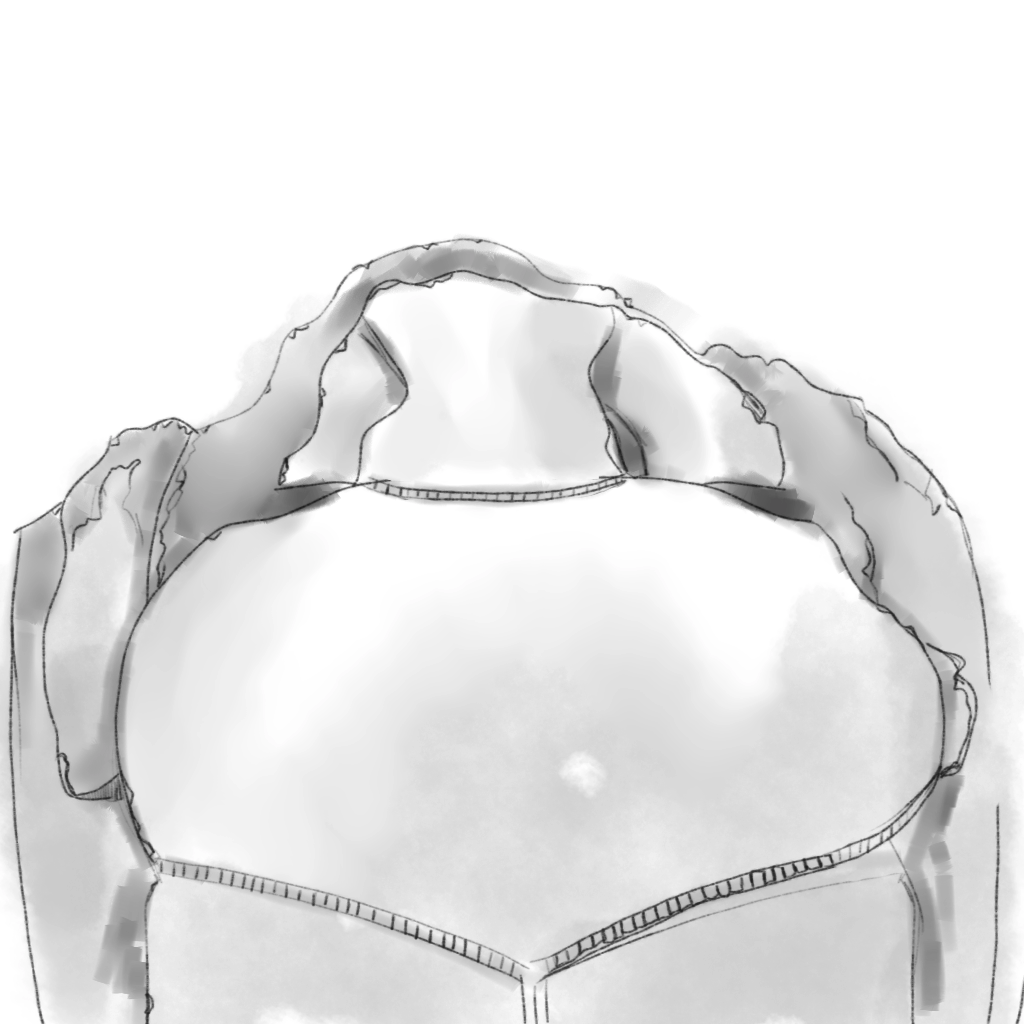
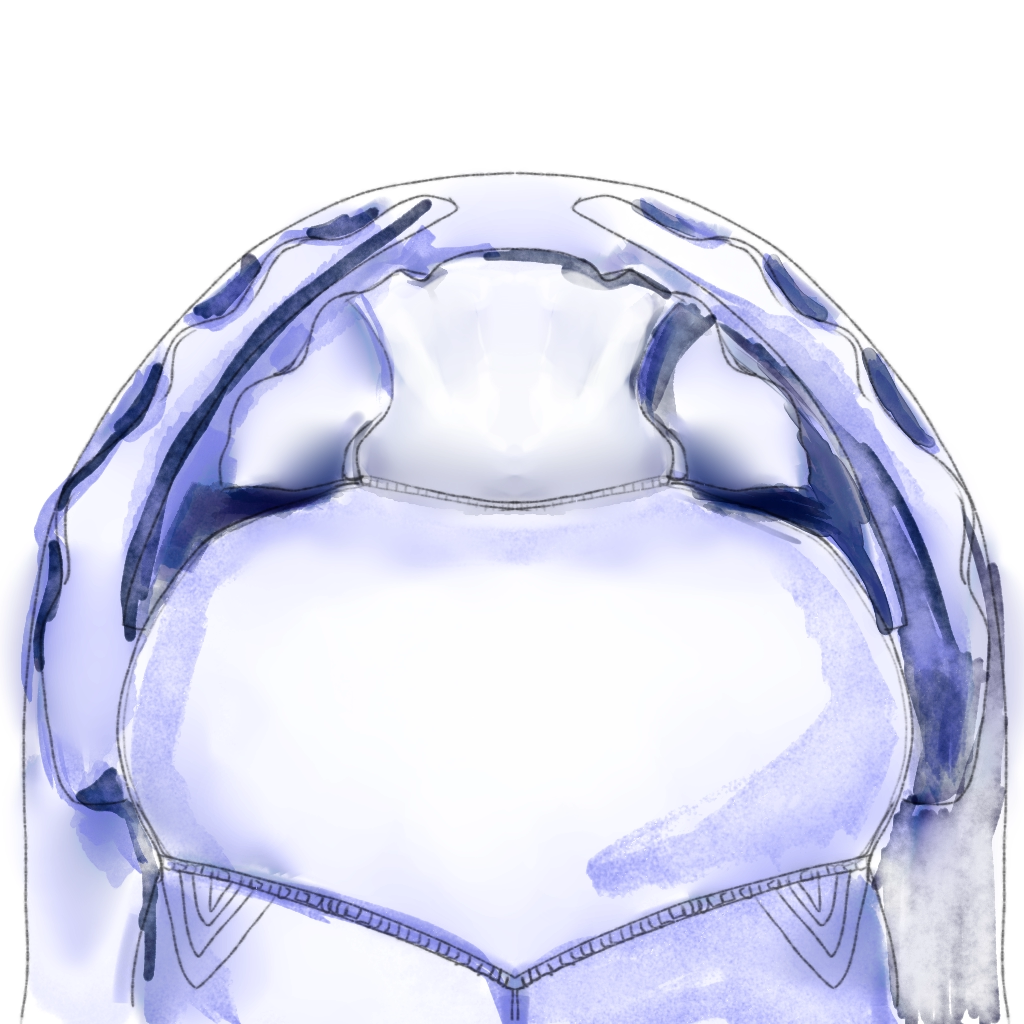
Besides the obvious missing parts, as progress on the model went, one spinous question arose. What about the horn ? And are there more than one ?
If you take close inspection of the head of our model, the pictures show marks on the frons.
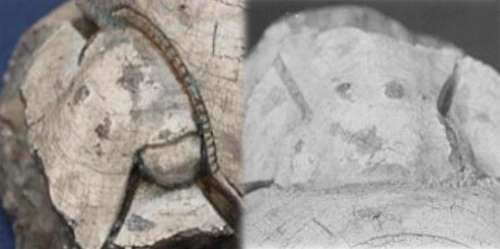
The abrasions can come from an inopportune contact with an object, eroding the surface on these points. It can also come from the abrasion of one or two reliefs that used to be there.
For a while, the size difference between the abrasions has me thinking of one singular horn in the middle.
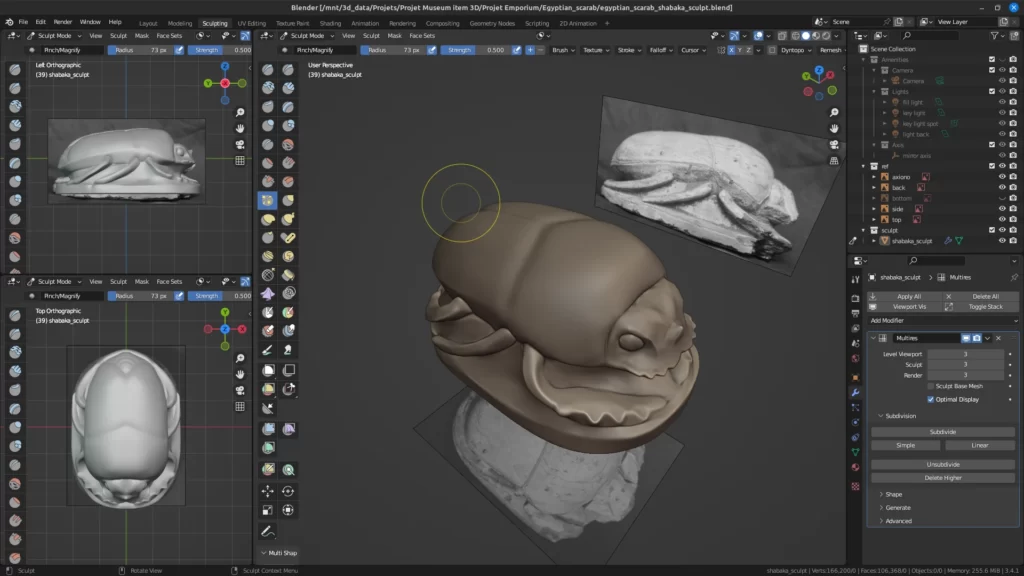
I kind of went back and forth with this until a strict comparison with existing examples and zoological context made me change my tune. But I do like the unicorn style on the little bugger !
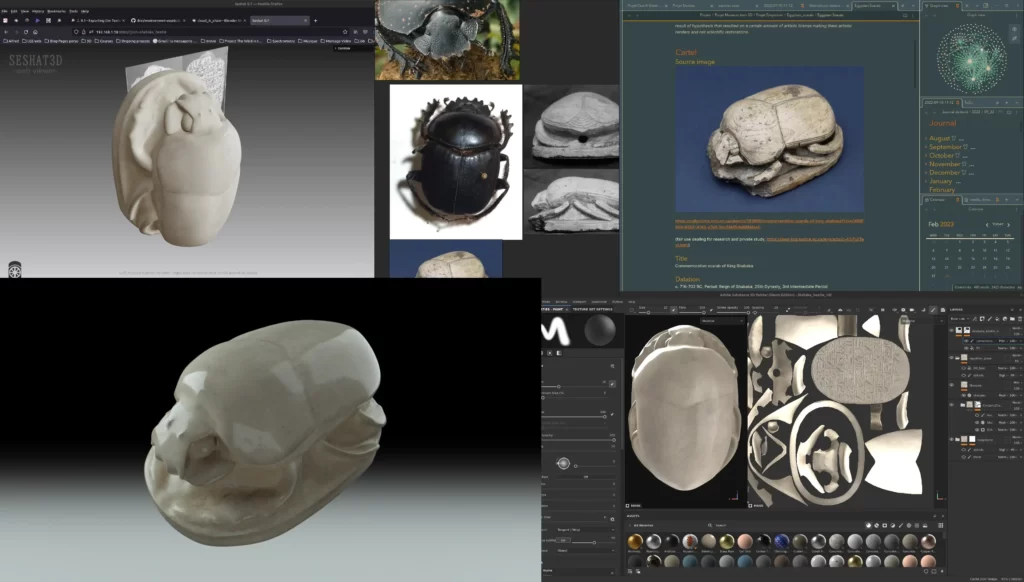
After retopology, UV mapping and a quick and dirty texturing, here’s where we’re at:
The hieroglyphs’ conundrum, second part
Spoiler alert: it has been a -long- process of trials and errors.
There was one thing I was certain of from the start: I didn’t want the epigraphy to be sculpted in the model. Two reasons for that, it would crank up the vertex count exponentially and, because I also want a web friendly version of the piece, it would make the piece way too heavy to use.
So I can only go the normal and height maps way.
This was challenging, mainly because I didn’t anticipate the level of precision the drawing would need to be easily readable.
Because, yes, the secret to it all is one has to use one’s digital reed pen and go manually over the text.
I tried using the images from the references, but digital manipulation did not yield a good enough result. The normal map effect was too blurry to be useful.
I think it is linked to the image quality, but I might be wrong. Even with a higher quality file, the noise rendered by the stone’s alterations may be the main issue.
As the text is not that long, it made sense to just draw over it to obtain a clean looking file.
Of course, I made sure to have my work regularly evaluated by an epigraphy specialist. Because in Egyptian hieroglyphs, it turns out snakes can have horns, circles with lines are not at all what they seem, and papyrus stacks are shifty !
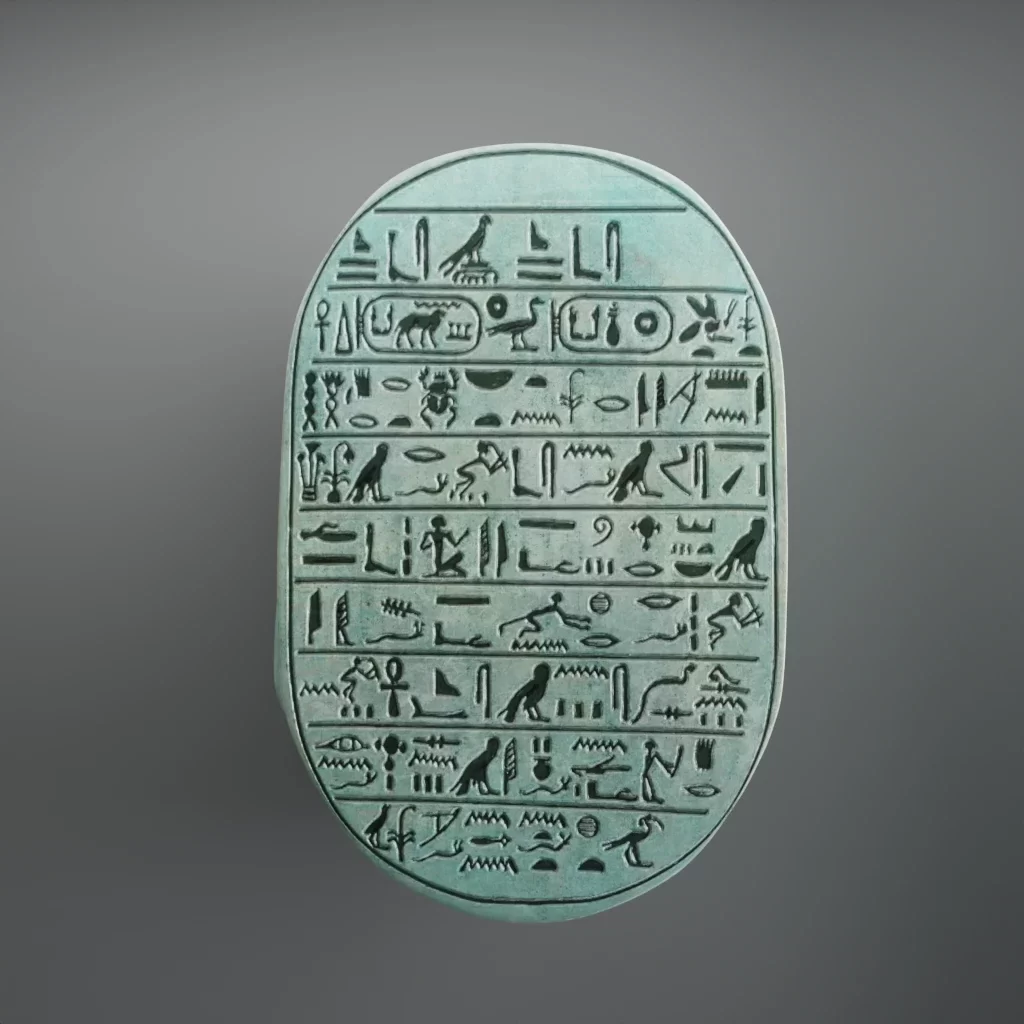
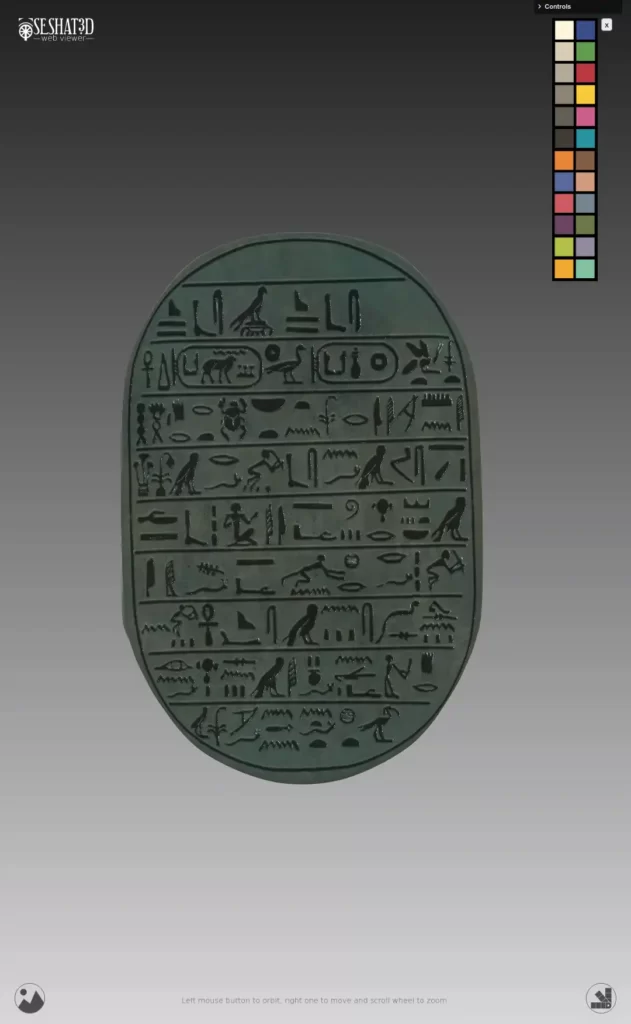
Here are the two last iterations of the image I’m basing the normal and height map on. Yes, I’ll be using both. I want the indents the surface modification will produce to emphasize the light bending effects. This provides enough precision for the text to be readable. Though obviously not by me…
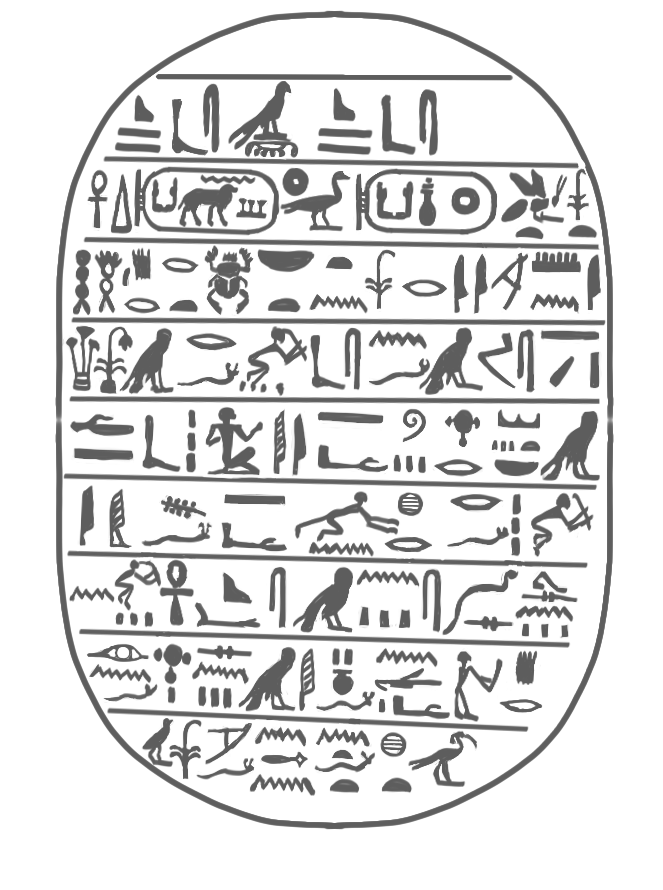
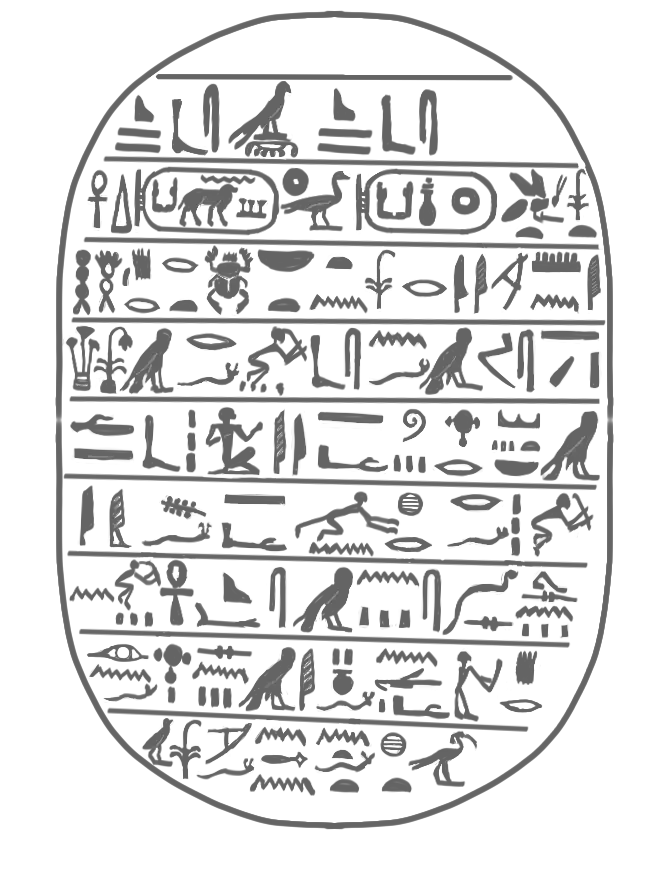
The main differences between the two are the addition of the striations as mentioned earlier by Yoyotte.
Texture the shape
When I caught the blues
We’re almost there and we now have a functioning model.
It’s at this step of the process that I came to a realization. I did not take into account the blue part of the enamel. Despite having read about it. And kept wondering to myself “It’s weird it’s not blue-green”.
…
…
No. I do not have another explanation than, well, I have had my head in the clouds lately.
I’ve been working with the quick and dirty version of the texture and forgot.
So, back to the digital drawing board. I’m thankful for the ability to organize projects and layers in Substance Painter and name them accordingly: change of colours ?
-Almost – No worries ! Tweak a little there, add a little here and presto, we have a nice blue-green hue as per Miss Needler’s instructions.
Shine a little light: stills renders using Blender
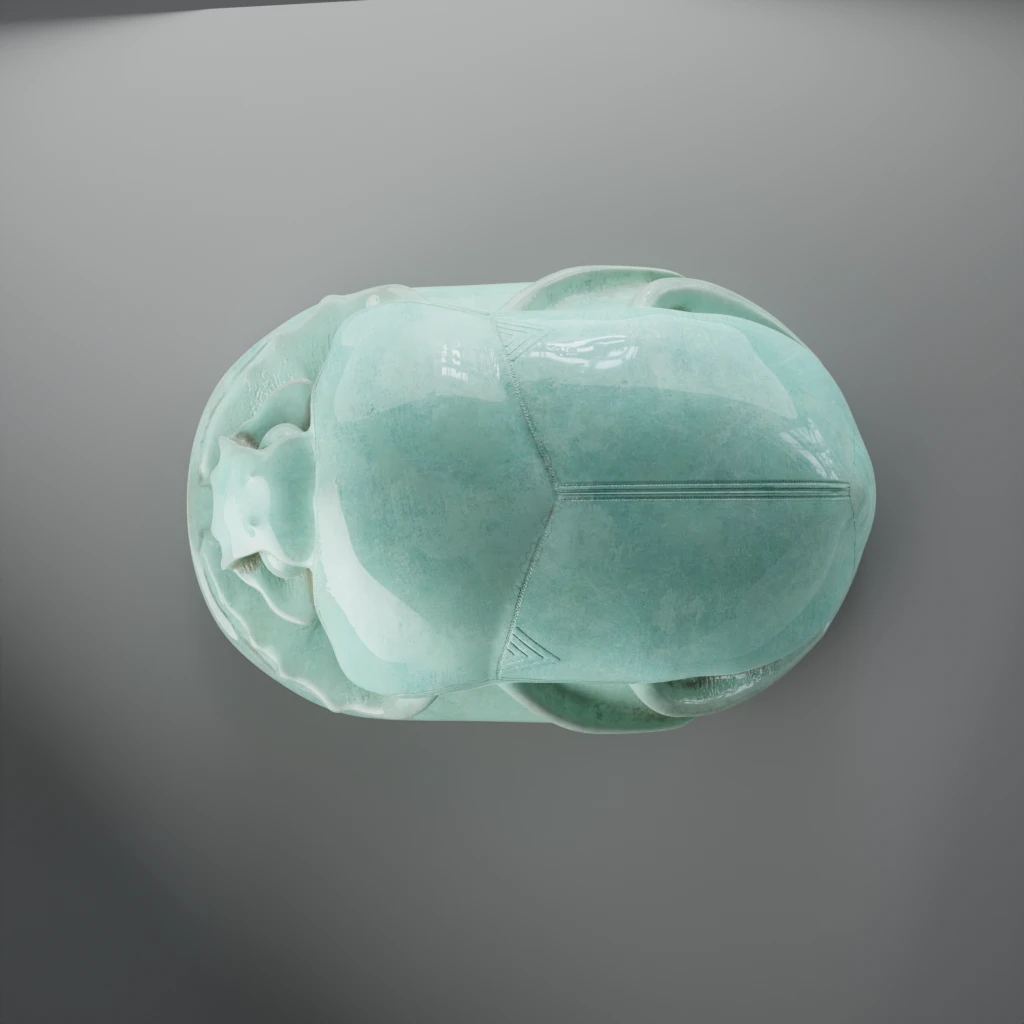
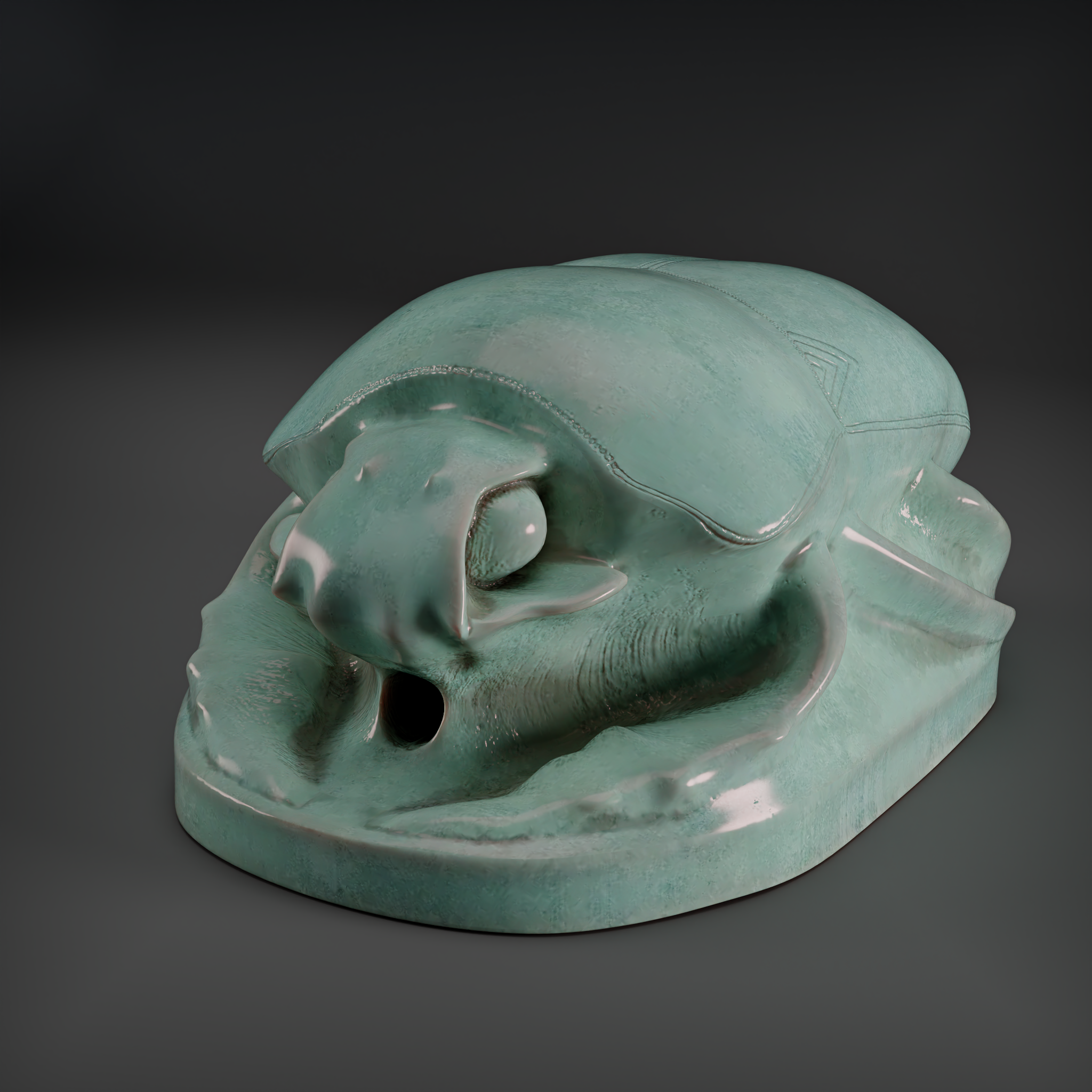
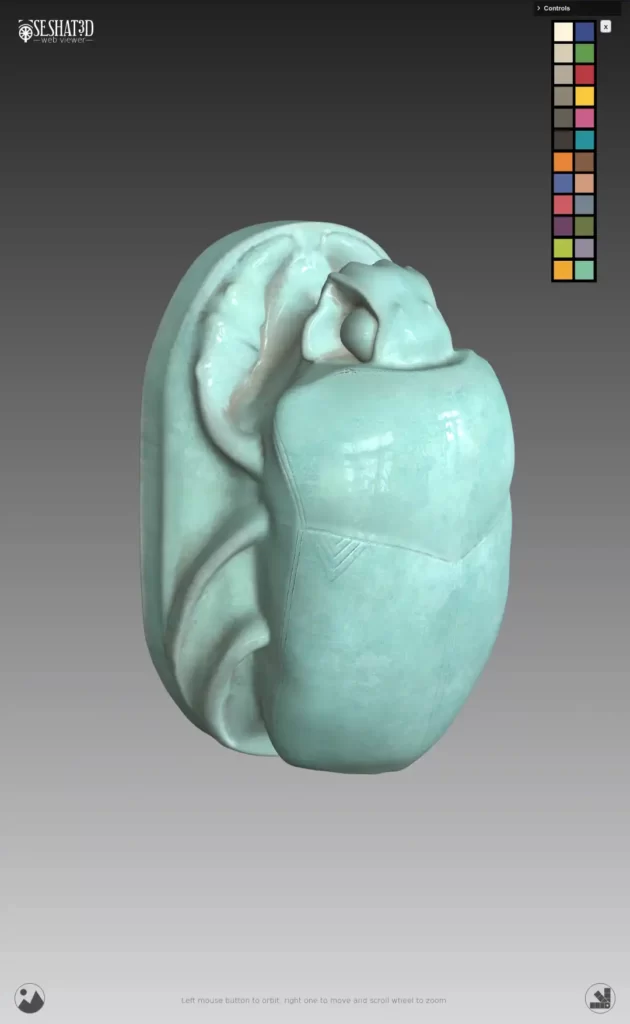
Here is my interpretation of a restored digital version of the scarab.
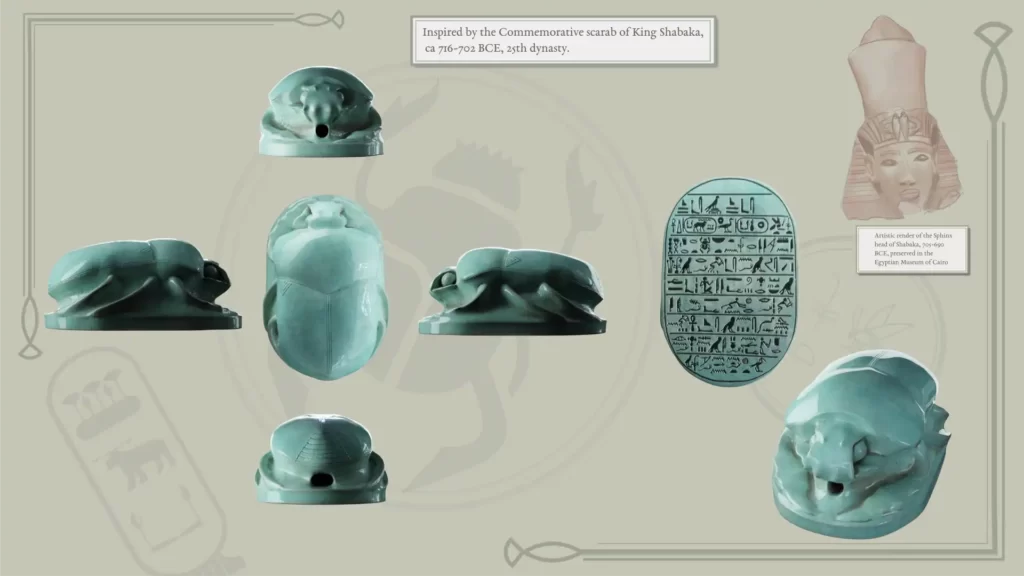
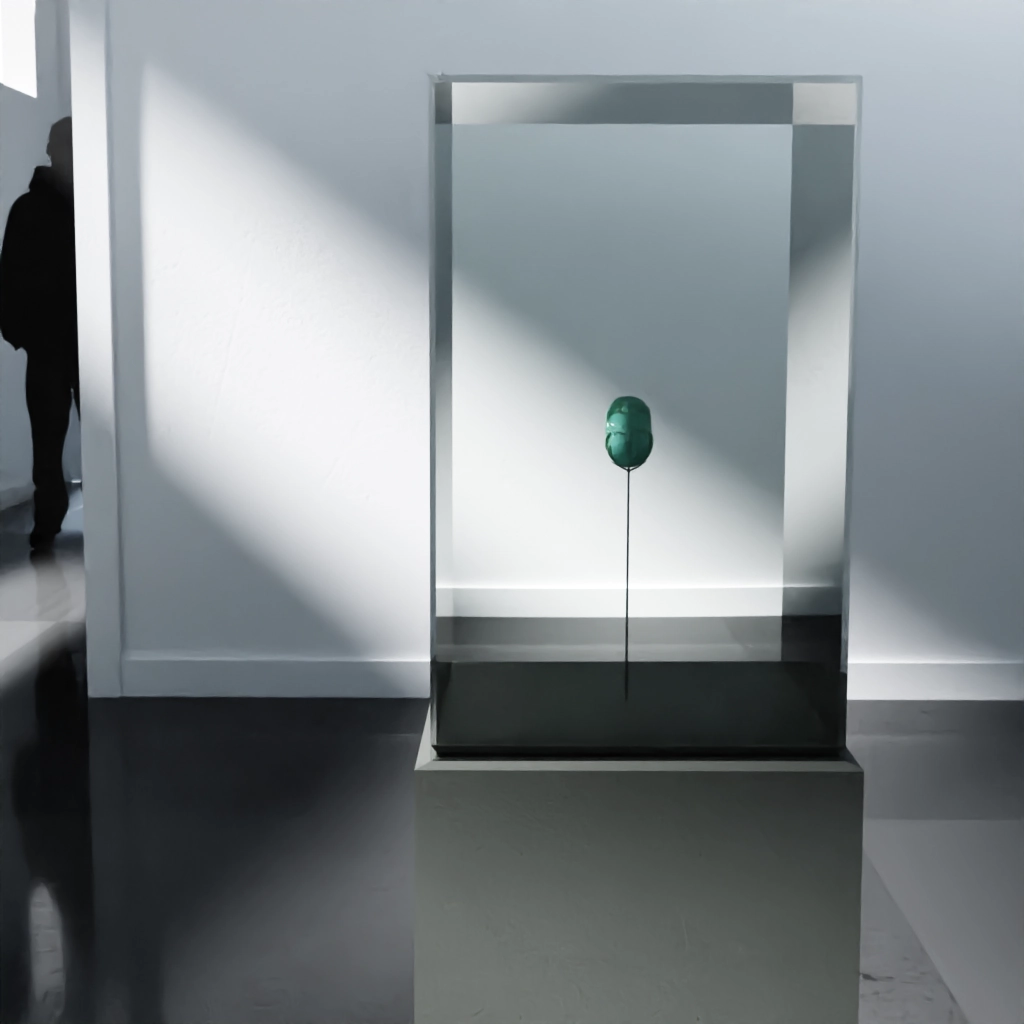
What about putting the digital version in context ?
Interactive rendering
All hands on code
The idea here is to make the model web available using Three.js and my homemade 3D web Viewer, Seshat.
Process
As I have previously exposed the method, I won’t bore you with the details. It’s relatively straightforward. Because I took some time to make sure the epigraphy parts were as crisp as possible, the switch from Blender to Three.js was -almost- seamless. A little cleaning up and tweaking here and there, and we’re done.
Code lines
The following code is an extract from the JSON file, Seshat is using, if any of you would like to see the parameters I used.
"3Dmodel": "./assets/models/shabaka_beetle/shabaka_beetle.glb",
  "meshes" : [

    {
      "name":"shabaka_sculpt_retopo_merged",
      "textures" : {
        "map":"./assets/models/shabaka_beetle/texture/Shabaka_beetle_diff.webp",
        "roughnessMap":"./assets/models/shabaka_beetle/texture/Shabaka_beetle_rough.webp",
        "aoMap": "./assets/models/shabaka_beetle/texture/Shabaka_beetle_norm.webp",
        "normalMap":"./assets/models/shabaka_beetle/texture/Shabaka_beetle_norm.webp",
        "displacementMap": "./assets/models/shabaka_beetle/texture/Shabaka_beetle_disp.webp"


      },
      "values" : {
        "aoMapIntensity" : 0.7,
        "displacementScale": 0.05,
        "normalScale": [0.1, 0.1],

        "envMapIntensity":1,
        "roughness": 1,

        "clearcoatRoughness": 0.2,


        "specularIntensity": 0.3,
        "lightMapIntensity": 8,


        "flatshading": true,
        "needsUpdate" : true,
        "y-flip": false


      },
      "modules" : {
        "side": "FrontSide",
        "envMap": "hdrEquirect",
        "normalScale.set.x":0.2
      }
    }
3D view
Disclaimer : technical limitation to material render in web app can let artefacts and scintillations show, particularly in zoomed views.
This link will get you to the full view (this will open a new tab in your browser).
Cabinet de curiosités
How would you like your own scarab ? Everybody needs a reminder of the cycle of things, I feel.
Also, beetles are cool.
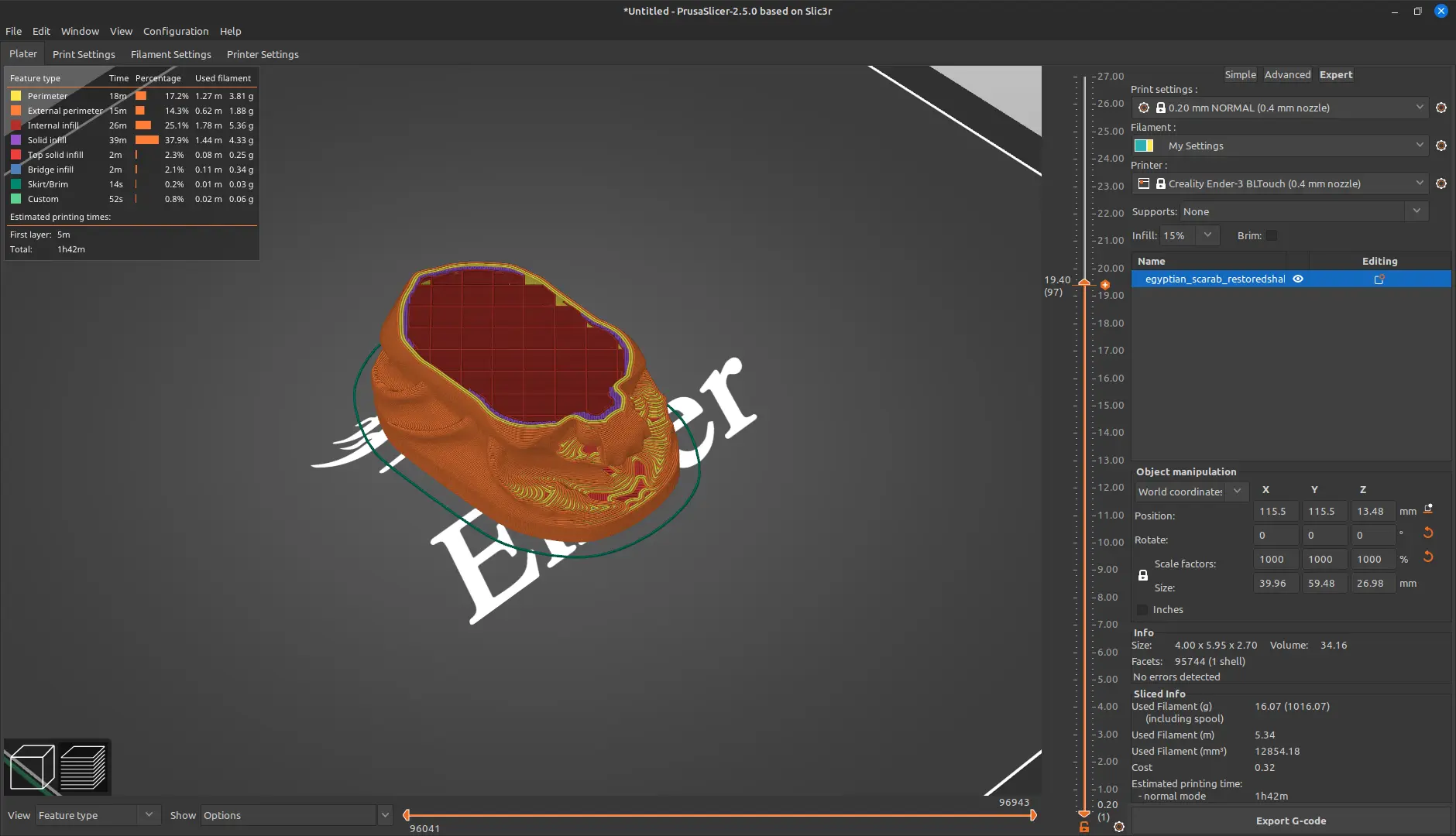
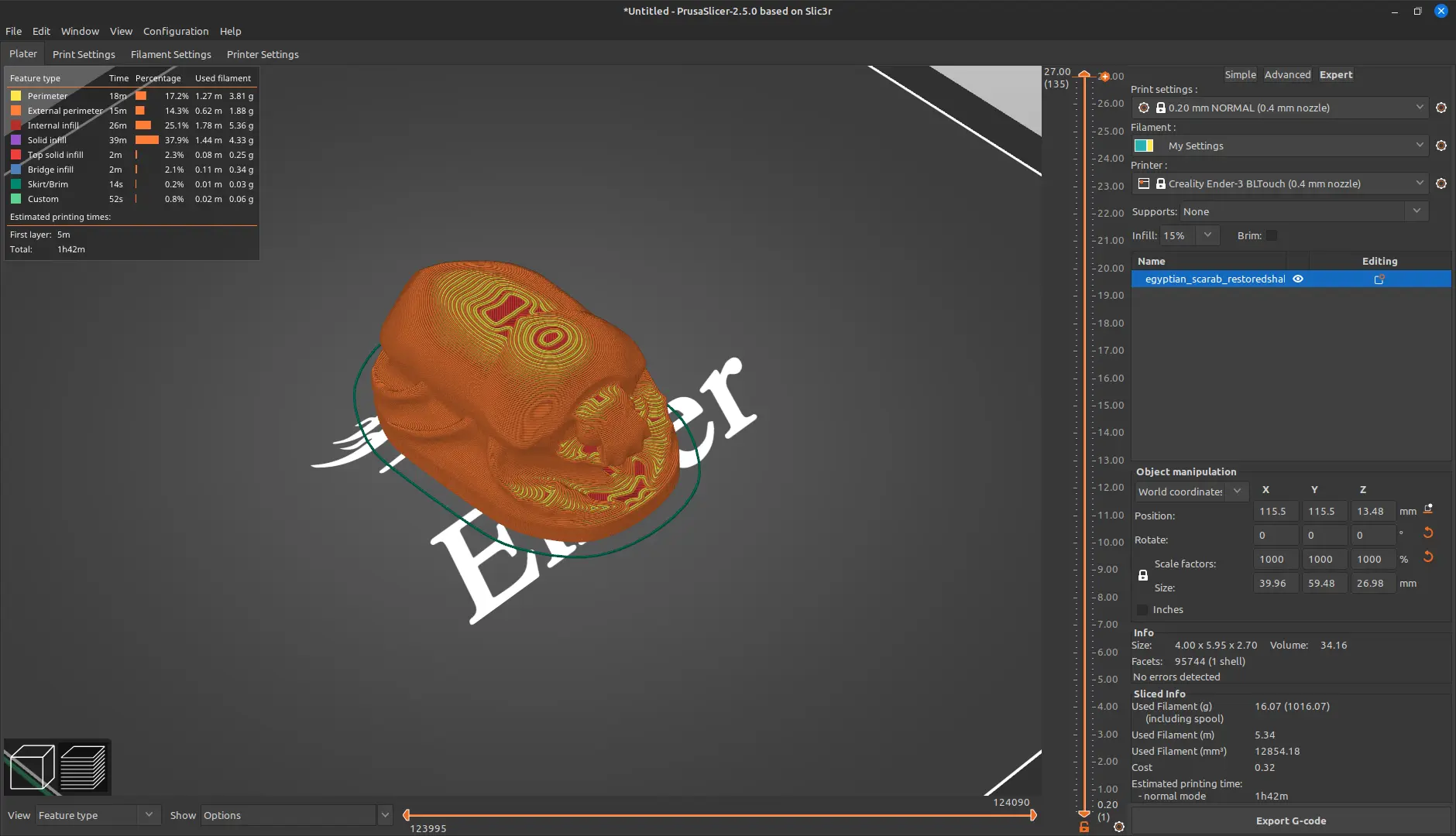
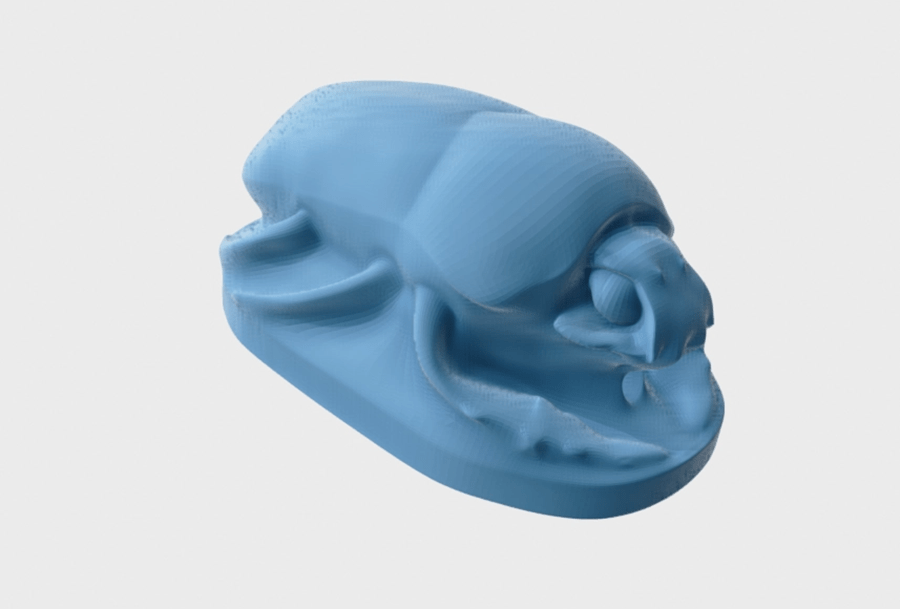
Here’s a link where you can download a 3D printer friendly version of the restored scarab. Note though that it won’t come with the hieroglyphs inscriptions. But maybe you can add your own message !
Credit
Unless otherwise mentioned, all images credit to LGS.