

Driving Rosie
The following texts and images are the results of a training exercise to go from the pictures or the description of an artefact to the creation of a 3D digital double, sometimes restored version of it. If you wish to know more about the process, explanations are in A journey into learning a (3D!) restoration process workflow article.
It seems a mandatory piece for 3D students is to model a variant of a spaceship. I’m not the spaceship type. In order to stay with the transportation theme and, as is my habit, I turned my gaze to more ancient vehicles for inspiration.
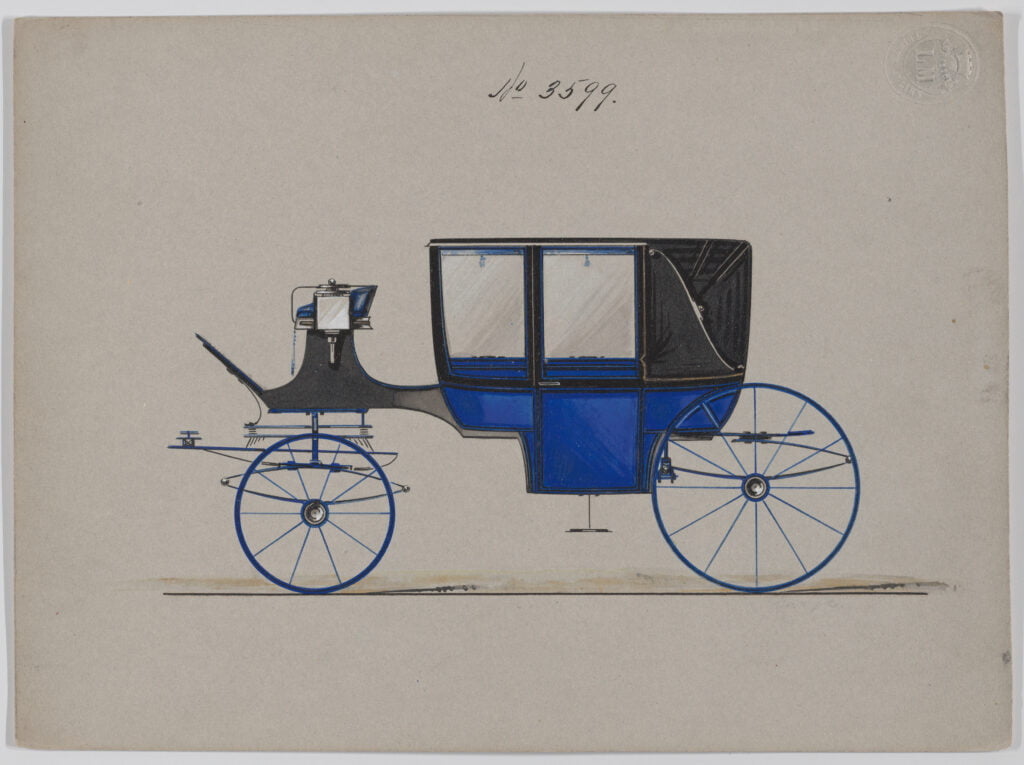
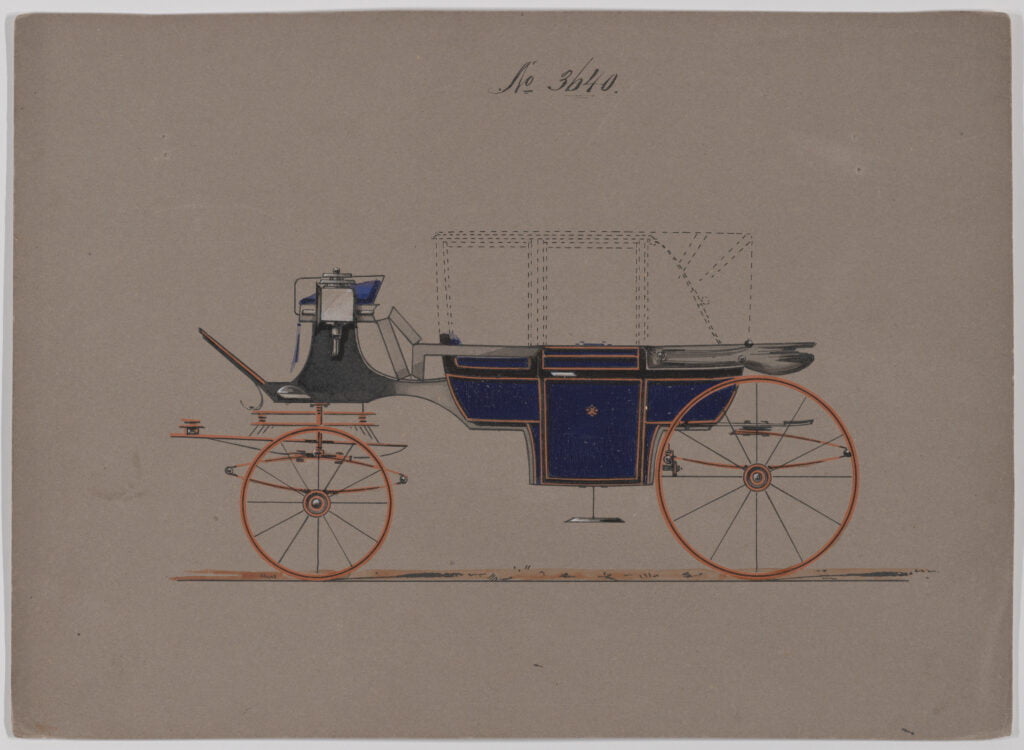
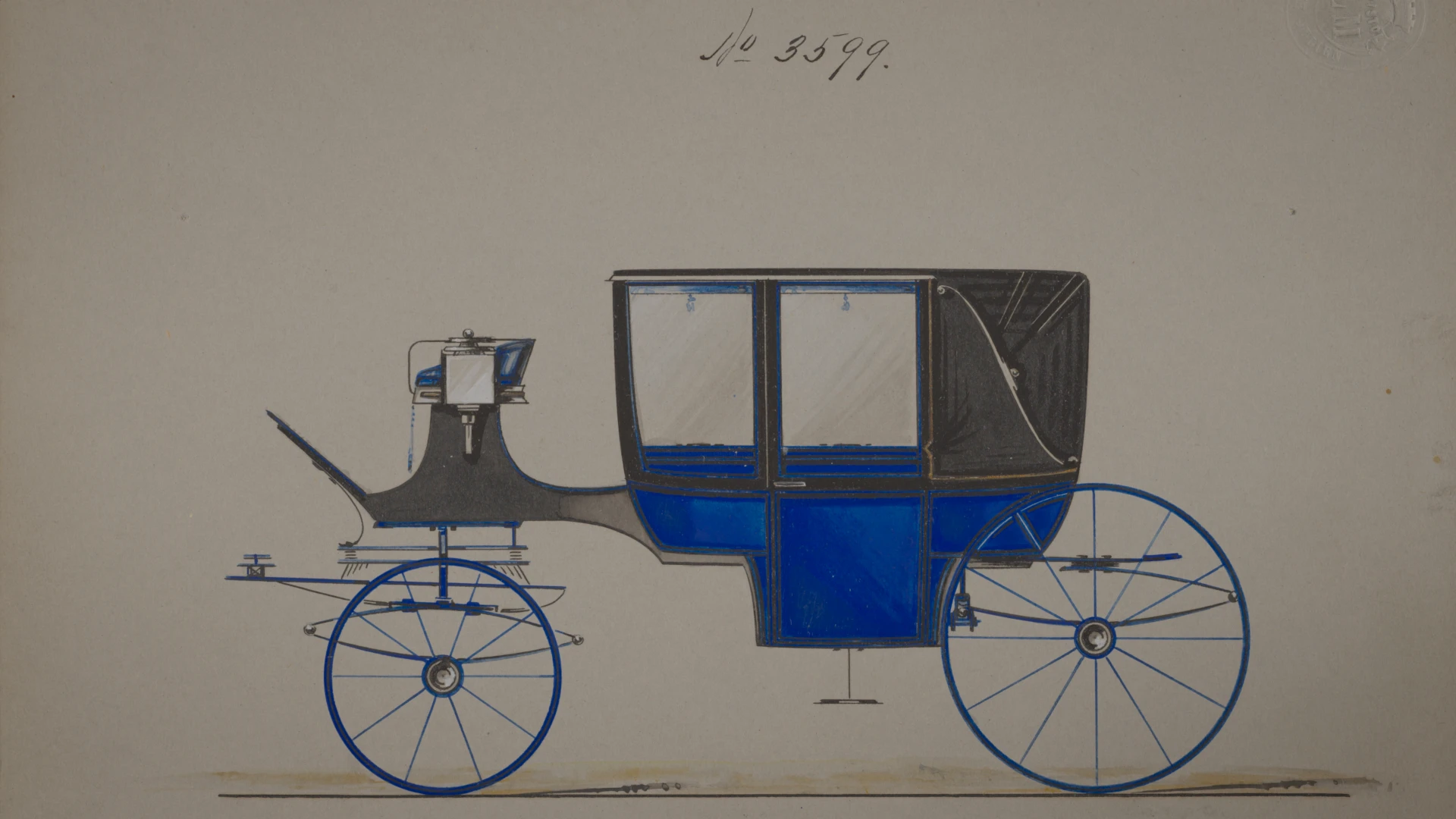
Title: Design for Landau, No. 3599
Datation: 1880
Provenance: Brewster & Co. (American, New York)
Dimensions: 17.3 x 23.5 cm
Media: Pen and black ink, watercolour and gouache with gum arabic
Source image: INV 23.112.116, Metropolitan museum of art
Description and Historical context
Horsepower
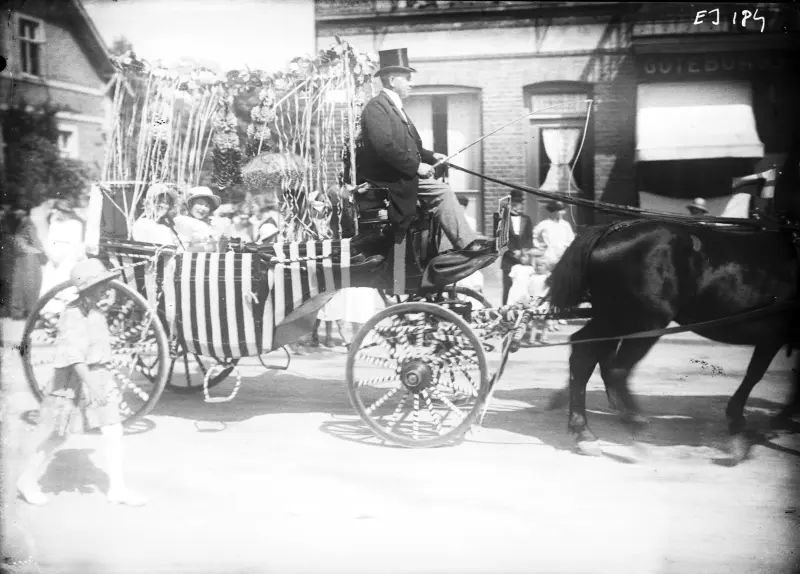
A landau is a “four-wheeled carriage with a roof that can be let down”. We’ve all seen them, at some point, for official ceremonies throughout the world. Some say the only interest of a landau is to be seen inside. Its low shell allows for a full view of its occupants when the roof is fully let down.
The type is supposed to have been invented around the 18th century. Its name comes from the German city where they were first produced.
It has seen numerous variants and numerous technical progress. It is a part of the prolific carriage industry that gave us, well, most of the luxury brands of today that began as saddle and leather goods makers. It is also where the metallurgic industry found one of its biggest market, pre-cursor to the automotive one.
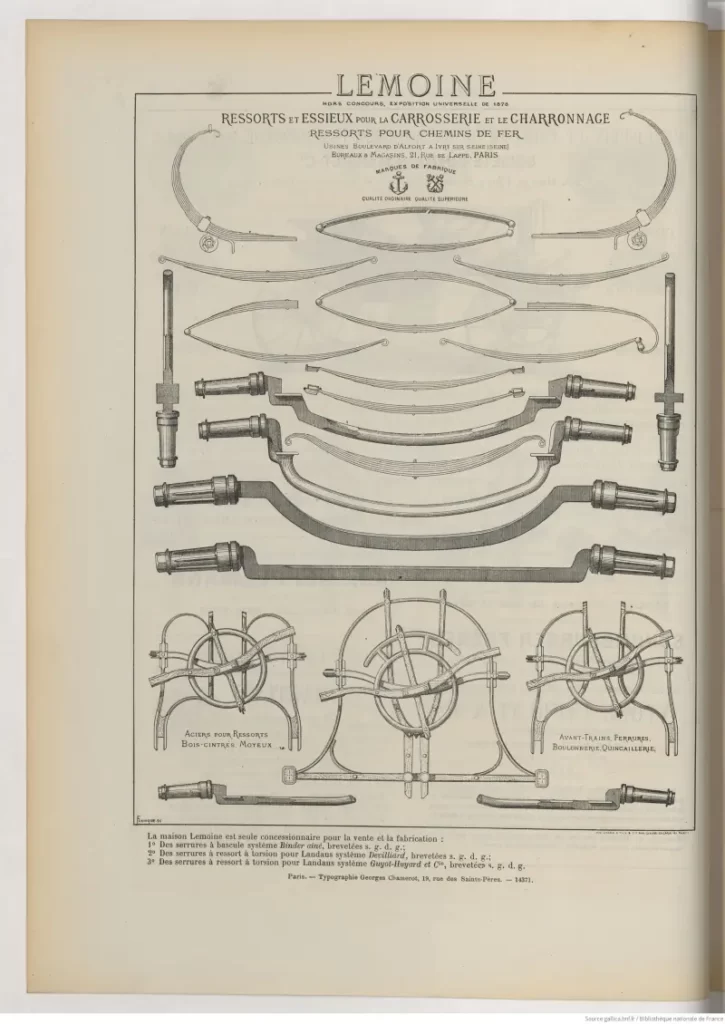
Their shape is more or less always the same, light structures on elliptical springs.
It seems the number of horses that draw these vehicles and the method use to harness them depends more on trends or showmanship than anything else. They are supposedly very light carriages: passed the commonly acknowledge two animals’ load bearing power, it’s all for the social status of the owner.
That is also why landaus are interesting. They allowed a wealthy upper-middle class to show off its newfound economic power in the 19th century and paved the way to the automobile industry. All the colours and variants are available. No glass, three-glass, five-glass ? The limit is your budget.
The only rule is: do not overshadow the occupants! It would be sad to be eclipsed by one’s vehicle.
The Brewster company
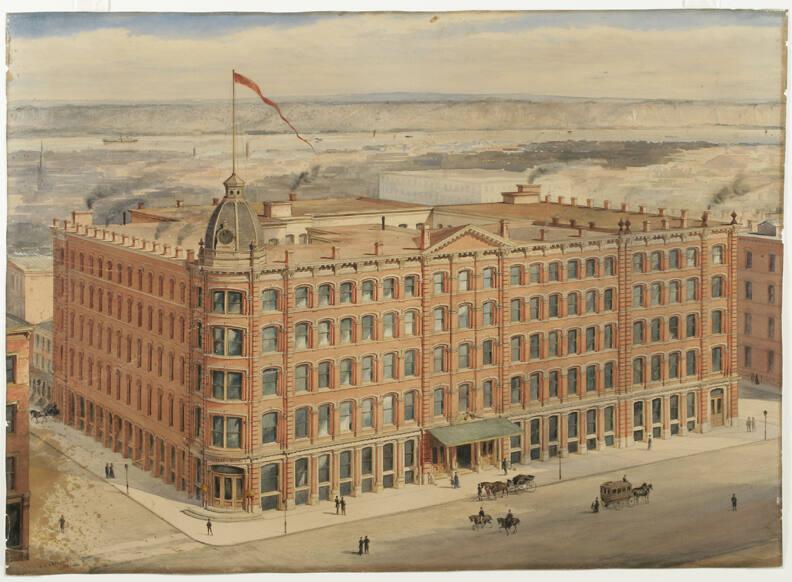
The Brewster and Company was a carriage and coach builder company established in 1810 and officially defunct in 1937. It was a renown maker in the United States, and some of its production is easily found throughout collections all over the globe. In 1838, the company adopted the slogan “For the American gentlemen”.
The company moved from being a hippo-mobile production factory to being a luxury automobile bodywork shop on European chassis, the bigger parts of its assets eventually being bought by Rolls-Royce America Inc around 1925.
The piece we are working on today dates a little while after the company was awarded numerous prizes at the 1878 Paris world fair.
The drawing is part of a full portfolio donated by the last owner of the Brewster company, William Brewster. Sadly, I was not able to find a preserved landau in existence of this particular model.
Visible condition report?
Confession time: I choose this drawing because I like the colour. Yes. Yes, I’m that person.
But because I’m also the person that will model it, I’m sure, dear reader, that you will give me a little leeway.
We are back to our old conundrum: how to model something that does not exist ? Or, more so, that doesn’t exist any more. Good news: we have numerous examples to draw from.
There is a caveat here too: the reference image seems more an “artistic render” than a precise one. Chances are, there might be modifications to create a realistic model.
The main issue, for me, is to be able to understand the mechanics and the way the horses are linked to it. Fun fact: I have absolutely no idea how it all works, and never took any horseback riding lessons.
First, the easy-ish part: the carriage itself.
I must say, I was a little scared by this whole universe of knowledge I never knew existed that suddenly opened in front of me. The hippo mobile world is dense, full of intense technical principles and no less intense authors.
Thankfully, it is the work of a conservator from the Henry Ford that helped me take my first steps, starting with the always important “how on Earth are all these parts called”.
Source: The Care and Preservation of Horse-Drawn Vehicles, by Ellen Seidell, The Henry Ford, Benson Ford Research Center
The final and decisive help has been this life-saving écorché, found on a very knowledgeable website dedicated to the hippo-mobile industry.
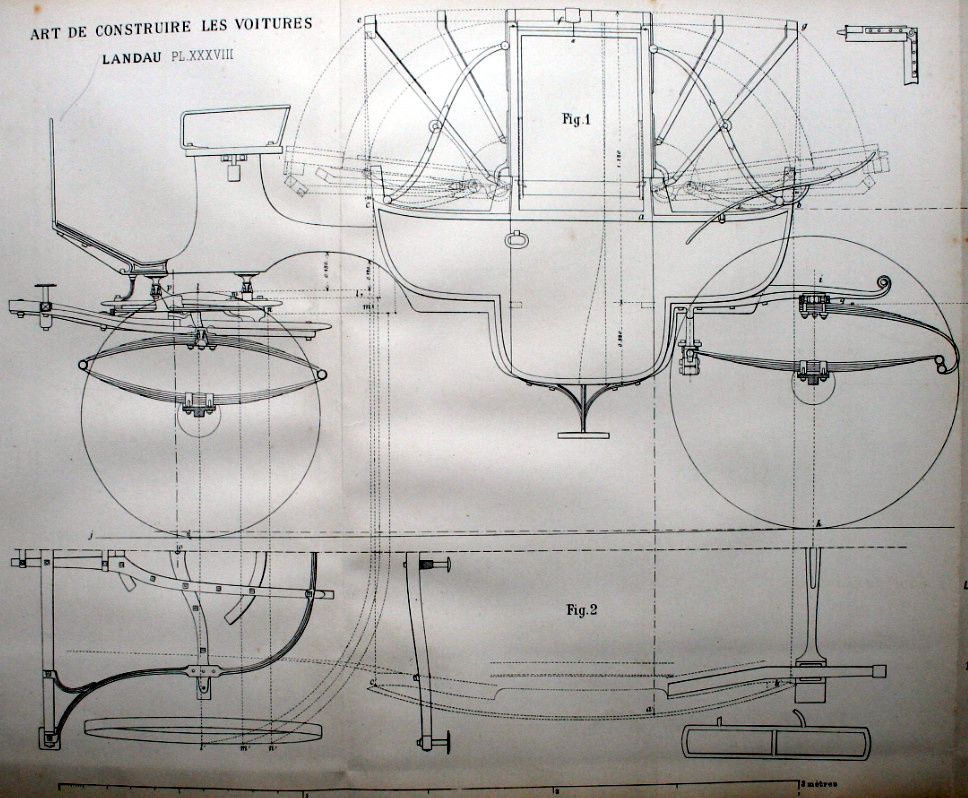
Then, the not so easy-part: the reins and horse-related elements
Dear reader, if you never wondered about your life choices, let me introduce you to the “wonderful ” world of enrenement attelage and horse tacking.
Let me regale you with an extract from my personal notes on the subject:
“…enrenement attelage = driving horses harness diagram.
There can be a yoke between the horses, probably joined in the middle of the cart ? I’ve been informed it is called a pole for fancy carts. Because of reasons. The yoke is the wood piece perpendicular to the horse / animal pulling the cart. On fancy carts, the pole seems to be linked to the breast collars to balance the weight between the horses. I have no idea what’s considered fancy…
And so on and so forth.
I did look for answers, but it seems specialists are as approachable as C developers and almost as prickly. I was on the verge of giving up and trying my hand at a spaceship when the New Zealand Digital Library came to my rescue. Librarians rock, and you won’t change my mind.
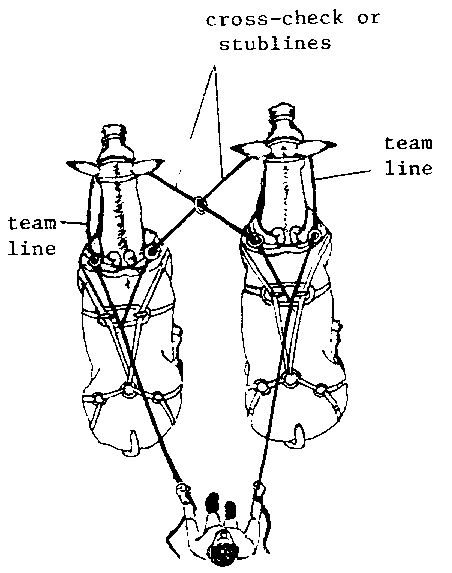
Now, don’t you start telling me “it’s not the way landaus are done”! And when you do, please be extra gentle and kind. I’m still sore.
Because I now have a visual reference that makes sense, I’m keeping it and moving forward. You can go and read the actual written description but, fair warning, your head will hurt.
Creating a 3D model of the piece: a reconstitution process
Disclaimer : this is an exercise, shown for documentation purposes only
Model the shapes: this is a group effort !
To roof or not to roof ?
Because the research part dug up very precise information, the modelling of the carriage itself was greatly facilitated.
I now think I understand the spaceship exercise. It’s not the shape, per se, but maybe the volume and number of pieces that counts ? A strict organization and rigorous naming is paramount, otherwise one gets lost very easily.
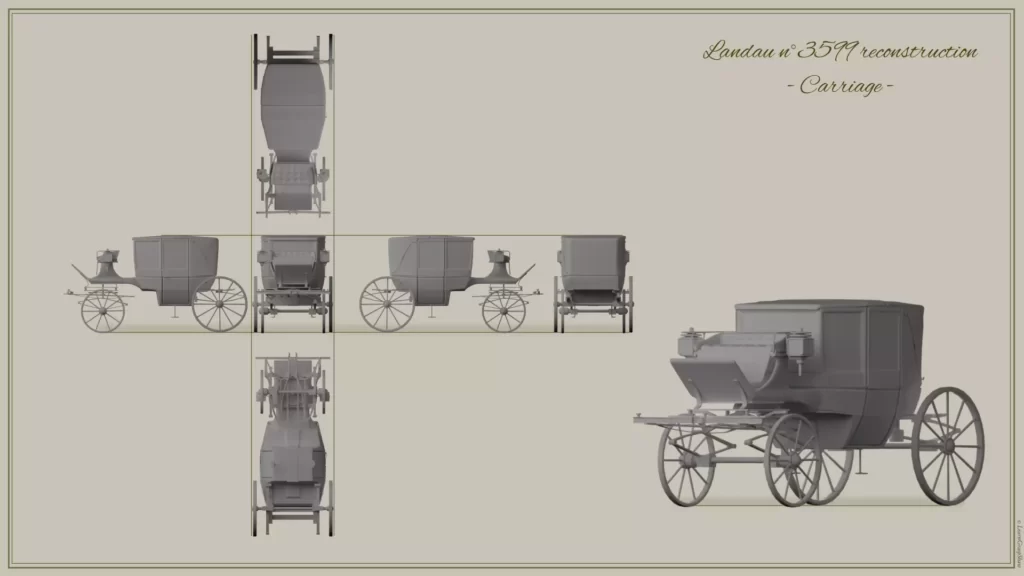
For me, the perfect example of this was the “what about the roof” part. The very essence of a landau is to be able to have a roofless carriage. There are between 11 to 15 parts to consider moving then. That means a lot of roof to carriage ratios conformations are available ! The best idea to be able to render that correctly was to animate it all. I even thought it would be the perfect opportunity to try inverse kinematics animation with something else than limbs. In my naive minds, it would have allowed me to fold and unfold the roof at will.
I just did not take into account that the only “movable” part was the very back of the roof. The rest is eventually removed and stored under the coachman seat.
I stopped there my try-outs: turns out folding the soft leather-like roof neatly and “naturally” became a tedious nightmare. Shape keys, FK, cloth: I think I tried almost everything I could get my hands on. Still, I didn’t think it was good enough. So I did the only decent thing to do. I scrapped it all and started over with a very simple modelled folded roof. Sadly, there will be no in-betweens for this project, for now.
Note on the fully opened shape:
My researches did not allow me to decidedly know how this particular model’s roof was to be folded. I found different ways to do so, and I’m not sure what would have been the effective one. On some drawings, the front roof is folded behind, but the panelling is shaped differently. On our model, it is unclear, then, what parts remained,if any, while opening and what parts were taken out.
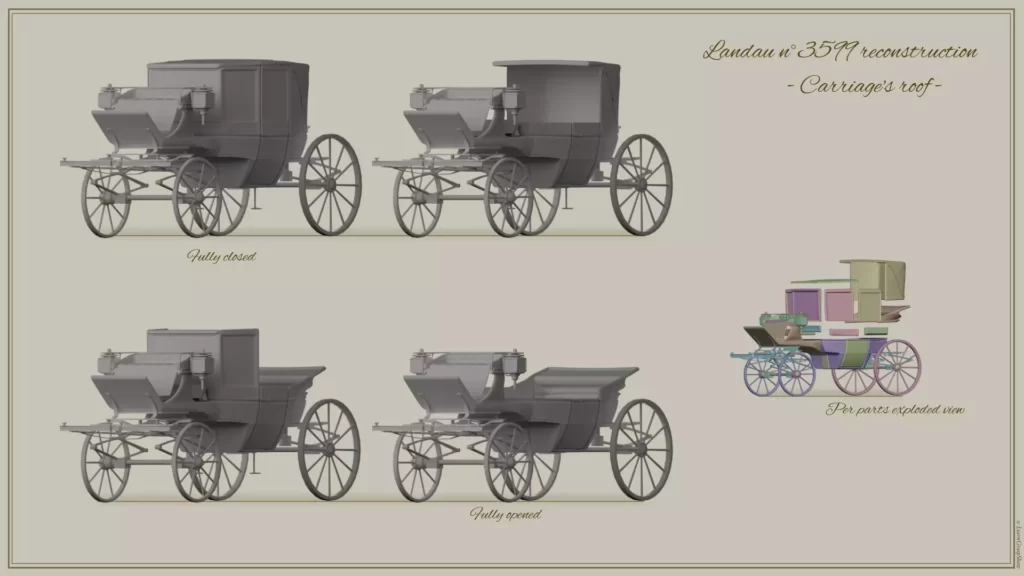
Understated elegance, they said.
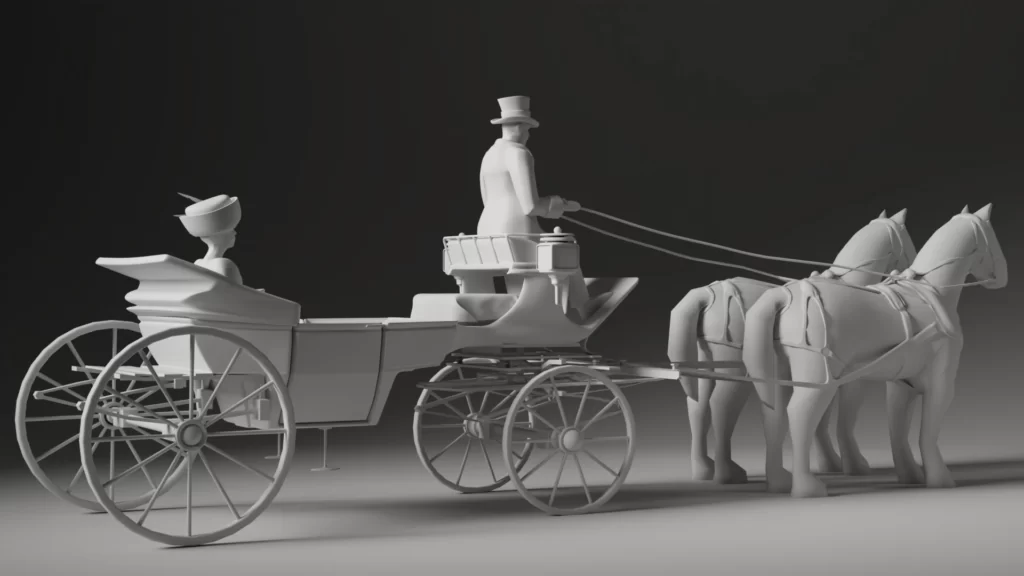
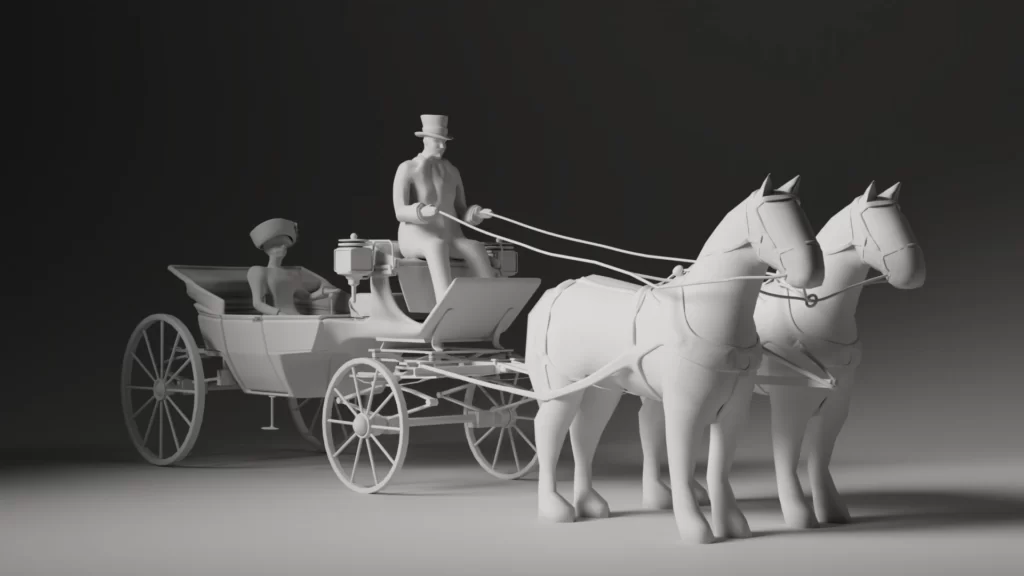
The model on its own is nice, but it lacks some sort of scale and a context reference. Such a carriage was always intended to be pulled by horses under the supervision of a coachman.
I don’t want these addenda to distract too much from the overall landau design of the reference. Therefore, I think they must stay in a low poly-ish state.
Horses and reins
As it seems that above two animals, the ratio of horses to cart is definitely in bling territory/ Let’s remain elegant and settle for the minimum.
I must also remember the tacking system that is needed to drive the carriage. Because the horses are linked to it, it seems reasonable to try to model them together.
…
…
Or at least to try to.
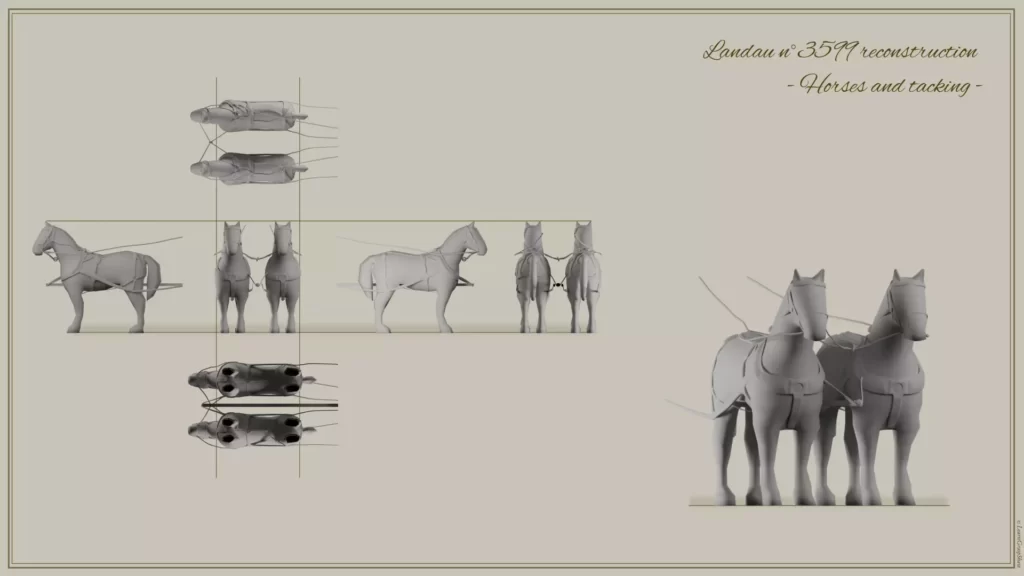
Fun fact, I think I like chunky horses. No psychotic looking arabian horses for me, give me some peaceful percherons anytime !
Besides, carriages are pulled by draft horses. This has a scale consequence for our model. From what I could see on carriages images such as the landau, the top of the horses head held high seems to be almost as high as the closed roof.
I checked and double checked because it makes for huge horses in regards to the cart itself and that initally threw me off. It seems so out of balance ! I shouldn’t be suprised: after all, they have to pull something heavy. Once the motion is acquired the wheels do most of the work yet the initial moment needs a hefty pull. The more you know.
I am not a specialist in the equestrian arts to say the least. All the informations I gathered are from readings and informations found online for this project. If I did miss something, please, gentle reader, let me know !
It’s a human affair
Now, we have a cart, horses but we still need a coachman. Once the scale part was settled, the main issue I had with this figure is to try and make his low-poly hat fit in with the era. Do you have any idea how twisted the top hat history is ? And that size matters but only in regards to your social class, from the “stovepipe” to the “chimney pot” ? Our poor coachman has had a series of hats, from the smaller to the definitely too tall ! You’ll notice he’s not really holding the reins. This is just a visual aid to understand the landau’s working, the details don’t need to be precise.
While we’re at it, how about a little more human presence ? We need a passenger. Let’s make it the wealthy owner of the cart. A respectable lady, widow of a whatever small “tycoon” of the time, on a morning errand in town where she will probably meet old aquaintances from her cabaret years. She’s called Rosalind but her friends call her Rosie. Take that for a back story ! Too far ? Probably. But that allows us to give the lady a most magnificent hat.
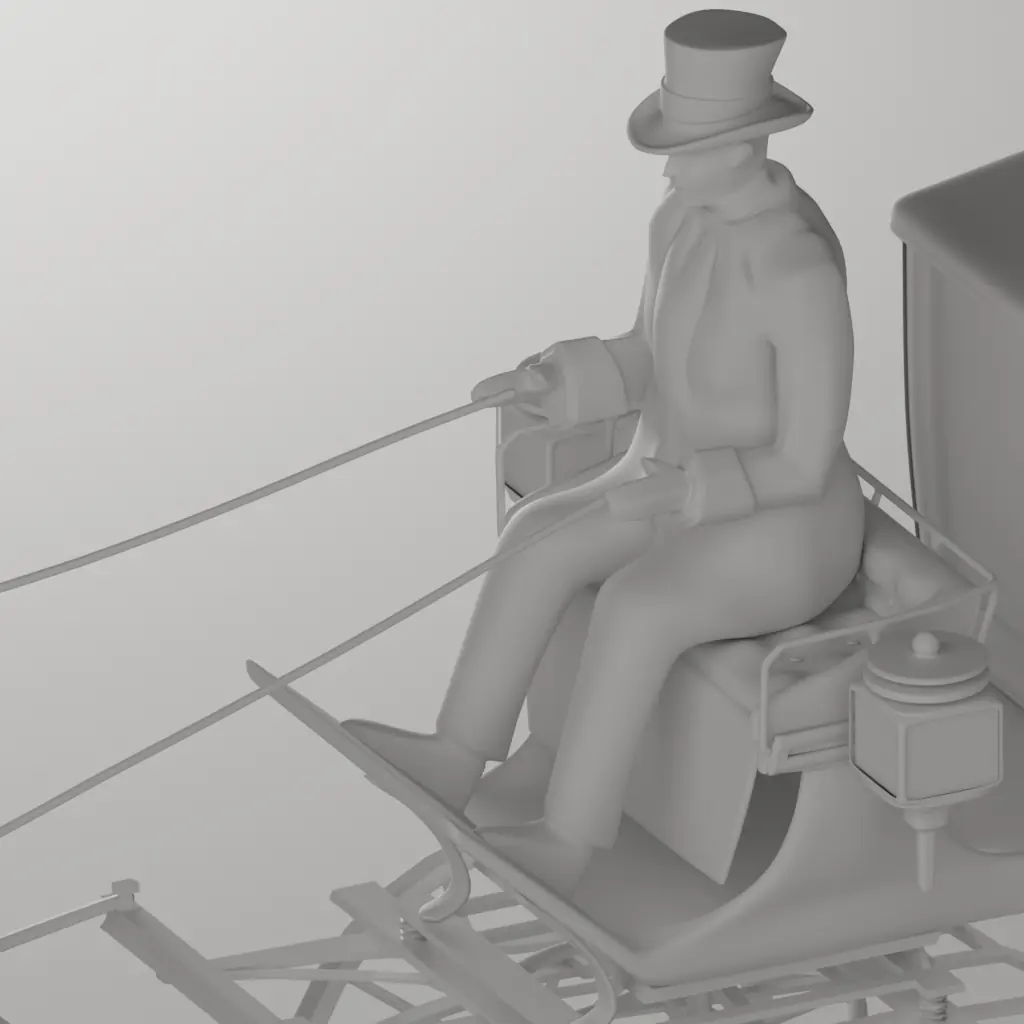
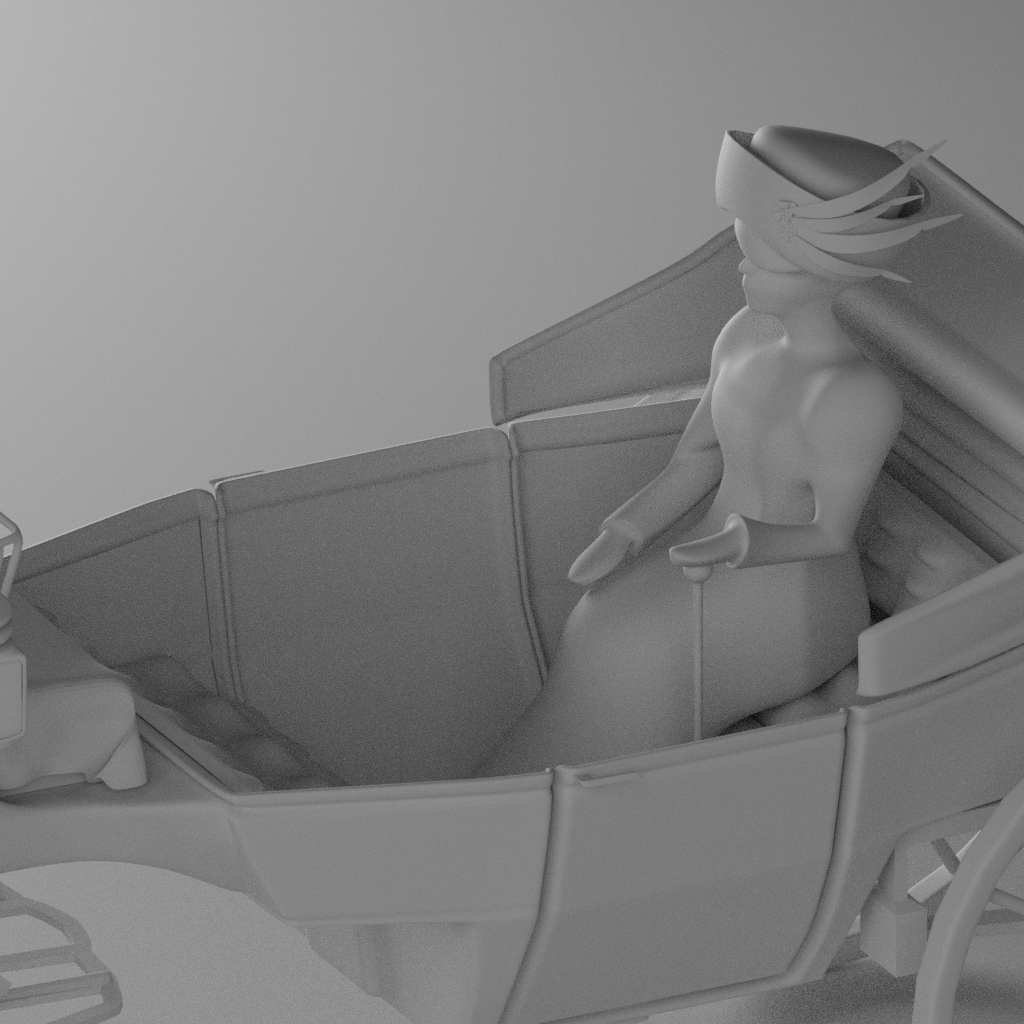
All together, this is where we’re at so far.
Texture the shapes
UV-geddon
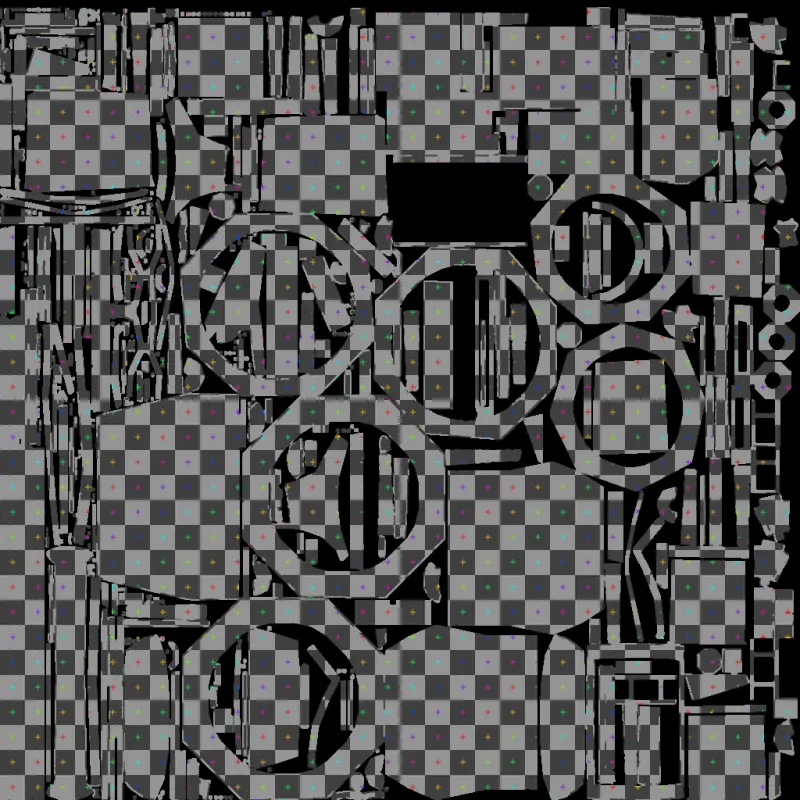
Before I proceed to the texturing part of the project, I need to make sure the UVs are clean. Or as clean as they can be. This is a complex project in the number of elements it has and I chose to unwrap as I go. I know ! I was amazed as well ! Even then, there had to be a few back and forth with Substance painter in order to make sure everything worked as it should. There are still a few cuts I’m uncertain about.
The bottom line is I had to use UDIM tiles in order to have a decent amount of details. I tried to make the most of it and limit the texture maps size in order to ultimately have a game friendly version.
Because this is a practice exercise, I wanted an object to try the Unreal Engine environment, it made sense to use this method.
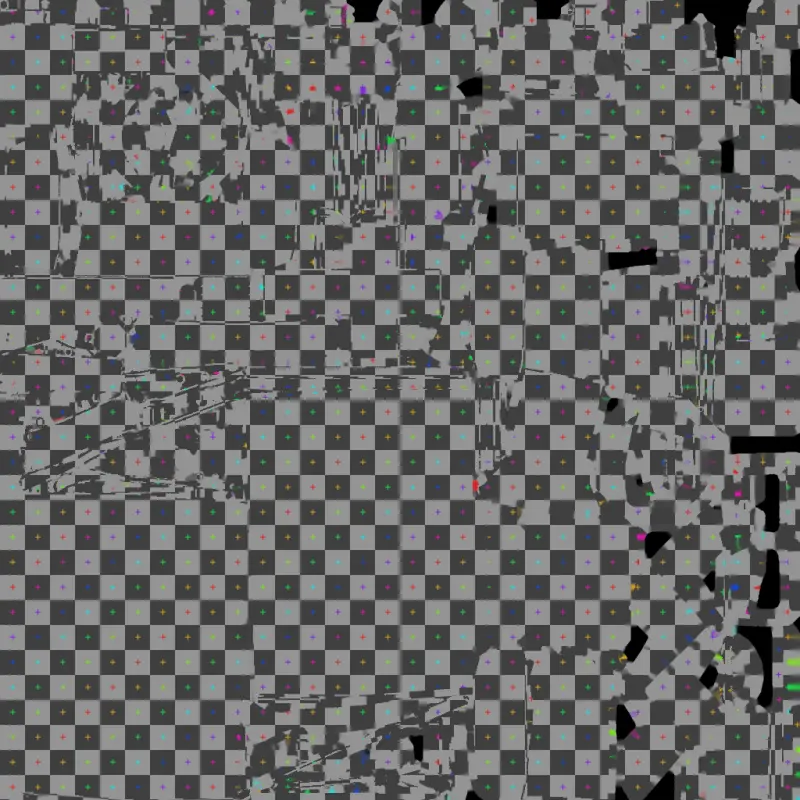
Three.js, the javascript 3D library I based my viewer on is not allowing that method yet. So, I have to also prepare a different UV map, on a single tile this time.
Let’s just say it’s all pretty cramped in there and that’s just for the carriage part alone !
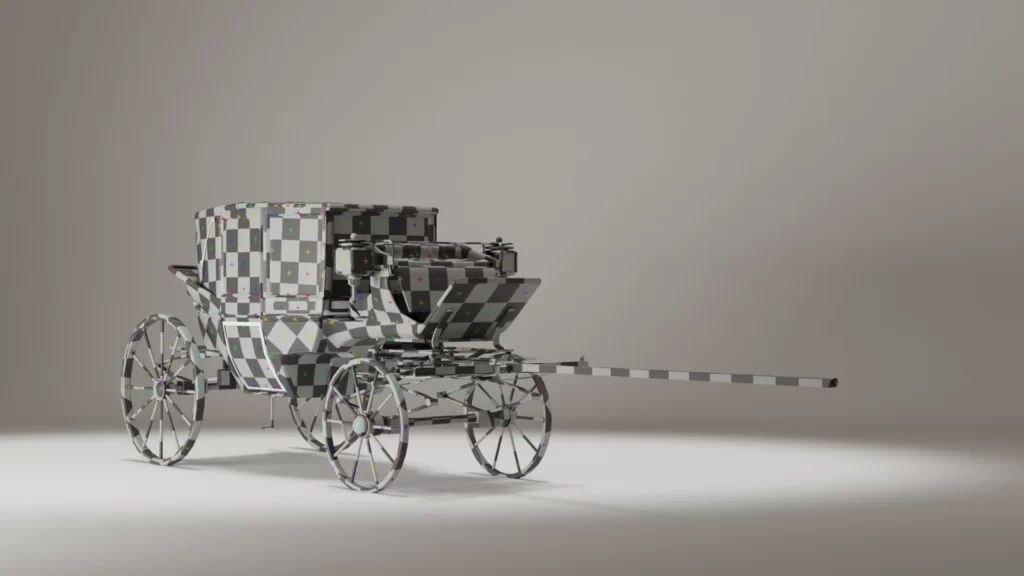
Texture-a-palooza
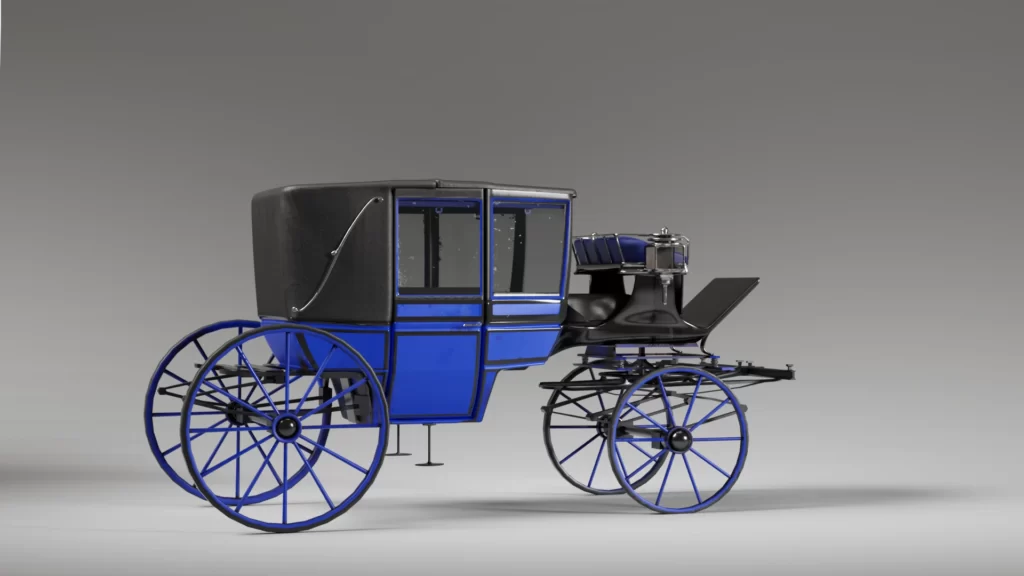
I won’t bore you with the details of the painting process for the carriage. There were quite a few materials and my main concern was to pinpoint the artistic direction to remain consistent in the creation process.
Because I have two different UV maps, I decided to create two different textures for this piece. One realistic yet sort of toy-like because that’s what the image I get when I look at the reference (don’t ask, probably some unresolved trauma). Another one inspired by the gouache like effect of the reference image, to be used only in the web-viewer.
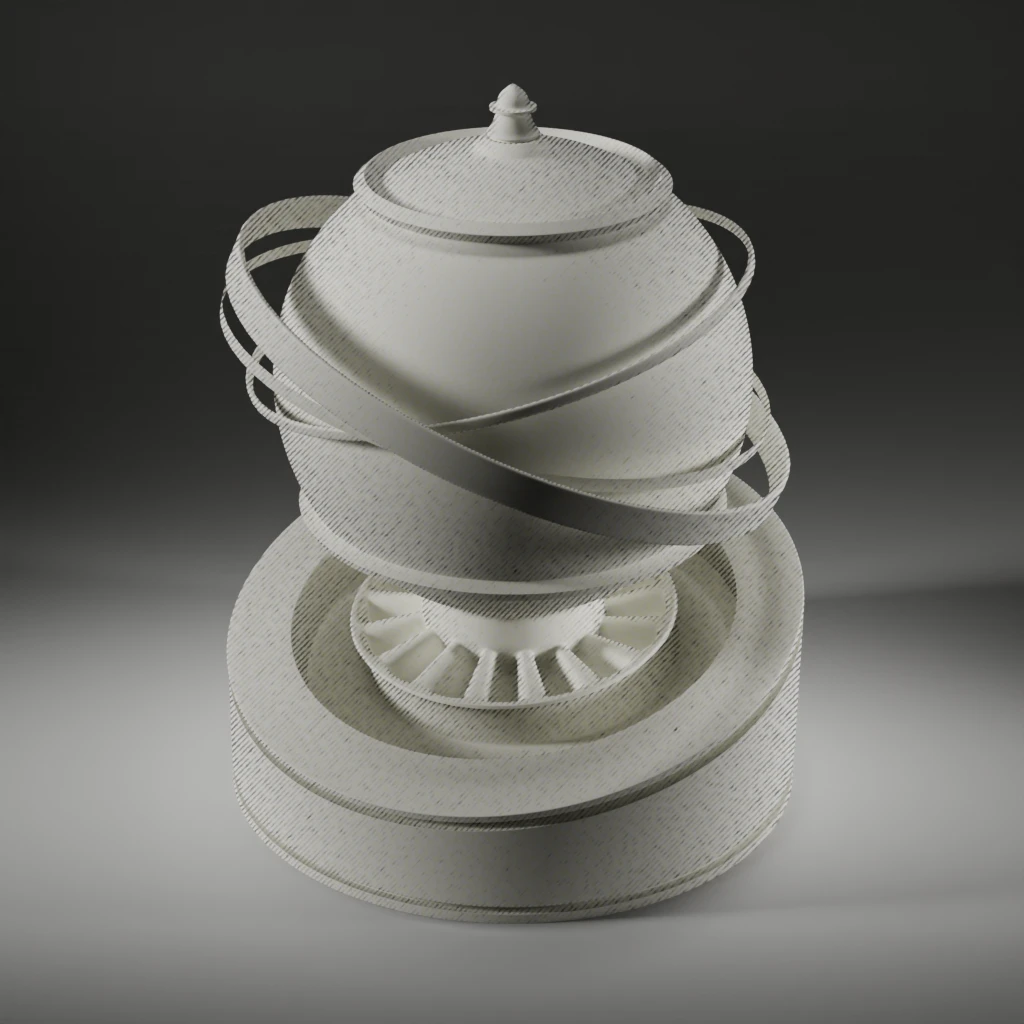
For the context elements, namely the horses, tacking and humans, I tried my hand at a discrete hatching texture to mimic the original drawing.
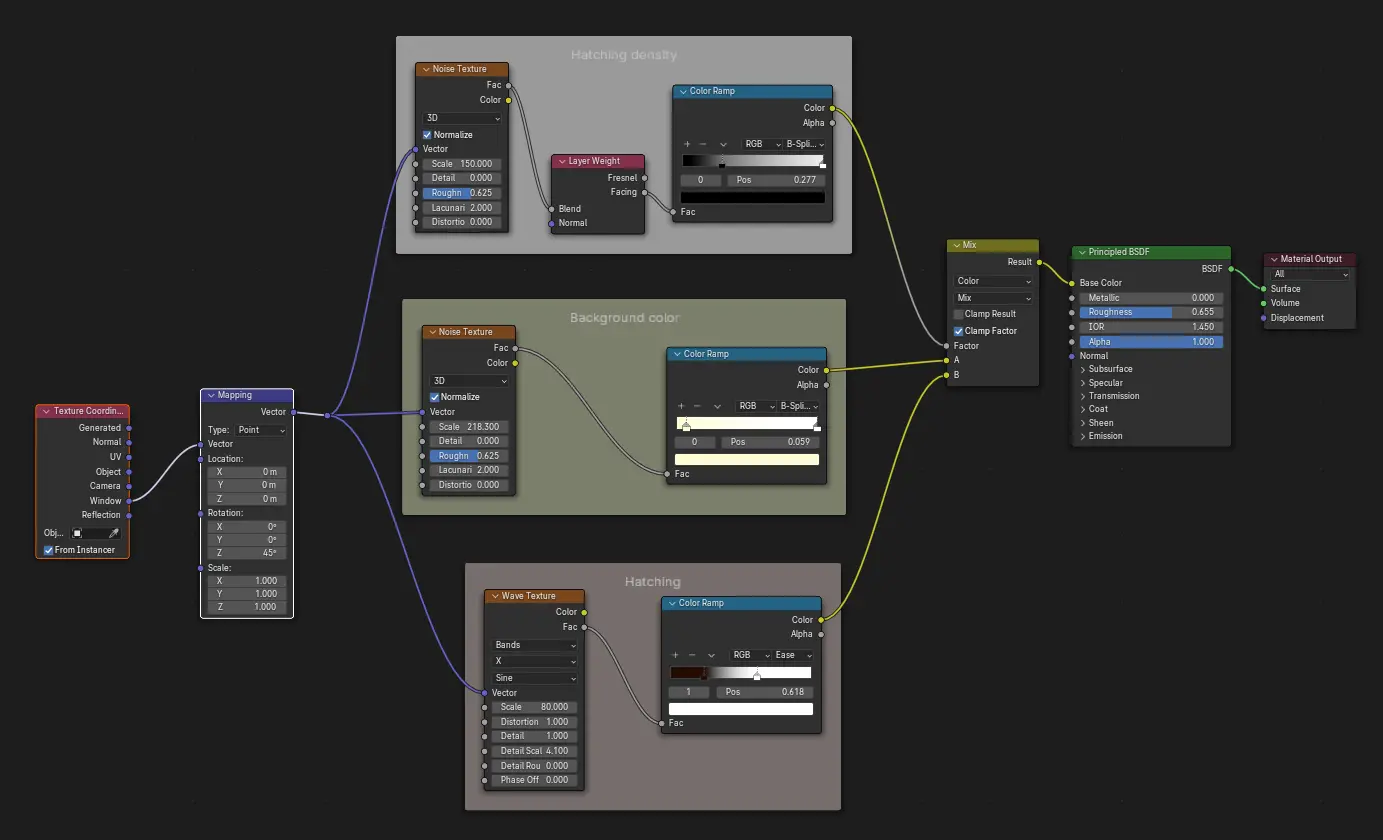
This give a decent enough material that will just suggest the hatching material while being visually discreet and not distract from the subject.
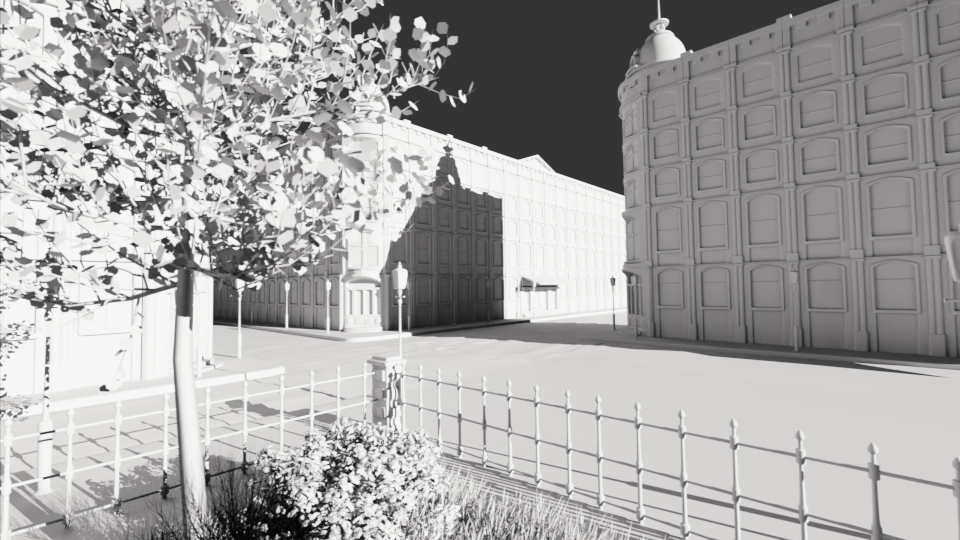
We may need a background.
As I toyed with the final scene shot, I noticed the neutral gray background was not the greatest. Something more in line with the hatching texture may be more interesting. The problem is: a flat surface is still not very interesting in that endeavour.
What can we do then ?
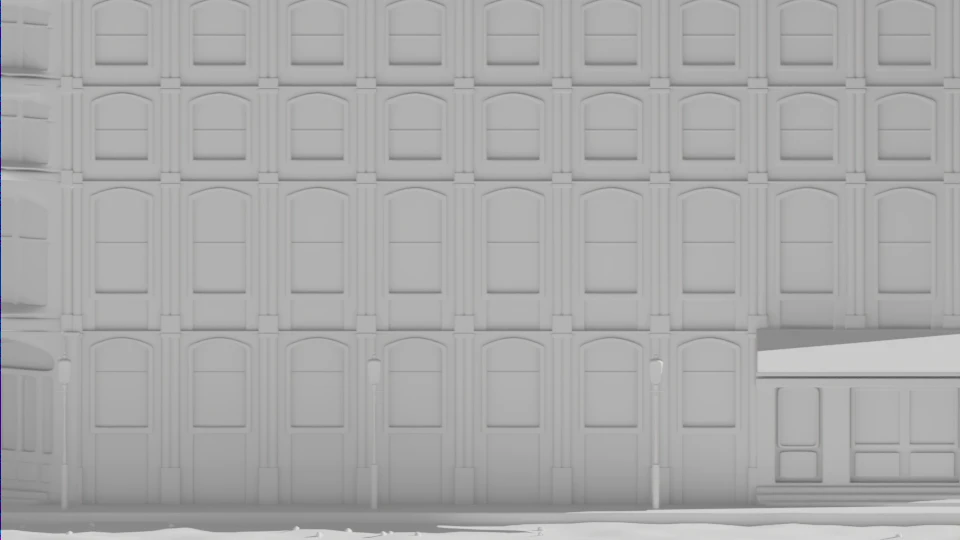
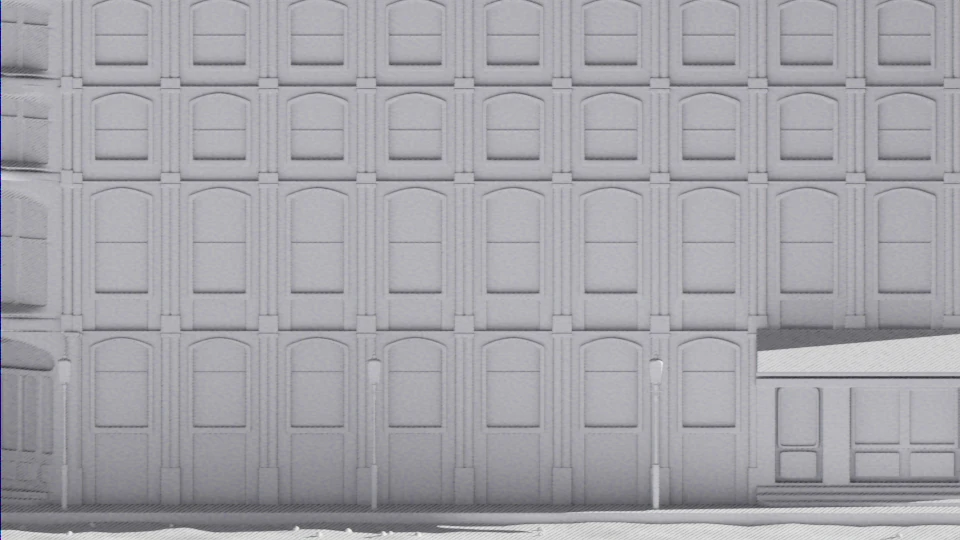
Remember the Brewster’s factory building from the beginning ? Isn’t there something that could be done with it ? As if the model was just out of the workshops ?
A little modeling time later, we have this lovely background.
Shine a little light: stills renders using blender
The statistics of the scene are (with subdivision surfavce on): Verts:345345 | Faces:340682 | Tris:681380
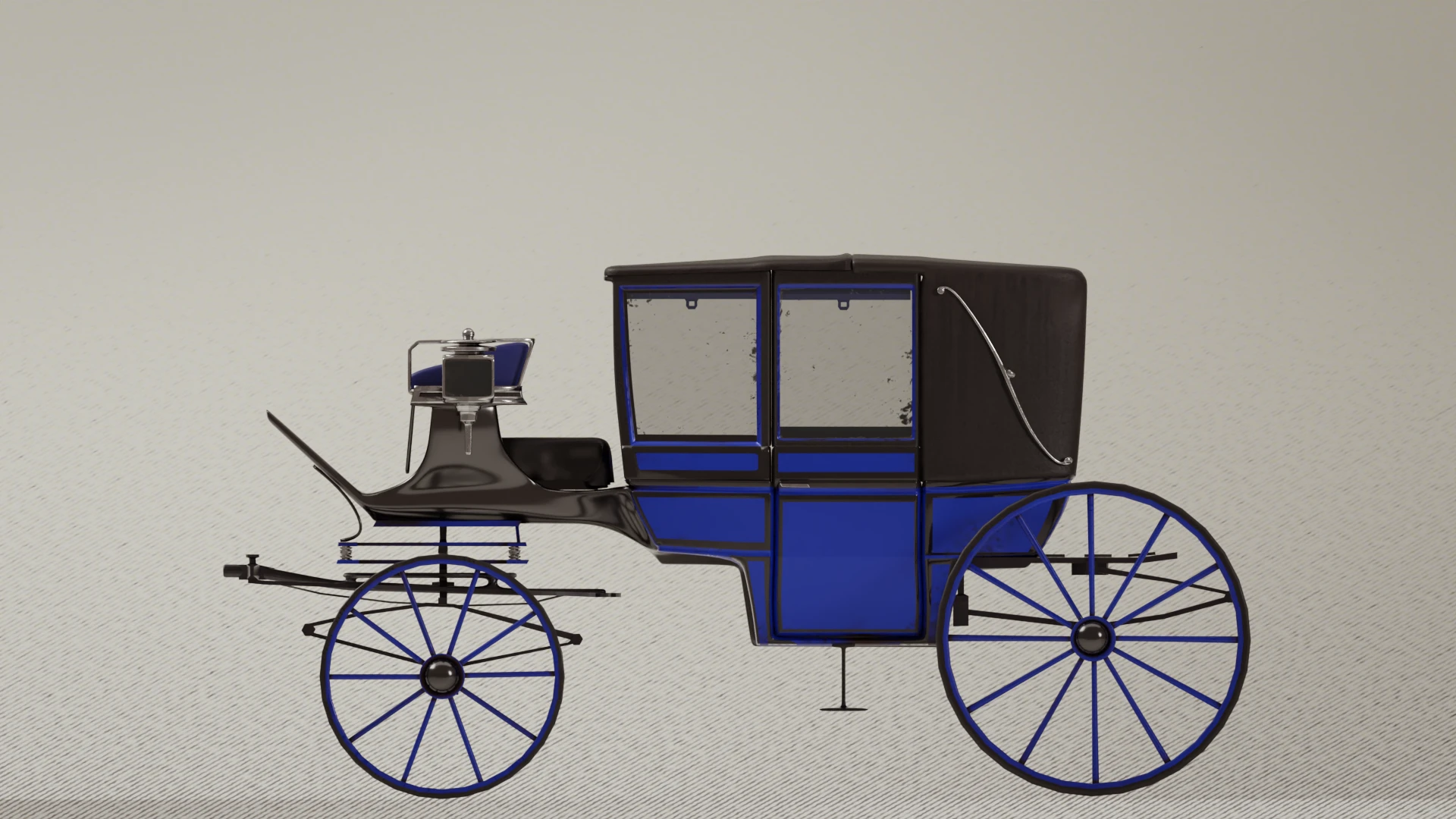
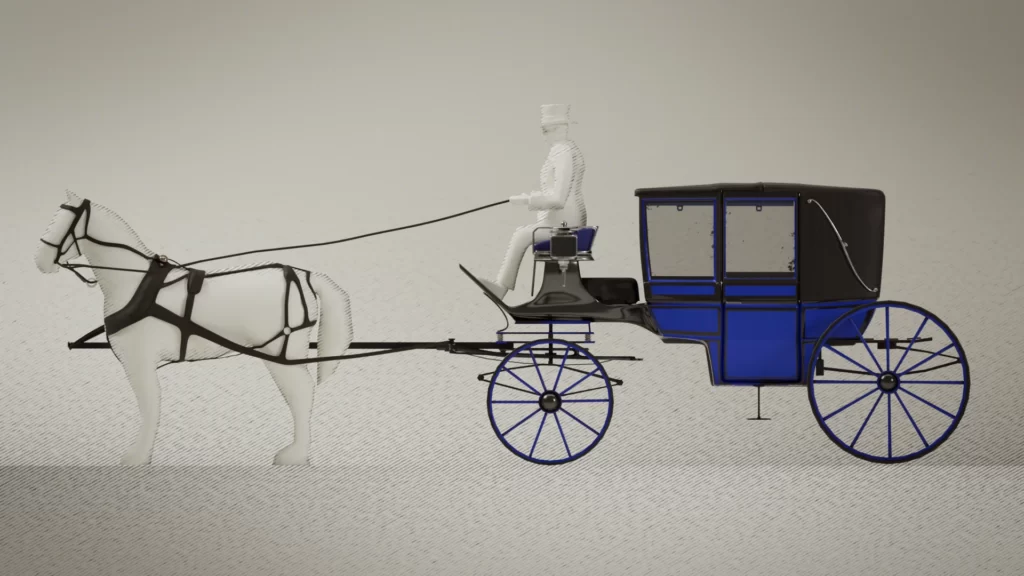
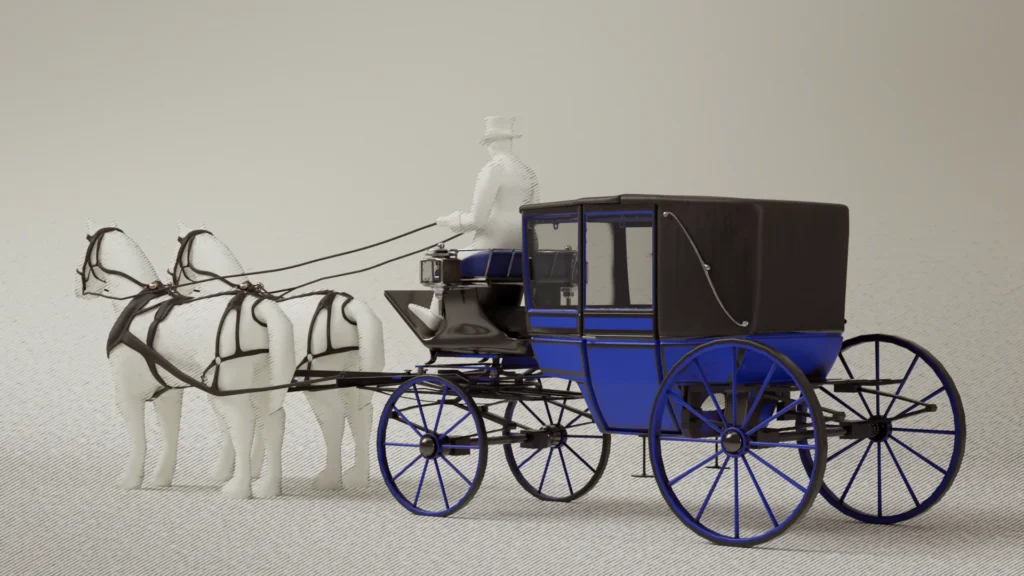
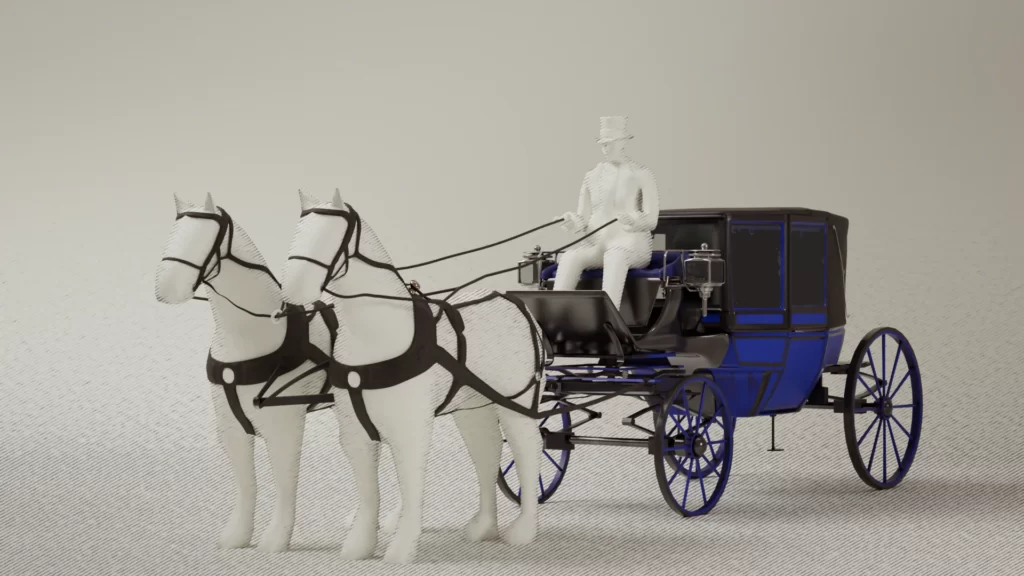
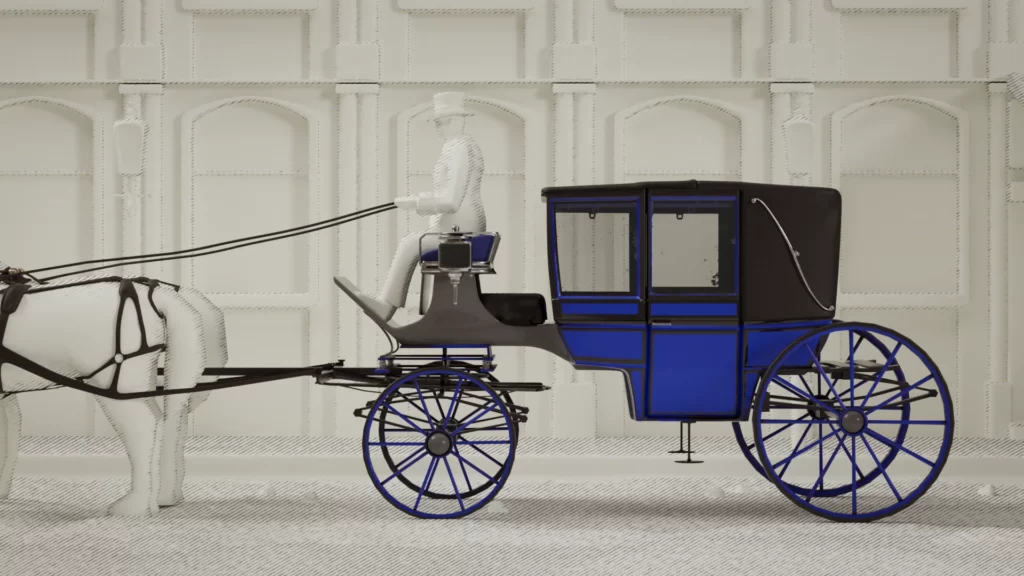
Interactive rendering
All hands on code: making the model web available using Three.js
I’m going to use the second UV map we created earlier, with every elements on the same map and the idea was to be able to give a gouache-like effect to the render.
I played with the different elements for a while while keeping an eye on the overall weight of the files. My initial intention to allow for everything to be manipulated. But it came at too high a weight cost.
In order to have a decent model I could hardly go under a .glb size of 650ko, adding the texture maps make the file an overall 1.4Mo for the carriage only. That is why it will be the only thing availble on a web browser for now. No horses etc. Sorry.
I know all things considered this is not so big a model and most modern devices would voraciously eat it and the other elements up. But as this is the piece directly created from the reference, I don’t think the rest matters much. There is no need to force a server to overdo it when it does’nt have too.
You’ll notice in the code it is almost a straightforward process with very little tweaks in the created MeshPhysicalMaterial. This is also one of the few models where I did not individualized the parts: because I’m aiming for a “gouache on paper” look, I thought it made sense.
Code lines
Here are the most relevant lines of codes behind the materials of the model in the web viewer. Remember that I’m working with a JSON file to feed the model to the viewer, so the syntax is irrelevant here. Just gather the information you need from it !
"3Dmodel": "./assets/models/brewster_landau/Brewster_landau_watercolour.glb",
"meshes": [{
   "name": "brewster_landau",
   "textures": {
       "map": "./assets/models/brewster_landau/textures/landau_watercolour_diff2.webp",
      "clearcoatMap": "./assets/models/brewster_landau/textures/landau_watercolour_gloss.webp",
      "roughnessMap": "./assets/models/brewster_landau/textures/landau_watercolour_rough.webp",
      "normalMap": "./assets/models/brewster_landau/textures/landau_watercolour_norm.webp",
      "aoMap": "./assets/models/brewster_landau/textures/landau_watercolour_ao.webp"
   },
   "values": {
      "clearcoatIntensity": 0.05,
      "clearcoatRoughness": 0.99,
      "roughness": 1,
      "aoMapIntensity": 0.5,
      "iridescence": 0.01,
      "envMapIntensity": 0.9,
      "needsUpdate": true
   },
   "modules": {
      "side": "DoubleSide",
      "envMap": "hdrEquirect"
   }
}],
"cameraPosition": {
   "x": "-6",
   "y": "3",
   "z": "6"
},
"perspectiveCamera": {
   "fov": 20,
   "near": 0.1,
   "far": 100
},
"controls": {
   "autoRotate": false,
   "autoRotateSpeed": 0.5
},
"renderer": {
   "toneMapping": "LinearToneMapping",
   "toneMappingExposure": 1
},
"AmbientLight": {
   "color": "rgb(177,204,136)",
   "intensity": 0.8
}
3D view
Disclaimer : technical limitation to material render in web app can let artifacts show, particularly in zoomed views.
See the full screen view (this will open a new tab in your browser).
Context
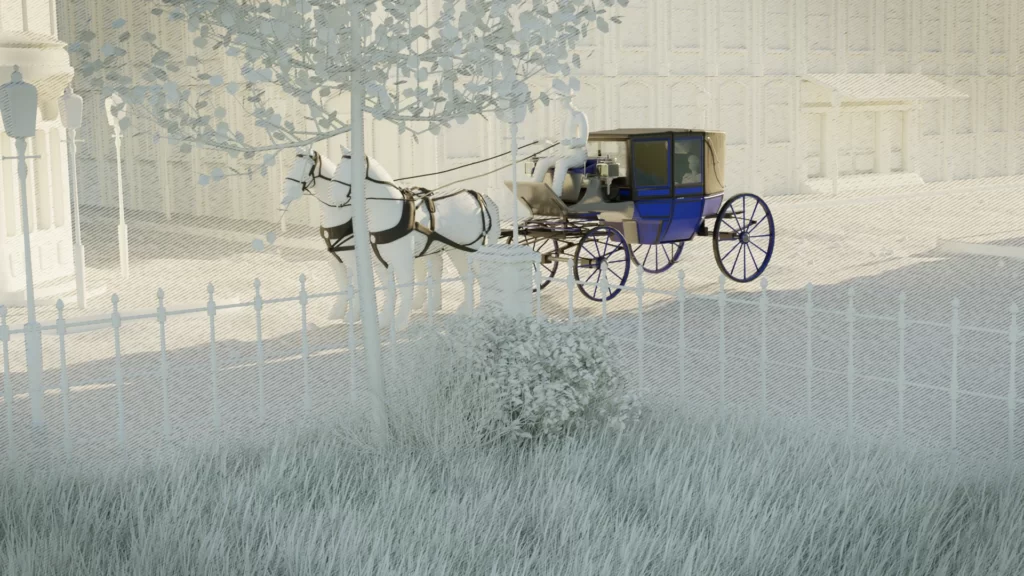
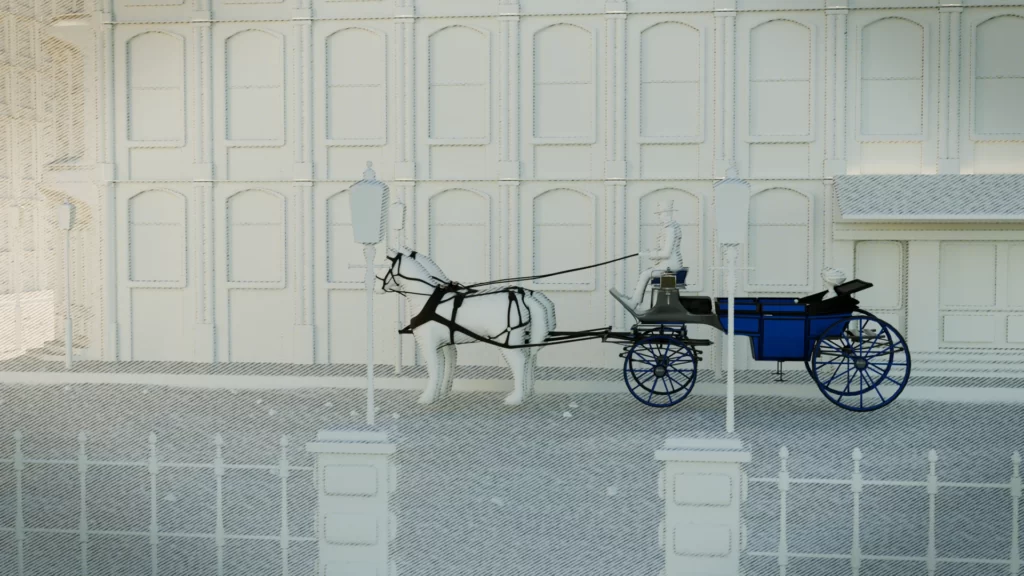
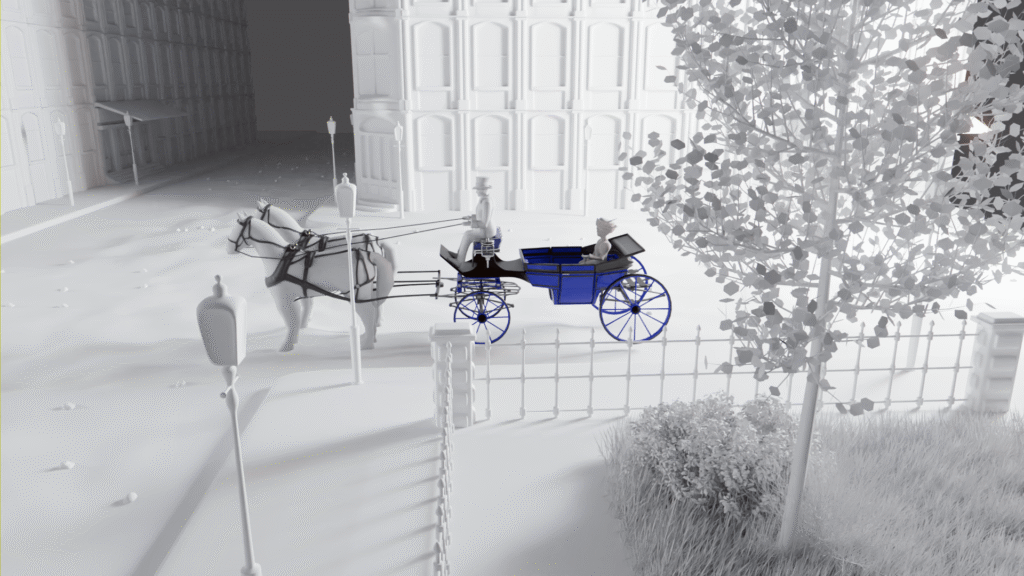
Because we already did a building, why not document further the old lady morning out in town ?
Credits
Unless otherwise mentioned, all images credit to LGS.