


Galathea’s legend : a sculptor’s way
The legend of Galatea and Pygmalion has many variants, just like every fairy tales (it’s an AT-945/D435.1.1 type for the folklorists among you).
The story goes like that: a sculptor was so skilled at their craft that they created a life-like statue of a woman that was so fantastic, a young man fell in love with it. A benevolent deity eventually gave it life.
From that story, I choose to retain the artisan’s skill and their talent at conjuring up an incredible piece.
But, why am I telling you that, gentle and now slightly concerned reader ?
Fantastic ornaments and where to find them
Michel Joseph Napoléon Liénard (1810–1870) started it !
I blame one person for this. His name is Michel Joseph Napoléon Liénard. He was born in 1810 near Rouen, in France. Classically trained, he became one of the brightest decorator of the XIXth century. According to his biograph, he thoroughly studied past styles and can render multiple periods and techniques with accuracy while developing his own style. If you’re reading these lines, I gather that you already came across his work.
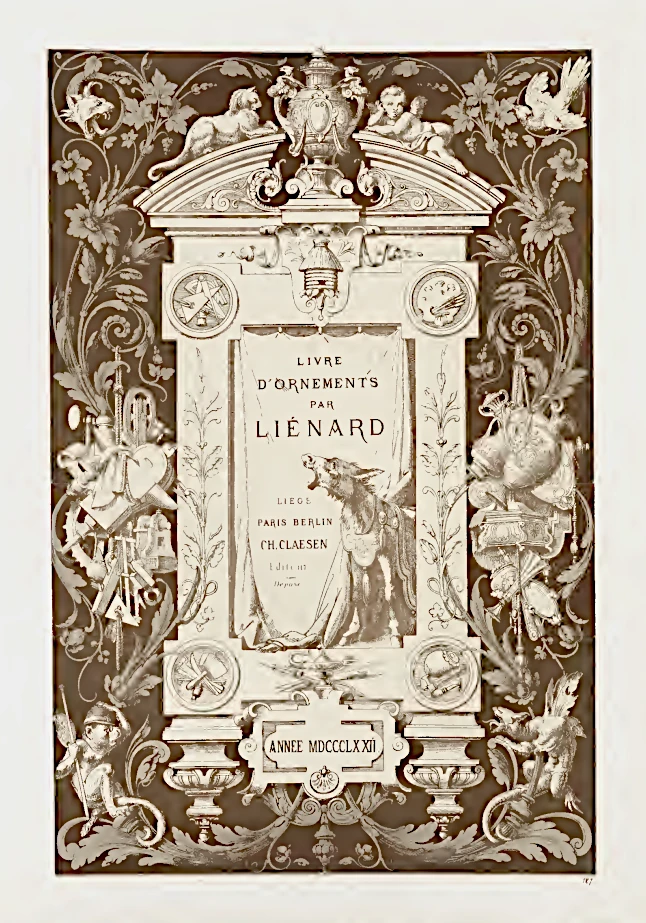
This voracity of preparatory studies and, basically, groundwork, is summarized in one of his books, “Spécimens de la décoration et de l’ornementation au XIXe siècle”. Etchings from this book have been reproduced numerous times, sometimes under the title “Fantastic ornaments”.
A digital 3D decor from the XIXth century
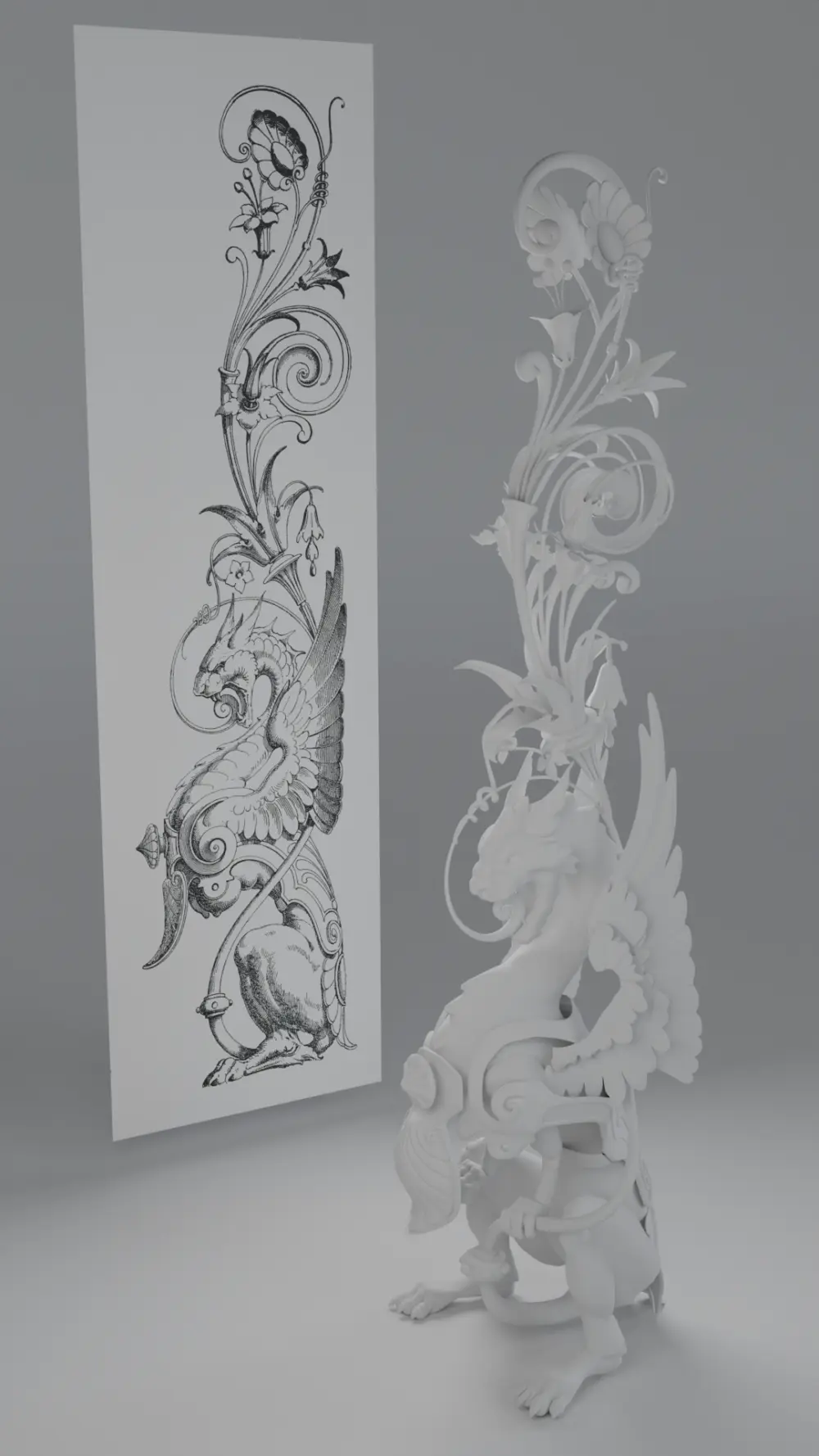
When I was looking for ideas to practice and illustrate my 3D work, I kept stumbling upon it. I liked some of it, but was somewhat afraid that the complexity of these motifs would be too hard for a beginner. Then, I was not really a beginner any more. I stumbled upon the biographer’s work about Liénard and I more or less came to liking his way of doing things, the attention to details and the references to past periods. Also, who doesn’t like a tamed griffin ?
As an incentive to try to model more complex pieces, this did the trick. You can see the results of these exercises on some 3D tagged pages of this site. The etchings from Liénard’s work on the left have my digital 3D interpretation of them on the right.
 and trophies with realistic subjects: vegetables), Trophy of Peas and Potatoes, Liénard, in "Spécimens de la décoration et de l'ornementation au XIXe siècle" https://archive.org/details/CAI1077440001Images/page/n264/mode/1up , pl. 15A n°80, p 49.](https://learngraspshow.eu/wp-content/uploads/2024/01/976a33e2e3679874859a35983229f5fe.webp)
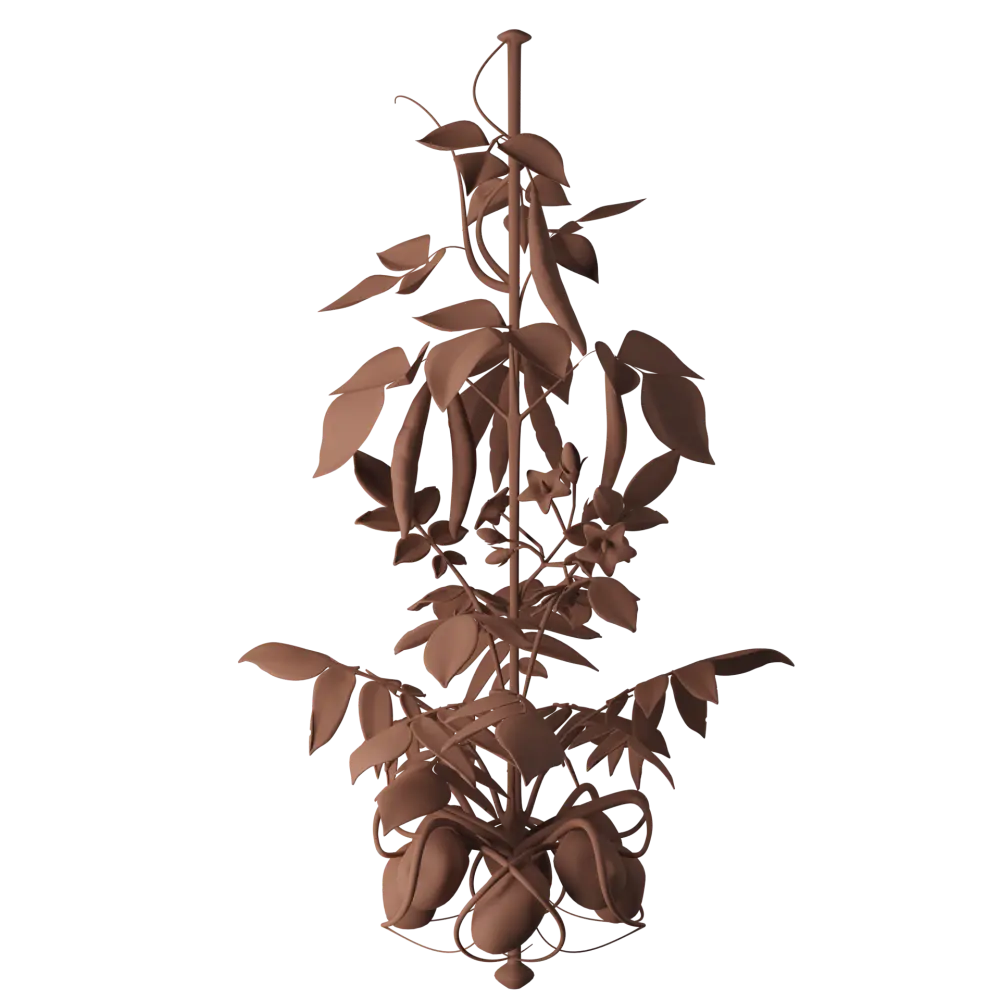
I really do enjoy this little game of mixing and matching old and new.
I took a little more confidence in my practice and looked for other pieces to model in the old master’s work.
This is where it all went very wrong.
But seriously, whaaat ?
All the little beasties
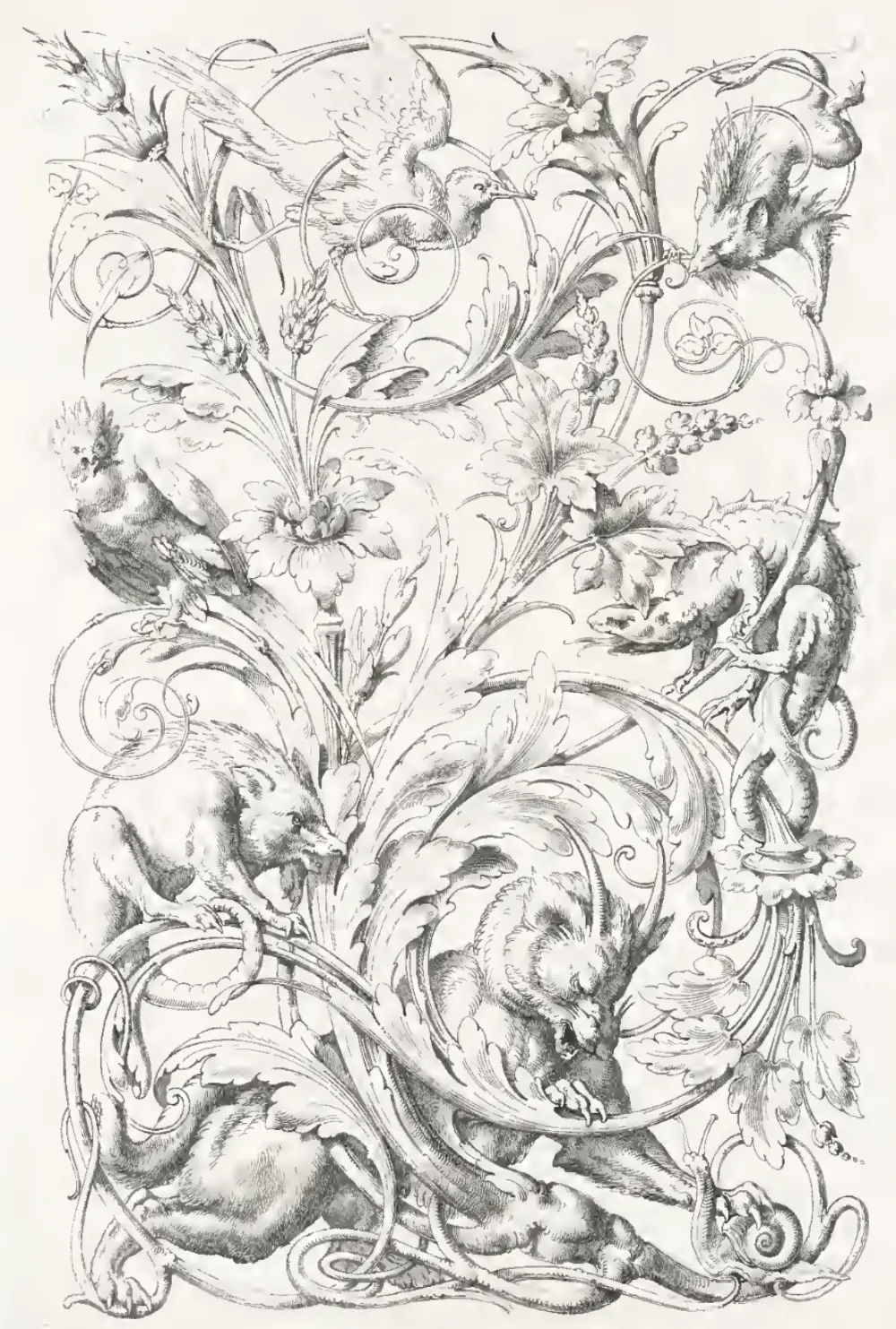
There was one piece I kept coming back to again and again. It’s a very heavily decorated one, way too much for my taste. But it has so much variety, my naive self thought it would be a most excellent exercise.
I see you’ve already understood that this was not a good idea! But I’m tenacious, and a challenge is a challenge.
Little did I know the depths of complexity this would launch me into. I did what I thought was the most sensible thing to do whenever the task seems daunting: split the problem into smaller parts.
I can see how I can render the vegetal parts. It’s a lot of work, but I don’t mind. The real issues are the animals.
I’m not mad, just a little disoriented.
The overwhelming fact this put me in front of was that my skills were not as developed as I would have liked them to be. Don’t get me wrong, I can make a decent animal in clay. But that may be the issue: my tablet isn’t my beloved ébauchoir. It’s a 2D representation of a 3D void. I need practice to understand how it feels to do things with it. On top of that, my anatomy knowledge is too scarce, for lack of a better word, to be able to use knowledge to counterbalance what my hands can’t feel.
For this project, I need to level up my skills. In my case, that means levelling down first. I need to go back to the source and learn things anew in a different setting.
So, though this seems discouraging, let’s hold on for dear life to the fundamental guideline: create a plan and execute it !
What are my goals ? Creating, animating and rendering the chimeras models.
How do I do that ? I need the fundamentals of animal anatomy for artists to be in place, I need practice and try-outs on a digital medium. Also, probably a lot of other things I can’t think about right now.
What do I need to do that ? Help, and a lot of it !
That’s right. I require guidance.
The Galathea project: a never ending quest where there might be dragons.
Just like the sculptor in the story creates a life-like sculpture, in order to create animals that look “the part” I need some help. That includes the animal on the right that looks like a tiny, vehement dragon.
There and then I created the Galathea project to put under a banner all the training I have to do in order to become a decent 3D sculptor.
As it is not a straight forward process and I know for a fact I’m not the only one interested in this craft, may these insights into this part of my journey help whoever might need it !
Divide and conquer: Edouard Lanteri (1848-1917) and consorts to the rescue
Art teachers, old and new
As a regular nerdy person, my first reflex is to look for books. The good thing with a bibliography is that there’s always one whatever subject you’re interested in, and thankfully, art is taught ever since it was, well, art.
The resources are numerous, most are free, and there are new ones every day. The real issue is to separate what works for me from what isn’t. It’s a heavily personal matter and the process is as important as the subject, I find.
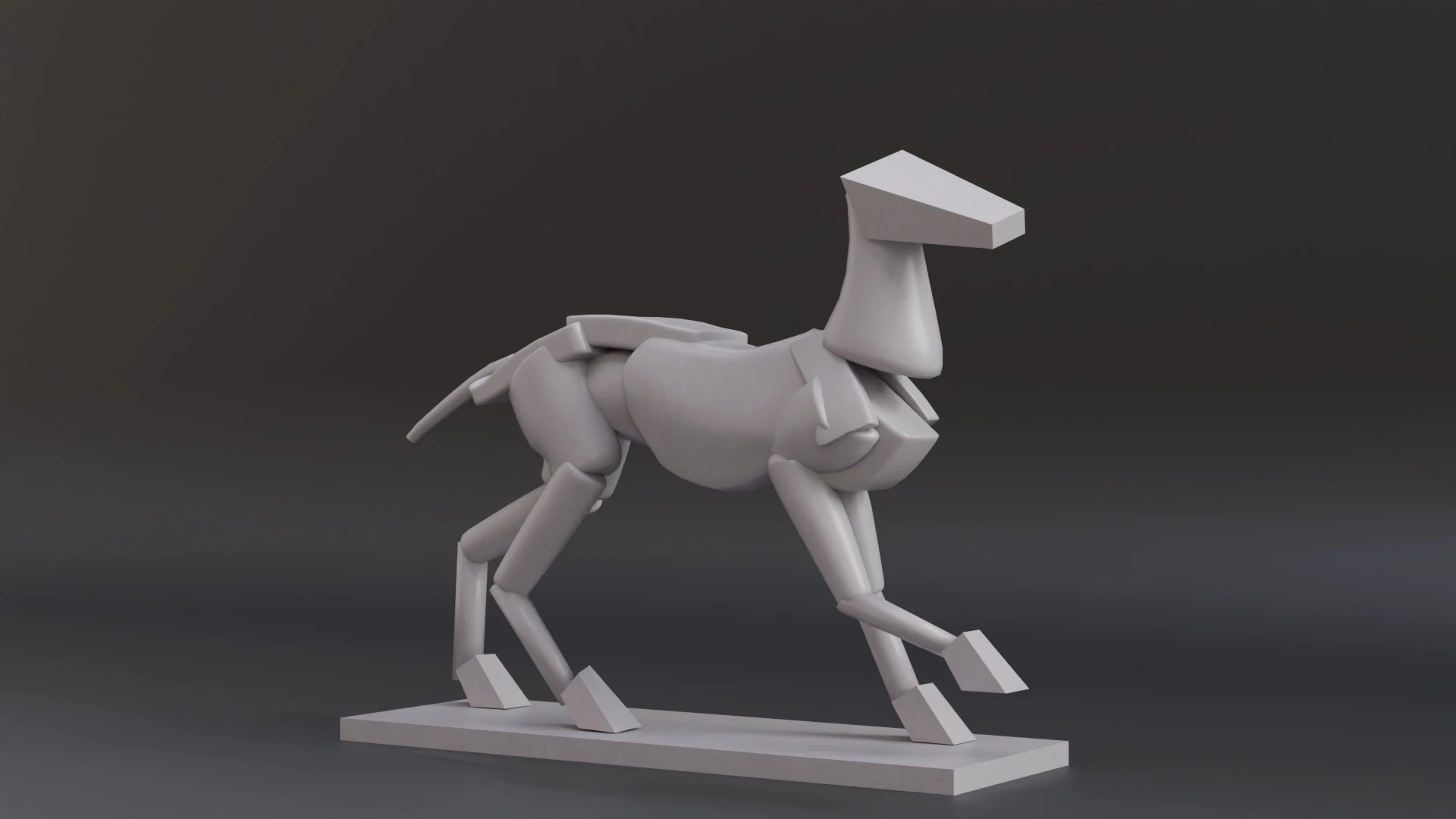
So far, I’ve identified different reliable sources, but I’m expecting the list will eventually grow.
The most prominent of which is Edouard Lanteri. He was a renown XIXth century sculptor and art teacher, born in France and then working in England. He wrote a series of modelling guides book on human and animal figures. These seminal pieces are still very much relevant today and the advices he gives are tremendously helpful.
I really like the idea of an old master from two centuries ago helping to embrace a modern technology.
As far as modern masters are concerned, hereafter is a small bibliography of the essentials references (this list will be updated as I go along) :
- “An Atlas of Animal Anatomy for Artists”, W. Ellenberger , H. Baum, H. Dittrich, Lewis S. Brown (trad), Dover Publication, USA, 1956.
- “The Weatherly Guide to Drawing Animals”, J. Weatherly, Ed. Drawing Animals, USA, 2003.
- “Animal Anatomy for Artists: The Elements of Form Illustrated Edition”, E.Goldfinger , Ed. Oxford University Press, Oxford (UK), 2004.
- “Mammals: Elements of Comparative Morphology”, M.Lauricella, Morpho Anatomy for artists coll. , Ed Deyrolles, 2022
There is a plethora of resources for human anatomy. I have often read and heard that it’s easier to start with it because, in the end, every animal is more or less built the same way. Only proportions and placements of the bones, muscles groups etc. differ. Plus, it’s a model we all can easily have on hands. So far, this idea does not fully convince me. Human and ape’s bipedalism give them a very distinct anatomy that I find hard to placate on other species. In my experience, it’s easier to start with true quadrupeds, like the heavily studied horses. The most efficient way is, of course, to do one of each at the same time to see the differences and similarities. It sure is not fast and definitely tough on moral because progression is alarmingly slow. Yet, the bases feel more solid that way. But maybe that’s just me.
Find and follow the red thread.
The hardest part, I think, is not to find references or information on a very specific subject but to try to make them play with each other without creating a cognitive cacophony. I know I usually never get anything positive from that.
So, I need to find a path to link the sources that makes sense to me; a red thread if you will. Because “Mix them all, shake well and see what’s up ?” is probably a headache in preparation. I’m already way too prone to migraine, thank you very much.
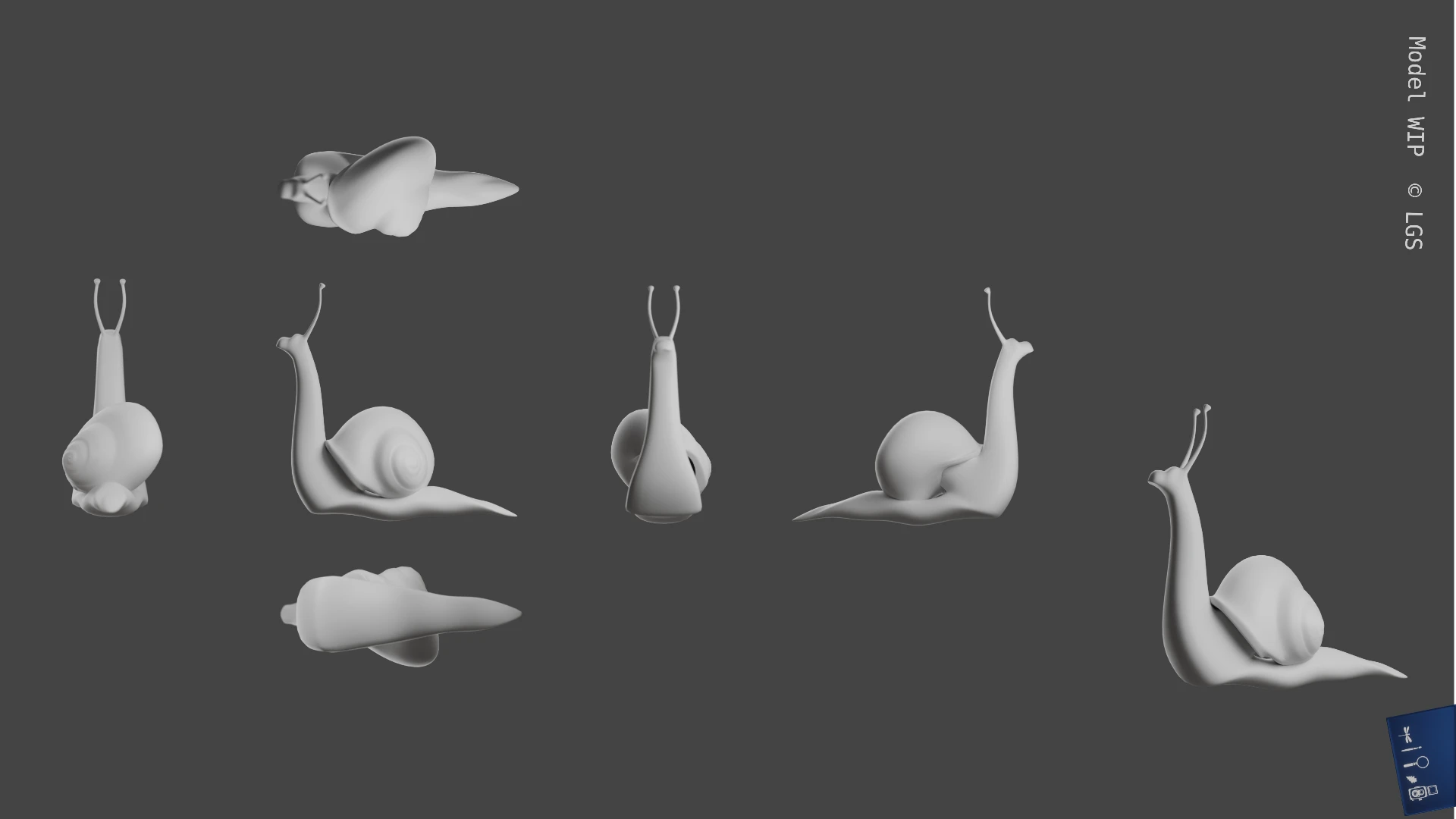
I need to create a method I can follow from all that and start my way slowly. In that case, better be a tortoise than a hare, I feel. Or better yet, be a Reginald.
Reginald is a humble snail, inspired from “Enroulements et chimères” (“Windings and chimeras”), Liénard, in “Spécimens de la décoration et de l’ornementation au XIXe siècle”, p31, pl. A8 n°19.
For various reasons including, but not limited to, the fact none is exactly what I’m looking for, I am not following a specific course. I do intend to use subject specific ones, provided my basic skills have progressed enough.
Because at that point in time I’m still searching for the best way for me to do things, I will try to use M.Lanteri’s advice in his 1902 “Modeling a guide for teachers and students”(vol 1), p4 : “And as Drawing is the principal foundation of Sculpture, and a good sculptural work depends largely on good drawing, the student should draw as much as, if not more than, a student of painting…”
I’m aware it’s probably better to do both drawing and sculpting at the same time. Particularly because digital media makes it easier to sculpt. But as far as the tedious school like learning part is concerned, I know I respond better to quick and annotated sketches.
Once I feel more at ease with the subject, I can go into a back and forth with the two methods, as elicited by artists, like Julian Kaspar from the blender studio.
And work from there.
Making sense of things and embracing the mess
Find a rhythm, find a rhyme
Now, I know what you might say: why not try the full Lanteri’s method ? Well, as the man says in his guide-book, “you need to find your own method”.
I tried to follow it to the letter, and found it doesn’t work for me as is. The method is very part-specific as in you train on modelling mouths, then noses, then eyes etc. I found I’m having a really hard time with that. I have a hard time focusing on details, then on the whole. In that very case, I’d rather do the opposite. I do know the exercises on specific parts will come, but I feel I need a more global approach first.
Oh, and also, I found out humans bore me. So it needs to be anything but a human model. See ? I’m finding things already !
So, I think I’ll try the organic way to find a red thread and a pattern. I hope I can keep being flexible and adapt as much as possible. As of right now, I firmly believe in the goods of compared anatomy, also sticking to a particular family, say mammals for starters.
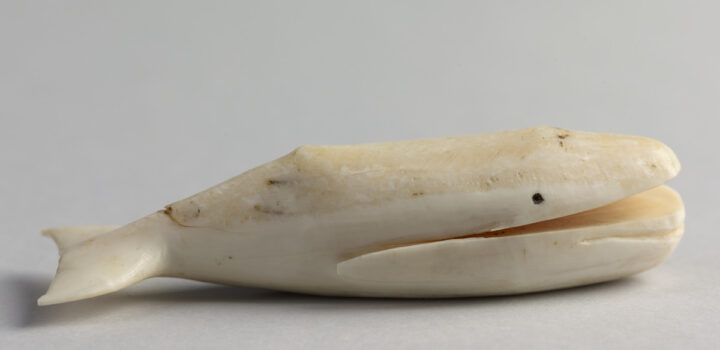
It’s all about the process: is this a white whale I see before me ?
I also need to keep in mind in these researches that dead ends are okay. They’re just a way to know it doesn’t work in that direction. I’ve learned something. I need to gather myself, take a break if I need to, and move on.
The first goal of this learning process is to be able to model the animals of the reference image. The idea after that is to be able to model them better ! And maybe some others as well. Past a certain threshold, I’m afraid that time is irrelevant there.
As it’s been said before, knowledge is a lifelong, iterative process and making sense of things takes time. I just hope I can see some progress in my practice and the final models from time to time. That would be nice.
This is just the beginning of a long series of ramblings and the continuation of a long process, you’re more than welcome to stay and participate !
Credits
White whale figurine, Pienoisveistos – Finnish Heritage Agency, Finland – CC BY.