

A world on the window sill
The following texts and images are the results of a training exercise to go from the pictures or the description of an artifact to the creation of a 3D digital double, sometimes restored version of it. If you wish to know more about the process, every explanations are in A journey into learning a (3D!) restoration process workflow article.
In these troubled times of various successive crisis, it is a well known fact that plants give us a modicum of solace. People cherish their own private gardens, no matter how small. Even a few pots can do the trick. As to the why, I’ll let you, dear reader, investigate on your own. I can but only vouch it works for me, too.
The indoor gardens and other horticultural trends of that kind are not new. I couldn’t find a definite date or pattern as to when and where it all began. As a historian, I’d probably go to the old trick of “whenever people started to care/ to be able to care about their indoor living areas” and “on every culture but at different times.” For that reason, climate is a key factor. I think I’d probably start to look for it in more warm and temperature-stable areas combined with enough water available to have a way to grow things easily, for an answer. Asia springs to mind, but I’m no ethnobotanist (though I find the subject fascinating).
I figured it would be interesting to try and re-create one of the first western documented terrarium. Spoiler alert: it is absolutely not what I thought it would be !
“…About three years ago I was led to make some experiments upon the subject, in consequence of noticing a seedling of Aspidium Filix-mas, and one of Poa annua, on the surface of some moist mould in a large bottle, in which I had buried the chrysalis of a Sphinx. Curious to observe how vegetation would proceed in so confined a situation, I placed the bottle, loosely covered with a tin lid, outside one of my windows, with a northern aspect…”
Title: Description of one of the first recorded terrarium in England extract from a letter to David Don, June 4th, 1833, in “On the Growth of Plants in Closely Glazed Cases”
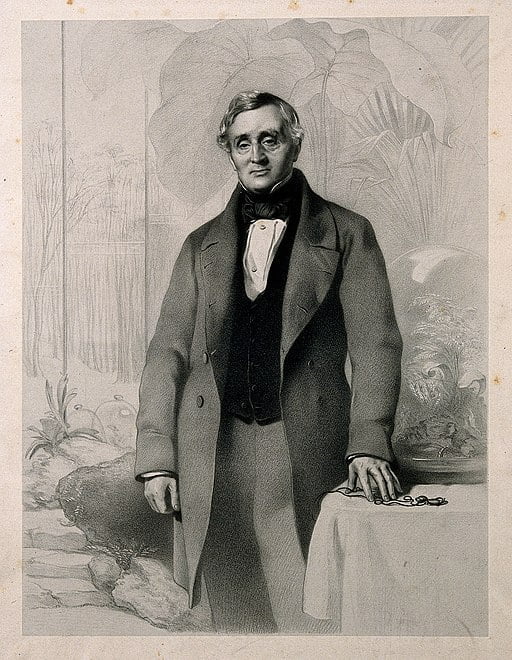
Author: Nathaniel Bagshaw Ward
Datation: 1842
Provenance: England
Description and Historical context
A little piece of the nearby forest or… the antipodes
The climate and the plants that grow in a specific places are linked. Plants from the Eastern equator regions will do very poorly in a Western northern garden, and vice versa.
The plant trade exchanging specimens for avid collectors all around the planet is documented from the 15th century onward. It initiated the creation of specific devices to keep the precious plants alive, first during transport, then, in order to keep the plants thriving in foreign climates. The latter are known as terraria, and they seem to have an increasing popularity these days.
One story, among others, shows how one such model started from a simple observation, about the humble European ferns in 1829 Victorian England.
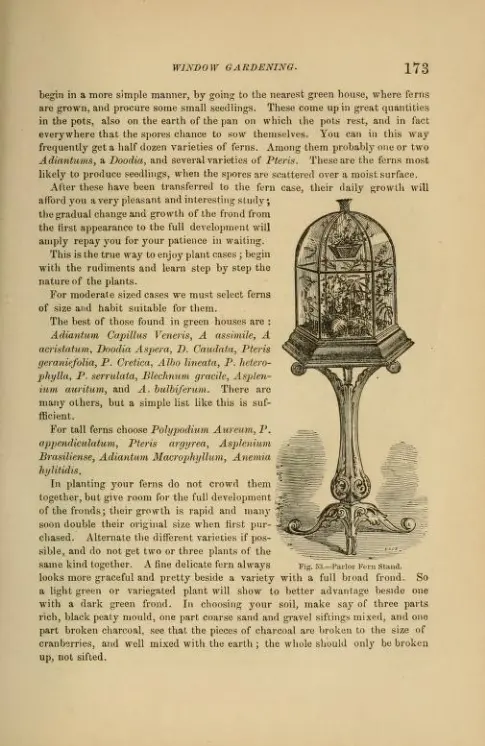
Victorian England is known to have had a large array of consumers goods, for better and for worse. It is also where the 19th century fern fever initiated. The amount and variety of glass housings for” window gardening” is staggering. But it seems the fully autonomous examples originated from one simple one.
The case of Nathaniel Bagshaw Ward
A Sphinx in a bottle
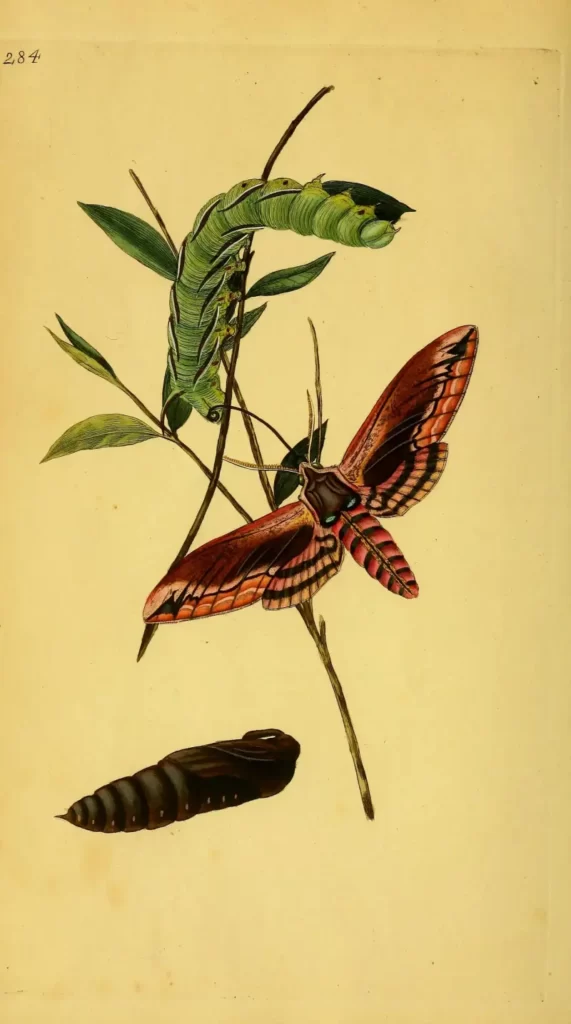
It seems it all started with this little guy or one of its cousin.
Moths are the largest lepidopetra order, long before their butterfly counterparts. They are mainly nocturnal, making their observation difficult.
Species of moths like Sphinx ligustri are common in England. They are the subjects of Nathaniel Ward’s entomology’s experiments. It is while trying to observe the transformation of a pupa to an adult that he said he made his discovery.
In his 1842 book, “On the Growth of Plants in Closely Glazed Cases”, Nathaniel Bagshaw Ward wrote :
[p25-26] “When the attempt had been given up [to grow ferns in his garden, because all of them eventually died due to the air pollution from the manufactories smoke], I was led to reflect a little more deeply upon the subject, in consequence of a simple incident which occurred on the summer of 1829. I had buried the chrysalis of a Sphinx in some moist mould, contained in a wide-mouthed glass bottle covered with a lid. From day to day, I observed that the moisture which, during the heat of the day, arose from the mould became condensed on the internal surface of the glass and returned whence it came; thus keeping the mould always in the same degree of humidity. About a week prior to the final change of the insect, a seedling fern and a grass made their appearance on the surface of the mould. I could not but be struck with the circumstance of one of that very tribe of plants, which I had fruitlessly attempted to cultivate, coming up sponte sua in such a condition; and asked myself seriously, what were the conditions necessary to its growth ?…”
In a letter reproduced in the same book and dated from 1833, he describes his 1829 experiment more precisely to David Don then professor of botany at King’s college in London.
Source: “On the Growth of Plants in Closely Glazed Cases”, Nathaniel Bagshaw Ward, 1842, in appendix (A).
Wellclose Square, June 4th, 1833.
My dear Sir,
The difficulty of conveying ferns from foreign countries has long been a matter of regret to the cultivators of that most interesting family of plants. About three years ago I was led to make some experiments upon the subject, in consequence of noticing a seedling of Aspidium Filix-mas, and one of Poa annua, on the surface of some moist mould in a large bottle, in which I had buried the chrysalis of a Sphinx. Curious to observe how vegetation would proceed in so confined a situation, I placed the bottle, loosely covered with a tin lid, outside one of my windows, with a northern aspect. This cover allowed a sufficient change of air for the preservation and development of the plants, and, at the same time, prevented the evaporation of the moisture within. In the bottle these plants remained for more than three years, during which time not one drop of water was given to them, nor was the cover removed. The Poa flowered the second year, but did not ripen its seeds; and about five or six fronds of the Aspidium were annually developed, but neither thecae (a theca (plural thecae) is a sheath or a covering) nor sporules were produced. These plants accidentally perished, from the rusting of the lid and the consequent admission of rain, which caused them to rot. During the last twelve-month I have tried this method with more than thirty species of ferns, with uniform success. Many other plants which grow in moist situations will succeed equally well when treated in
this way. […]
So, this seems to be one of the first documented case of an outdoor terrarium.
However, it is now doubtful it was the actual first. What is certain, though, is that the personality of Ward, the publication of his experiments and his social aspirations were paramount to him being able to let his name to the very form of the transportation case we now know.
The story doesn’t say what happened to the Sphinx…
Wardian case concept
The concept of the case is simple: it is basically a sealed protective container that let’s the light in.
From Sydney, with love
From his first experiment, Ward extrapolates the use-cases scenarii of this method for plants transportation on a larger scale:
[…] We may learn a few useful lessons from this little bottle. We see how abundant the seeds of ferns are, and how easy it would be to obtain many species from distant countries by collecting from various localities a handful of the surface mould, and, at any convenient season, placing this in a situation favourable for their growth…
Source: “On the Growth of Plants in Closely Glazed Cases”, Nathaniel Bagshaw Ward, 1842, pp48 et s .
It seems that he was able to test this method:
[…] When I reflected upon the above causes of failure, it was obvious that my new method afforded a ready means of obviating all these difficulties, so far, at least, as regarded ferns and plants growing in similar situations; and in the beginning of June, 1833, I filled two cases with ferns, grapes, etc., and sent them to Sydney under the care of my zealous friend Capt. Mallard, whose reports on their arrival, will be found in the Appendix. These cases were refilled at Sydney in Feb. 1834, the thermometer being then between 90°[F, 32°C] and 100°[F, 37°C] in the shade. In their voyage to England, they encountered very varying temperatures. The thermometer fell to 20°[F, -6°C] in rounding Cape Horn, and the decks were covered a foot deep with snow. At Rio Janeiro the thermometer rose to 100°[F, 37°C], and in crossing the line, to 120°[F, 48.8C]. In the month of November, eight months after their departure, they arrived in the British Channel, the thermometer being then as low as 40°[F, 4.45°C]. These plants were placed upon deck, and were not once watered during the whole voyage, yet on their arrival at the docks they were in the most healthy and vigorous condition, and I shall not readily forget the delight expressed by Mr. G. Loddiges, who accompanied me on board, at the beautiful appearance of the fronds of Gleichenia microphylla, a plant now for the first time seen alive in this country. Several plants of Callicoma serrata had sprung up from seed during the voyage, and were in a very healthy state…
Source: “On the Growth of Plants in Closely Glazed Cases”, Nathaniel Bagshaw Ward, 1842, pp74 et s .
Wait just a minute, this is not new !
As this article by Luke Keogh suggests, the concept is certainly not new and its refinement is a key factor in the development of the Western collections and crops of plants coming from around the globe, supporting the industrial growth. As well as importing the pests that come with them !
“One of the more interesting methods proposed was that of Nathaniel Wallich, pioneering botanist and surgeon for the East India Company, based in Calcutta; he sent a box that had a roof made with translucent shell inserts, which allowed light in. These early decades of the nineteenth century were an intense period of experimentation in sending live plants.” (source: Keogh, id.)
Other examples can be found and, in 1824, John Lindley presents to the Horticultural society a sketch of one of the boxes from Mauritius by its then governor, Robert Farquhar.
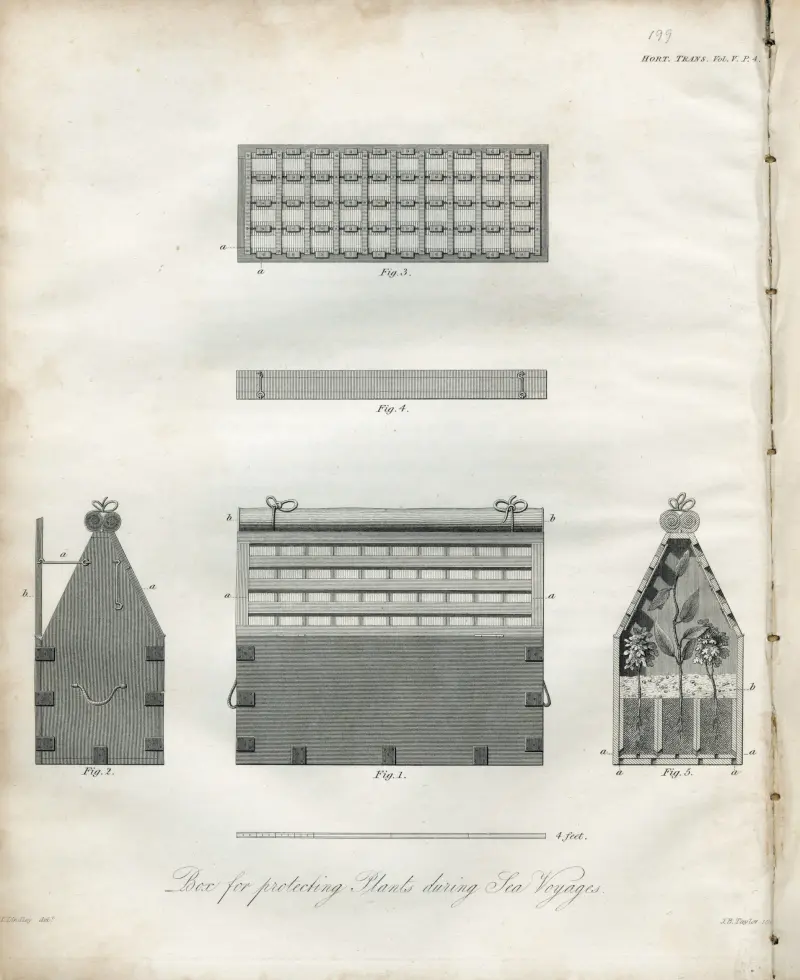
Authors seem to acknowledge Ward’s improvement was his proposal of an airtight system in which transpiration inside the case provides sufficient moisture to keep plants alive for extended periods. We would call this system a terrarium today.
On his 1842 book, Ward himself poses the basis of what a good terrarium does:
[…] I could not but be struck with the circumstance of one of that very tribe of plants, which I had for years fruitlessly attempted to cultivate, coming up sponte sua in such a situation; and asked myself seriously what were the conditions necessary for its growth? To this the answer was,— 1stly, an atmosphere free from soot; (this I well knew from previous experience) : — 2ndly, light : 3rdly, heat :—4thly, moisture :—and lastly, change of air. It was quite evident that the plants could obtain light and heat as well in the bottle as out of it; and that the lid which retained the moisture likewise excluded the soot. The only remaining condition to be fulfilled was the change of air ; and how was this to be effected? When I published my account in the ‘Companion to the Botanical Magazine,’ I overlooked the law respecting the diffusion of gaseous bodies, described in the preceding chapter, and stated that this change was produced by the variations of temperature causing alternate expansions and contractions in the air surrounding the plants, and which of course produced a certain but very limited effect. Thus, then, all the conditions necessary for the growth of my little plant were apparently fulfilled, and it remained only to put it to the test of experiment […]
One of the last recorded use of a Wardian case as such was in a 1962 journey from the Fiji lslands to Kew Gardens. It was already supplanted by other means of transportations.
What to do when all you have is a text ?
Although it might be a good exercise to try to model the case with the translucent shell, I think for now I’d like to try my hand at modelling the first “wardian bottle” from where the idea of the wardian case comes from, i.e. one of the oldest recorded terrarium.
Question: But what do you do when all you have are texts ?
Answer: you make hypothesis and you find references !
The Wardian bottle : an odds-and-ends made precursor.
The Bottle itself
What could the bottle have looked like ?
We have two mentions of the bottle from Ward. Sadly, we know only two things about it: that it is wide-mouthed and made of glass.
We can surmise the bottle had to be clear. Any coloured glass would forbid the light from coming in or distort it too much for it to have any effect. It has to have been produced before 1829.
There are numerous resources about ancient bottles. It is an important collector’s market and the pieces can go for tremendous prices. But we have no clear idea of the shape we’re looking for.
Let’s assume Ward probably took a bottle that was easily available to him. He was a doctor and a surgeon: we can therefore also look into medical glassware.
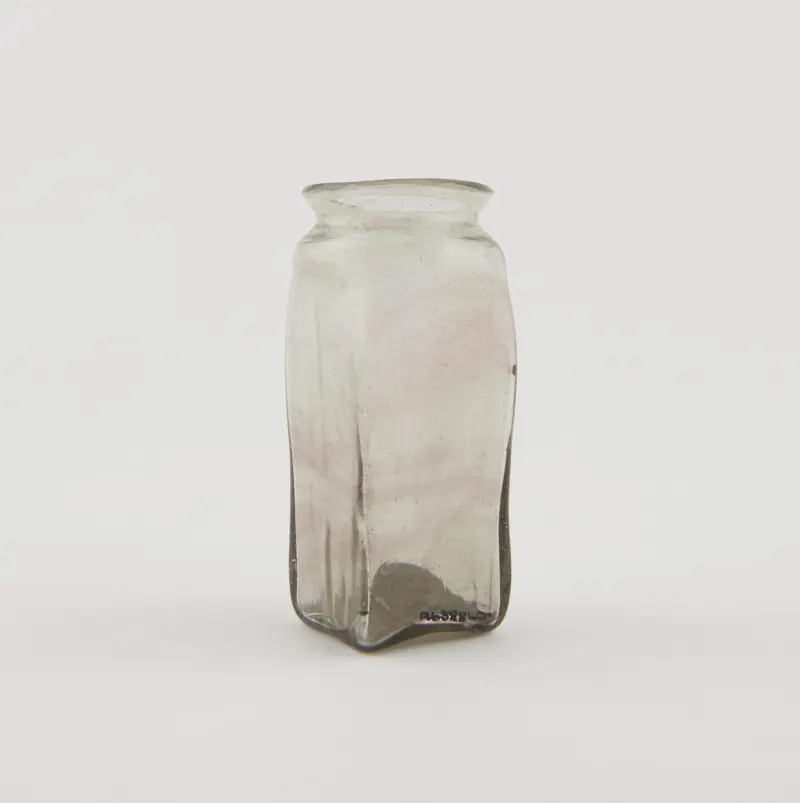
After rummaging for a while on the web, I found something in the medical glass-ware category that might fit our brief. It is not perfectly clear though, it seems to have the slightest of green hue, though that is to be expected in glasses of that period.
Good. We have a bottle !
A metal plate to seal the deal
Let’s find our bottle a tin lid to “loosely” cover it, as Ward puts it.
First, what is tin ? Well, it’s a silvery coloured metal. Chances are it’s not what Ward used. Ward says in his text that a few years after the summer of 1829, the lid rusted away and allowed rain in. Tin doesn’t rust.
What does rust is tinplate, a steel sheet coated with a thin layer of tin. The tinware industry was dominated by English productions from the late 1790s to the 1890s. Besides a very prolific range of kitchenware, it was also widely used as roof covering or tin cans. This material ends up being called “tin” in vernacular speech, as in a shortening for “tinplate”, and not a reference to the metal alone. As always, context is key !
As for the bottle, we have no idea of the shape the lid had. It fitted loosely around the round shape of the bottle’s neck. Because the bottle was probably not meant to have that sort of lid, it is presumably a makeshift one. So we are looking either for something that could be repurposed or easily cut and forced into shape.
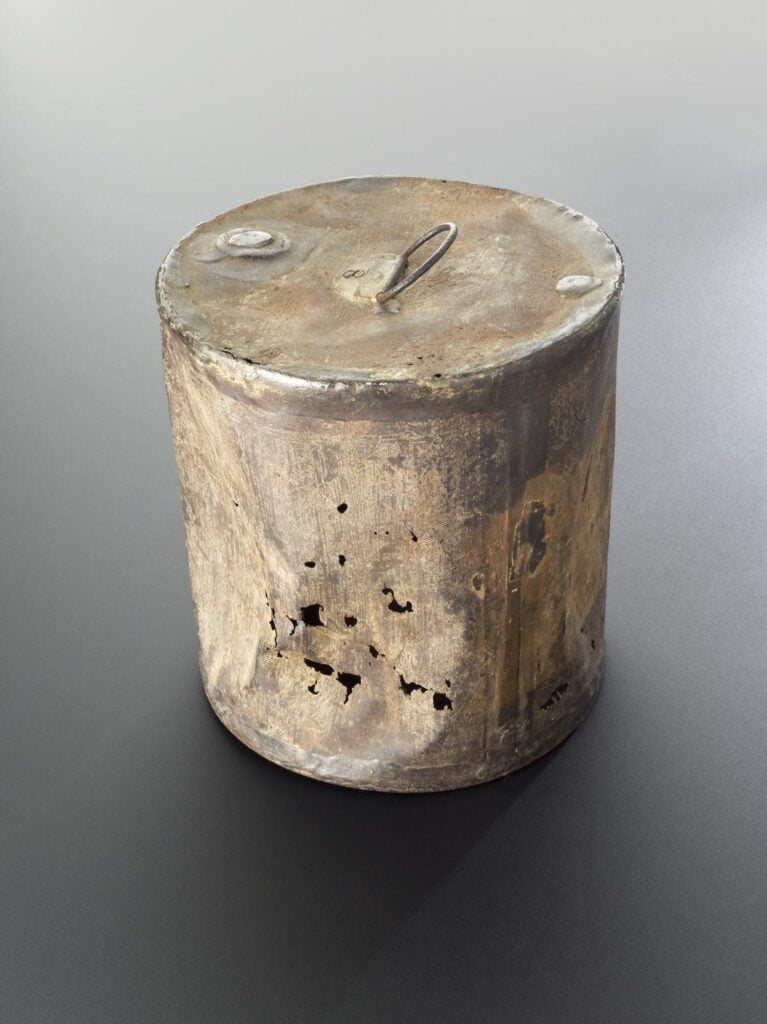
Though that should have given us a larger searching ground, it was actually not that easy to find an exploitable reference for this material.
I think we can go for something like a tin can to reference the material. Though the rust would not have appeared in the early days of the terrarium, the exposed to the elements lid would have had acquired a dark patina fast.
Plants and soil
The plants are the easy part: Ward identified them as Aspidium Filix-mas, and one of Poa annua. It should be fairly easy to find references for them.
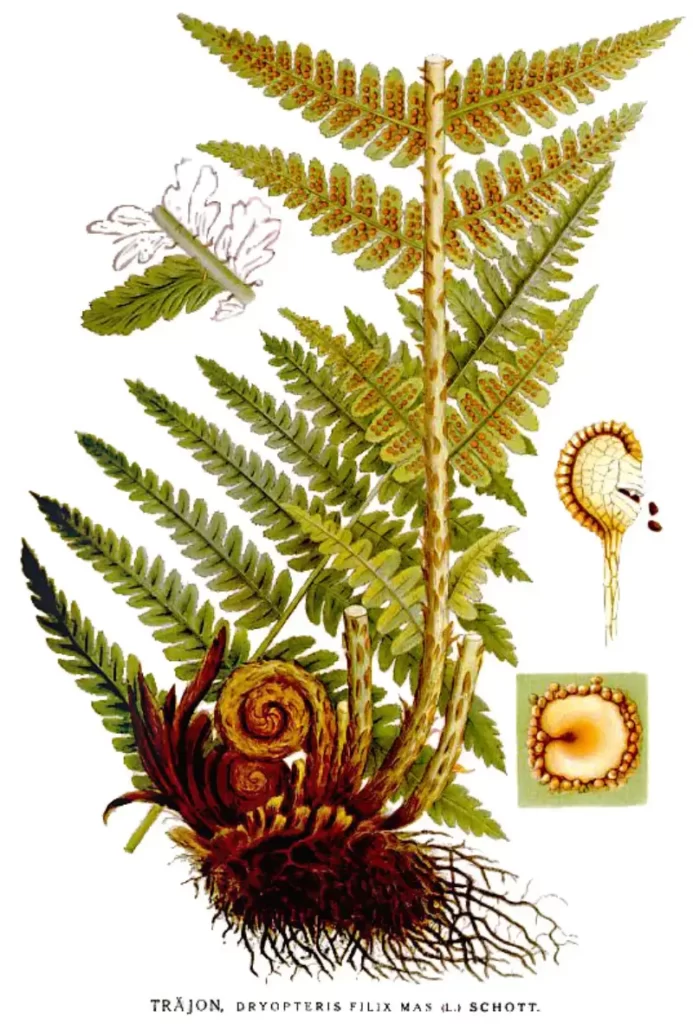
Aspidium fiIix-mas, now known as Dryopteris filix-mas, is a semi-evergreen common fern in the temperate Northern Hemisphere.
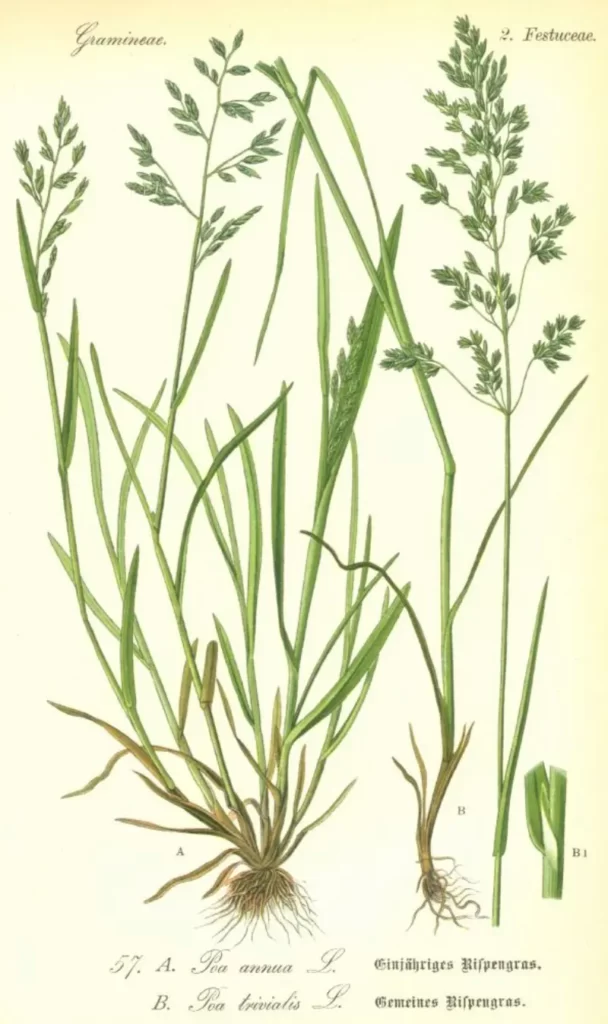
Poa annua is a widespread low-growing turfgrass.
The “mould” Ward uses might be confusing. Again, it’s not what our modern acception of the word is. It is a crumbling soft friable earth suited to plant growth.
And still, nobody knows what happened to the sphinx.
Creating a 3D model of the piece
Disclaimer : this is an exercise, shown for documentation purposes only
How to do it: a 3D reconstitution process
Model the shapes
A bottle with a makeshift lid
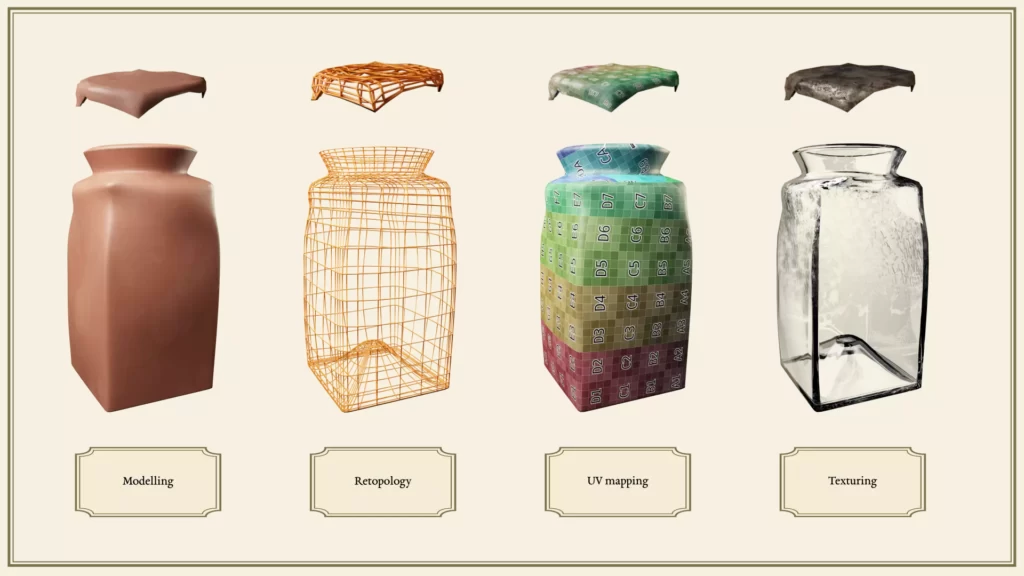
The bottle shape can be extrapolated from the reference picture. The idea behind the lid is to mimick what can be done by forcing a ductile material like tinplate from a tincan on the wide opening of the bottle mouth.
Plants growing in mould
Time for some herbaria modelling. Note that plants are not being treated at this point: I’ll explain later.
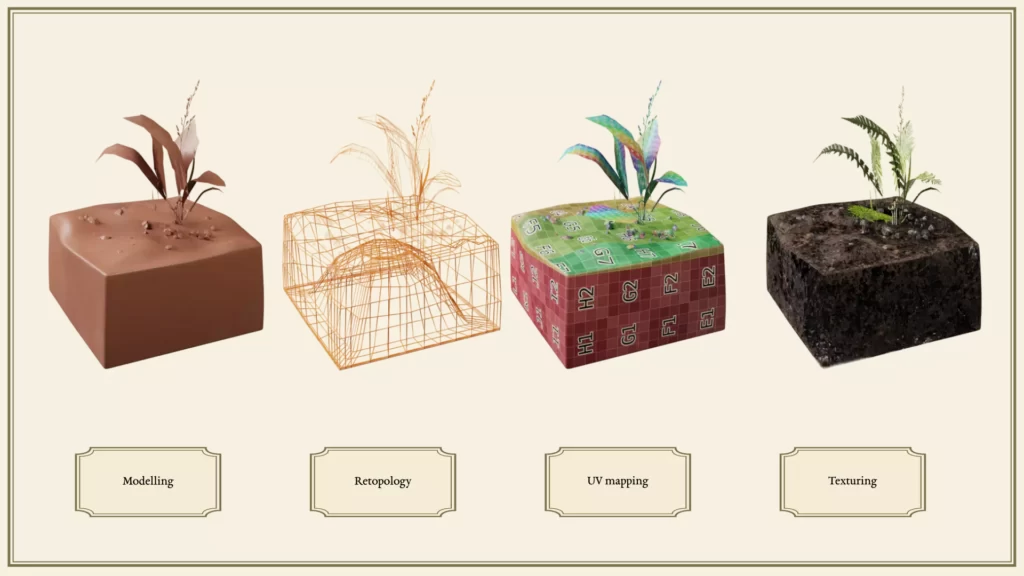
You’ll note that I did keep the soil mass present, even on the bottom. On most views, that would be unnecessary, but I intend to have a web browser version of it. This means you, dear viewer, will be able to manipulate it. So I need all the faces to show !
Texture the shapes
Note: Maps are basically information encoded into images giving the computer information about the material, so it can render as you want it to.
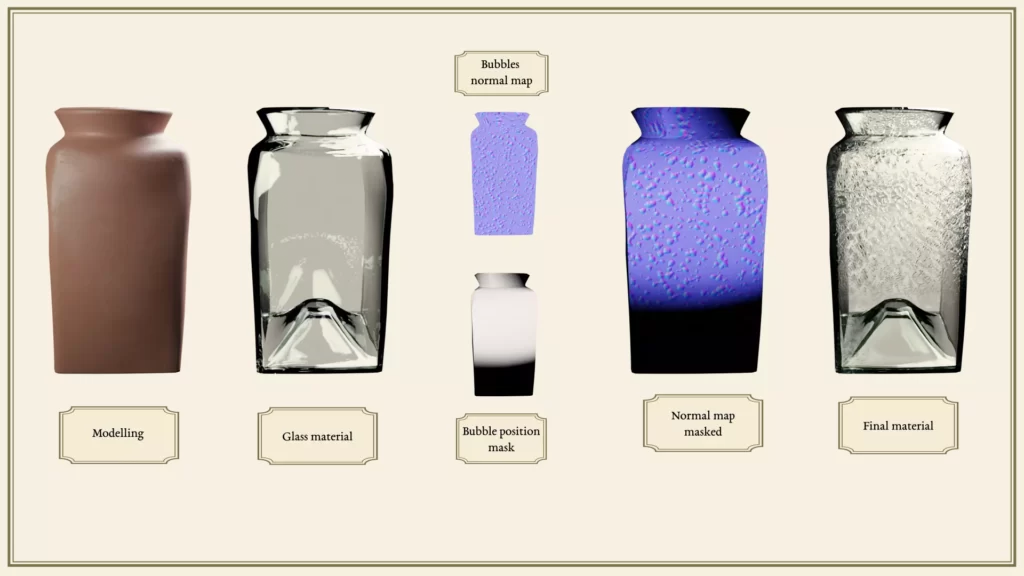
It’s a case of placing the dropets on the right places.
Beside the obvious glass material, Ward description of the bottle adds an observation we all made:
“From day to day, I observed that the moisture which, during the heat of the day, arose from the mould became condensed on the internal surface of the glass and returned whence it came; thus keeping the mould always in the same degree of humidity.”
So. We need glass with water droplets on the inside to mimic the terrarium climate.
In order to keep it simple and not make the model heavy with too much geometry, I’m going the normal map way. A little mask work is there to make sure the droplets are concentrated on the parts where they’ll look the most natural, namely the shoulder and the upper part of the bottle above the soil. Voilà, we have a hopefully convincing dewy glass material.
Of ferns, alphas layers and soil.
Ferns can be delicate, exquisitely light looking plants. Their leaves seem to glide on the wind. I found that the easiest way to get that effect on grown leaves was to use images and alphas on a simple plane deformed by a lattice to keep everything smooth and non destructive.
The reasoning behind that is that the plants will only be seen from afar through the bottle glass. Of course, in any other circumstances, a fully modelled solution would be more appropriate.
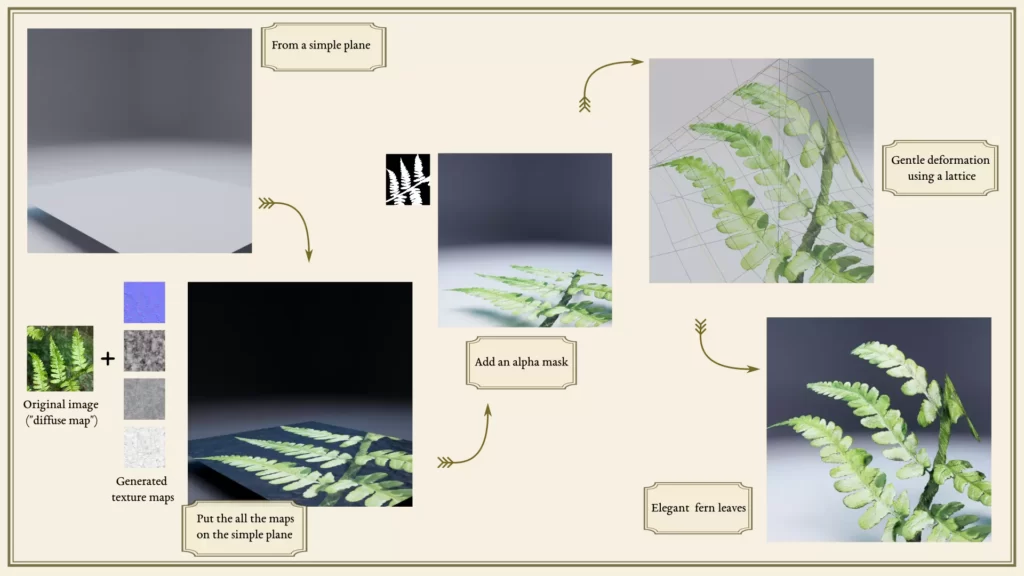
I tried a new process to create a texture this time. The original image has been cleaned up in Gimp using the G’mic add-on for foreground extraction as a base.
Then, the resulting image was processed in Armorlab to obtain a set of texture maps to import in Blender.
I used the same method for the Poas annua.
I won’t bore you with the details of the soil texture development. Fun fact, it’s actually not that easy to try and find a geographical reference for the humble dirt. Don’t get me started on the rocks and pebbles. It’s like no one ever archive easily accessible historical information on those. So, I did make do with what I thought would work !
Shine a little light: stills renders using Blender
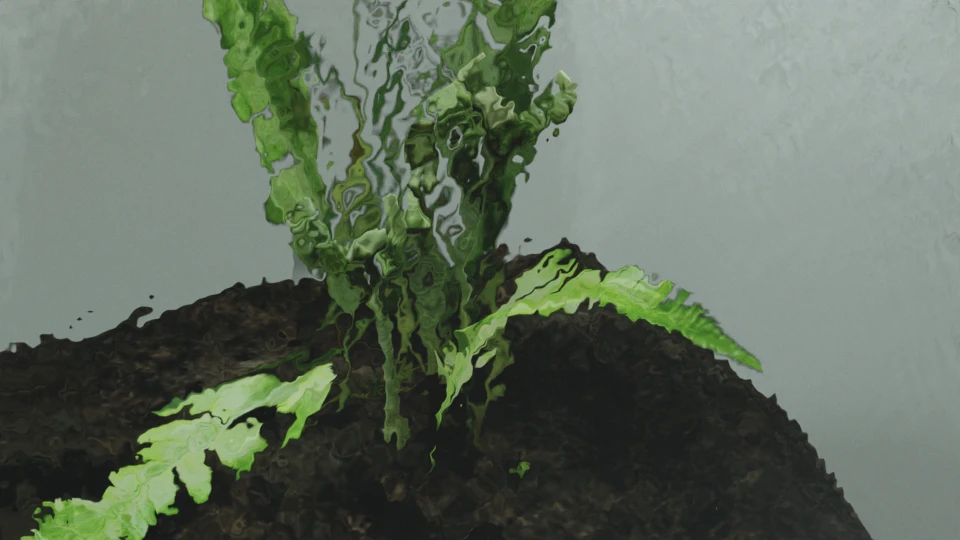
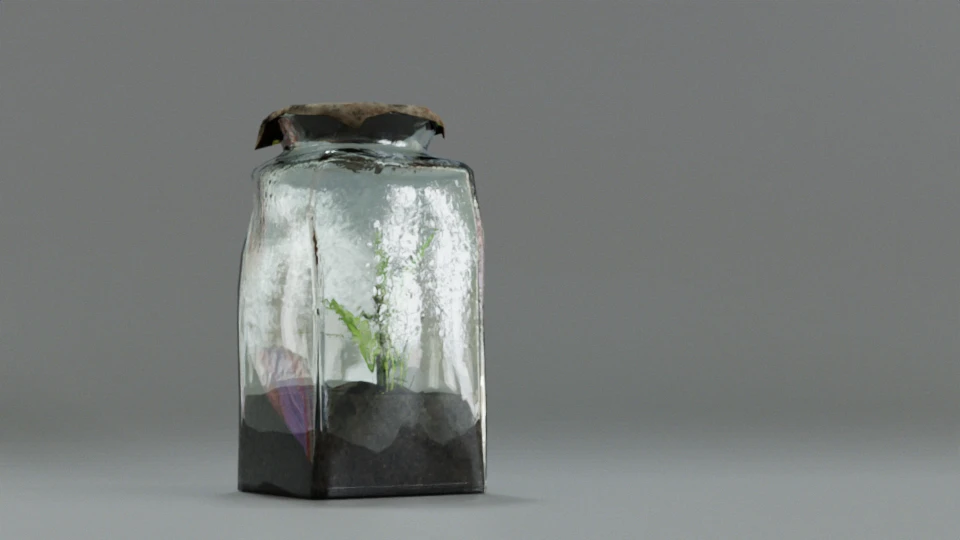
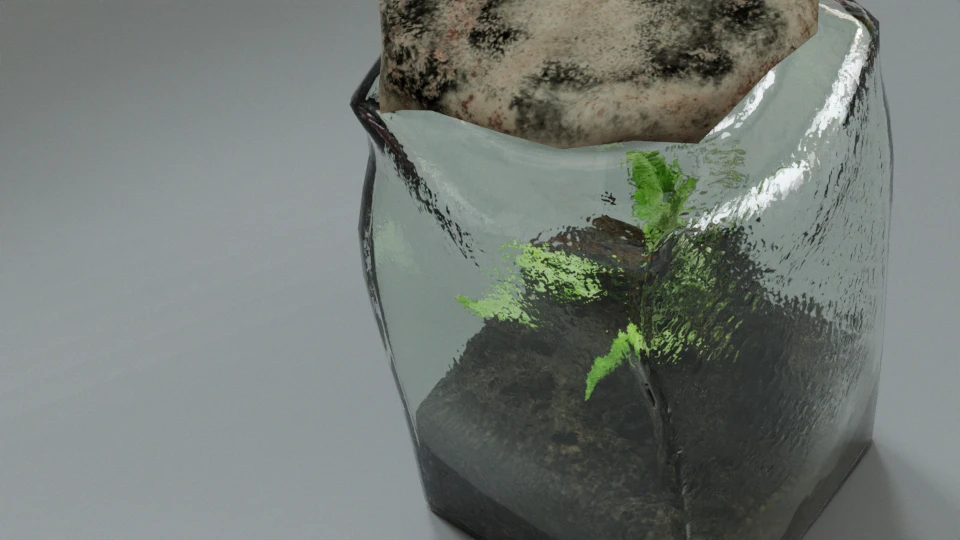
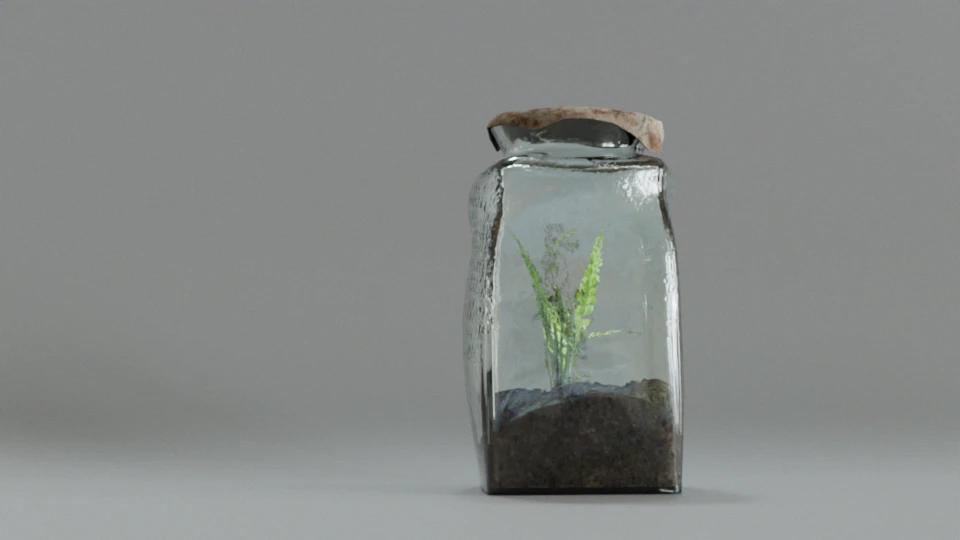
Interactive rendering
All hands on code: making the model web available using Three.js
Transarency is key
The actual pain was to put every element on the same tile. I know my baking skills are a little rough, and I admit the double set of UV’s method had me drooling a little. But tenacity eventually prevailed.
The only element that does not respond fully to the maps is the glass bottle. For it, I had to make a few manual tweaks.
For once, I was not faced with the transparency / alpha dilemma head on as with the [ornate beaker](link to come). But I still had to make do with a mitigation of it for the plants because they are inside the glass container. I think it kinda works okay.
There is one effect I couldn’t seem to get rid of, though. Under a specific angle, the Poas annua disappear. I’m not sure why. Well, I have ideas but using more geometry would weight down an already heavy model.
Code snippets.
Here are the most relevant lines of codes behind the materials of the model in the web viewer. Remember that I’m working with a JSON file to feed the model to the viewer, so the syntax is irrelevant here. Just gather the information you need from it !
{
   "textures": {
      "normalMap": "./assets/models/wardian_bottle/texture/wardian_bottle_norm.webp",
      "roughnessMap": "./assets/models/wardian_bottle/texture/wardian_bottle_rough.webp"
   },
   "values": {
      "transmission": 0.92,
      "thickness": 0.8,
      "color": "rgb(177,204,136)",
      "ior": 1.55,
      "specularIntensity": 0.8,
      "specularColor": "rgb(231, 239, 219)",
      "sheenRoughness": 0.5,
      "envMapIntensity": 0.5,
      "needsUpdate": true
   },
   "modules": {
      "side": "DoubleSide",
      "envMap": "hdrEquirect"
   }
},
{
 // Metallic lid
   "name": "metal_cap",
      "textures": {
        "map": "./assets/models/wardian_bottle/texture/wardian_bottle_diff.webp",
        "normalMap": "./assets/models/wardian_bottle/texture/wardian_bottle_norm.webp",
        "bumpMap": "./assets/models/wardian_bottle/texture/wardian_bottle_rough.webp",
        "roughnessMap": "./assets/models/wardian_bottle/texture/wardian_bottle_rough.webp",
        "metalnessMap": "./assets/models/wardian_bottle/texture/wardian_bottle_glos.webp"
      },
      "values": {
        "metalness": 1,
        "roughness": 1,
        "needsUpdate": true
      },
      "modules": {
        "envMap": "hdrEquirect"
      }
 },
// Rocks
 {
    "name": "rocks",
    "textures": {
      "normalMap": "./assets/models/wardian_bottle/texture/wardian_bottle_norm.webp",
      "roughnessMap": "./assets/models/wardian_bottle/texture/wardian_bottle_rough.webp"
    },
    "values": {
      "color": "hsl(0,8.4%,37.3%)",
      "metalness": 0,
      "roughness": 0,
      "needsUpdate": true
    },
    "modules": {
      "side": "DoubleSide",
      "envMap": "hdrEquirect"
    }
  },
// Mould
    {
      "name": "dirt",
      "textures": {
        "map": "./assets/models/wardian_bottle/texture/wardian_bottle_diff.webp",
        "normalMap": "./assets/models/wardian_bottle/texture/wardian_bottle_norm.webp",
        "roughnessMap": "./assets/models/wardian_bottle/texture/wardian_bottle_rough.webp"

      },
      "values": {
        "roughness": 8,
        "needsUpdate": true,
        "specularIntensity": 0.2
      },
      "modules": {
        "envMap": "hdrEquirect"
      }
    },
// Poacea
    {
      "name": "poacea",
      "textures": {
        "map": "./assets/models/wardian_bottle/texture/wardian_bottle_diff.webp",
        "normalMap": "./assets/models/wardian_bottle/texture/wardian_bottle_norm.webp",
        "roughnessMap": "./assets/models/wardian_bottle/texture/wardian_bottle_rough.webp",
        "alphaMap": "./assets/models/wardian_bottle/texture/wardian_bottle_trans.webp"
      },
      "values": {
        "metalness": 0,
        "roughness": 0.8,
        "bumpScale": 0.0005,
        "alphaTest": 0.5,
        "depthTest": true,
        "transparent": false,
        "needsUpdate": true
      },
      "modules": {
        "envMap": "hdrEquirect"
      }
    },
    {
      "name": "poacea_2",
      "textures": {
        "map": "./assets/models/wardian_bottle/texture/wardian_bottle_diff.webp",
        "normalMap": "./assets/models/wardian_bottle/texture/wardian_bottle_norm.webp",
        "roughnessMap": "./assets/models/wardian_bottle/texture/wardian_bottle_rough.webp",
        "alphaMap": "./assets/models/wardian_bottle/texture/wardian_bottle_trans.webp"
      },
      "values": {
        "metalness": 0,
        "roughness": 0.8,
        "bumpScale": 0.0005,
        "alphaTest": 0.5,
        "depthTest": true,
        "transparent": false,
        "needsUpdate": true
      },
      "modules": {
        "envMap": "hdrEquirect"
      }
    },
// Fern
    {
      "name": "fern",
      "textures": {
        "map": "./assets/models/wardian_bottle/texture/wardian_bottle_diff.webp",
        "normalMap": "./assets/models/wardian_bottle/texture/wardian_bottle_norm.webp",
        "roughnessMap": "./assets/models/wardian_bottle/texture/wardian_bottle_rough.webp",
        "alphaMap": "./assets/models/wardian_bottle/texture/wardian_bottle_trans.webp"
      },
      "values": {
        "metalness": 0,
        "roughness": 0.8,
        "bumpScale": 0.0005,
        "alphaTest": 0.5,
        "depthTest": true,
        "transparent": false,
	    "needsUpdate": true
      },
      "modules": {
        "envMap": "hdrEquirect"
      }
    }
3D view
Disclaimer : technical limitation to material render in web app can let artifacts show, particularly in zoomed views.
This link will get you to the full view (this will open a new tab in your browser).
Context
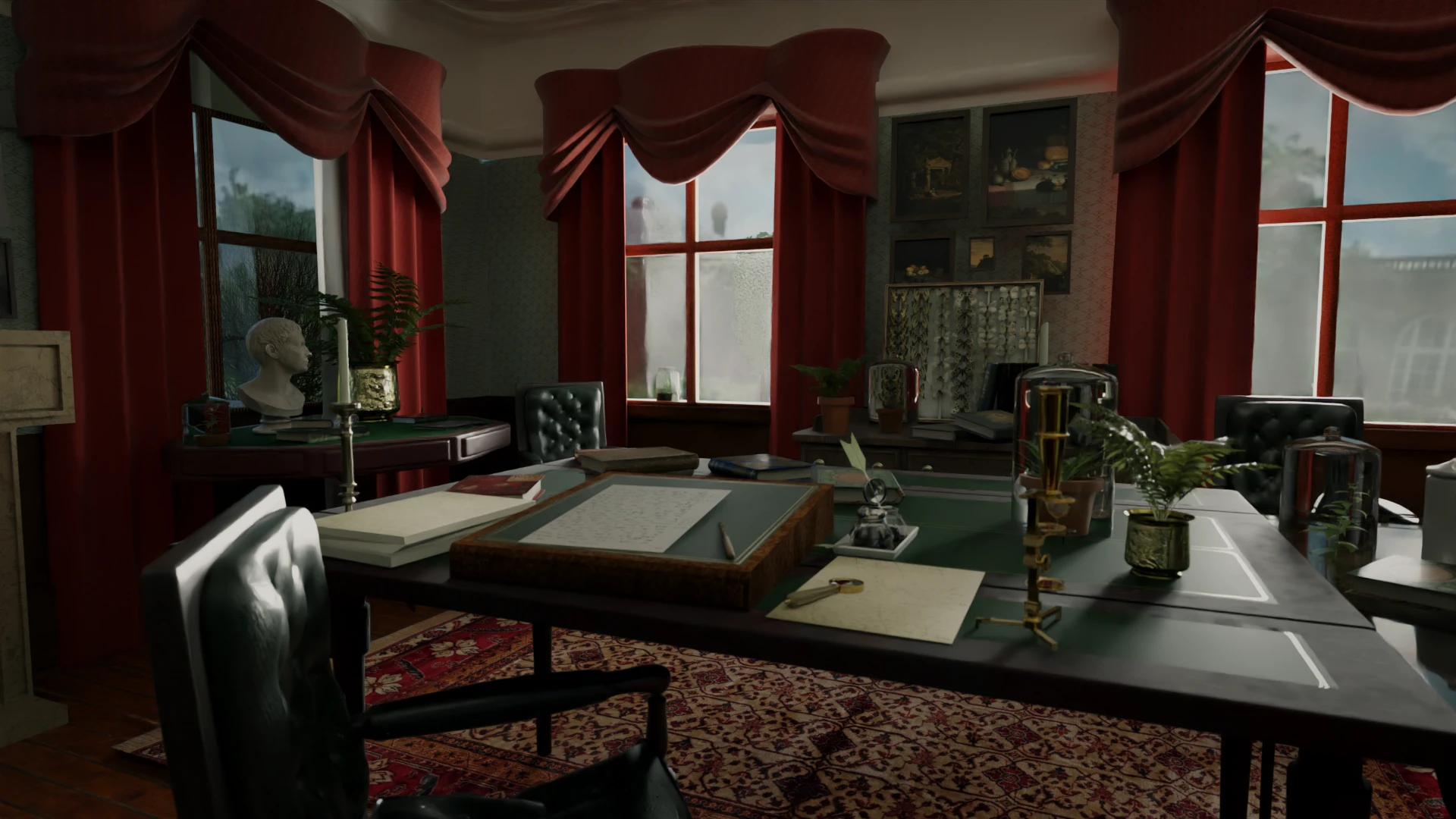
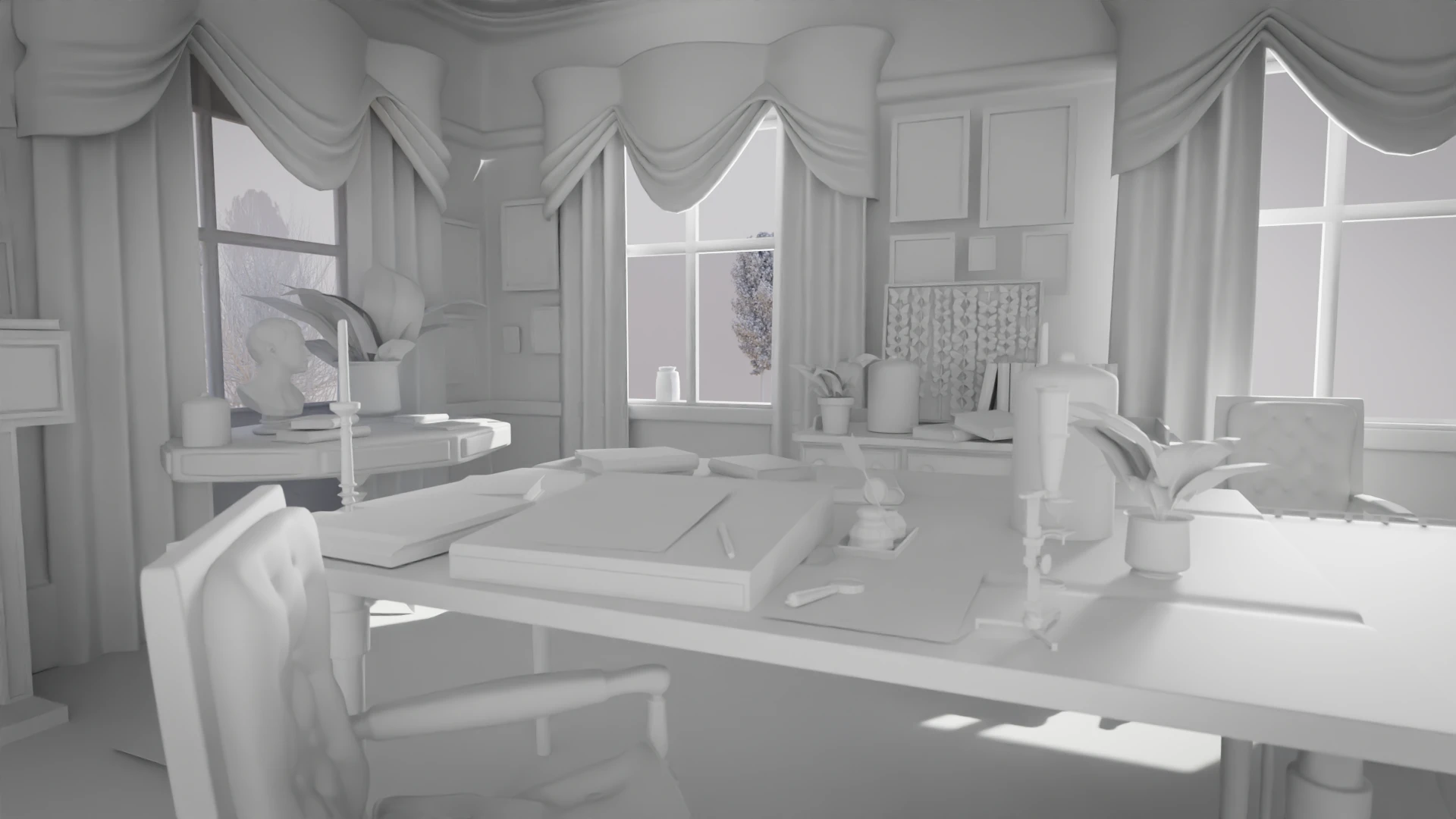
Putting this item in context is interesting. This also is the period in which Charles Darwin was beginning his academic career. As an thinly veiled hommage (and also because I couldn’t find a decent reference), I took the drawing that is passed as the one of Darwin’s office and tried to imagine it a few years earlier to accomodate the dates.
I know, I know. It is apocryphal, and I have no notion if the two men even knew of one another’s existence !
Cabinet de curiosités
Where we learn what happened to the sphinx.
Now that we are a lot more informed about the terraria ancestor, we need to talk about the unsung hero of the story: the young sphinx moth that most probably gave its life in the name of scientific observation.
But then, the improbable happened !
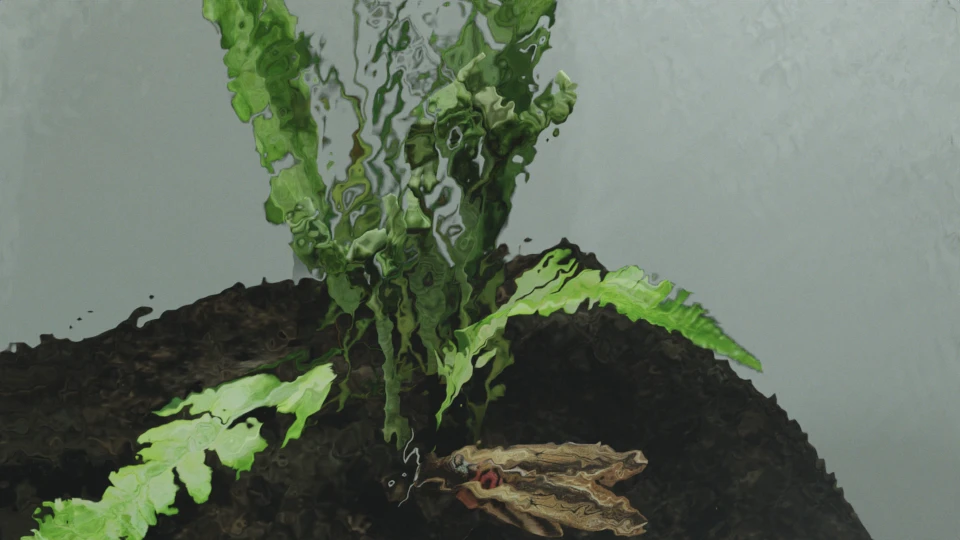
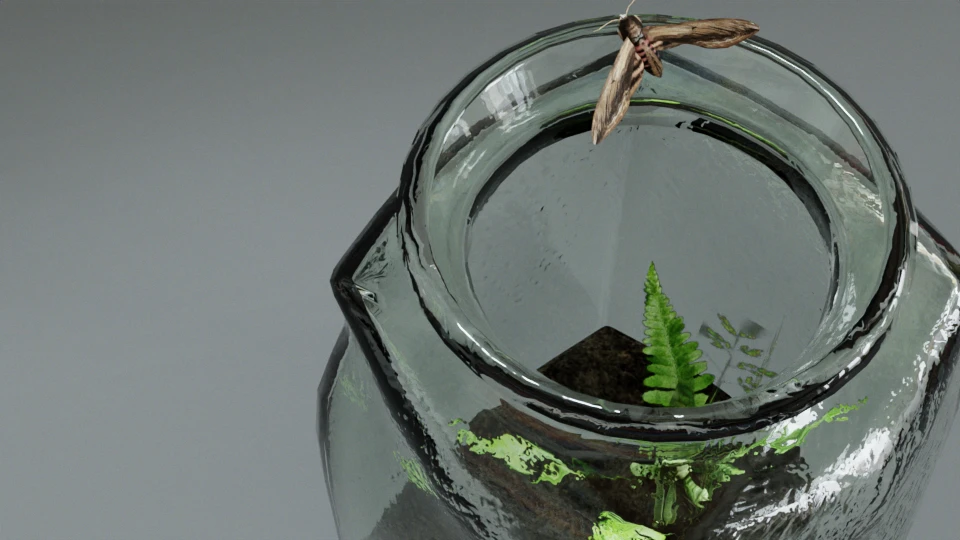
I like to think she* has then been living her best life in a nearby garden.
(*yes it’s a she, see credits!)
Credits
Dryopterix filix-mas original image from Stefan Lefnaer , via Wikimedia Commons

Wall paper, turquoise and gold, Victorian and Albert museum
The Childhood of Jupiter, Relief, ca. 1850 – ca. 1900, Victorian and Albert museum
Gilbert & Sons Compound Microscope (No. 147 ), ca 1818, Golub Collection, Berkeley University
Unless otherwise mentioned, all images credit to LGS.
Still Life with Cheese, Floris Claesz van Dijck, c. 1615, Rijkmuseum
Wooded Landscape with River, Johan de Lagoor (attributed to), 1645 – 1680, Rijkmuseum
Arcadisch landschap met ondergaande zon, 1792 – 1809, Daniël Dupré, Rijkmuseum
Carpet, c.1855 (made), Hyderabad, knotted silk carpet, inv. 0739(IS), Victorian and Albert museum
Sphinx ligustri (female), by Didier Descouens – Own work, CC BY-SA 4.0, via Wikimedia Commons