

Blue crocodiles are very good listeners
The following texts and images are the results of a training exercise to go from the pictures or the description of an artefact to the creation of a 3D digital double, sometimes restored version of it. If you wish to know more about the process, explanations are in A journey into learning a (3D!) restoration process workflow article.
Today, let’s delve into Mayan territory for a quest to learn more about the elusive yet glorious blue crocodile and try to model one. Spoiler alert: there will also be a hint of chocolate!
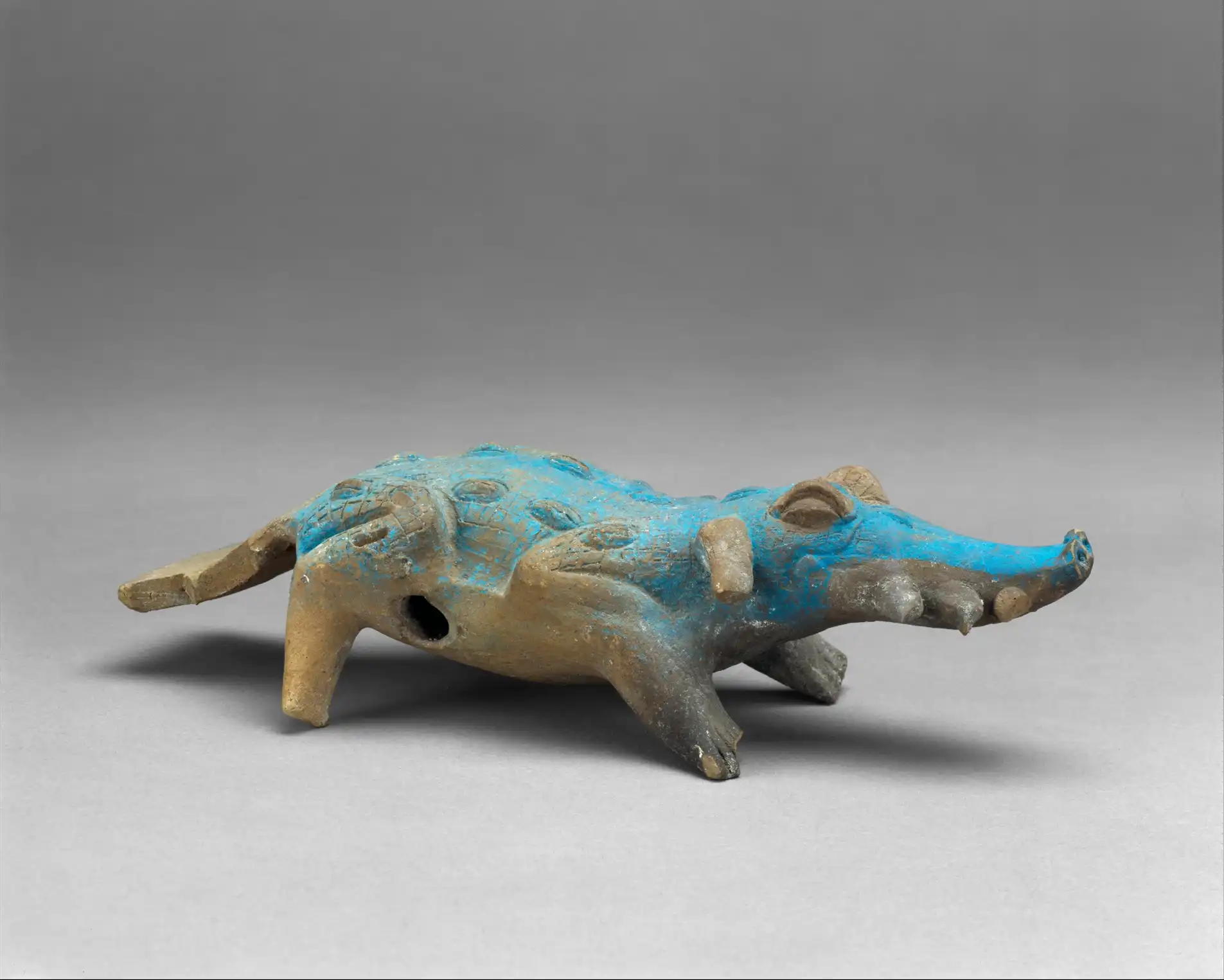
Title: Crocodile whistle and rattle
Datation: 700-800
Provenance: Mexico, Mesoamerica, Jaina?
Dimensions: H 5.1 x W 8.5 x P 18.7 cm
Media: Ceramic, pigment
Source image: INV n°1979.206.1143, Metropolitan Museum
Description and Historical context
Crocodiles are not monsters!
Zoomorphic representations on paintings, reliefs, sculptures, or ceramics are well documented in the Mesoamerican world. They often borrow traits from different animals to create composite fantastic beasts. Deers, peccaries, monkeys, felines, or fish are among the most common.
The crocodile figure is rare. It has a deep meaning in Mayan culture that has long been ignored by scholars, though commentators from the XVIth (Diego de Landa) and the XVIIIth centuries (Lizana) noted that they were revered. Recent studies have shown that the Mayans, living near these dangerous neighbours, were definitely using these powerful creatures as iconography sources. Moreover, figures long identified as “monsters” are nowadays more and more re-described as of crocodilian descent. Other species, like sharks, suffered the same academic despise though most likely being an important part of the Mesoamerican groups’ system of beliefs.
Forces of Nature, crocodiles are seen both as destructors and creators in the Mayan world. Their semiaquatic lives make them both part of the world of humans and the world of water, itself related to the underworld. The crocodile is part of the Mayan cycles’ cosmogony epic stories that ultimately involves the Hero twins.
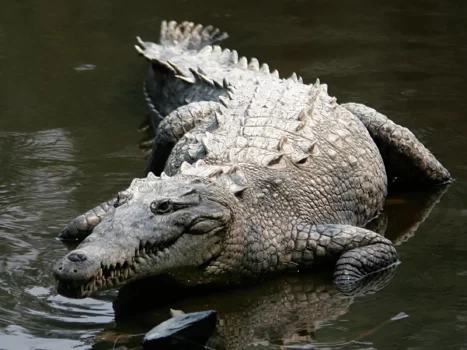
Drifting, motionless, in the water, crocodiles look like (deadly!) floating wood. It seems the Mayan went a step further: look at the scales and scutes of the skin from the side. Doesn’t it look like the outlines of a landscape, with mountains, valleys, and plains?
The crocodile embodies the Earth beast, the “surface of the earth floating on the primordial sea of existence (the fiery pool)” (Thurston, 2011). It is the middle kingdom between the celestial heavens and the dark waters of the underground. From this earth sprouts maize and vegetation, giving humans a home and means of subsistence. Scholars note that the Mayan were fully aware and respectful of the ecological balance their civilization needed to survive. The success of their crops relied on canals maintenance and pest control, in which an apex predator like the crocodile plays a key role.
Here, the animal that inspired the main part of the piece is most likely Crocodylus acutus, the American crocodile or its cousin, Crocodylus moreletii. With ears. Because they are very good listeners?
Or maybe deer and or peccaries were involved in the thought process of the artist!
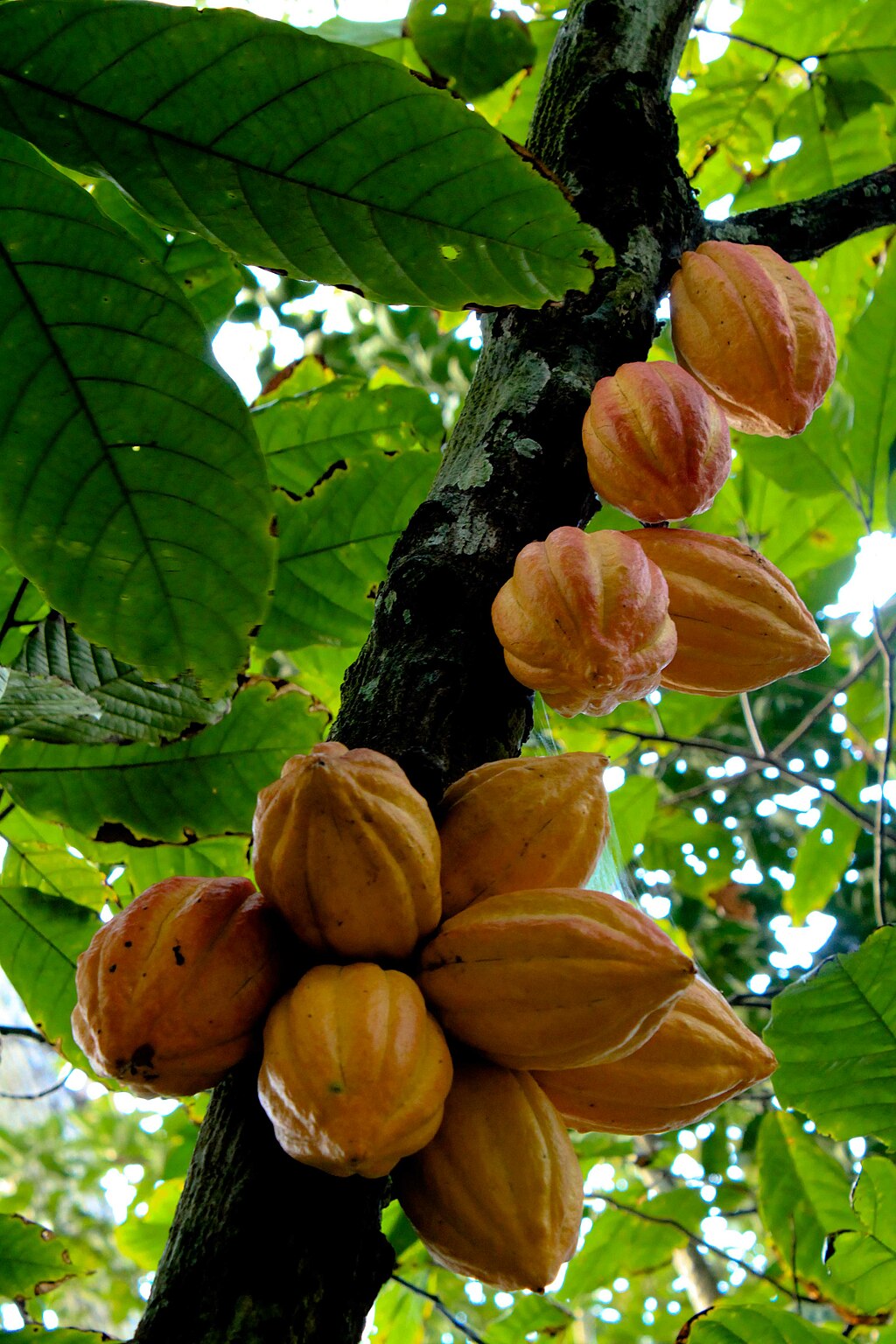
Scientific literature also underlines the cocoa pods shape of the main scutes on the beast’s back. This is a common motif and also refers to the duality of the creature as both destructor and creator. The role and social importance of cocoa in South American civilisations is still under hot debate within archaeological circles. It is way much more than a drink (sugary treats are a late 18th century western invention), it is a literal gifts of the gods and part of the economy and culture of the Mesoamerican societies.
Jaina?
This artefact is sourced in the 2010 exhibition publication “Fiery pool: the Maya and the mythic sea” at the Peabody Essex museum as coming from the “artificial” necropolis island of Jaina. This information is not repeated on the Metropolitan museum’s site. The piece is traced up to 1965, in the private collection of the antiquity dealer, Everett Rassiga, and then on loan to The Museum of Primitive Art in New York. I suspect the original acquisition contexts are “unknown” and that the curators of the exhibition did a typology sorting to ascertain the Jaina hypothesis.
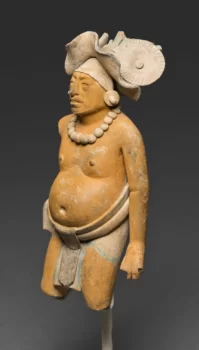
Jaina is known as one of the Mayan elites burial site. The necropolis excavation has unearthed numerous orange clay figurines, renowned for the details and delicacy of their features. These sculptures are almost exclusively representing humans, from all parts of Mayan society, maybe effigies of the deceased and their world. Animals’ representations are said to be extremely rare. Blue paint is commonly present on these funerary artefacts along other ochre and red colours.
Many of these figurines can serve as whistle and rattle, just as the one we’re interested in, with pellets hidden in the hollow clay structure. This is reminiscent of slide whistle. The musician head goes back and forth to move the pellet inside. It modifies the channel length, making different bird-like sounds. So far, it is unclear what role these elements had in Mayan rites, funerary or otherwise.
Maya blue
One of the most intriguing part of the artefact is the vibrant blue colour on its back.
Chemical mystery solved
This pigment was identified in 1931 on wall paintings in the temple of the warriors in Chichén Itzá. Described in 1942 as “Maya Blue”, it presents rare resistance capacities to almost every alteration factors known (thermal or chemical). There is a slight variation in turquoise hues in the overall corpus of pieces identified, ranging from darker blues dominant to ever so gentle greens undertones.
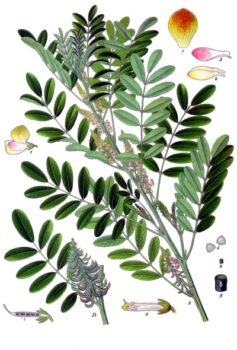
It was in the 1960s that different analysis concluded that the colour is the compound results primarily of indigo leaves dyes (Indigofera suffruticosa) and palygorskite (a type of clay).
The botanic determination of the colour source is now being researched. Projects involving local artists have put forward other local plants that have a blue hue when used as dyes, such as Lonchocarpus sp., Justicia spicigera or Commelina sp..
Symbolism
The blue powder is described in XVIth century De Landa’s “Relación de las cosas de Yucatán”. The Spanish inquisitor gives his version of the Mayan rites. He describes blue pigment being spread on altars and sacrifices, whether human or objects.
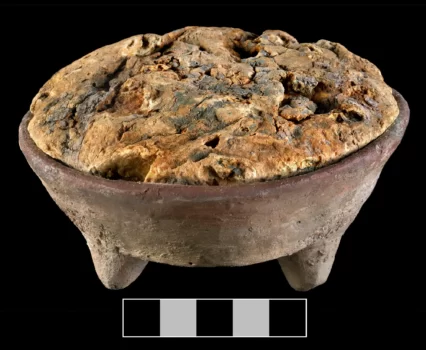
It is not clear what role Maya blue really had, though it has been proposed the colour linked it to the water and with healing and appeasement properties for the gods. The cenote of sacrifice at Chichen Itza has a layer of blue pigment deposited at the bottom. It detached itself from the sacrifices and settled. It has been identified as Mayan blue.
In 2008, anthropologists from Wheaton college and the Field museum made a discovery as to how the pigment could have been made. They used the chemical analysis of the content of an incense burner from the museum’s collection, among other elements, to do so.
They suggest that the very creation of the pigment was ritualistic and part of the sacrifices ceremonies. The powdered dye and clay were mixed with copal incense (maybe from Protium copal) and a slow and continuous low heat apply. I was not able to find a definitive description of the result. I imagine it would be a thick slurry that can be spread and painted warm. It would also be brittle once cooled down and can then be ground into a powder.
Visible condition report
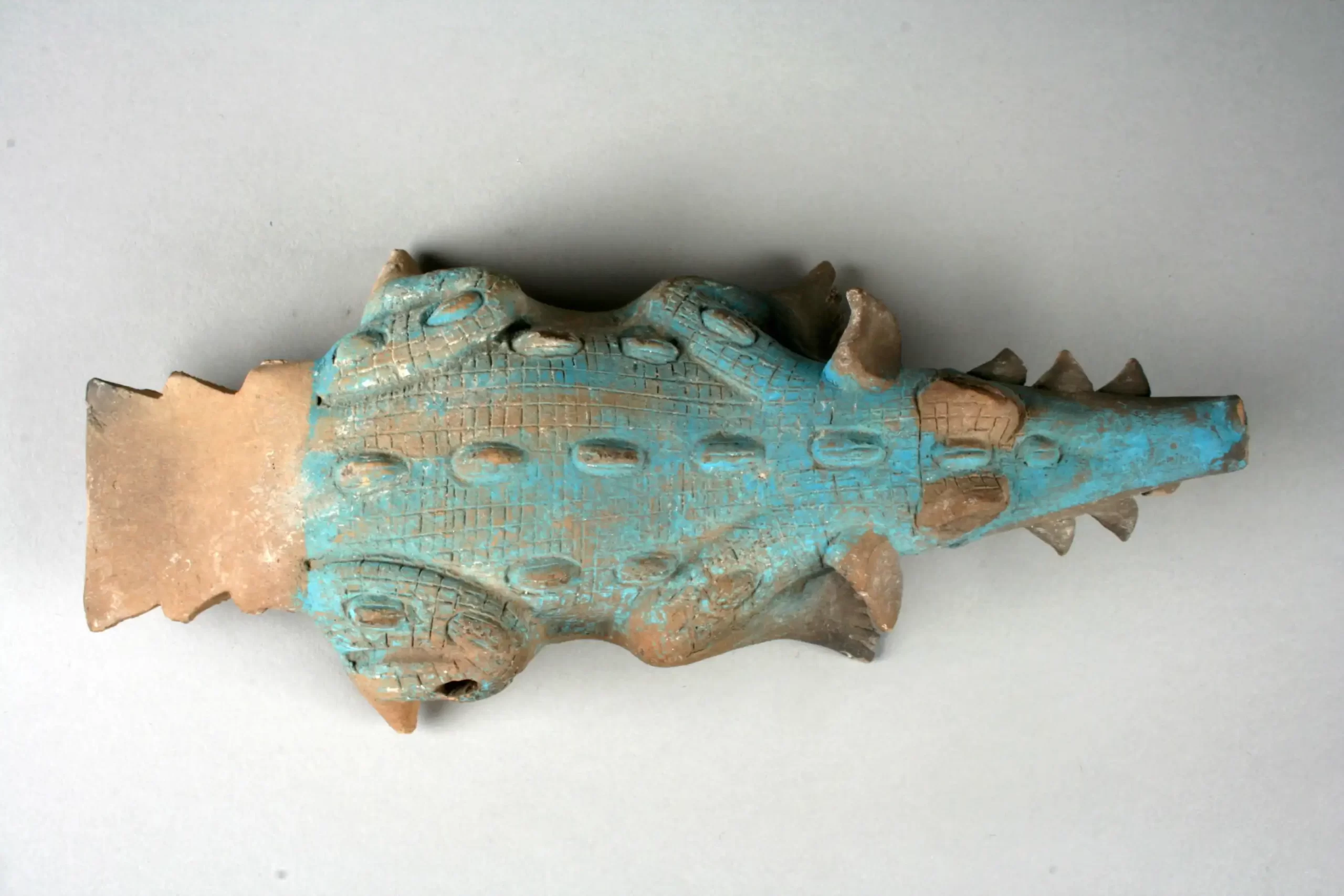
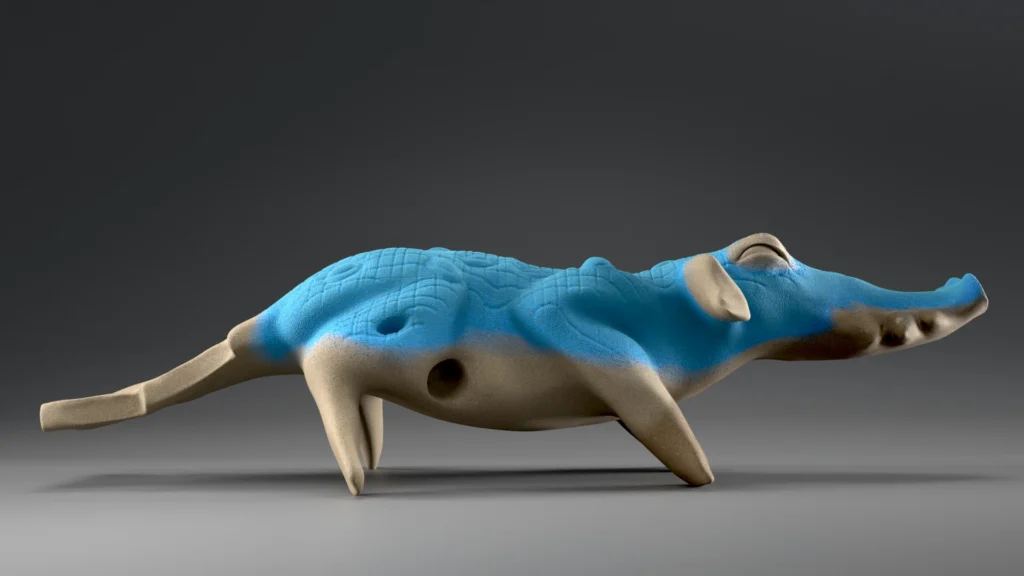
The piece shows a crocodilian looking creature on its four feet, in a walking posture, body mass up in the air. The tail is short, only a third of the body length. The artefact stability is maintained by the inside of the paws.
The top part of the figurine is adorned with reliefs and motifs to mimic the scaly hide with rows of ossified scutes of a crocodile. The latter are incised with shallow parallel lines.
The right forelimb is missing part of its toes. The smaller tooth on the right side seems broken.
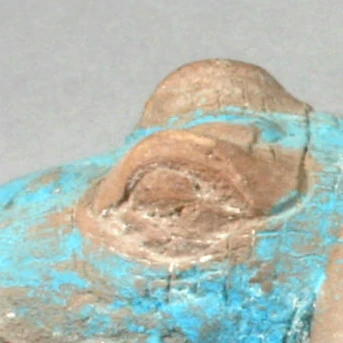
The whole body is not symmetrical; there are slight differences in the features and decorations. A striking difference are the eyes. I’m not sure if it was deliberate or if part of the left lower eyelid broke, or if it is a trick of the light on the reference images. I can but hope I’ll be able to go see the figurine myself someday to better assess the situation! Or maybe one of you, dear reader, have more information on the subject.
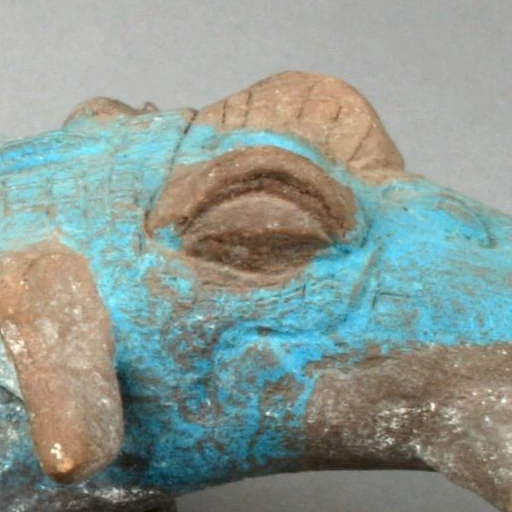
As mentioned by archaeology literature, the base shape may have been moulded or formed with patches and slabs of clay. Coiling methods do not seem to have been present in the area at the time. Then the smaller elements and decors were handmade and added, hence the substantial differences. A large dark shadow (kiln flames related?) is visible on the front side of the piece, under the throat and snout.
The missing elements as well as the surface alteration may have similar causes. Mayan ceramics use a low fired orange toned clay body that remains susceptible to water and therefore biology based alterations. The geographical situation and the burial site provenance hypothesis could corroborate that.
There are two visible holes: one on the right thigh and in front of it, on the belly, at ankle level. The museum’s description adds that there is another opening present, underneath the animal neck though I was not able to obtain a picture of it.
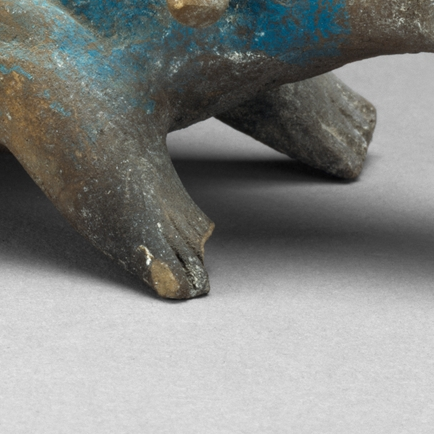
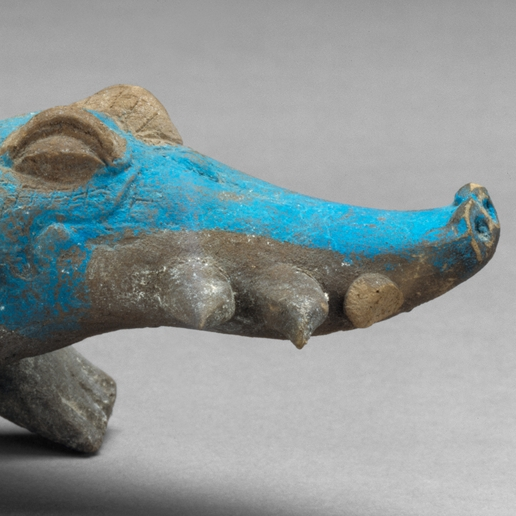
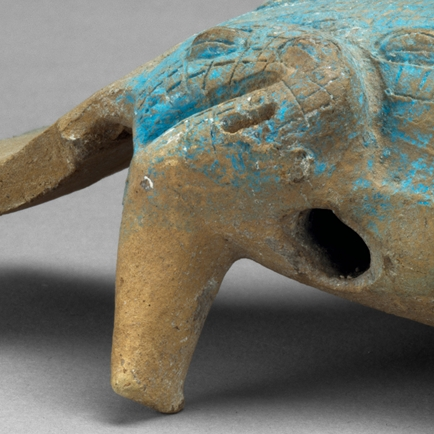
The top part of the body is covered in a blue powdery layer, down to approximately the top of the forelegs. This colouration is not present in the most salient parts, where it may have rubbed off. On parts like the protruding eyes and floppy part of the ears or the tusks-like teeth and the tail, it seems it was never present, as there are no signs of it even in deeper incisions.
The colour, identified as Maya Blue, is applied post firing: organic compounds would burn completely around 350°C and the open kilns or fire pits were run around 800°C.
As usual, it would be very helpful to have a true turnaround to model the piece on. Let’s try to create one from the pictures we have. We have sources for almost all sides, except the underside. One caveat though, we have low-angle side views of the figure. That means there is a warping in perspectives. Therefore, extracting true neutral side views won’t be straightforward. We will most likely need to make adjustments while sculpting.
Because we are once again dealing with artists with an acute sense of observation, I will also use images from crocodiles, deer, and peccaries to serve as references.
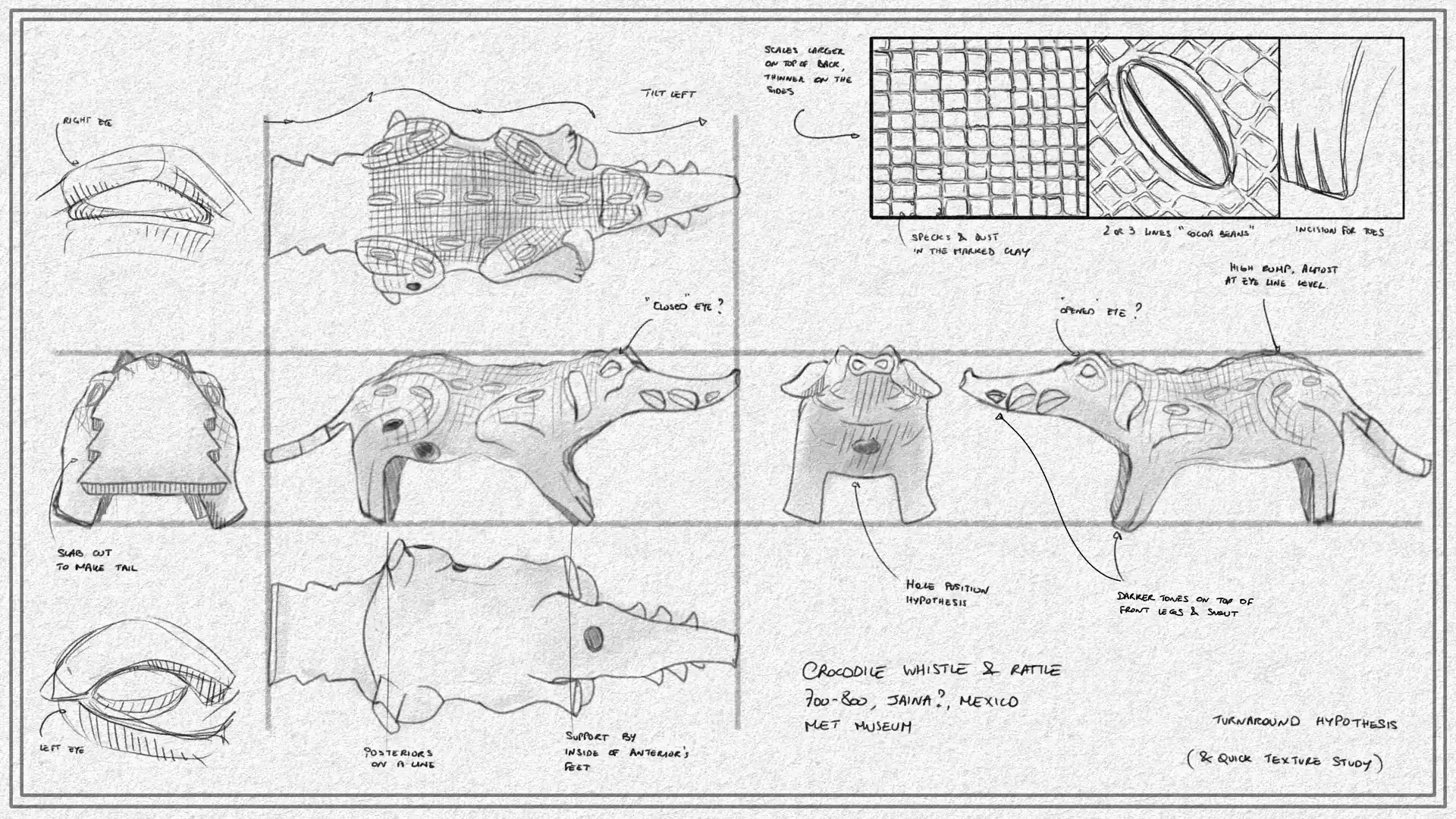
3D notes: a 3D reconstitution process
This is an exercise, shown for documentation purposes only
Now that we know more about the beast, how about trying to make a -loose- replica of it, filling in the missing parts and polishing the colour a bit?
Model the base shape
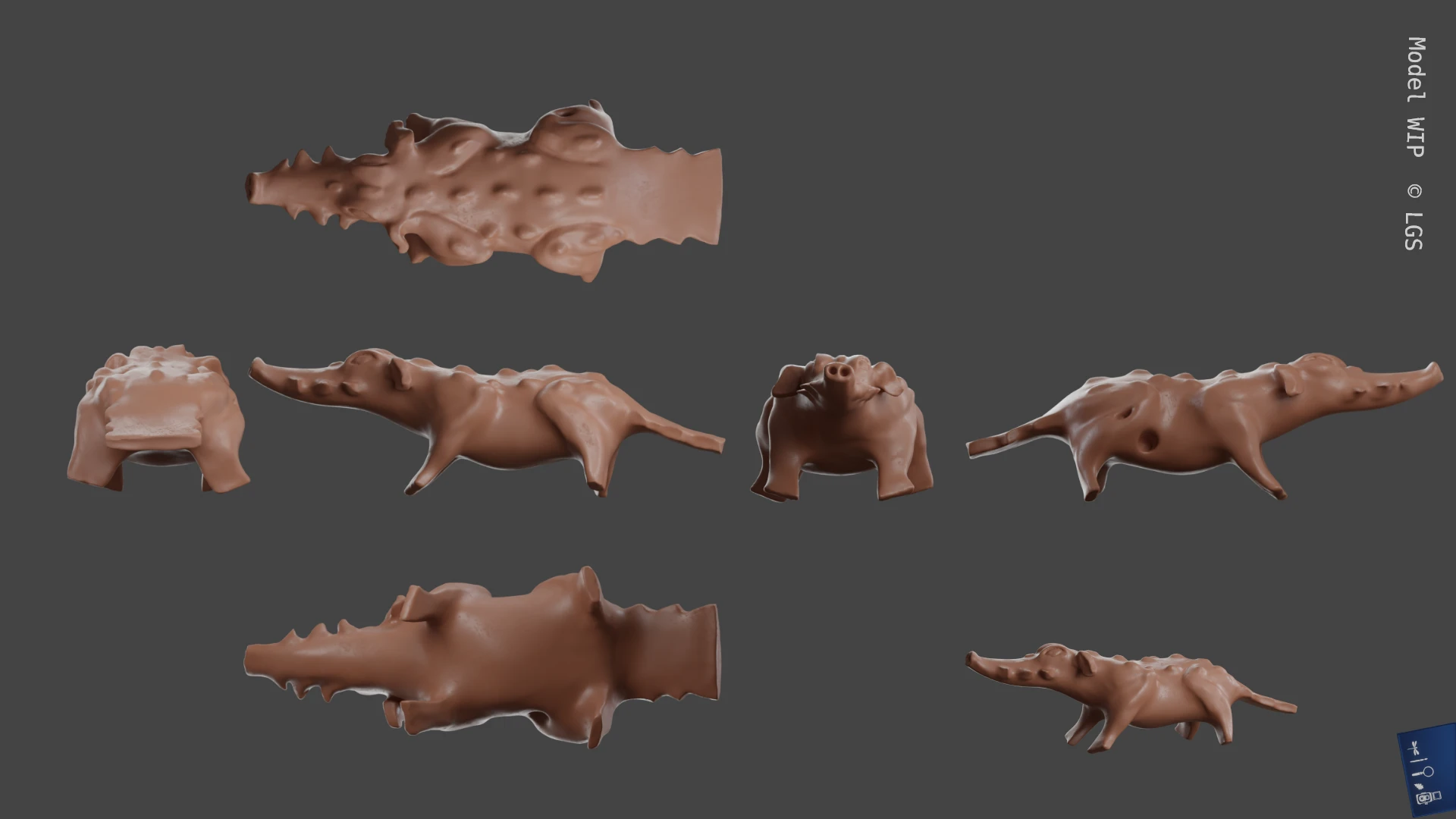
It is mainly a case of back and forth with the references and the sketched turnaround. As I rely on hypothesis, both sketches and sculpt were modified conjointly.
The face and back view (the jaw and the rear, to be more graphic) are missing entirely from our references. Hence, they were not created at first in the drawn turnaround. Despite a lot of trials, I was not able to draw an acceptable image of them. It is to be expected because, say it with me, “it is not an easy exercise at all”. Tell that to my frustration!
I had to use a render from the sculpt as a base to draw the outline and then iterate on that. The sculpt was wrong at that point: the nose was too high, the anterior limbs were to wide etc. It doesn’t matter: all I needed was the stepping stone of a volumetric idea of the shapes. Then, it was easier to draw these faces according to the references and try things out. The drawing exercise forces me to think about the volumes in order to render them properly. It’s just another way to study things. I know it’s not the fastest of paths but in the particular case of rendering a very peculiar and specific piece I find it helps me a lot.
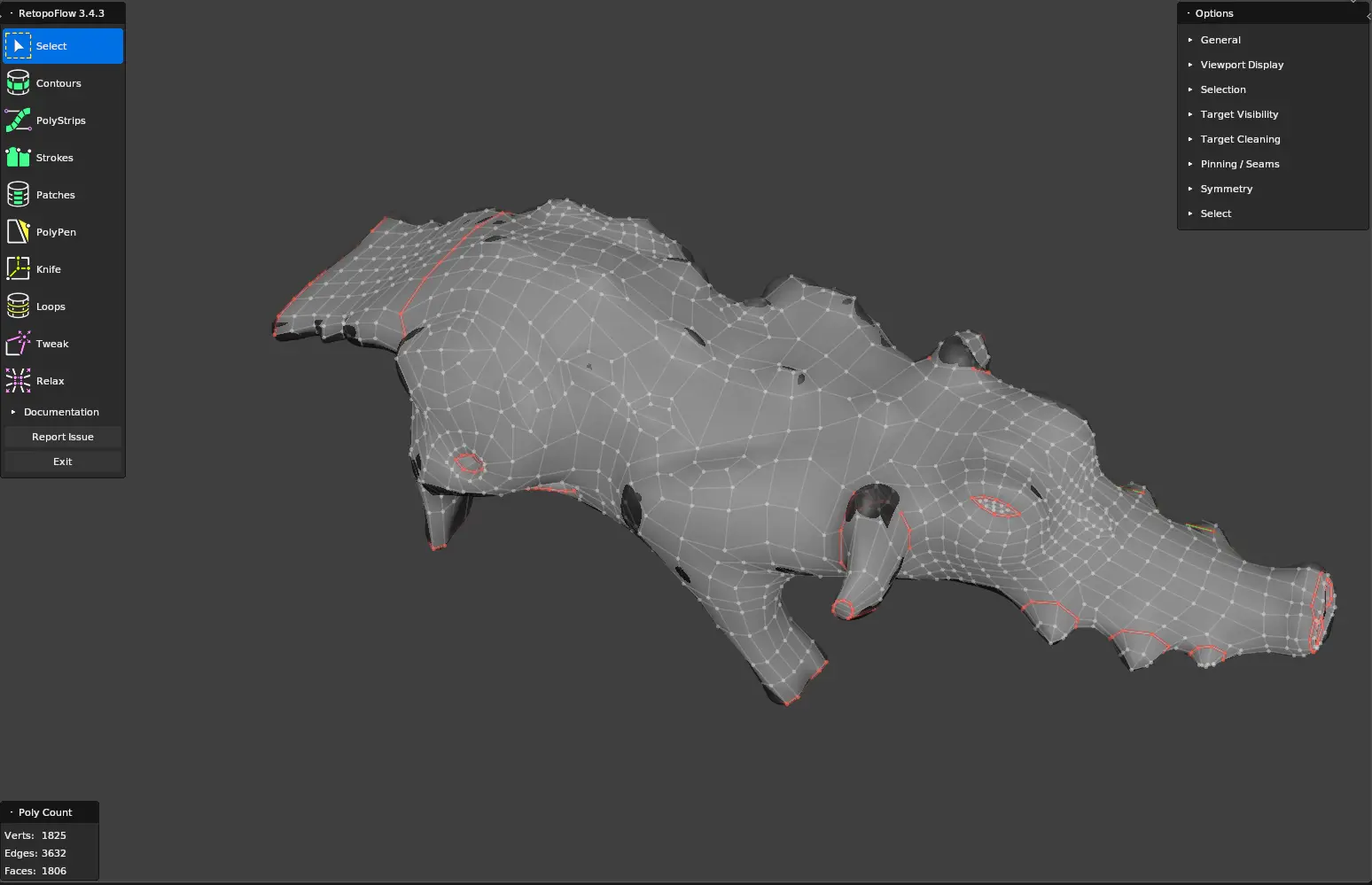
Now that the basic shape is done, I will make a “quick” retopologizing to go from 96834 vertices to a more amenable 2300. True, this was not a very heavy model to begin with, and I could probably have done without this step. Let’s call it ‘computer care’. Actually it’s also a way to rethink the shape and its flow as I retopo. I know it sounds weird, but it’s still a training exercise: taking the time to think and try is the whole process!
The rest will be henceforth dealt with using the multires modifier. I intend to try to make the model web-browser ready, so baking normal maps from the modifier will help keep the weight under control.
Texture the shape
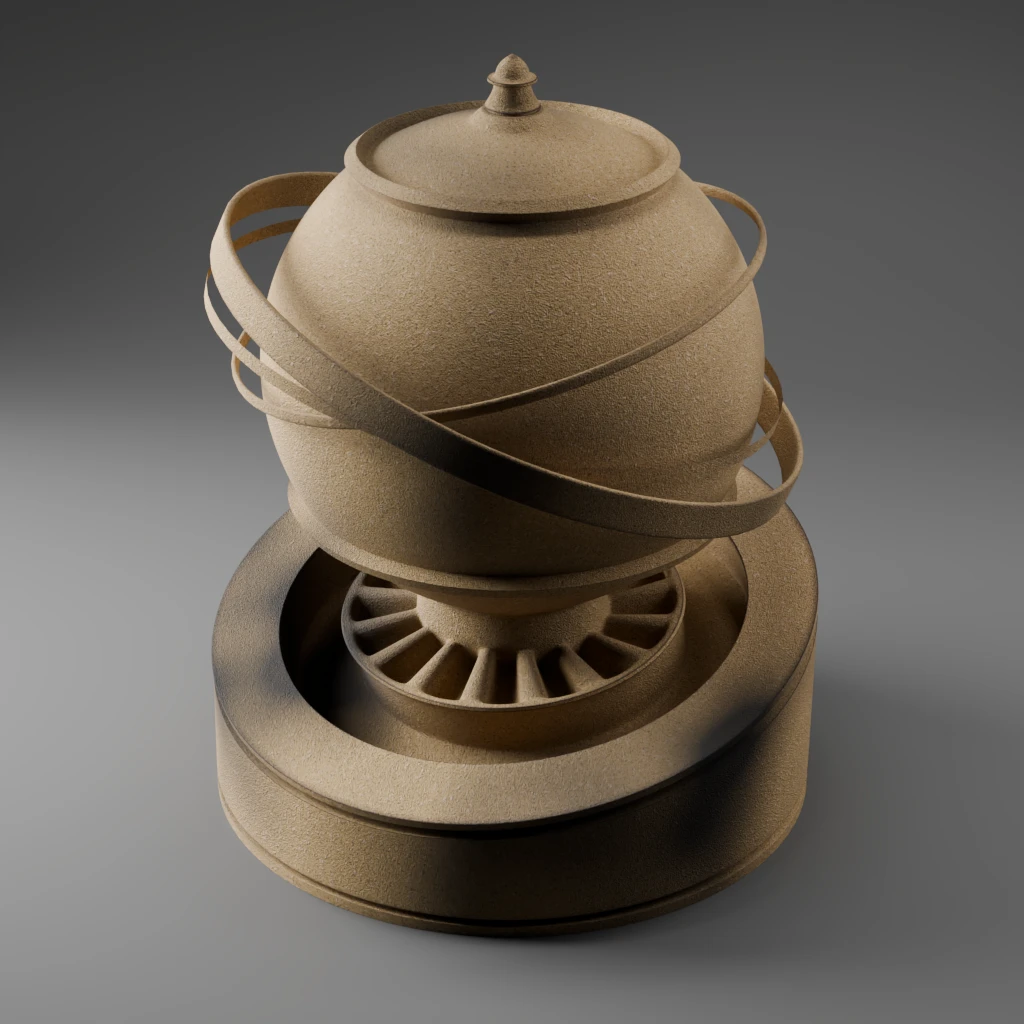
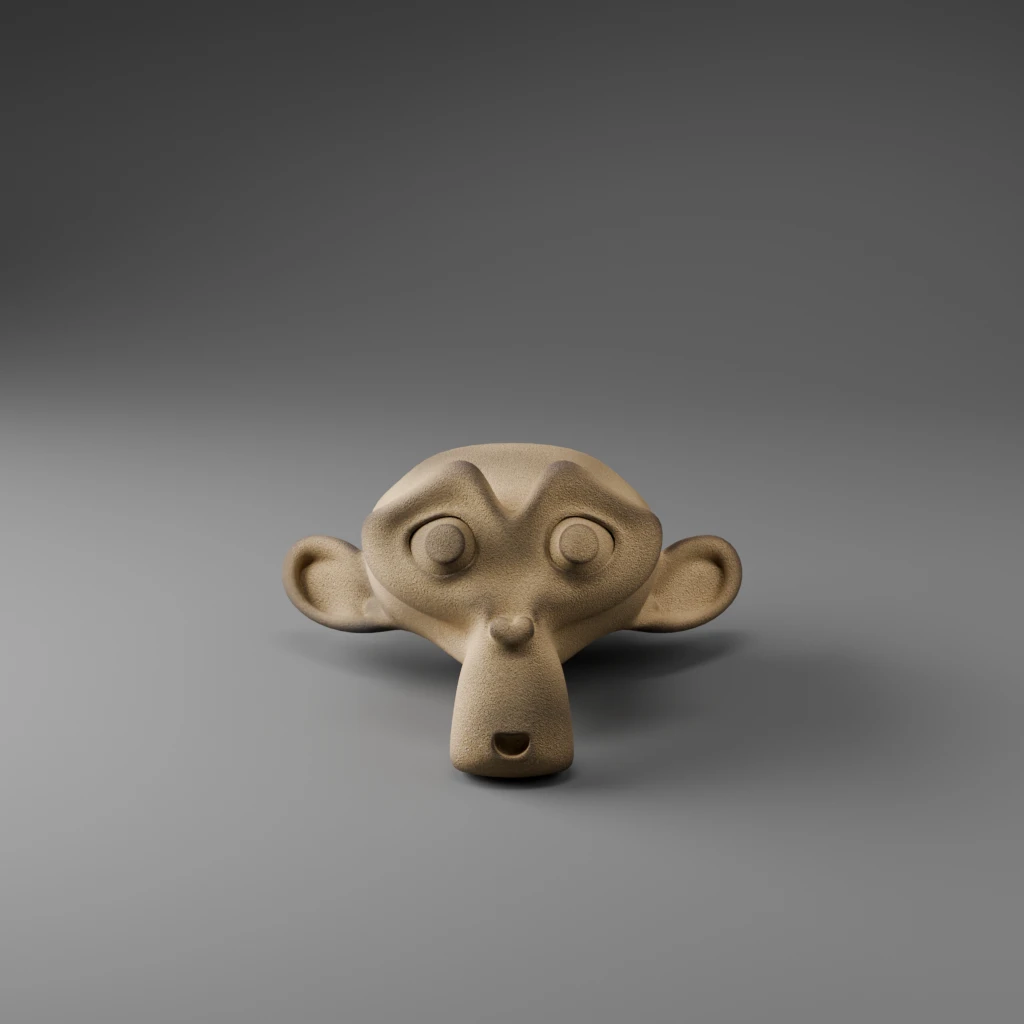
We need to create two textures: the clay body and the blue paint spread on top.
Clay body
Once fired, the clay body has orange hues, with grog and various tempers giving an ever so slight relief. On some pieces from the same corpus (in the Jaina hypothesis), it looks like the clay may have been polished once leather dry.
There are flames and kiln marks on the surface. I was not able to find information about the firing itself. I’m not sure Mayan potters were using saggars. The fire marks could be explained by a direct exposition to flames and fire soot.
Maya blue
The paint has a powdery opaque turquoise-blue texture, spread on the object uppermost parts and gradually fade over the shape.
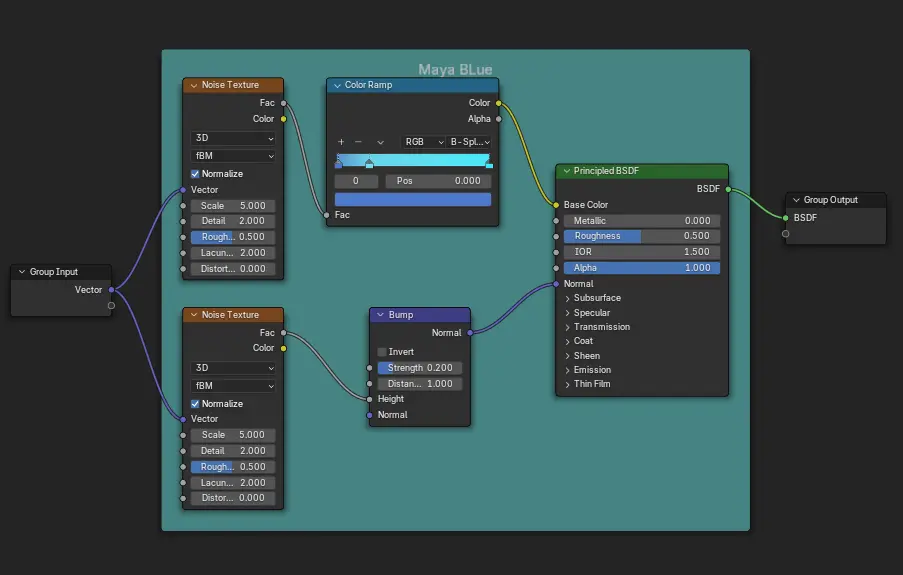
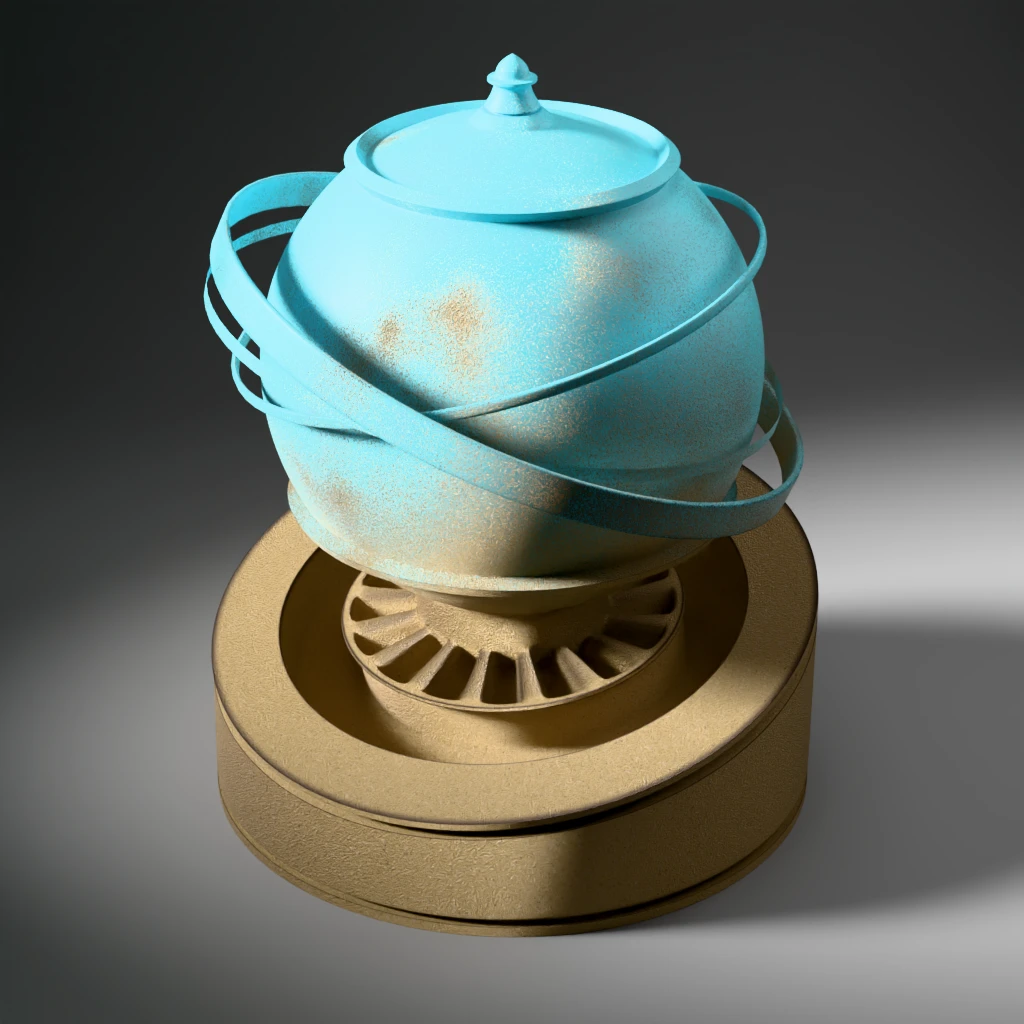
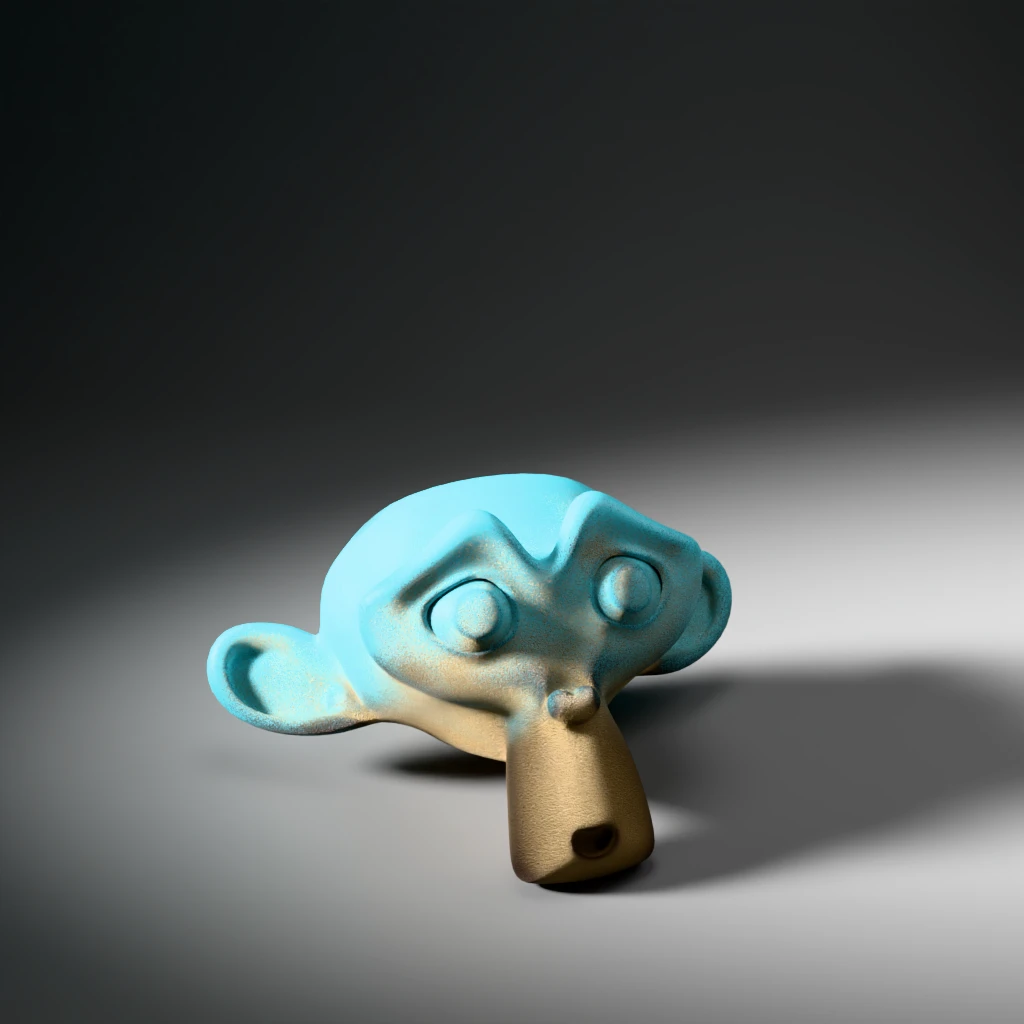
You may have noticed that parts of the crocodile are not covered in blue. The underside of the body, where the colour seem to gradually fade, springs to mind. There doesn’t seem to be any blue specks of colours below the elbows and knees: perhaps these parts were always colourless?
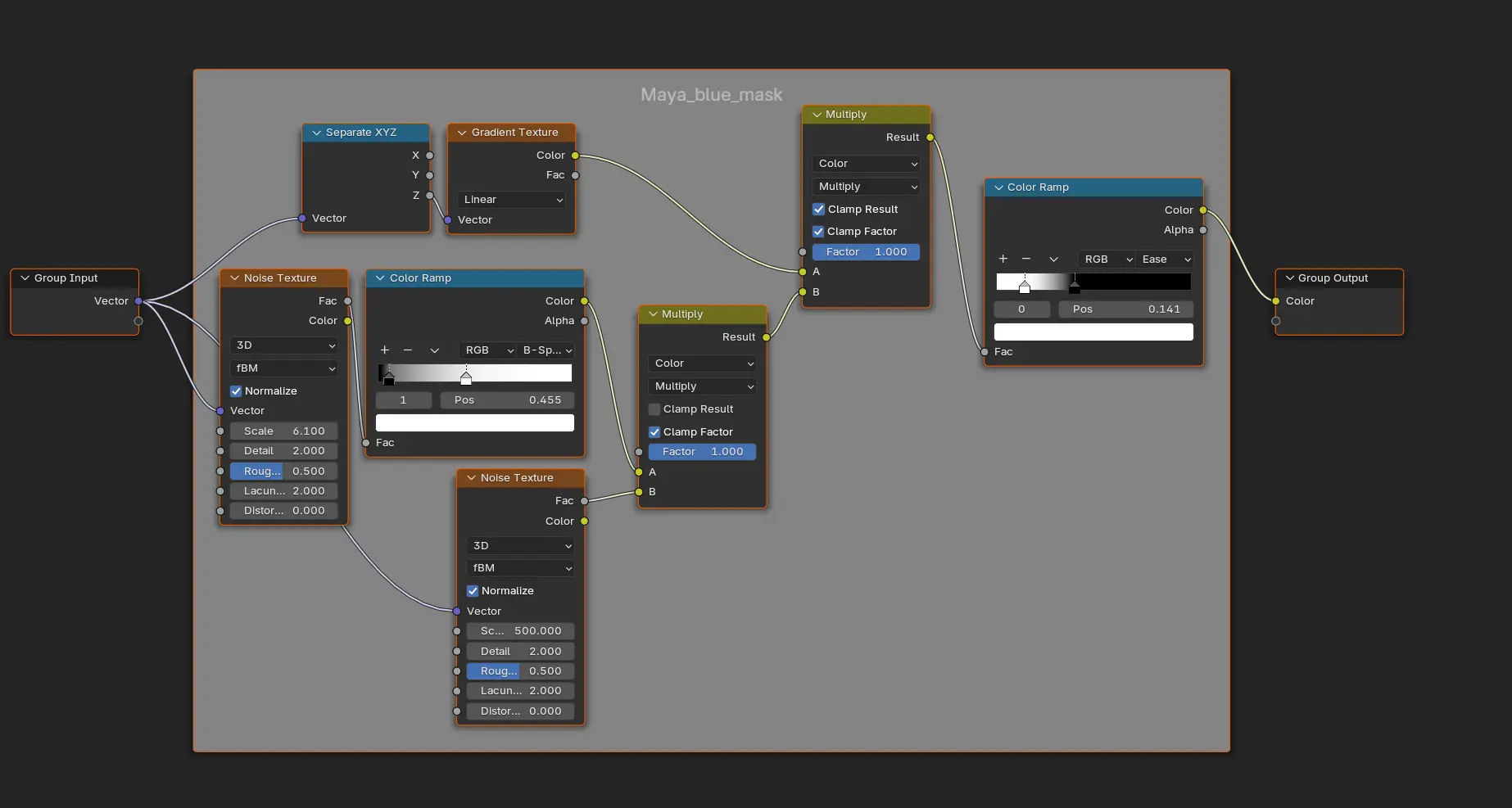
A variant of a gradient on the z axis should help with the heavy lifting.
However, on the eyes, the top of the ears, the teeth/fangs and the tail, the application of the blue seem to have been carefully avoided. There are clear and definite demarcations where the colour stops.
In order to accommodate for that fact, we need to tweak the mixing part of the node tree that decides where the clay body and the blue colour are seen. As this is an object-specific pattern, I think the easiest way to do it is to plug in a weight map and use its information to guide the shader.
Modelling and texturing all together now
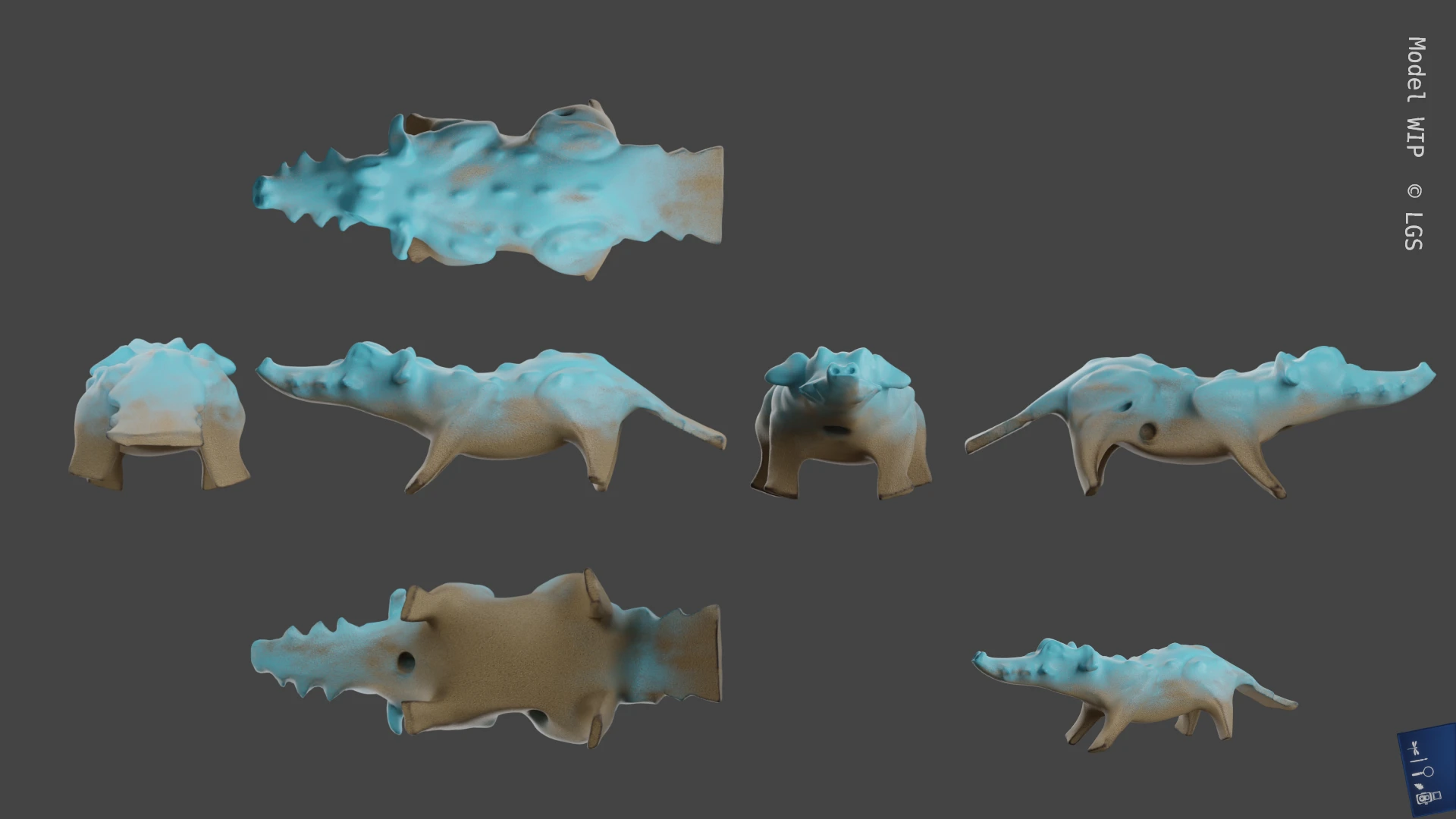
Lately, I’ve noticed a change in my workflow to create sculpts heritage pieces from image references. I used to sculpt first and texture later. Now, after I deem the base shape acceptable, I’m more and more creating at least a mock-up version of the final texture to try it on an automatic model sheet, as described by the Blender Studio.
The model sheet render is a good tool, particularly with a feel for the final render that, the blue coat in this project. It allows a quick comparison with the references.
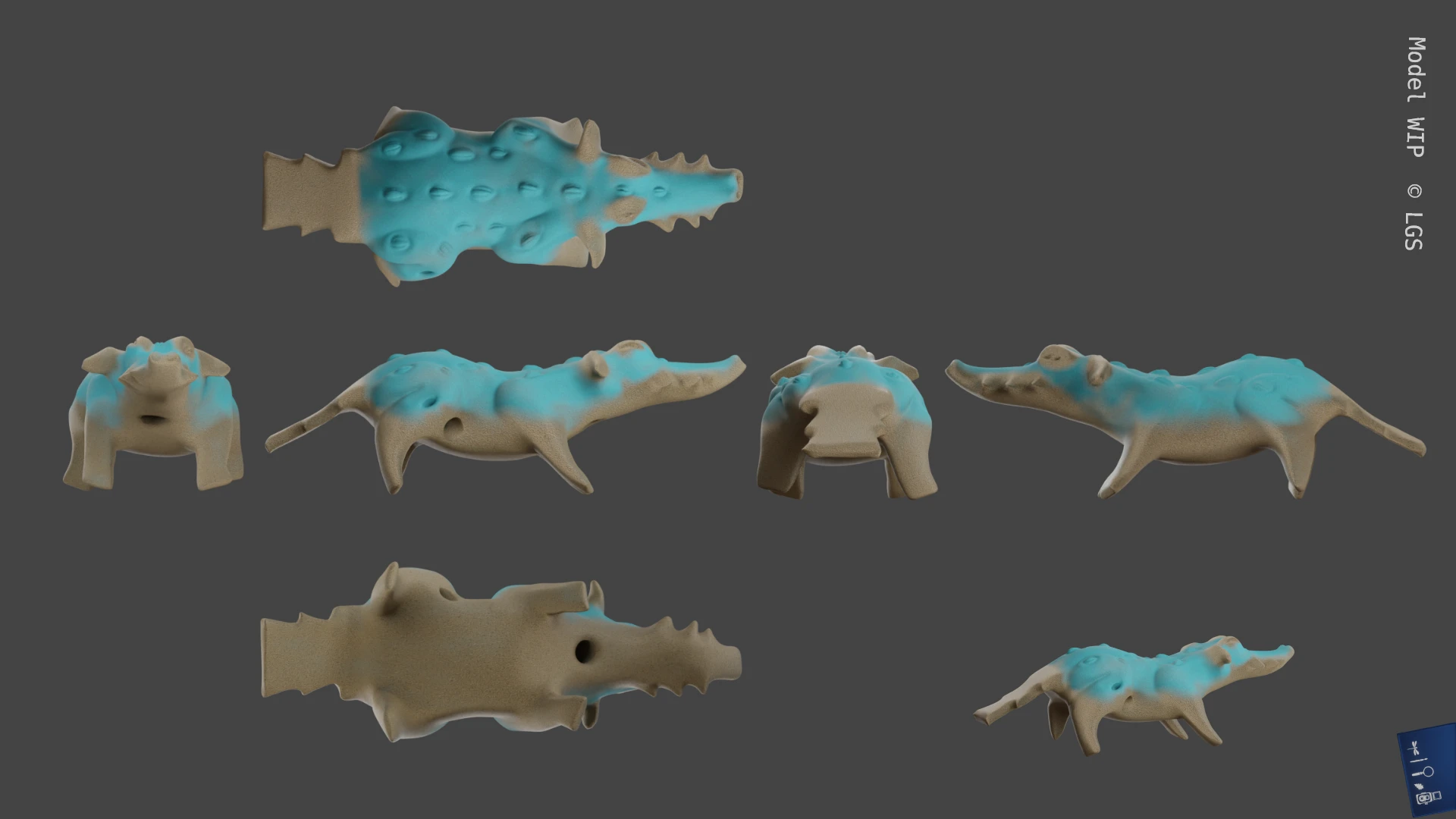
As I already noticed in other projects, the colour element is misleading and sometimes makes me project the volumes of the shapes wrongly. The colour pass on the sculpting piece underlines the issues immediately. It is unforgiving and kind of tough after hours spend sculpting just to see you’ve been wrong. I try to see it as a good way to progress and not make errors perdure until too late in the project. Because when it does, you can lose more than a few hours’ work!
For the record, I try to do this part the day after a sculpting session to keep as fresh an eye on things as possible. This way, I can assess what needs to be done (or re-done) in the next sculpting session.
Here, on this third iteration, I noticed a few details that do not match. The forelimbs’ articulations should be slightly further back and there should be a more marked demarcation with the neck. The feet could be slightly shorter and perhaps a bit larger?
The hindlimbs’ articulations should be ever so slightly higher, closer to the tail. The tail should be wider, more like on the second iteration. The tip of the tail should be more horizontal. The line of the back shouldn’t be that arched, the middle section should not dip that much. The tip of the nose should be more pronounced. The teeth must stand out a bit more. I have my roadmap for the next sculpting session!
This way of doing things also helps in finalizing the textures to create a cohesive piece, as respectful as it can of the original in an iterative manner.
I was not particularly happy with the Maya blue texture at that point. I’m still searching the turquoise: it needs to be both more intense and ever so slightly more blue. Yet there are others elements that struck me as missing. I think it needs some white specks presence. I don’t know if this is from the copal, the incense ash or from alterations, but there are some on the reference images. Overall, there seem to be some kind of powdery effect to the surface that is not reflected in the shader.
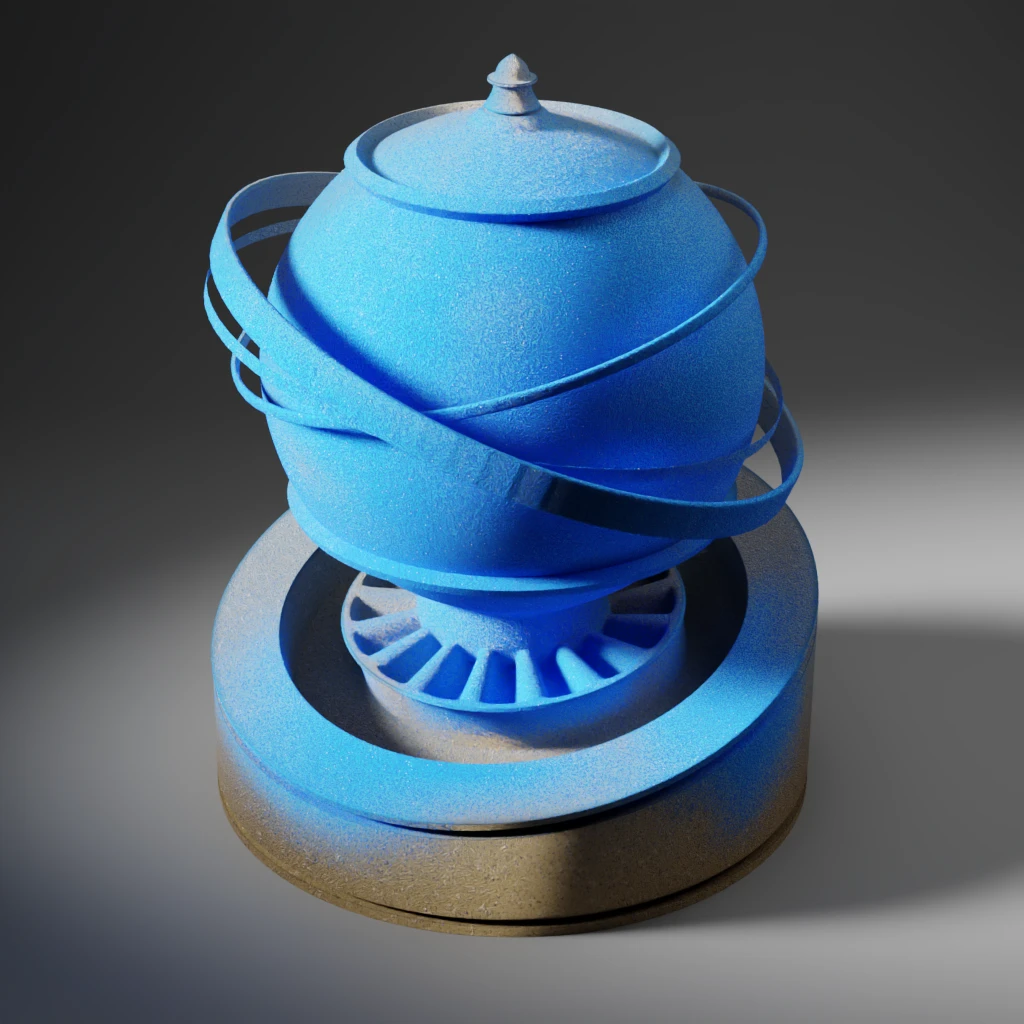
Enter geo nodes. I know, I’m putting them everywhere lately with various degrees of success. I thought it would be a good idea to try and see if I can create the powder effect with them, literally creating small particles to sprinkle over body of the piece and respecting the already existing weight map input.
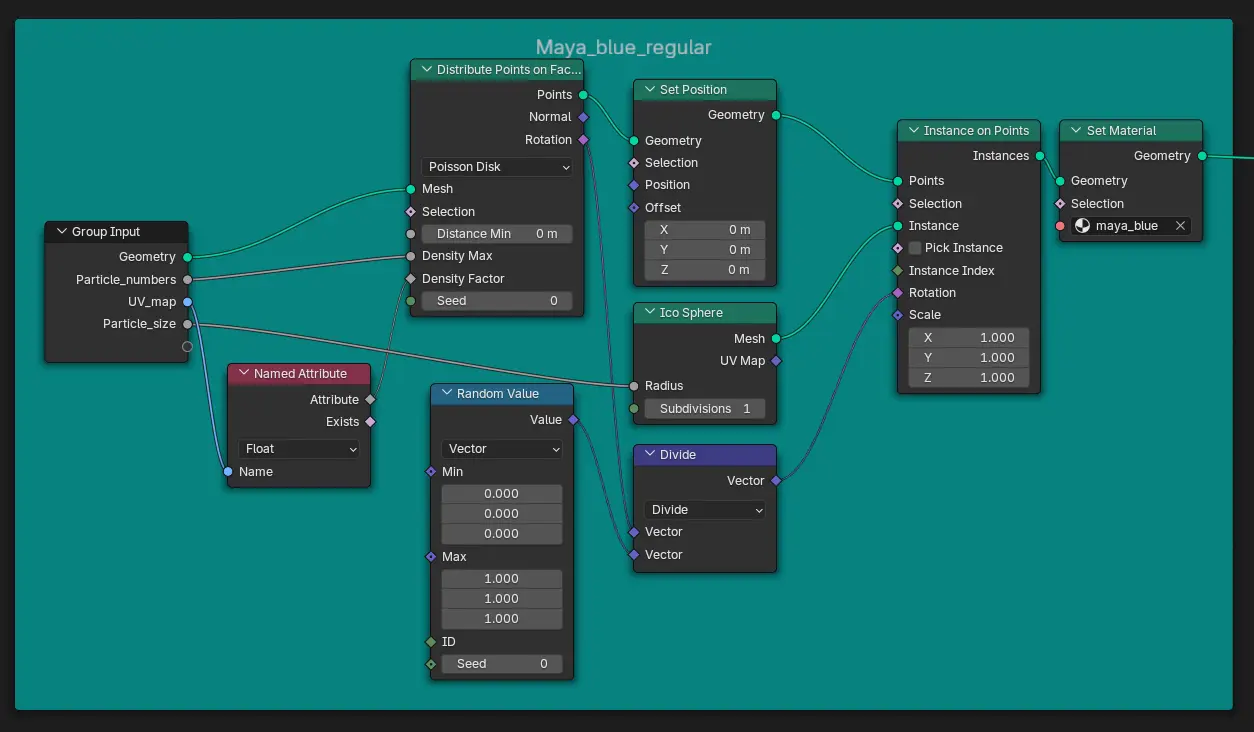
Something along those lines, though, according to the reference, the blue is still a little too green. I’m afraid I may also be hitting on one of the color management limitation, both in Blender and in my own setup. That could be dealt with in post-production.
The computation time is not that bad considering the number of tiny icospheres I’m asking the computer to create.
The web experience idea, however… Let’s cross that bridge when we get there!
Now, let’s try this new texture idea on the 4th iteration of the sculpt. The lighting setup plays an important part in the blue render effect.
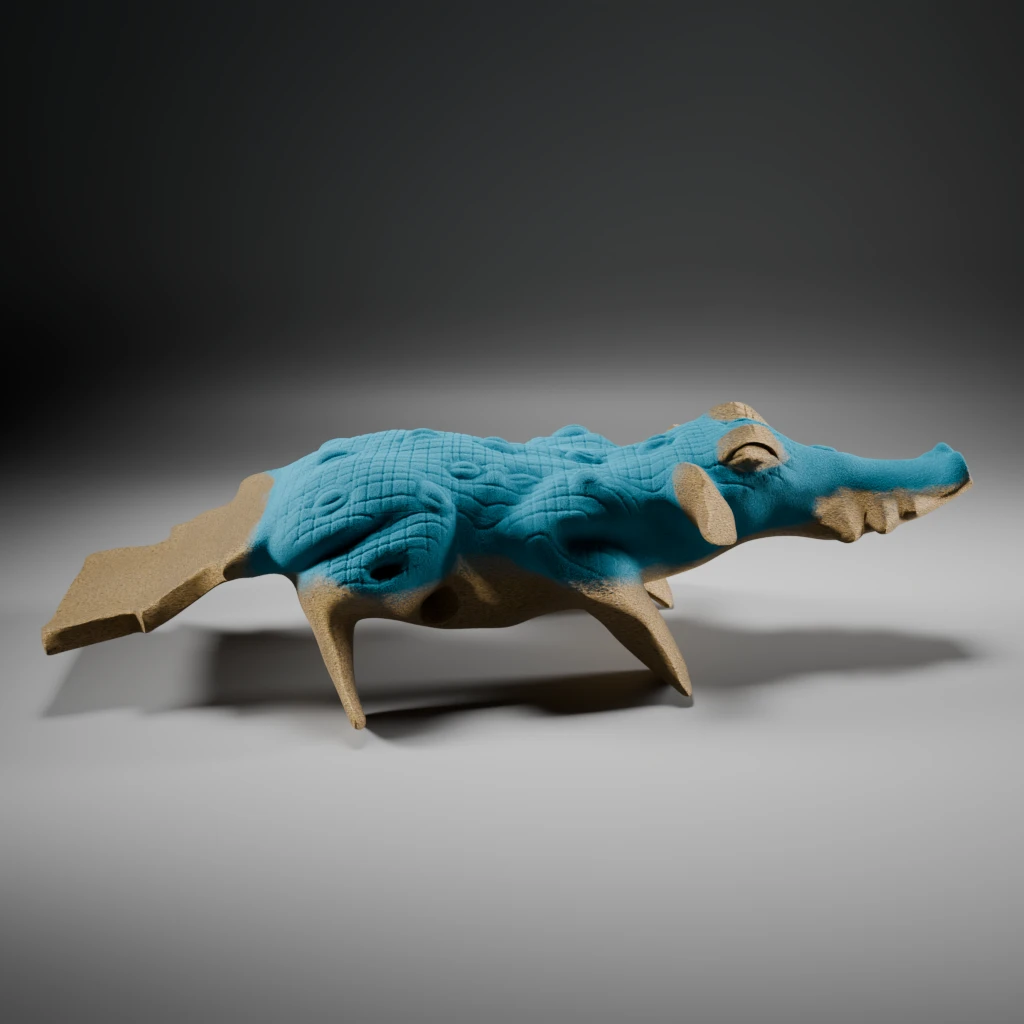
Getting closer but we’re not quite there yet. There is something askew in the back and the eyes are still a bit weird. The blue mask can also be improved.
As to the effect of the Maya blue shader combined with geo nodes, I am still not convinced. I did some further researches and I feel now that the powdery effect I thought I saw might be related to the underlying clay body as is clearer on this human figure from the Museo Nacional de antropologia in Mexico. Don’t get me wrong, the clay in the Maya blue recipe can give this powdery aspect but not as noticeably as in my geo nodes attempt.
Once again, I am faced with the difficulties of having to work with hypothesis because I can’t see the piece, or similar ones, with my own eyes. It’s part of the game but it still is frustrating sometimes! The bottom line is I may stick to using a texture only and no geo nodes.
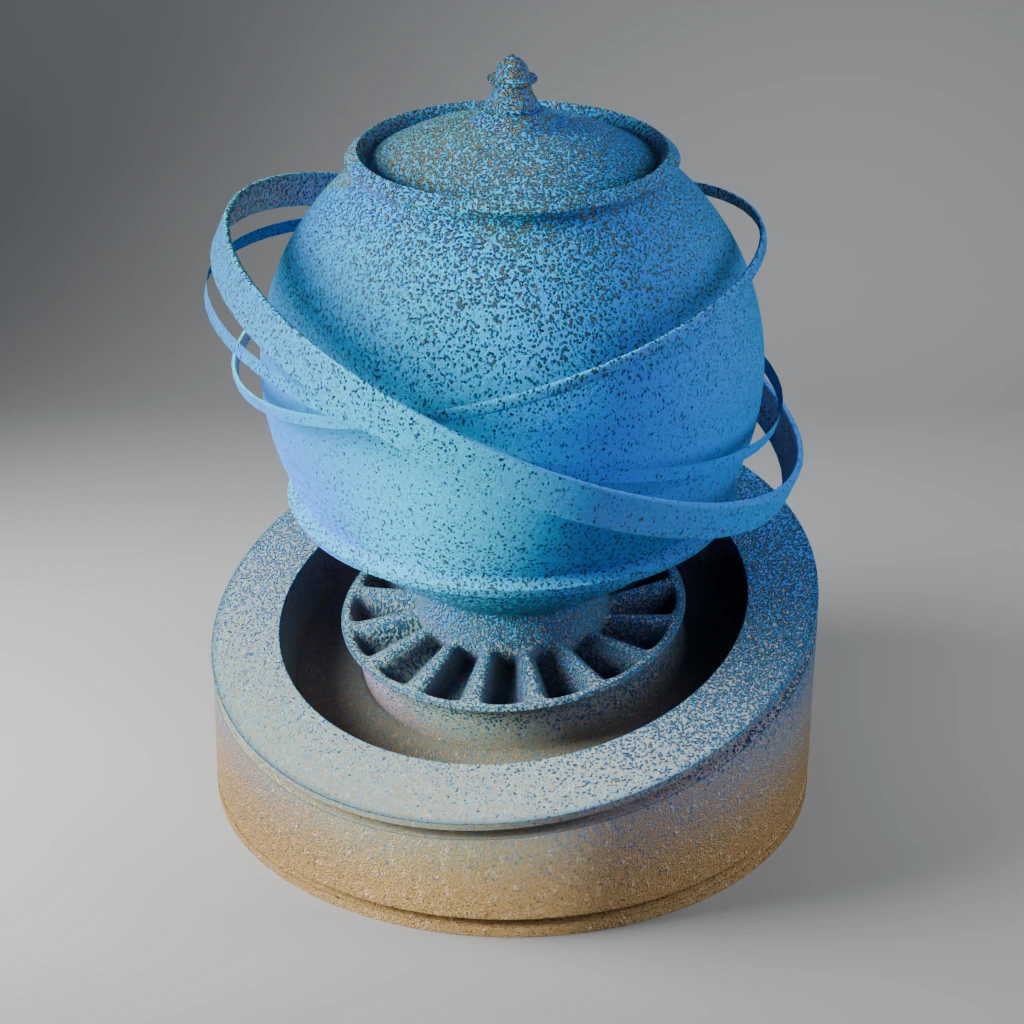
The effect is more interesting. The amount of base clay showing through can be adapted to the piece. Let’s try it on the artefact.
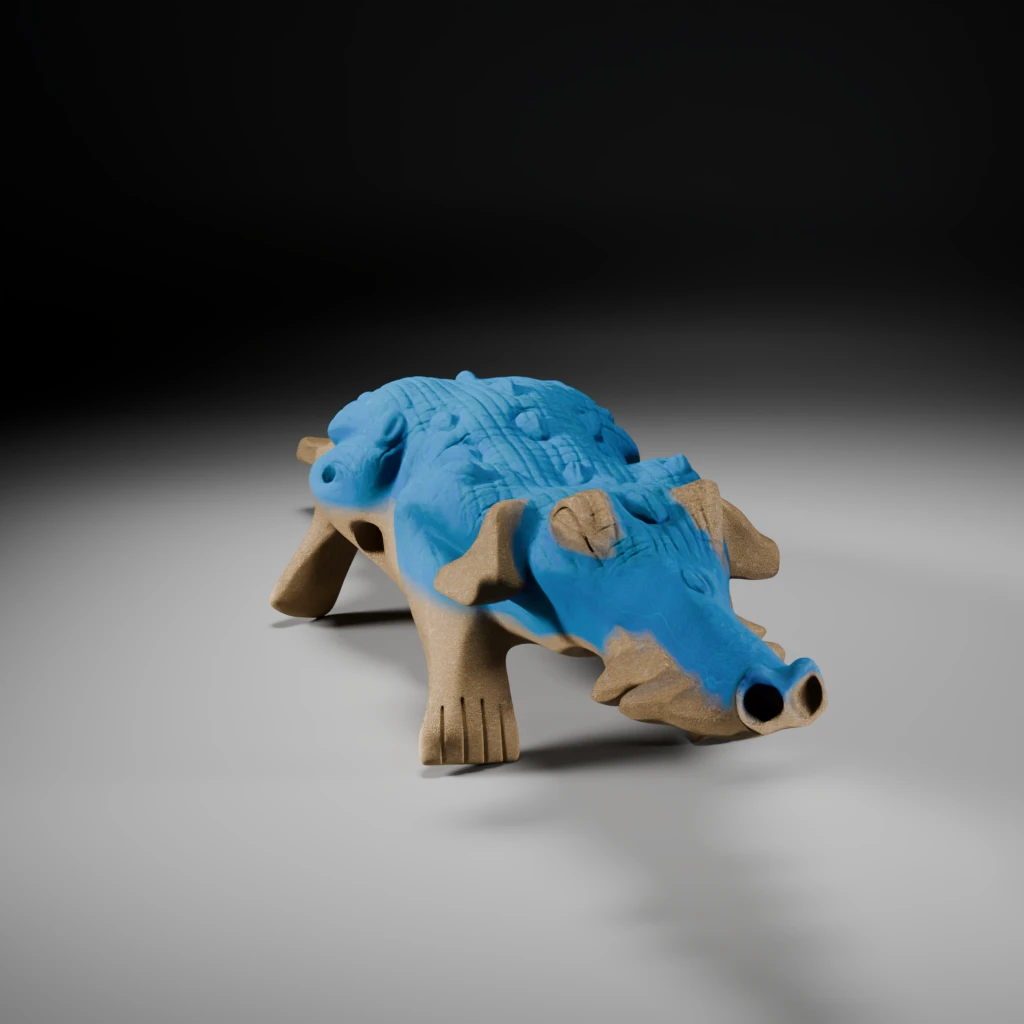
I like it, but maybe the effect is a tad too strong. The clay paste is a little grayer and the white specs are now invisible. I also need to add the dark soot-like colour under the front part of the creature.
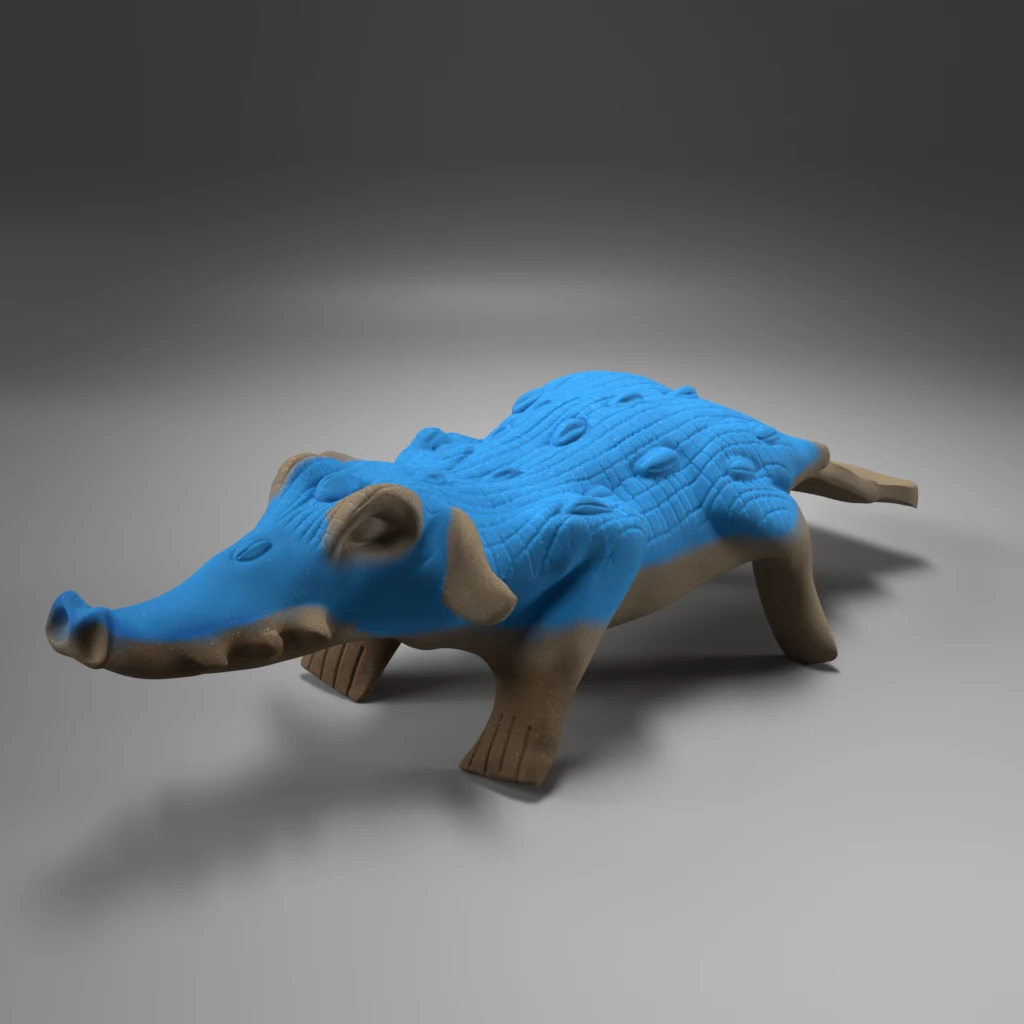
We’re getting there!
For the darkened part, I tried my hand at the very nifty (though with a slightly steep learning curve) Ucupaint add-on. The white dots are made with a simple noise node overlaid on top of the artefact.
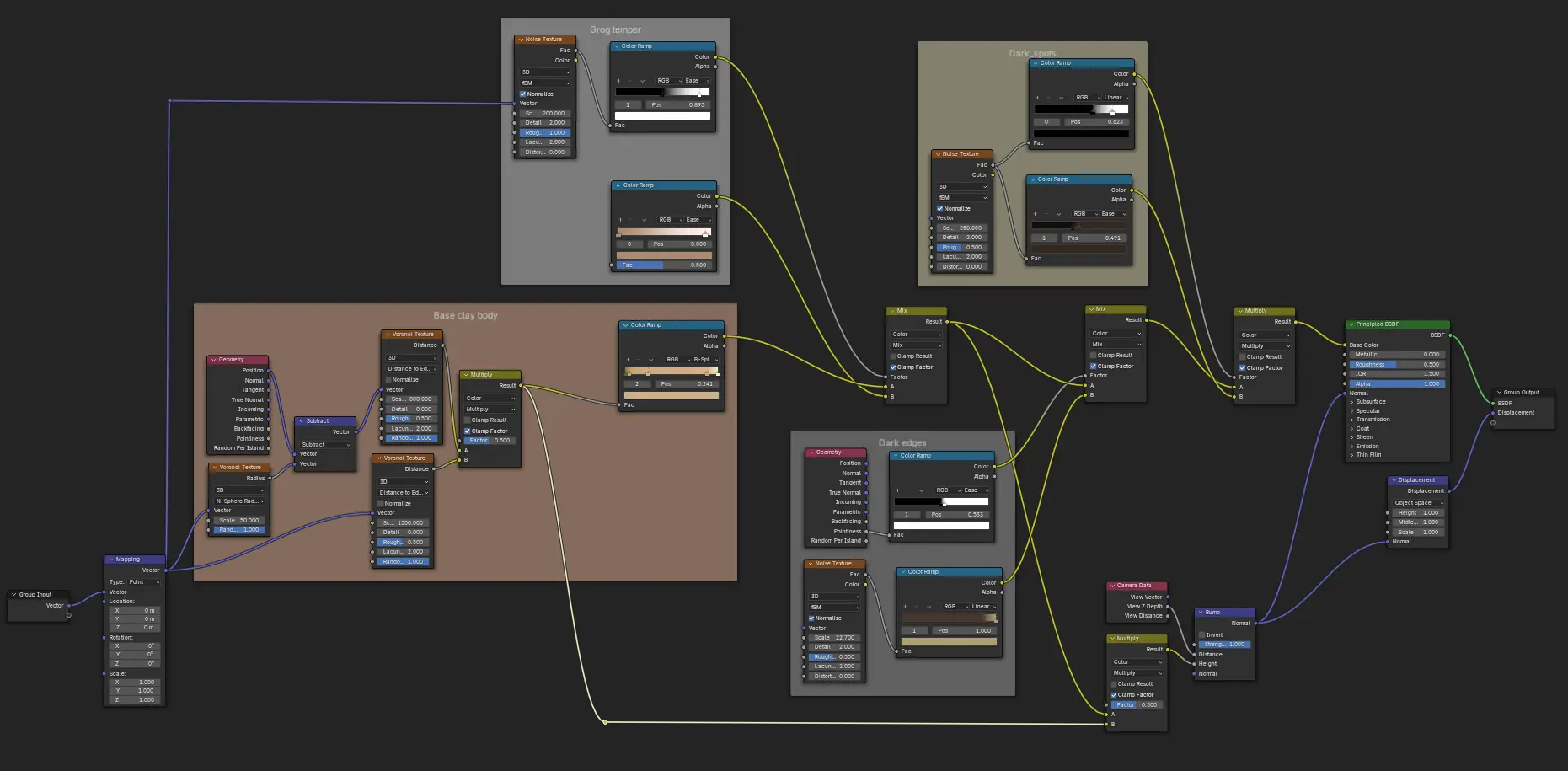
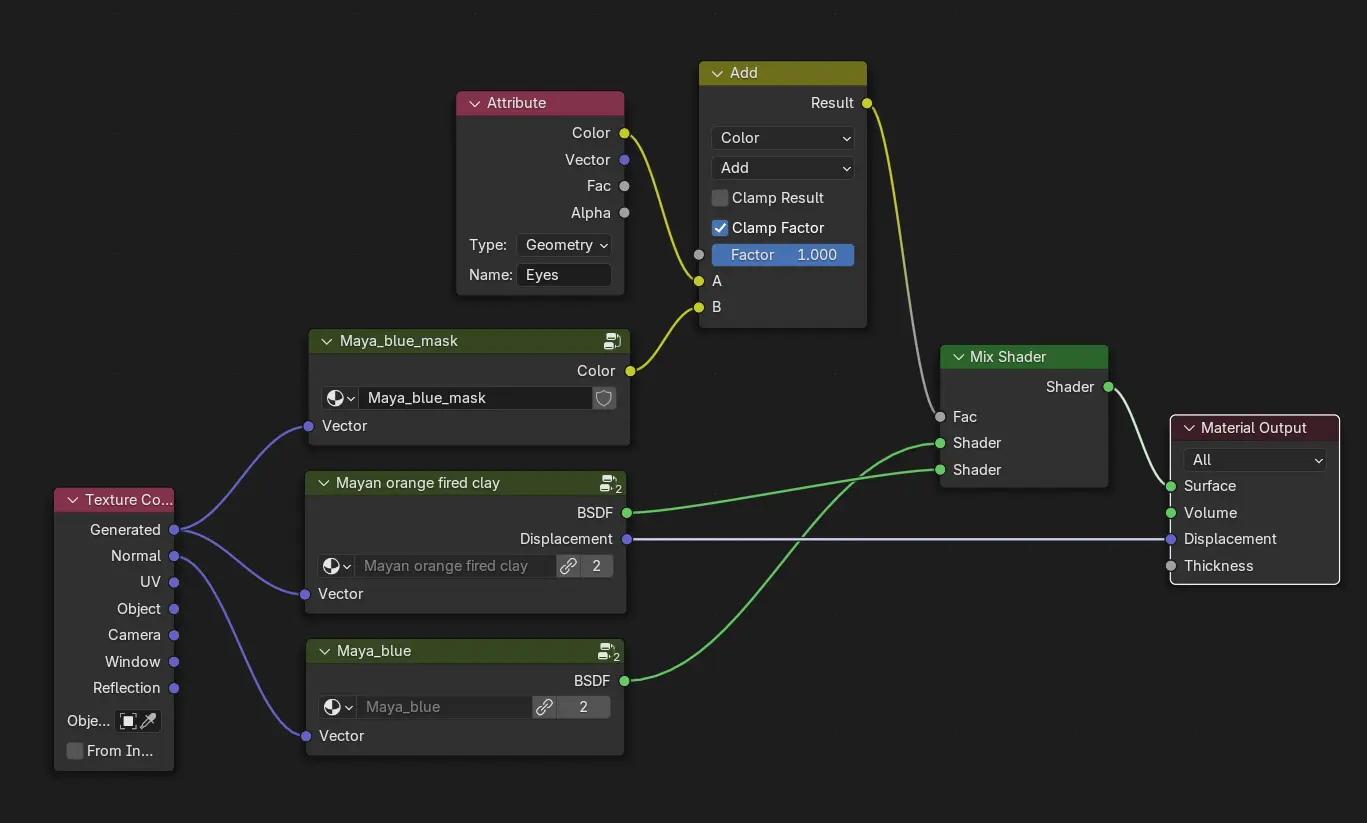
The shader node tree looks like this now:
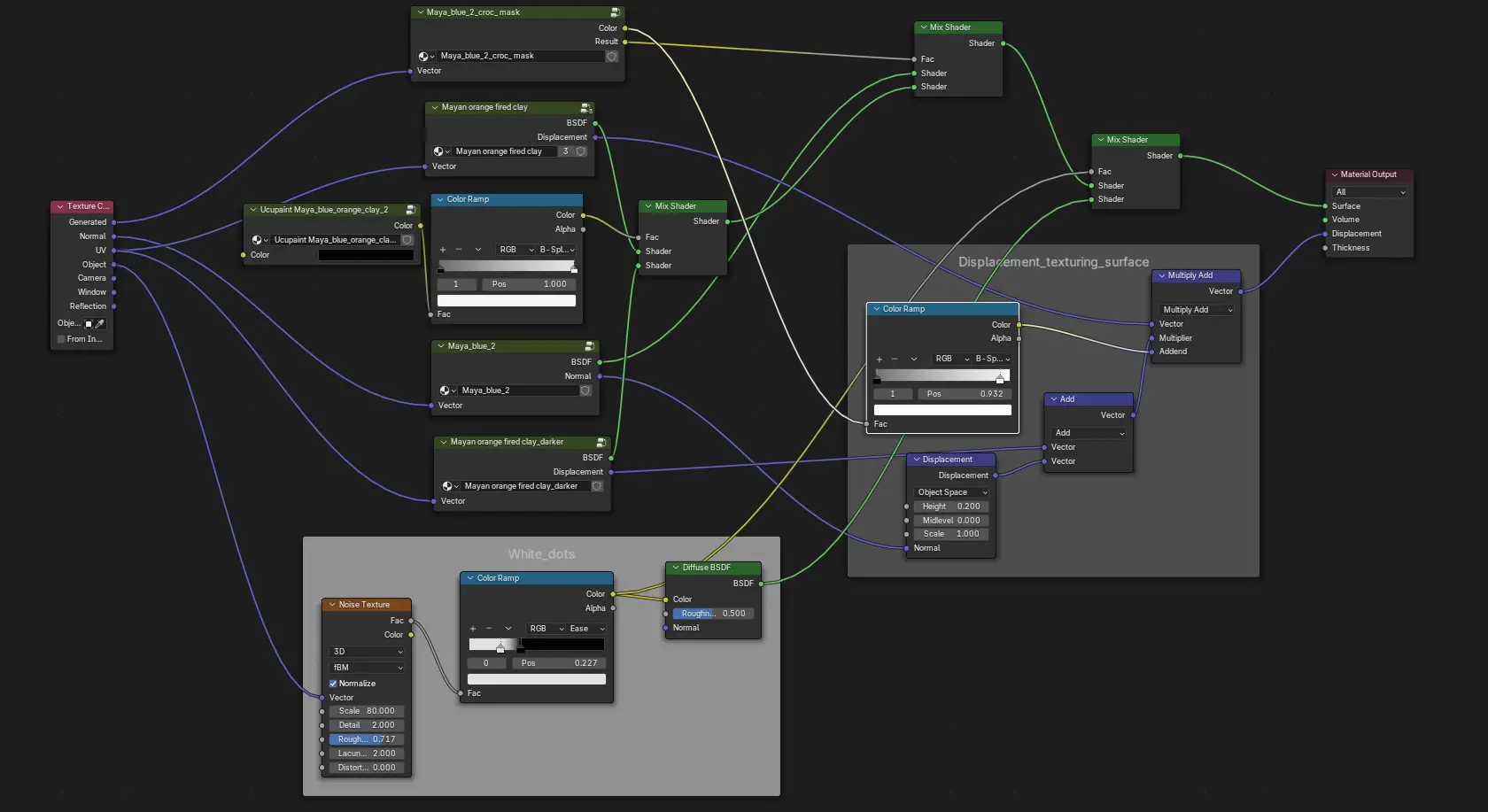
I know what you’re about to say: it is bad practice to multiply BSDF nodes, and it is better to only use the least amount one can in order to keep computation costs down. So let’s refacture things a bit. This time it’s easy. It means extracting the Principled BSDF node from the node groups and add it only at the end.
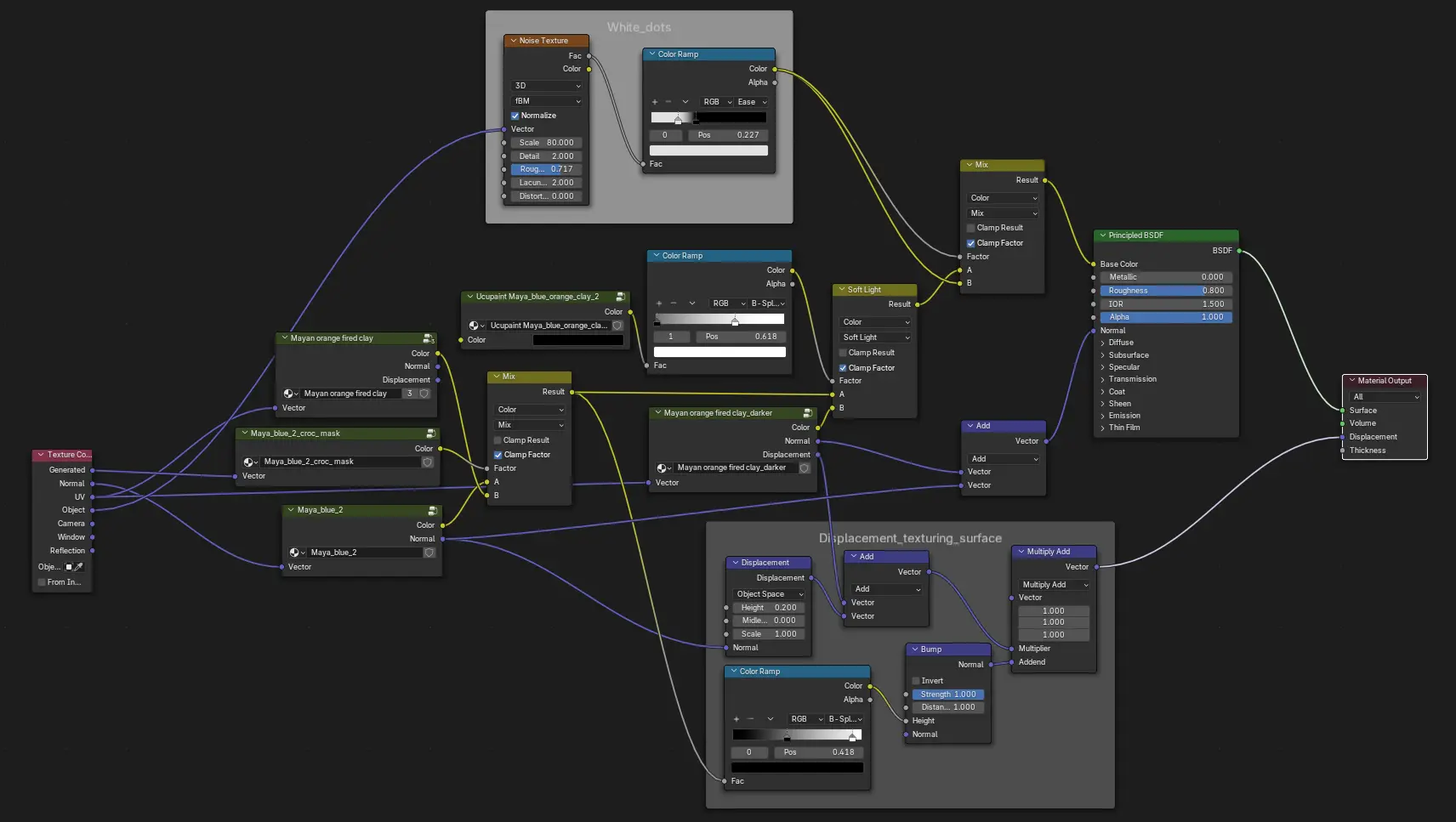
You’ll note the displacement area only uses inputs from the darker clay body and the Maya blue shaders. As the regular and dark clay body shaders share the exact same displacement method I only need one of them to create the final effect.
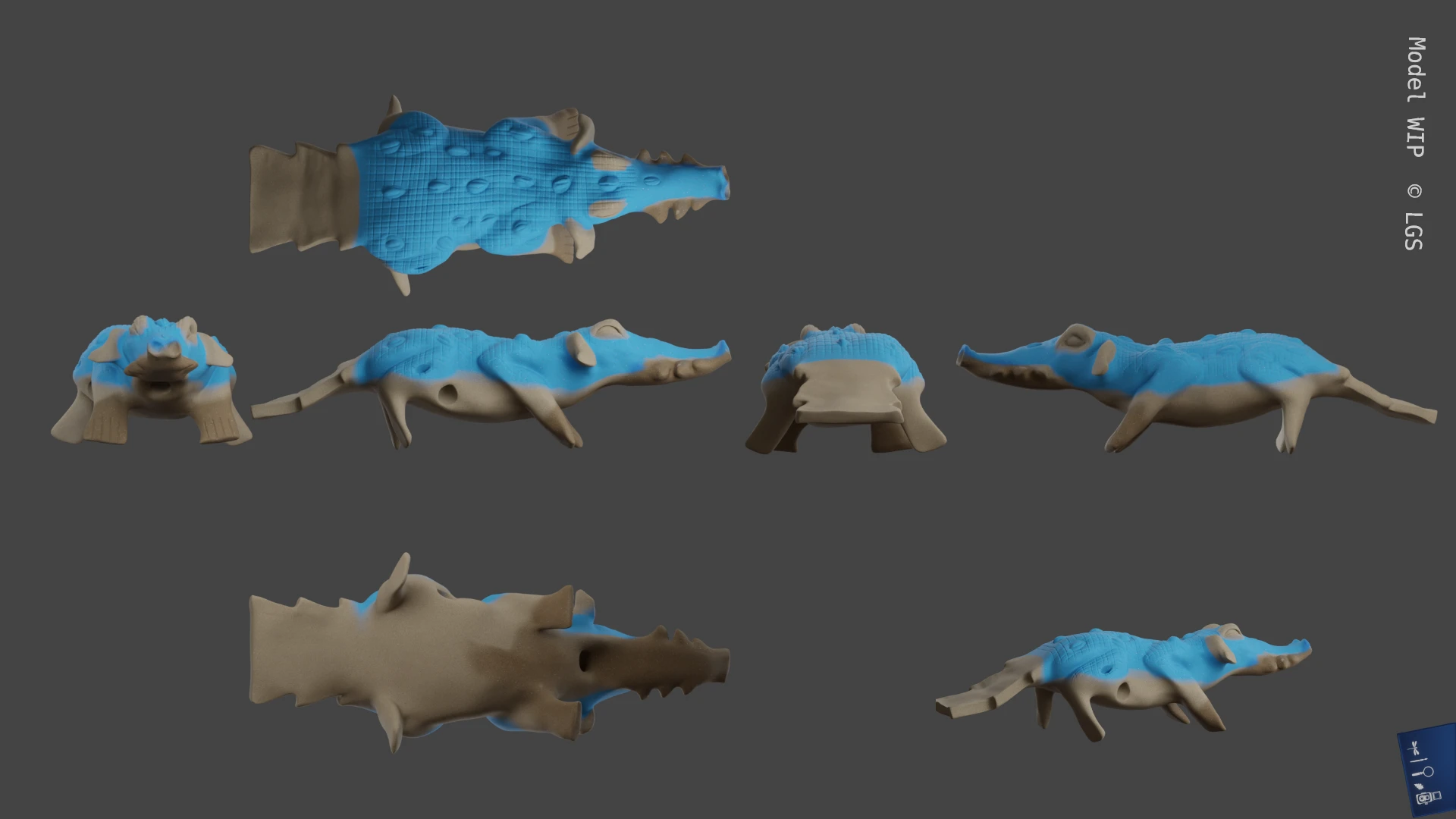
As this project needs to eventually end, I decided to stop there (after a few “last minute tweaks”, of course!).
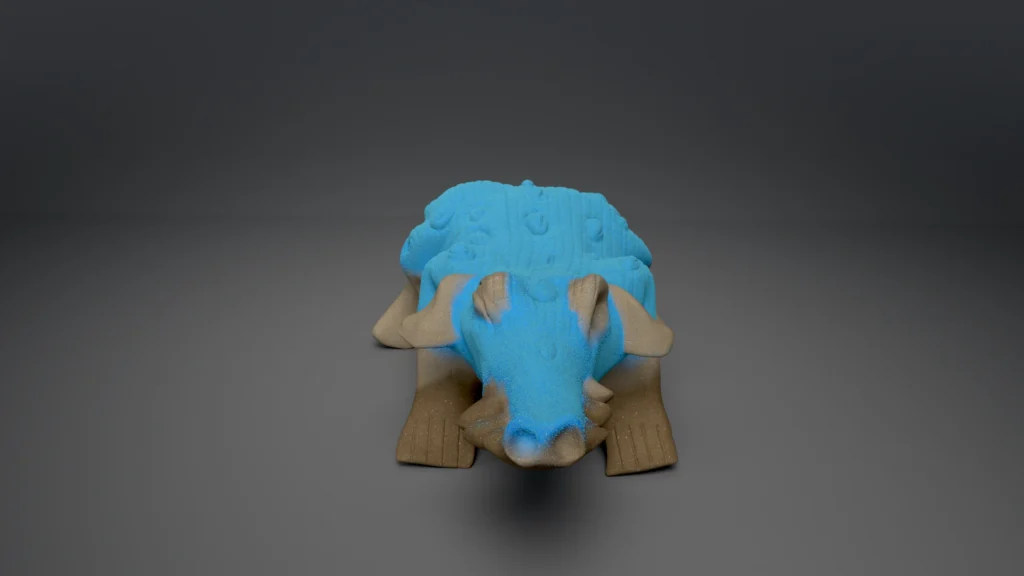
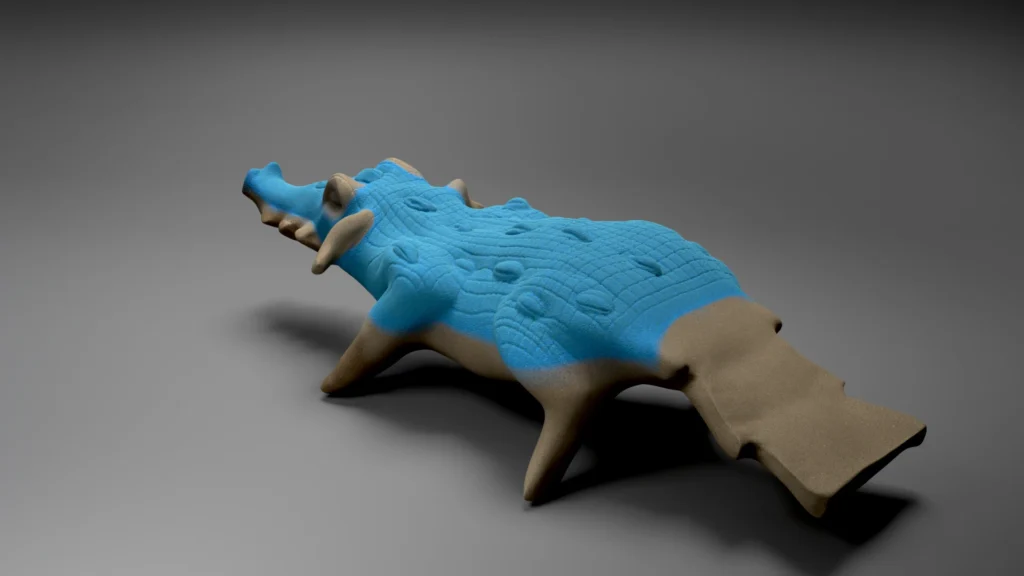
Shine a little light: stills renders using Cycles
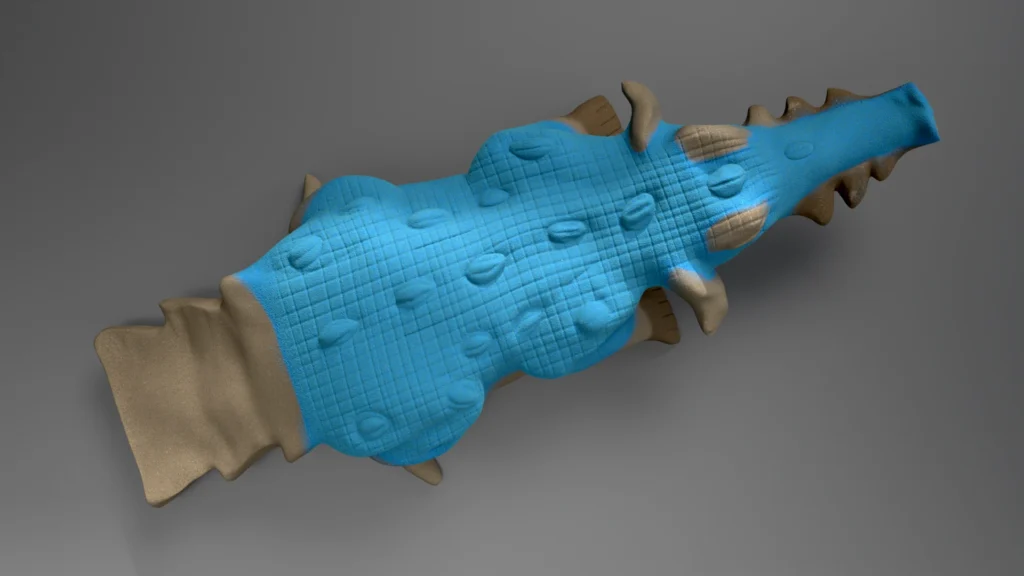
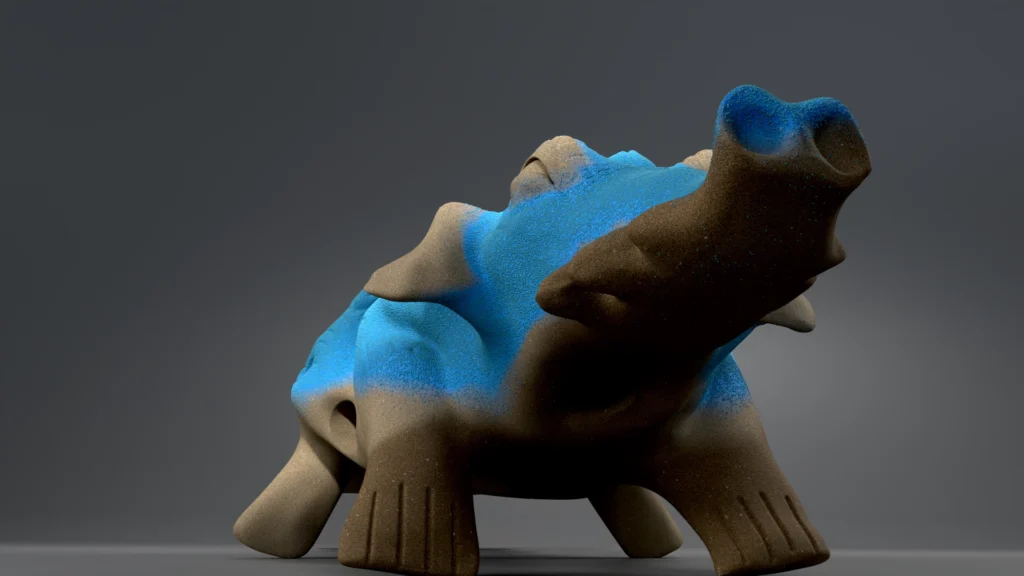
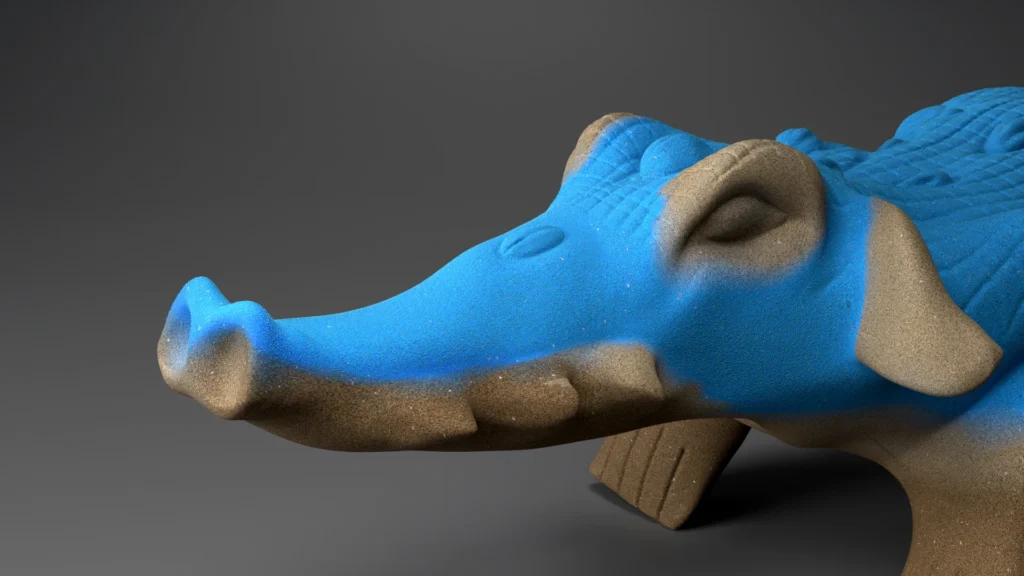
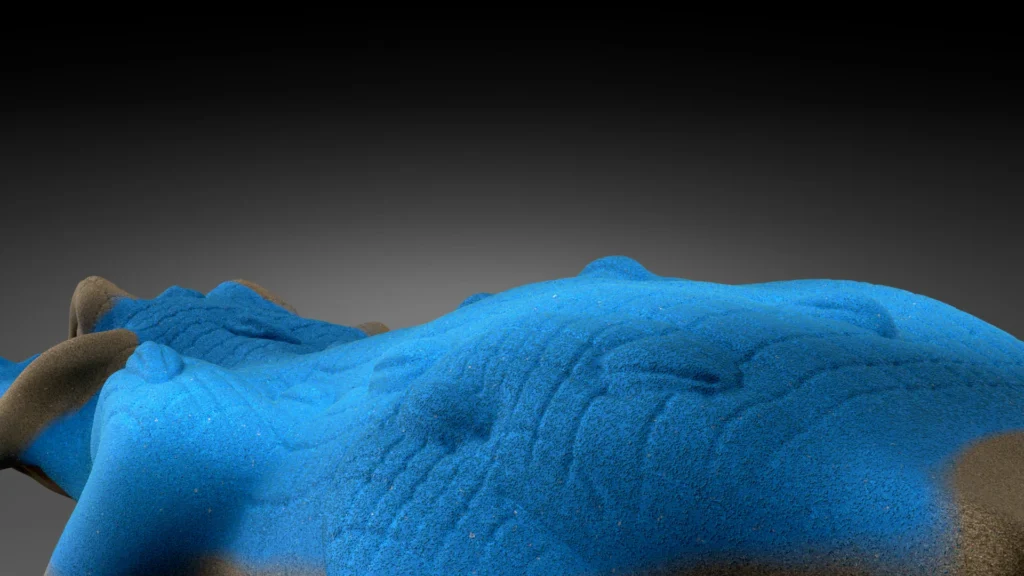
3D view
Disclaimer : technical limitation to material render in web app can let artefacts show, particularly in zoomed views.
See the full screen view (this will open a new tab in your browser).
Contact
If any of you, dear reader, want to further the conversation, you can do so on Mastodon or Pixelfed.
Credit
Unless otherwise mentioned, all images credit to LGS.
Bibliography
Diego de Landa; William Gates (1978). Yucatan Before and After the Conquest.
Field Museum. “Centuries-old Maya Blue Mystery Finally Solved.” ScienceDaily. ScienceDaily, 28 February 2008. www.sciencedaily.com/releases/2008/02/080226162953.htm.
Peltier, Nicolas (2003). “Synthèse et caractérisation d’un complexe organo–argileux: le pigment “Bleu Maya”” (PDF) (in French). Grenoble: European Synchrotron Radiation Facility. Retrieved November 2024.
Sanchez; et al. (2011). “The Maya Blue Pigment”. Developments in Clay Science. 3: 453–481. doi:10.1016/B978-0-444-53607-5.00018-9. ISBN 9780444536075.
Thurston, Elizabeth Barbara. “Crocodiles and the ancient Maya: an examination of the iconographic and zooarchaeological evidence.” (2011), available online
Ancient Mesoamerica , Volume 31 , Issue 2 , Fall 2020 , pp. 230 – 247, DOI: https://doi.org/10.1017/S0956536119000099
“Fiery pool: the Maya and the mythic sea”, Salem, Mass.: Peabody Essex Museum ; New Haven, Conn.: in association with Yale University Press, 2010.
Rice, P. M. 1987. “Pottery analysis: A sourcebook, second edition”, 2015, Chicago: University of Chicago Press.
Ting Carmen, “Continuity and change in fine-ware production in the eastern Maya lowlands during the Classic to Postclassic transition (ad 800–1250)”, December 2018, University of Cambridge, DOI:10.1007/s12520-017-0506-5 available online at Research Gate
Constantines Reyes-Valerio sum on works on Mayan blue http://www.azulmaya.com/ up to 2006.
Images
Crocodile whistle and rattle, 700-800, Mexico, Mesoamerica, Jaina?, INV n°1979.206.1143, Metropolitan Museum
Crocodylus acutus, American Crocodile, Mexico, Tomás Castelazo, CC BY-SA 2.5, via Wikimedia Commons
Cocoa pods on a cocoa tree, 2010, Luisovalles, CC BY 3.0, via Wikimedia Commons
Standing Male Figure, 650–800, Late Classic Maya, Jaina, Campeche or Yucatán, Mexico. Chicago ArtInstitute
Standing human figure with a necklace and a long blue short sleeved garment, Maya, moulded and modelled clay, INV. n°05.0-01056, Museo Nacional de Antropologia, Mexico
Indigofera suffruticosa, Köhler Franz Eugen, in “Koehlers Medizinal-Pflanzen in naturgetreuen Abbildungen und kurz erläuterndem Texte”, 1887, Germany, from Wikimedia Commons