

Gaul’s bling
The following texts and images are the results of a training exercise to go from the pictures or the description of an artefact to the creation of a 3D digital double, sometimes restored version of it. If you wish to know more about the process, explanations are in A journey into learning a (3D!) restoration process workflow article.
What was the ultimate trend in Gaul and Gallo-Roman fashion accessories ? How much bling can one Gaul get away with ? That we may never know for certain. But we can try to hypothesize what the jewellery pieces could have looked like !
There is a significant amount of work to do before the actual modelling but if you are here for the bling, you can skip the methodology and jump straight to the shinies !
Here’s one of the main issue for us to understand now the effect jewels could have had then, and something that have been bugging me for years: the artefacts we can see are mostly heavily altered pieces, mostly green and brown with uncertain shapes. I’m incredibly curious about the effect they may have had in their “prime”. The first caveat of the exercise is the same as every other reconstitution project: we see it with 21st century eyes shaped in very different societies. This is only and forever can only be an exercise in as educated as possible guesswork.
This is also going to be our second hurdle: going past the scholarly psychological barrier of “but it looks so weird like that”, fed by numerous fallacies lying around in books that modern archaeology keeps debunking ! I must say that I did not anticipate this to be as violent as it was. The shock, dear reader, is real.
Bronze, the material used in most of Gaul and Gallo-Roman pieces, is closer to gold colours when it is first produced. With time and other aggressions, it slowly alters to one of the stable-ish forms of its main component, copper. That gives the green shaded most often lumpy coat covering elements we can see in museums.
The actual work to restore these pieces basically boils down to a conservator scraping the unwanted concretions with a scalpel or affiliates for hours on end. It is a very limited operation: it is risky for the piece and often uncertain as to the exact limits of the act. It can make more damages than good. Not to mention the cramps and articulations pain it invariably gives your scraping hands. The trade lingo is “mechanical removal”. That’s when you know it’s going to hurt!
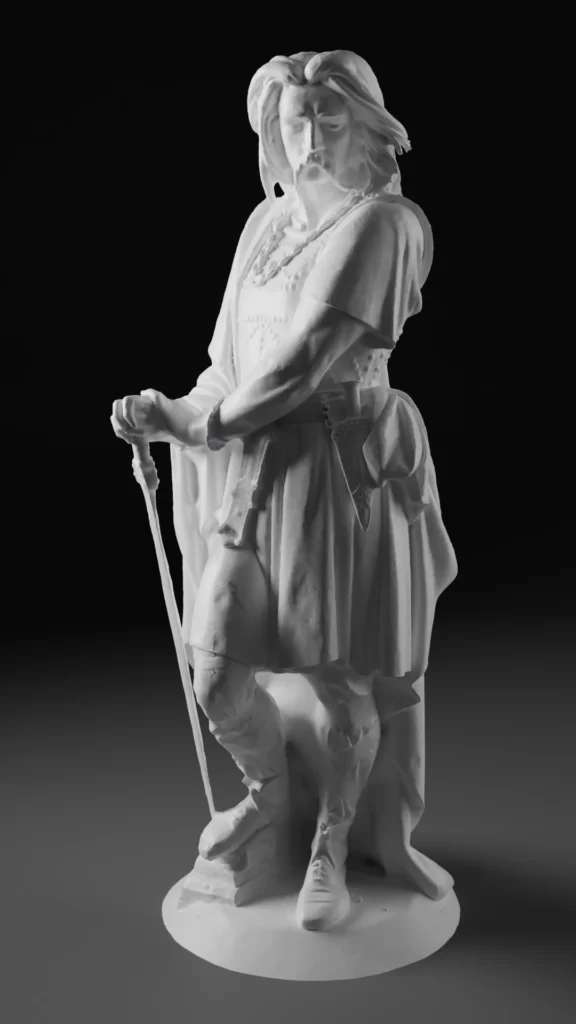
Though skillfully modeled and executed, this is a heavily politicized piece, bearing nearly all the anachronistic clichés XIXth century France could muster describing Gauls.
It is not something that can and should be done on every piece, as far as the state of science is right now. Besides, the piece then needs to be protected and kept under heavily controlled conditions. One step out of line and the alteration process starts again, gnawing more heavily into the remaining parts of the original piece. Which is also why one seldom see a fully back to shiny state restored piece: the green layer we know forms a protective barrier that slows down the chemical deterioration of the piece.
So, let’s try to use 3D as a sandbox to test hypothesis while the original pieces can remain safely on their climate controlled shelves and still be used as references for the future.
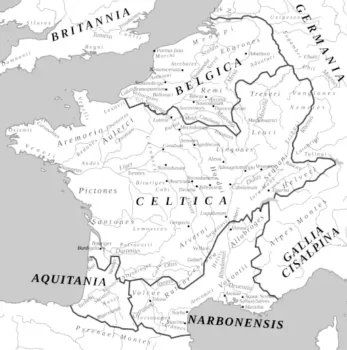
I chose Gauls or Gallo-Romans pieces, mostly from the first century era and from the Gallia Lugudensis (Lyon) region “school”. I’d like to say it was a well thought of decision and that my knowledge of the subject allowed me a clear vision. It wasn’t. I just liked or was intrigued by each of them.
Well, to be fair, I did select my victims in a way also because one of the preserving institution, the Louvre Museum, had the good idea to publish online references about them. I do really, really like when sources can be easily traced !
Of course, I would have loved to be able to go back and forth with a specialist on the matter. I really hope I’ll be able to do that for future projects. As this is all stemming from the limited vision a restrained bibliography and limited scientific articles gave me, everything needs to be taken with a grain of salt !
So, once again, this will mainly be applied hypothesis for the interest of exercising my rendering muscles. I also work only from the photographs on the museum’s website, I can’t go and scan or even look at them in situ (besides most of them are in storage!).
This is an exercise, shown for documentation purposes only.
Description and Historical context: Celts, Gauls, melting pot and tutti frutti
Fibulas are a way to fasten garments. They are found in a way or another everywhere human societies were. With time and development, they changed shape and forms. As fashion accessories, they are subjects to trends and depend upon a society’s taste at one particular time. That makes them period and geographic markers (as well as being found in profusion in every archaeological digs, at least in Western Europe).
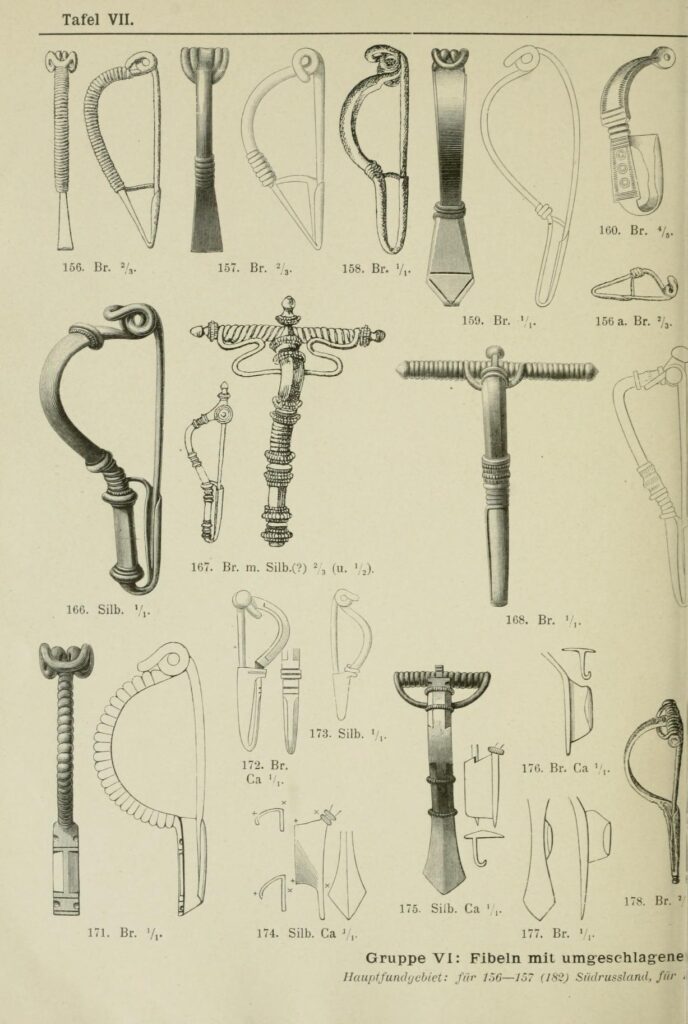
Gaul produced lots of them and specialists have created a precise typology of fibulas based on shapes, periods, and techniques used. Well typologies, plural, and then proceeded to undermine the other ones and pilfered the reputation of their authors.
There is an over abundant literature on the subject spanning from the Renaissance to modern times, sadly most often barely lists and catalogues for vernacular pieces with little to no context or sourced historical explanations. While pieces deemed the most prominent are over-represented and over-analyzed making any research murky, more humble pieces are ignored. And, yes, scholars will be at each other’s throat for a detail most people would overlook
As I am in no way shape or form a specialist, let’s not dwell on these waters, shall we ?
Gaul fibula production of the period we are looking at, say 1st century ACE, is dominated by a distinct Roman influence. With a “barbarian” twist: Celts like things shiny, naturalistic and with colours. Though the pieces are less colourful than in the neighbouring Belgica and Germanica territory, they have a more plastic quality. Being quite literally between the Northern and Southern Europe, blocked by the Alps on the continent side, it is the recipient of influences from all around.
Multicoloured metal
Ok. Now we are a little more up to date with the context, let’s look at the material we have and the references we may extract from them.
Let’s deal with the elephant in the room. We can’t be sure of the colours our eyes are seeing. I know, I know, we generally can’t. But here we have to make do with materials that have changed. Time and alterations have modified their chemistry and most likely change the outlook of their colours. This goes for every material here, metal or glass.
The maze of bronze colours.
Bronze colour depends mainly on its recipe: golden yellow copper is a base, but additions and impurities can give a different hue and shine to the metal. Which can then be patinated, adding another layer of uncertainty. As the production centre is, well, large (it spans on a diagonal across modern France), there could have been quite a lot of local variations depending on what materials craftspeople could have had access to.
The pieces I selected are common, small elements. As in really tiny: just a few centimeters wide ! I like these vernacular pieces that could have been used by most, probably been the centre of small yet indispensable stories that create a life.
Thus, we have no way to know what was the composition of the alloy used and the patina they may have used. I mean we could, but it would need scientific analysis and, to the best of my knowledge, it has not been done for any of the chosen artefacts.
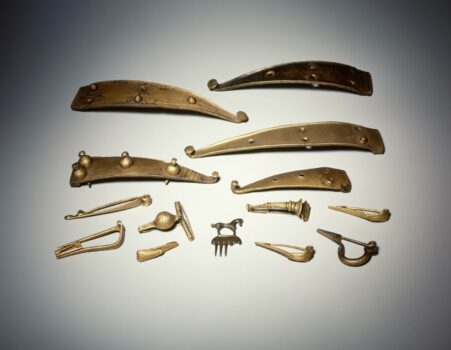
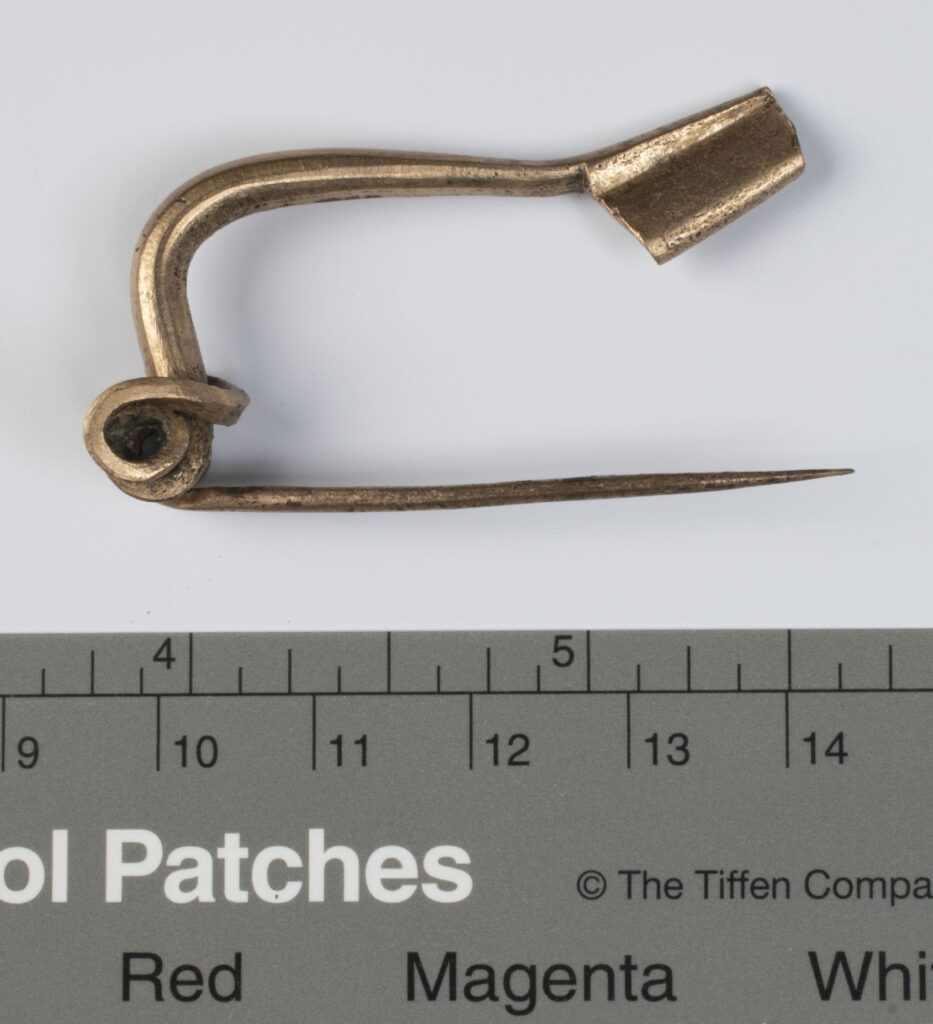
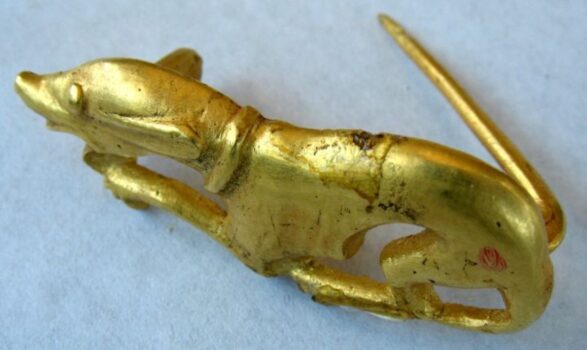
So in order to create a plausible effect, we have to rely on comparison and period correct pieces that have retained their original tints. As this is a most limited amount, I will be adding gold enhanced ones to the list. Chances are these were the real pricey ones. Therefore, I hypothesize that they were also the one the cheaper versions were trying to emulate. I might be wrong.
I will also add to that a musing along the DIY bronze casting videos, if only to reassure me that it is indeed quite a shiny thing once polished even a little !
Wide diffusion and cheap-ish cost mean, these artefacts were most likely cast in batches and then reworked upon. The production techniques, like sand or lost-wax casting, have left a rougher surface that can be seen on the backside of the pieces. Some have then been the subject of enamelling in the recesses left in the base model.
I have no notions of Gallo-Roman economy and had a really hard time finding some basic articles on the subject. I have no doubt they exist, I just did not find them as I operate in a limited time frame. Therefore, I do not know how pricey these items were and therefore how much cold work– all the operations done after casting- was involved. The link with a temple or any religious insignia would only add to that.
Now, we have more information and can start to see an idea of what we are aiming for. To finalize things, we also need to choose a (hypothetical) moment we’d like to see in the (hypothetical) life of the objects because bronze changes through time.
We know two of its state already. The beginning one of the alloy fresh from the crucible, and the current one, almost fully crystalline on the museum shelf.
As I have mentioned at the beginning, my issue with the current state is that my visually-thinking brains have a hard time transposing green and black slumps into domestic, every day, items.
There lies the answer we are looking for. I’d like the artefact to be a state that could make sense in a “household” context. Fibulas are essential to Gauls clothing, but clothing is not now what it was then, besides the whole “Is a bit cold, innit, I’ll go put a coat on”. So is “household context”, but that’s another matter. I would like to see the pieces as if someone just took it off their garment and went about their business.
So, in a nutshell, I have been hunting down copper base jewels on people around me to see what they were looking like. Thankfully, they are now used to my overall weirdness. Though they still are a bit weary when I approach armed with a camera and, if you don’t mind me saying, what I think is a very well crafted inconspicuous look on my face.
I came to these few key points:
- There are deformations on the most thin pieces induced by wear and usage.
- Because the shine has changed, the colour appears darker.
- The material is not as shiny as when it has just been made and polished, there are bumps and scratches. It is still shiny but in a dull way, the brightest parts are the ones on salient zones because they are being rubbed against cloth or skin, keeping them polished.
- The alteration process has begun in recesses and hard to reach places, both green and almost black spots and layers are visible.
The objective here is to make a base material that can then adapt to every model. Working smarter etc.
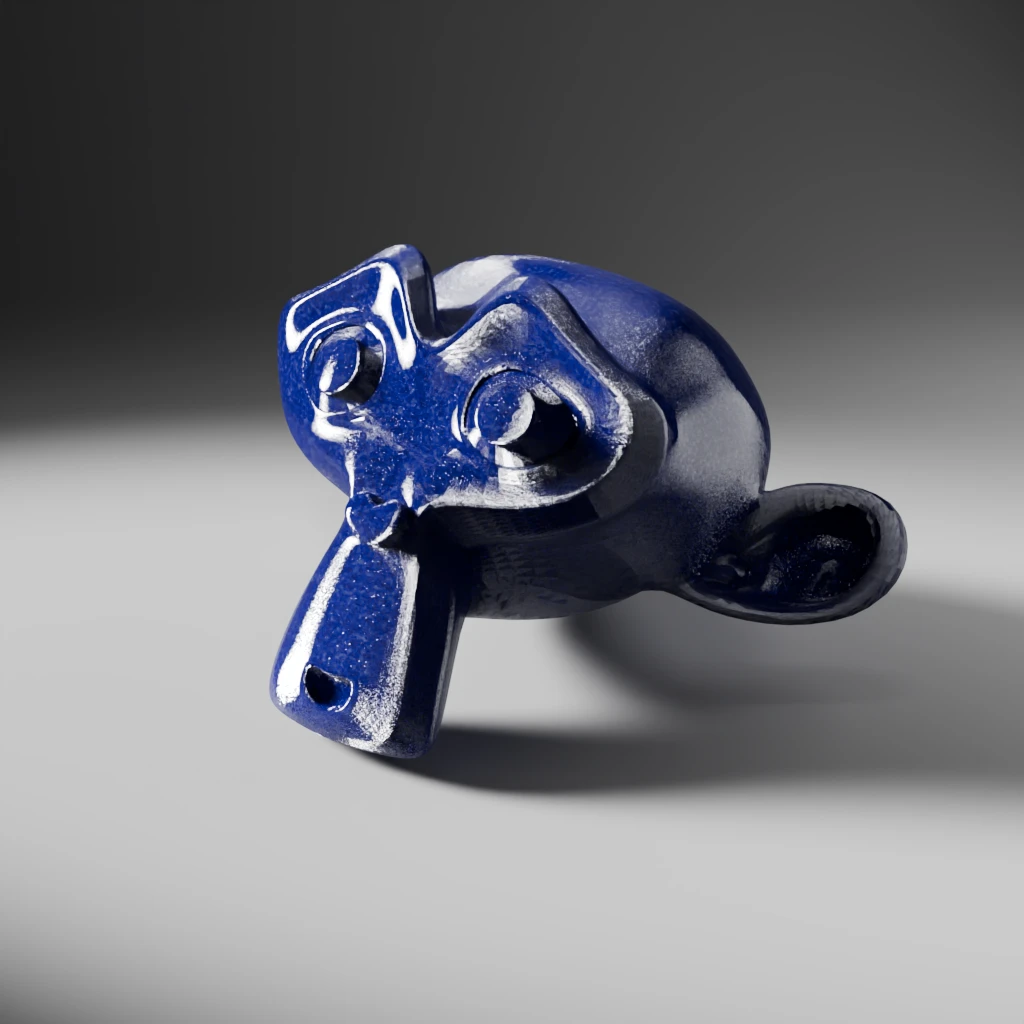
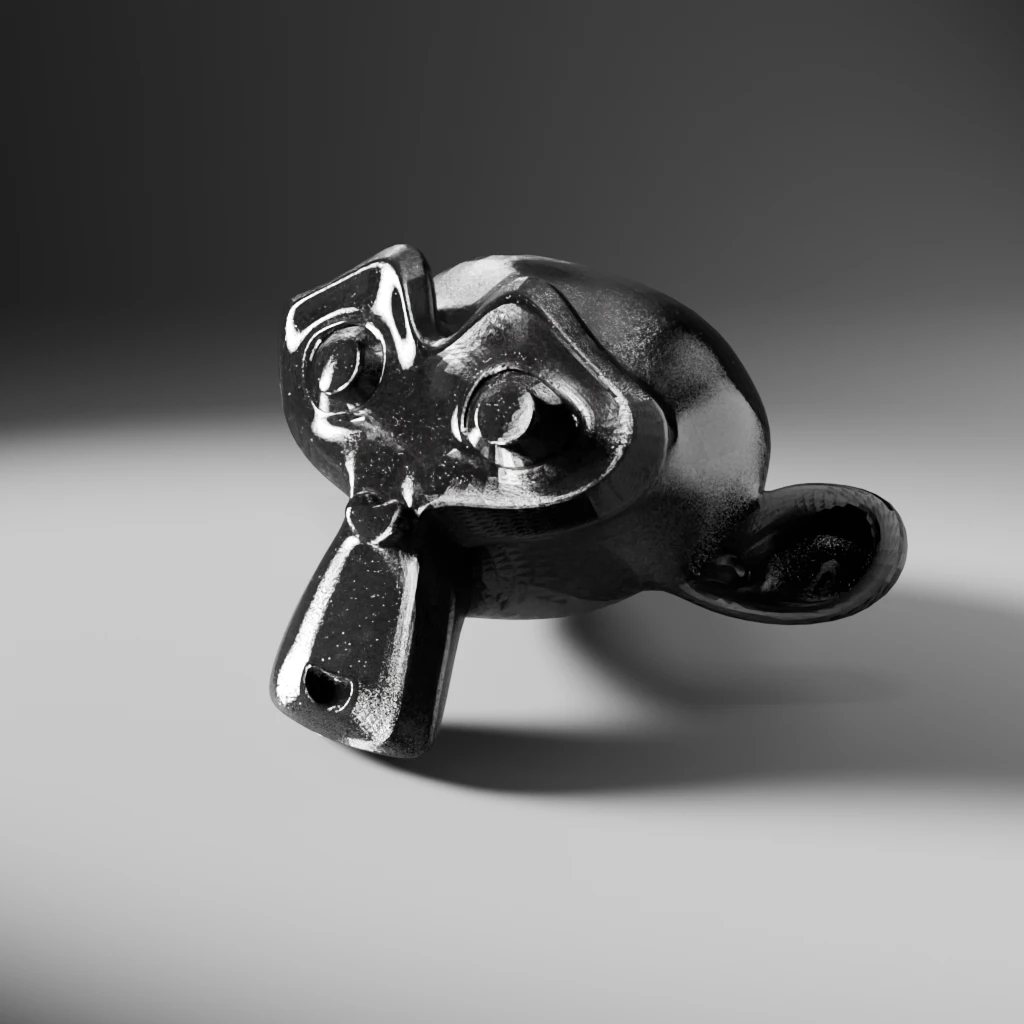
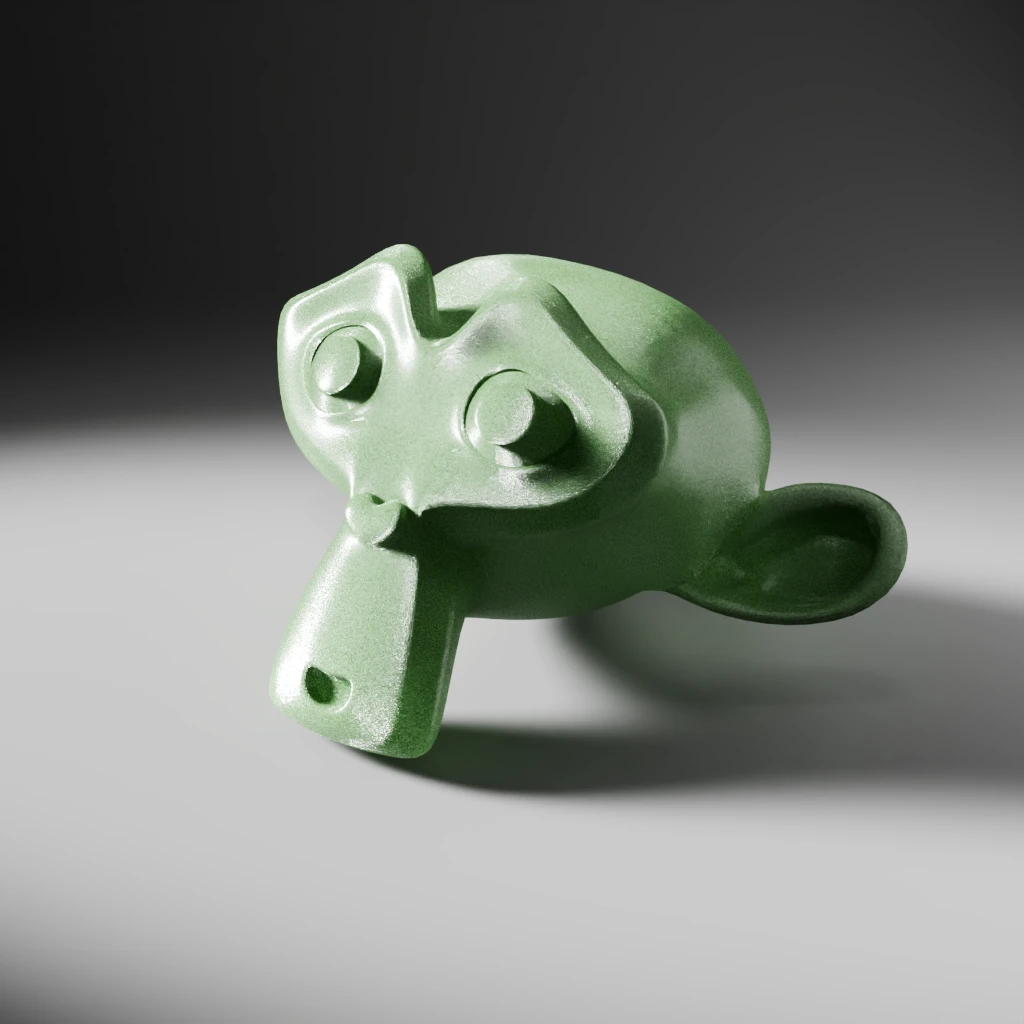
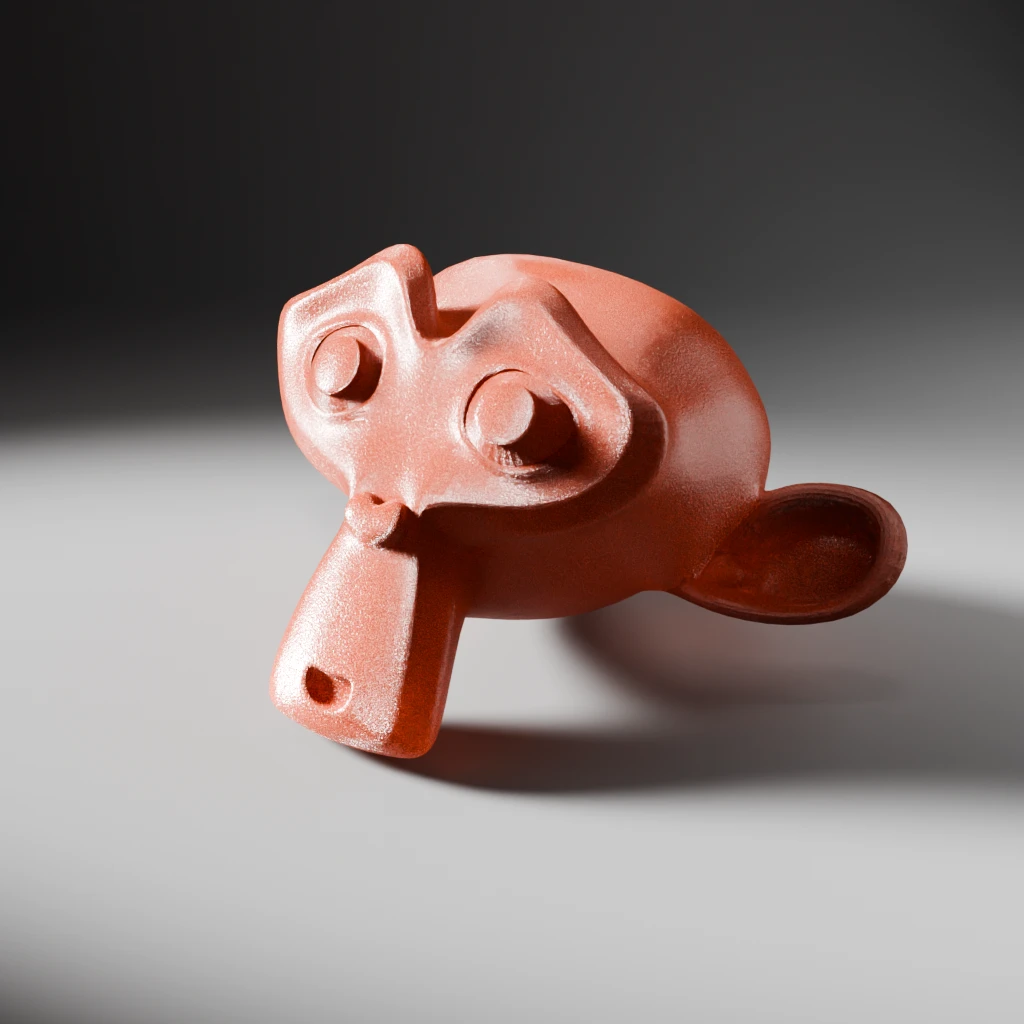
So, let’s adapt the infos into nodes so we can have a Gallo-Roman tin based bronze generic shader. It’s a mouthful, isn’t it ?
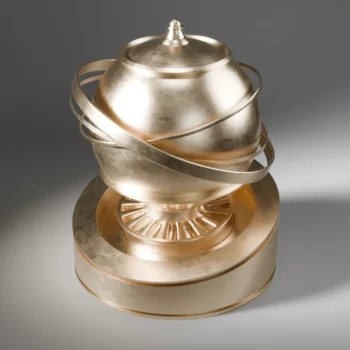
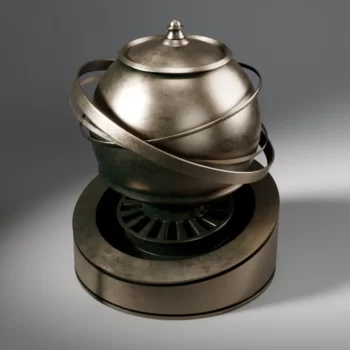
It’s relatively simple. I created 2 materials, one inspired from the fresh from foundry one and another, linked to the actual altered state of the pieces.
The harder part is creating a dynamic mask that regulates how much of each is added to the mix, i.e. determines the “age” of the piece.
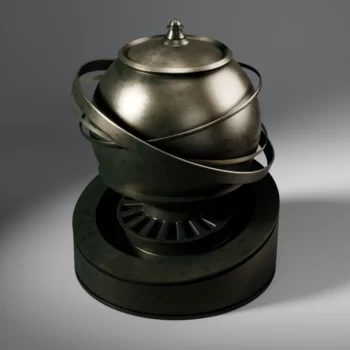
There is one effect that I did not manage to render as much as I well as I wanted. Alteration on metallic pieces starts on more or less precise locations: either where the alloy is weaker and/or where there is accumulation of solvents, starting with water vapor. That means recesses and holes alter first, and then it spreads out on the surface. On my material balloon, it means it outside rounded elements will alter last.
There are pigments in my glass !
In the beginning, I mentioned how “barbarians” liked their knick-knacks colourful but so far we stuck to monochromatic metal. The colour is added by touches or frank (pun intended) display of enamel using the champlevé technique. This technique seemingly started with the Celtic La Tène culture in Western Europe and that was in favour up to the Romanesque era.
You thought the bronze recipe conundrum was tough ? Hold on to your socks, we can go a few steps tougher. Introducing enamel ! Because we’re already in too deep and crying can only get you so far, we need to find a red thread we can follow.
First, let’s use a mental trick. To learn about enamel, we need to learn about glass. Why ? Because enamel is similar to glass, and we can use these similarities to our advantages in this particular case. We must remain cautious, though, correlation is not causation. We will not be comparing chemistry (they are different) but colour outlooks only. If the colour can be done in glass, it can be done in enamel. Though not on actual ceramics necessarily, but that’s a matter for another day.
Once we have the probable sources of colours identified, the idea is to compare with known material and pieces evolution and hypothesizes what the colour range could have been. So everything needs to be taken with a definite all spices and salts seasoning.
Thankfully, this is a pretty well covered subject ! TL;DR: copper, lead and iron are the base of a lot of colours.
There are quite a lot of enamel decorated fibulas in collections, so finding references is easier.
The geographic location of the selected artefacts, more or less “Celtic” Gaul, is not the most prominent place where such decors are used. Enamel seems to be more employed in Belgian and Germanic parts. Though chances are the chemistry will be different, the outlook is similar.
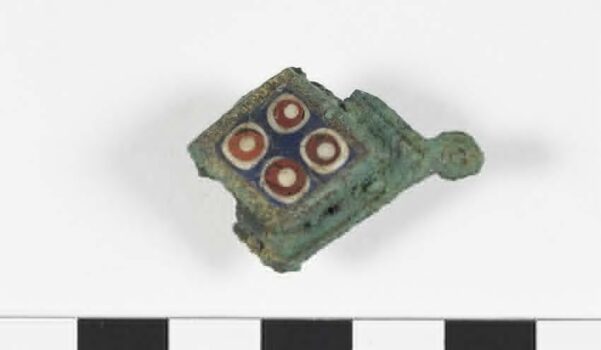
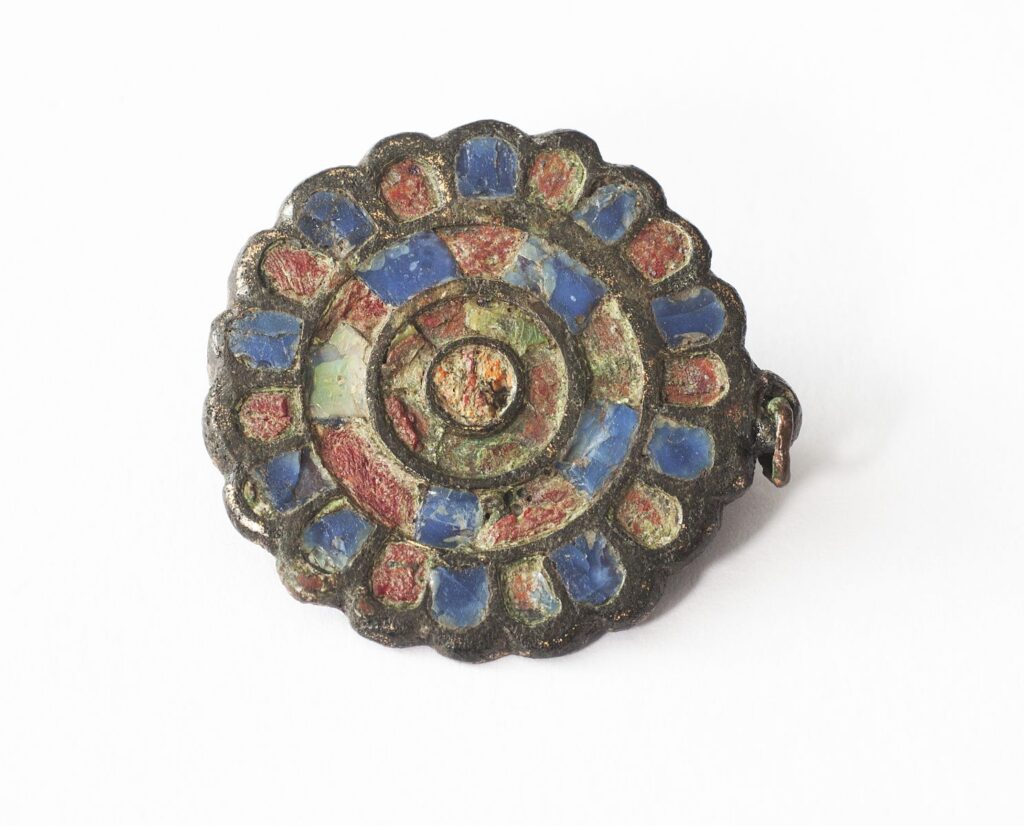
Some of you familiar with the subject probably know that there is another type of enamel decor consistent with the period that is missing from these cherry-picked examples. There are quite a few examples of Millefiori tiles imbedded in flat coloured enamels on fibulas. I left them out of my references images pool because there is no way for me to know if it was there and what kind of decor it could have been. But just as insets of stones or glass beads were most likely present on some artefacts, it could have been a possibility.
So, from the examples above (and loads of others, but I’m sparing you the nitty-gritty), we can have a few key points :
- Champlevé technique means there are recesses in the bronze model to accommodate enamel being laid. Colours can be placed on top of one another to be layered, but the overall stack doesn’t go above the metallic walls.
- Colours are vibrant, opaque and lay mostly flat with the usual wear and tear.
- There can be slight variations in saturation and value but no shifts in hue. This seems more prevalent in blues and greens less so in warm colours.
- White streaks or dots can randomly appear in all colours. I initially thought it was just another sign of alterations, but I’m not so sure now.
- The shine has now gone, but chances are the enamel parts were glossy. Though, the technique involves a low fire firing (around 850 °C): materials melt and sinter creating a glossy surface, but it does not vitrify (above 1200 °C).
- Colours mostly alternates, but variants are introduced in the pattern, in relation to the shape of the fibula (for example in the hook or clasp axis).
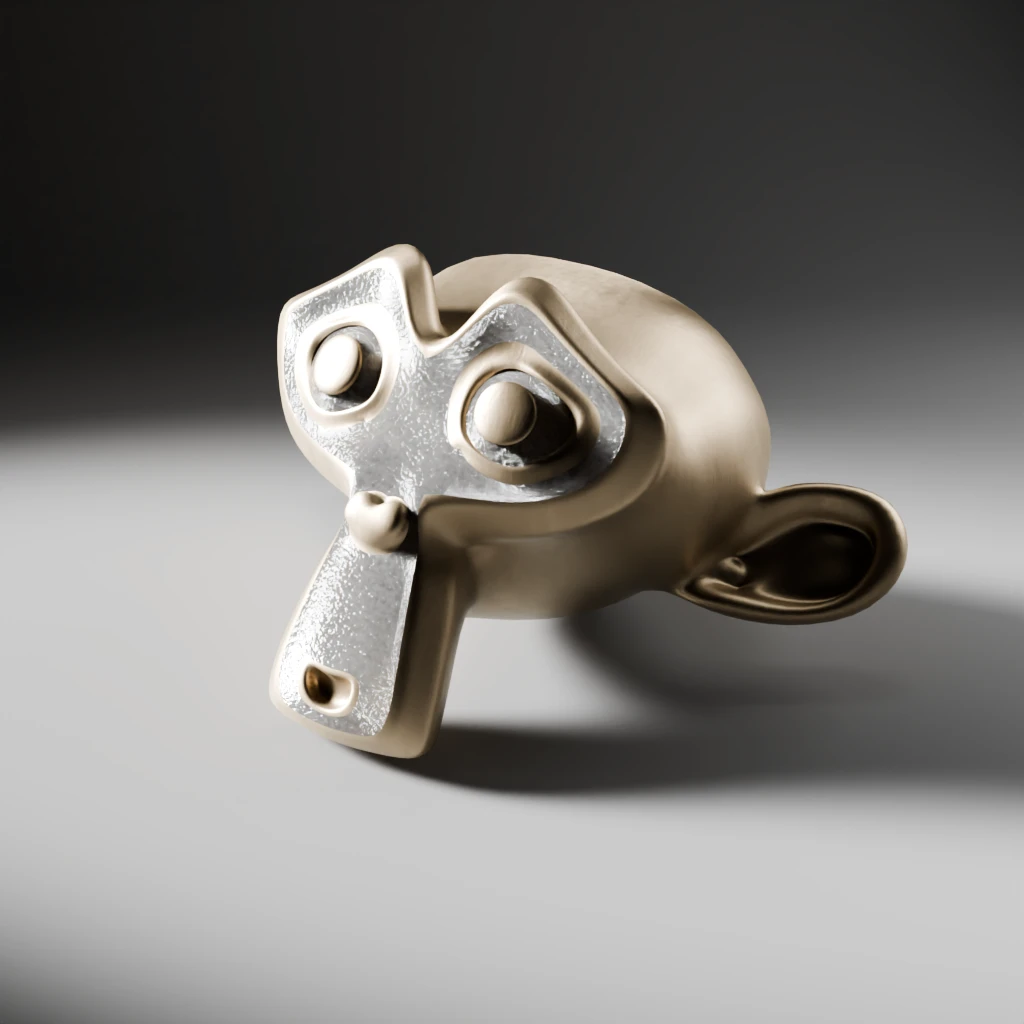
Once again, we are aiming for a generic material that will be modified per artefacts, using the right colour palette.
Gaul’s bling
A fish is watching over you
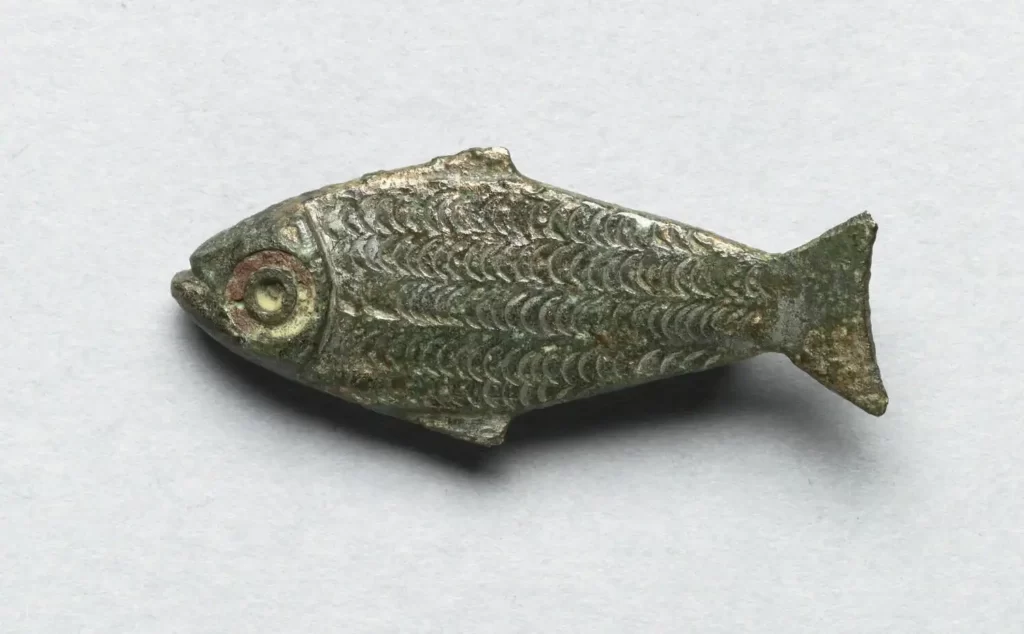
Title: Fibula in the shape of a fish
Datation: 25-75 ACE
Provenance: Gaul, discovered at Le Chatelet de Gourdon
Dimensions: 3.4 x 1.4 x 0.7 cm
Media: bronze, enamel
Source image: INV. Br 2032, Musée du Louvre
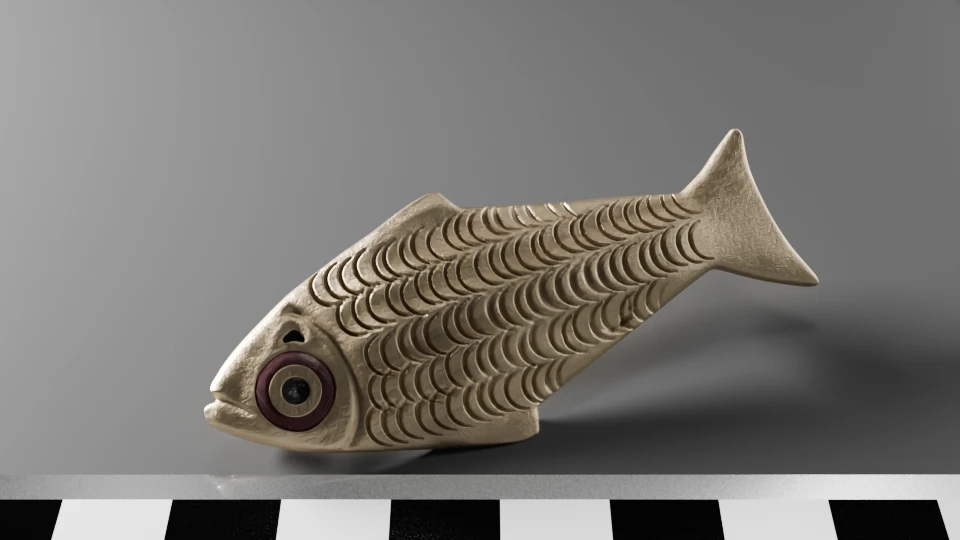
There are quite a few examples of ichtyomorph fibulas (in the shape of a fish) in the wild. One preserved in the Musée archéologique départemental de la Mayenne is stunningly similar to our reference.
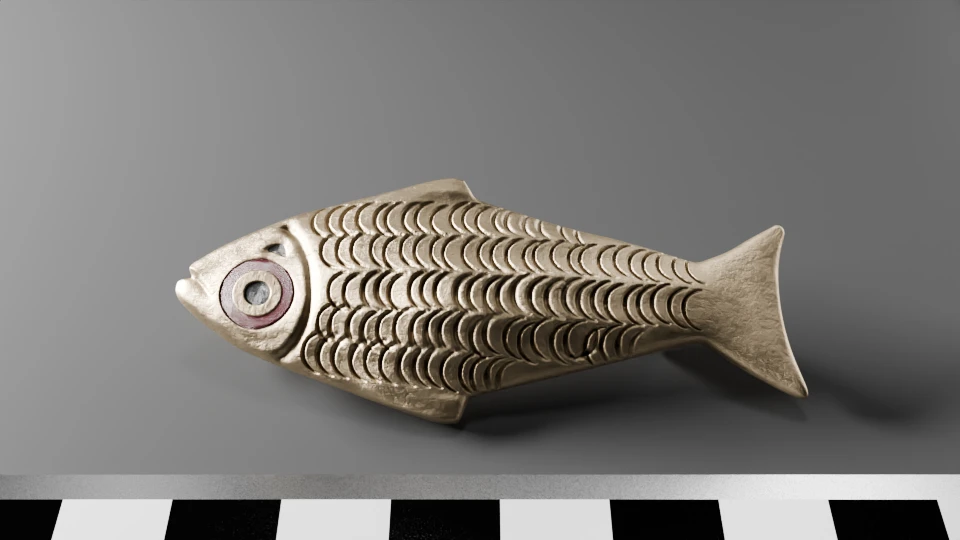
I particularly like the attention to details. The mouth is naturalistic, taking great care to make the lower “lip” more prominent, its inflexion guiding to the oversized eye. There is a cavity above the eye, creating a sort of eyebrow. It does not look like an alteration but more like a nare (“smelling organ”), albeit a tad high on the head, so I kept it.
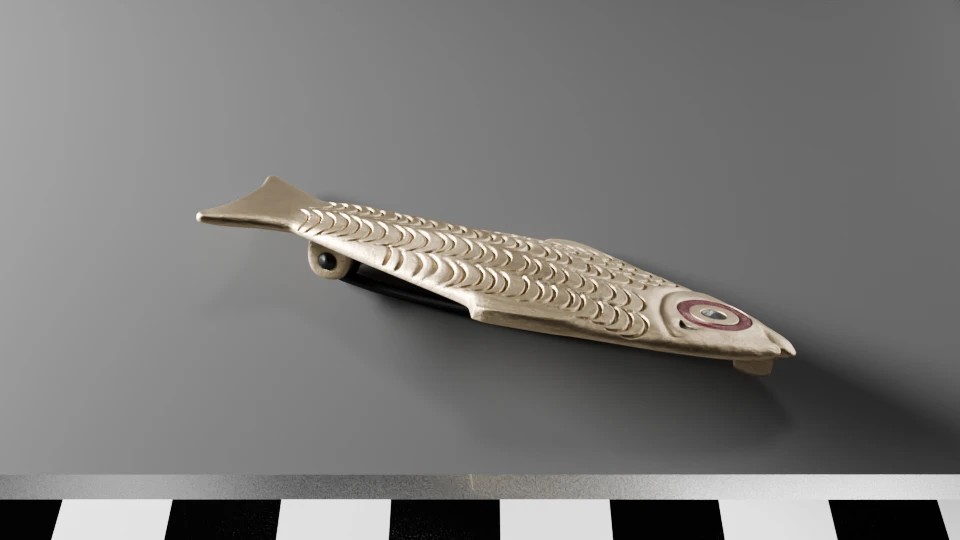
The outline of the shape can be extracted from the picture easily enough, provided a few tweaks. The volumes are sculpted, though they are mostly hypothesis because we do not have a clear side view. I based my suppositions on both what I saw and what I know about bronze casting and its requirements.
The scales cove the whole body after the guile demarcation. From the pictures, it is unclear if this was done in by the mold or by incisions after casting using a semicircular tool. The museum’s notice mentions hammering, so that can points to the latter.
In any case, we need a digital version of it ! A few passes in Inkscape and we have a brush to render the scales. Bonus point, it is easy to re-use on similar decors for the other pieces.

An intriguing bone enhanced rosette
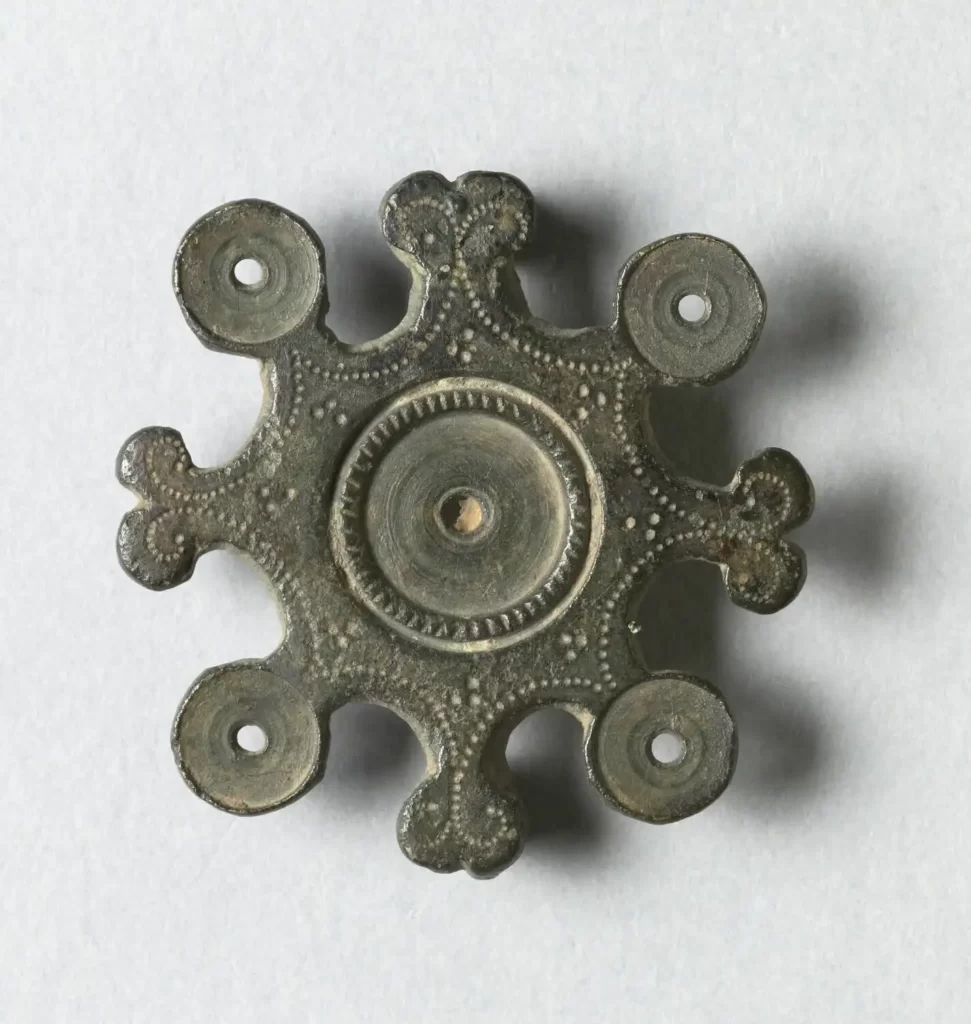
Title: Fibula in the shape of a rosette
Datation: 25-100 ACE
Provenance: Gaul, Gallia Lugudensis
Dimensions: 3.6 (diameter) x 0.65 cm
Media: bronze
Source image: INV n°Br 1982, Musée de Louvre
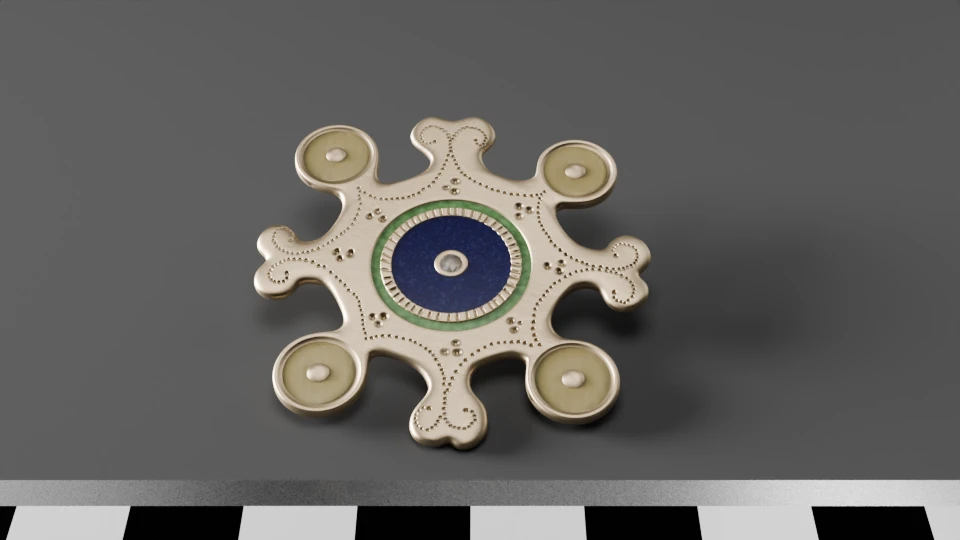
What makes a regular brooch go from classic to Celtic punk rock ? Bones !!!!
For this piece, the museum notice mentions that it is missing 4 riveted bones disks. Metal.
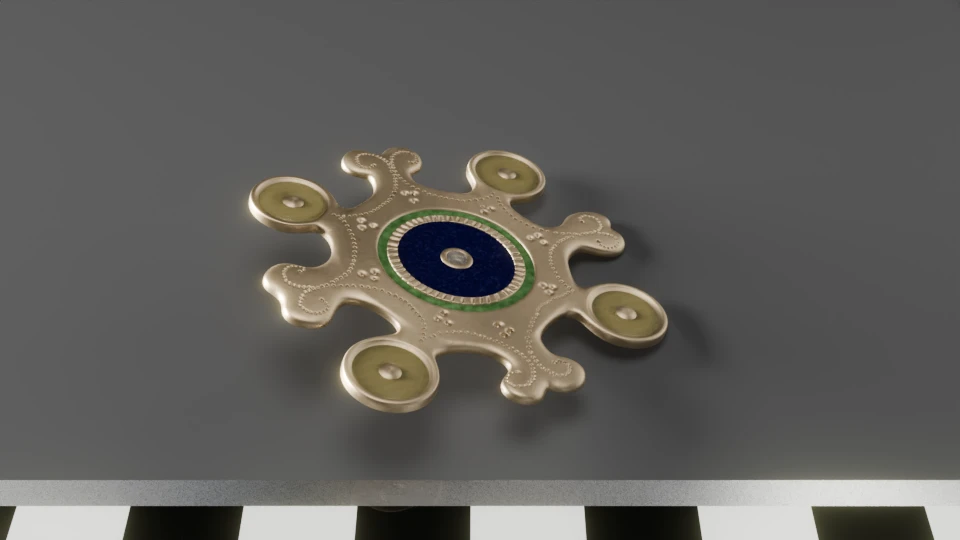
Modelling the shape was easy as it is responding to a centrally symmetrical pattern. The embossed decor sculpted over and was then transformed into a normal map. There are many ways I could have gone to obtain this effect, this one was the most enjoyable. Sculpting usually is !
Adapting the materials from our base generic ones was a breeze. The bone disks are a variant of an ivory shader I created for another project. The real conundrum for this piece was to choose what colour the two most inside champlevés should be. I settled on green and blue. Mainly because as a Westerner, I like these colours and I gathered it has something to do with historical social construct and all that.
Yes, yes, I’m babbling. Why do you ask ?
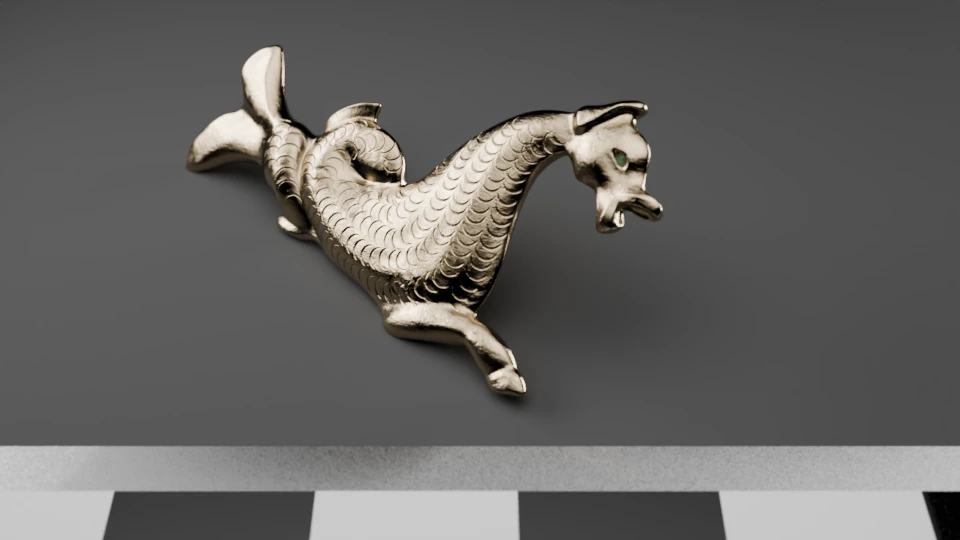
A hippocampus with an attitude
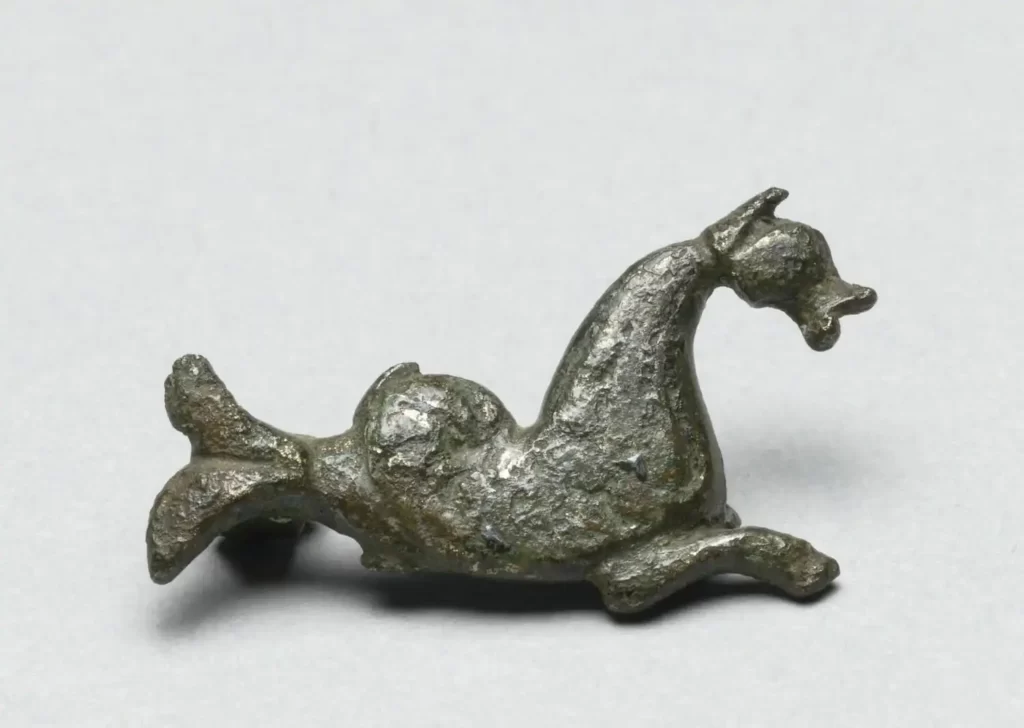
Title: Fibula in the shape of a hippocampus
Datation: 25/75 ACE
Provenance: Gaul, Gallia Lugudensis, discovered in Le Chatelet de Gourzon
Dimensions: 3.6 x 1.7 x 0.6 cm
Media: bronze
Source image: INV n°Br 2029, Musée de Louvre
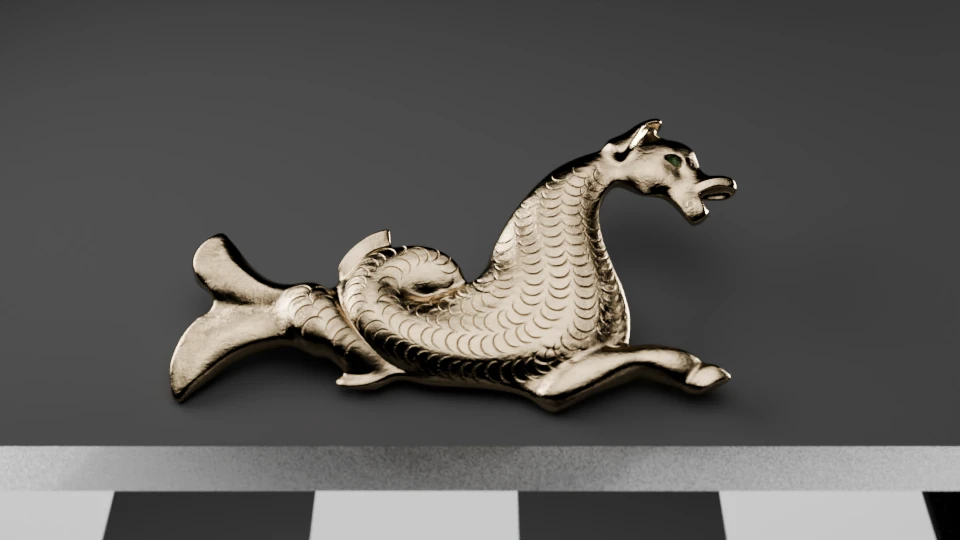
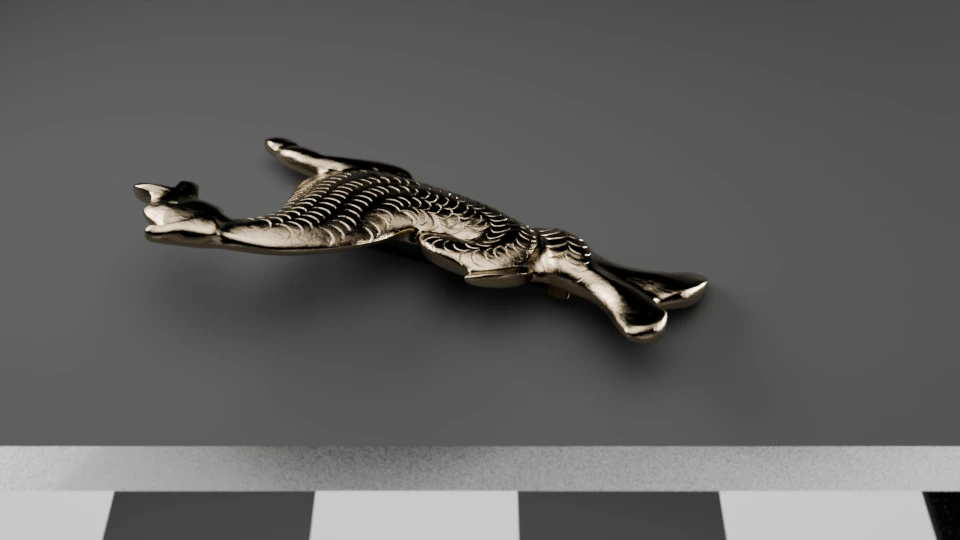
This artefact is interesting on different levels. First, it’s a hippocampus. That’s cool enough as it is. Moreover, it’s a distinctly Roman inspired hippocampus with Greek roots. How do I know that ? The style, volumes and most of all the overly twisted tail are give-aways. The head however gives a somehow Nordic feeling, though I could not objectively put my finger on what renders this impression. Remember, Gaul is basically a crossroad in Western Europe.
Then, it was discovered in one of the most famous French archaeological dig, Le Chatelet de Gourzon. It is one of the longest studied site, starting from the 18th century up to today. Furthermore, it is also one of the first state funded dig. The overall site is huge, approximately 24ha, and is covering a period from the neolithic to the 9th century ACE. Yet, it seems only a very small part of it has been researched yet.
Some objects found were given to the Musée du Louvre in 1825: therefore we have regular stream of publish scientific studies that mentions them up to today.
This is interesting because, as we already alluded to, these are vernacular pieces, not masterpieces. It is not that common to have information about these artefacts and they most of the time lay dormant in drawers for years never seeing the light of day. But the Louvre being what it is, we have regular catalogues mentioning them and, here’s the kicker, where there are drawings of the pieces.
Our little aquatic friend has two identified occurrences, mentioned on the museum’s website in the bibliography section (insert tears of joy). One of them is the “Recueil des monuments antiques”, where 19th century drawings by Jean-Baptiste Muret cataloguing most of the pieces curated in the then Royal Library, more accurately artefact from what is now the “Cabinet des médailles” whose collections go from coins, medals and seals to vases, jewels, statues etc.
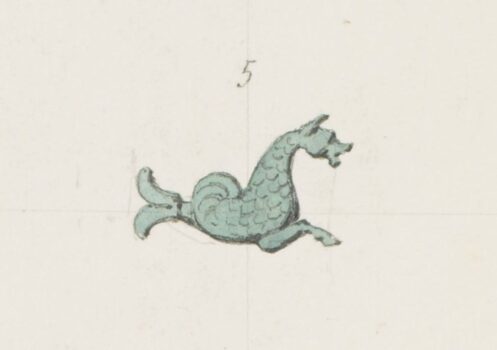
As we can assume this is a first hand source, you’ll notice the artist gives us another point of view of the piece. Though the proportions are slighlty skewed, Muret has sectionned the volumes in a distinct way that is harder to read on the photograph. He as has also given us more insight as to the decor: on the photograph, we can only see 2 or 3 of the incised scales (just above the forelimb).
That tremendously helped to finalize the shape when modeling. You’ll notice I added an eye to the shape. It is both a personal choice and because exists in another reference drawing of the piece , though it isn’t present on the Muret. If you look closely at the photograph, you can see a weird shape on this spot but that could just be an image related thing.
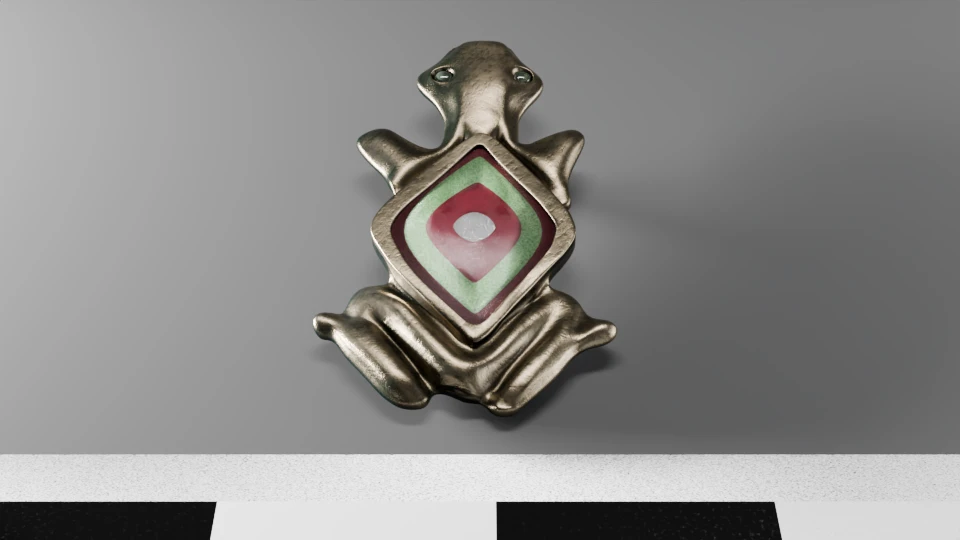
Frogs are your friends
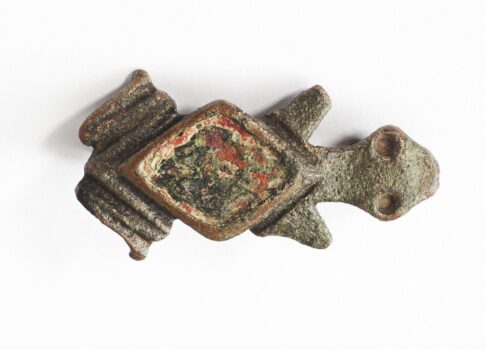
Title: Fibula in the shape of a frog
Datation: Roman antiquity
Provenance: Beisheim
Dimensions: 3.6 x 1.7 x 0.6 cm
Media: bronze, enamel
Source image: INV n°2009.1.72, Musée Gallo-Romain de Biesheim.
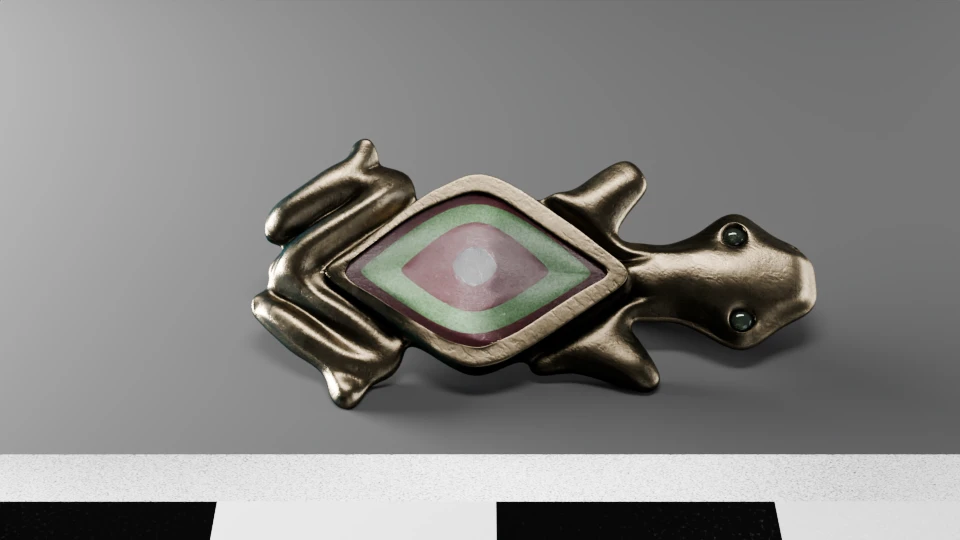
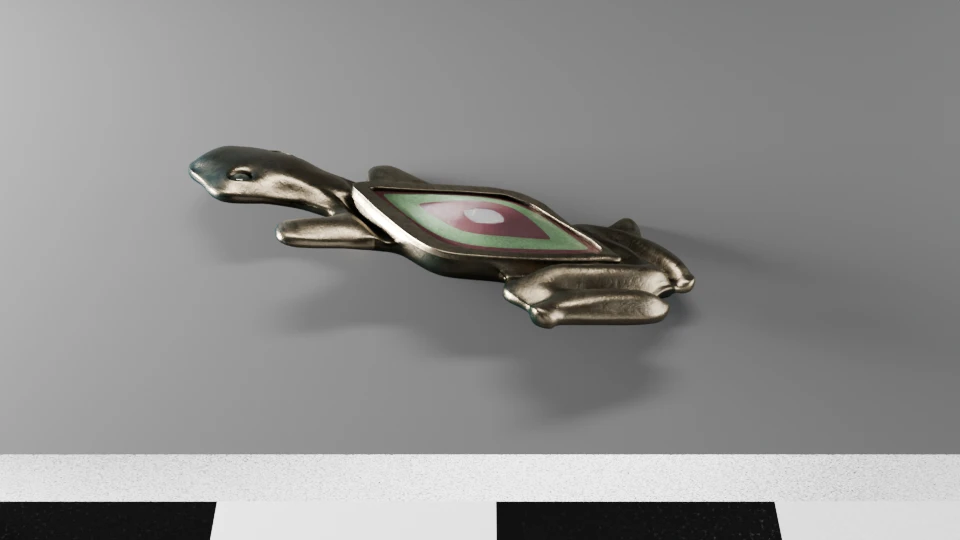
I like the stylization of the humble frog. The conundrum with this model was to try and “reconstruct” the decor.
A thorough inspection of the image reference reveal the red hue of remaining enamel. It also shows a diamond shape negative space where the decor is missing. I think I also identify a central circle but, let’s face it, that may just be my eyes playing trick on me.
I also added eyes in the recesses on the head by adding glass beads, a technique found on other fibulas. I’m not sure it is accurate but I think it adds a little quirkiness to the model on par with the overall cheekiness of the Gaul’s tradition !
Contact
Credit
Unless otherwise mentioned, all images credit to LGS.
Iconography
Fibula in the shape of a fish, 25-75 ACE, Gaul, discovered at Le Chatelet de Gourdon, 3.4 x 1.4 x 0.7 cm, bronze and enamel, INV. Br 2032, Musée du Louvre
Fibula in the shape of a rosette, 25-100 ACE, Gaul, Gallia Lugudensis, 3.6 (diameter) x 0.65 cm, bronze, INV n°Br 1982, Musée de Louvre
Fibula in the shape of a hippocampus, 25/75 ACE, Gaul, Gallia Lugudensis, discovered in Le Chatelet de Gourzon, 3.6 x 1.7 x 0.6 cm, bronze, INV n°Br 2029, Musée de Louvre
3D Scanned version of the bronze Vercingétorix statue by sculptor Aimé Millet for the monument in Alesia fields, 1865, Alise-Sainte-Reine, France.
Nauheimer fibulas, 250 BCE to50 ACE, bronze, INV n°k1999/2.16, Netherlands, Rijkmuseum Van Ouheden.
Fibula, 5-275 ACE, bronze, Netherlands, INV n°f2019/12.3684, Rijkmuseum Van Ouheden.
Zoomorphic fibula, Roman era, gold on bronze, INV n°20945, Gavrilă Simion Eco-Museum Research Institute Tulcea, History and Archaeology Museum, Romania.
Enameled fibula, 101-200 ACE, INV n°11003345, bronze and enamel, Musée archéologique de Namur, BALaT / Royal Institute for Cultural Heritage, Belgium
Fibula with alternating colours enamels, 100-200 ACE, bronze and enamel, Biesheim, INV. 1984.1.587 , Musée Gallo-Romain de Biesheim
Fibula in the shape of a frog, Roman antiquity, Beisheim, 3.6 x 1.7 x 0.6 cm, bronze, enamel, INV n°2009.1.72, Musée Gallo-Romain de Biesheim.
Bibliography
Riha Emilie, “Die römischen Fibeln aus Augst und Kaiseraugst”, 1979, inclue fibulae visual typology, available online and on forums.
De Ridder, André, Les bronzes antiques du Louvre, 2, Les instruments, [Musée du Louvre], Paris, E. Leroux, 1915, available online , p. 74, n° 2032
Grivaud de La Vincelle, Claude-Madeleine, Arts et métiers des anciens, représentés par les monuments, ou Recherches archéologiques servant principalement à l’explication d’un grand nombre d’Antiquités recueillies dans les ruines d’une ville gauloise et romaine, découvertes entre Saint-Dizier et Joinville […], Paris, Nepveu, 1819, available online , pl. 43
Hippocampus fibula at Digital Muret project , Institut national d’histoire de l’art – Bibliothèque nationale de France, available online
Rosette fibula at Digital Muret project , Institut national d’histoire de l’art – Bibliothèque nationale de France, available online
Almgren O, “Studien über nordeuropäische Fibelformen der ersten nachchristlichen Jahrhunderte mit Berücksichtigung der provinzialrömischen und südrüssischen Formen”, 1897, Haeggstrom, Stockholm, available online