

Owl and oil
The following texts and images are the results of a training exercise to go from the pictures or the description of an artefact to the creation of a 3D digital double, sometimes restored version of it. If you wish to know more about the process, explanations are in A journey into learning a (3D!) restoration process workflow article.
The following modelling exercise is taken from an artefact that has a particular place in my own story. This time, we’re off to Corinth via the Louvre Museum and the wonderful world of scented oils in terracotta vessels.
As it is most often times the case, we’ll have to work with limited direct resources (a few pictures) and the heart of the matter will be to make educated guesses using as many scientific and contextual help as we can found.
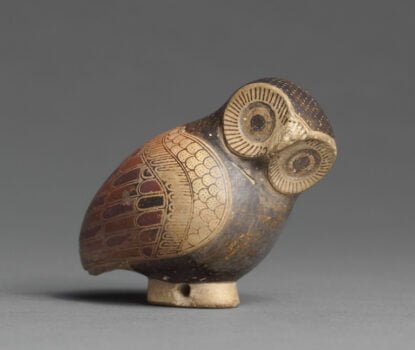
Title: Chouette (Aryballos)
Datation: ca -640 (BCE)
Provenance: Corynth, Greece
Dimensions: H 5 x W 6.4 cm, depth not mentioned
Media: terracotta
Source image: n°CA1737 Musée du Louvre
Description and Historical context
Perfumes and scented oils in Ancient Greece
You might be wondering why the introduction mentions oils and perfumes when what you see is an owl. Well, it’s because it isn’t just an owl. Aryballoi (plural of aryballos, from its Greek roots) are “small flasks […] used to contain perfume or oil”. They were most probably containing perfumed oils, because it’s easier to keep a fragrance in a fat solvent, though an alcoholic method existed already.
As this little owl is Corinthian, chances are it would have been filled with a mixture of almond, sesame, or low fragranced olive oil and a scented compound.
Though an important pat of the day to day life, actual sources about the perfume making process in ancient Greece are scarce and research is still active in this area. Just to give you a hint of the available fragrances at the time, you can take a look at what Theophrastus(371-287 BCE) has to say about this subject in his essay “On Odours”.
Aryballoi comes in all shapes and sizes, including zoomorphic ones.
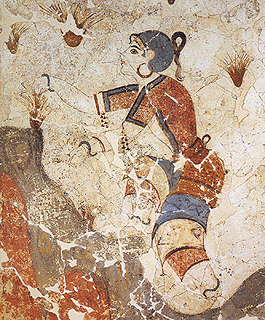
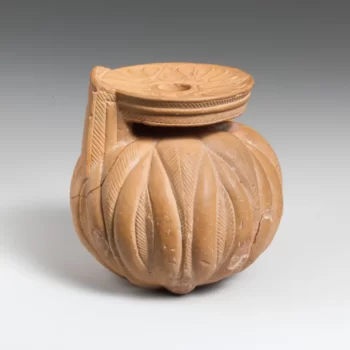
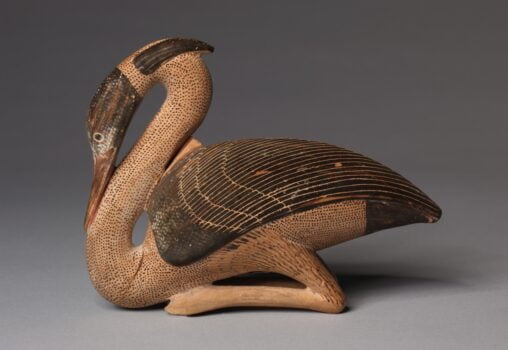
Now, if you have gone and read Theophrastus essays you may now be a little disheveled : that was long and sometimes confusing, wasn’t it ? Thankfully, scholars have been deciphering and making sense of it all, as with this study of the use of iris.
We now know some perfumes or perfumed oils were dyed. The funny thing about dyes is that they are most usually dying everything they are in contact with for too long. I’m skipping ahead a bit and telling you that there doesn’t seem to be traces of that on our little owl.
So, just for fun, in our intellectual reconstruction of the fragrance contained in the aryballos, we can eliminate the megalaieon, the rose and the sweet-marjoram type.
Because I am the one writing, I think I will pick the quince scent. Feel free to choose whatever fragrance you want to project on our owlet, and let’s continue our modelling journey.
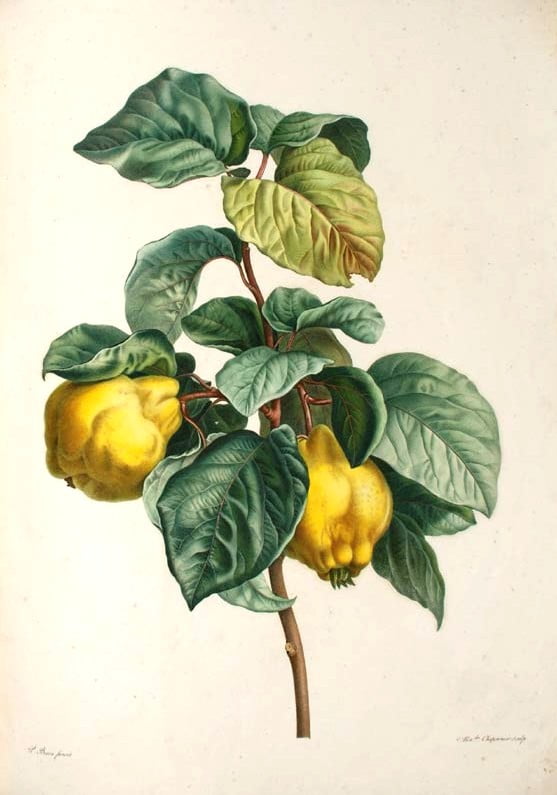
I am always amazed at how little our tastes for what’s closest to us have changed through human history. Those are exactly still some of the main fragrances in today’s perfume industry in the (broadly) western world, though in different ratios.
Orient inspired art
The period that saw the aryballos creation is known as the Orientalizing period. Which, for once, is exactly what it sounds like. Populations and trades moved from the orient world (Egypt, Phoenicia, Anatolia etc.) to the western-er world, bringing new resources, new materials, new inspirations and new tastes.
It is also because of these new trade routes that Corinth became one of the Aegean world commercial and political centre. This is particularly prevalent in ceramic exportations: Corinth’s black figure painted vase are found all around the antique world. Scholars often put forward the influence of metalware and its ceramic imitation as incentive to produce spectacular pieces.
This technique uses a slip decoration technique on the raw clay that is then fired in a oxidizing environment.
Thus, a black figure ceramic is born.
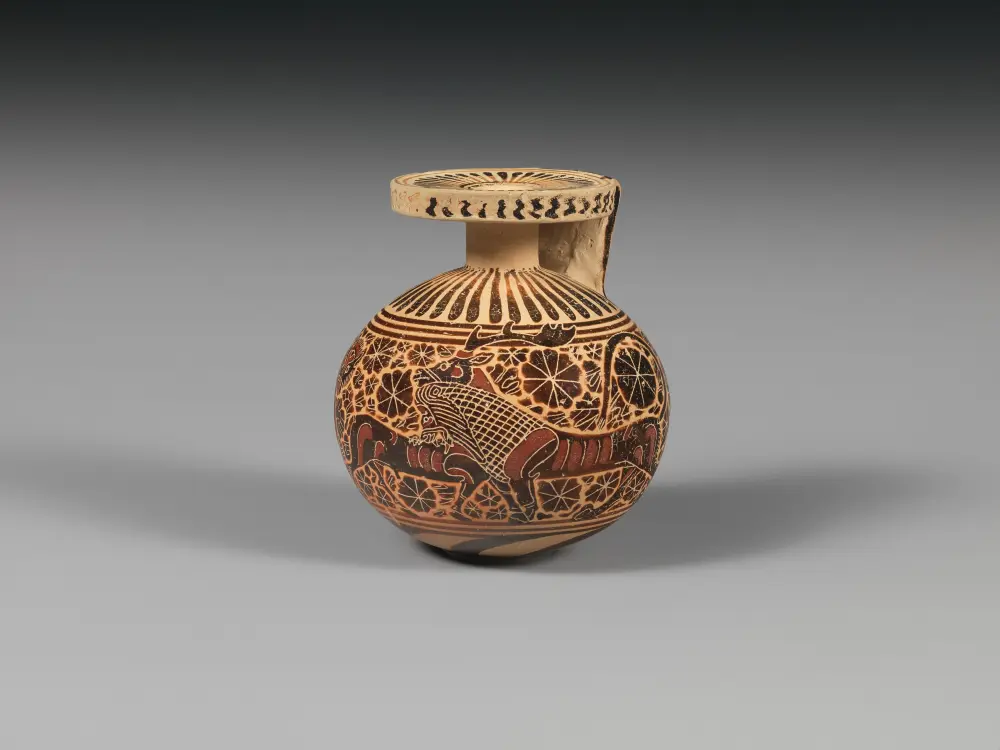
Corinth geological stratas provided a rich clay source, mainly a calcium-rich illite with montmorillonite traces, in the region between Lechaio, Kechries south of Loutraki and north of Examilia.
The clay is light in colour, pale yellow with occasional tints of green or pink.
Its colour is usually more looked at in comparison to the deep red shades of the attic clay, whose ceramics will eventually supplant Corinthians’.
A slip is a clay in a more liquid form that can be applied with a soft brush on a surface.
As the Metropolitan museum puts it: “… In black-figure vase painting, figural and ornamental motifs were applied with a slip that turned black during firing, while the background was left the colour of the clay. Vase painters articulated individual forms by incising the slip or by adding white and purple enhancements (mixtures of pigment and clay)…”
And, thus, a black figure ceramic is born.
Artefacts reference of the same period.
Once again, I’m going a little ahead and add an information from the condition report of the piece: its decor is not incised. We shall then restrict our search to smoothed pieces. Let’s start with a cousin !
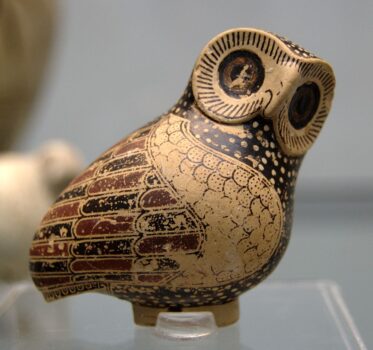

There are many similarities between the two pieces: the oves of the underside, the dotted body, the “glasses” pattern around the eyes and the colour alternating feathers on the wings. The main difference is on the attitude of the animal: this one’s head is up when the Louvre’s is turned sideways. If the beak is defined by a line at its extremities, the nostrils are apparent here when they are missing on the Louvre’s.
The picture shows brighter colours, though the altered epidermis doesn’t give us many variations.
Fortunately, there are numerous other pieces that can help us with that.
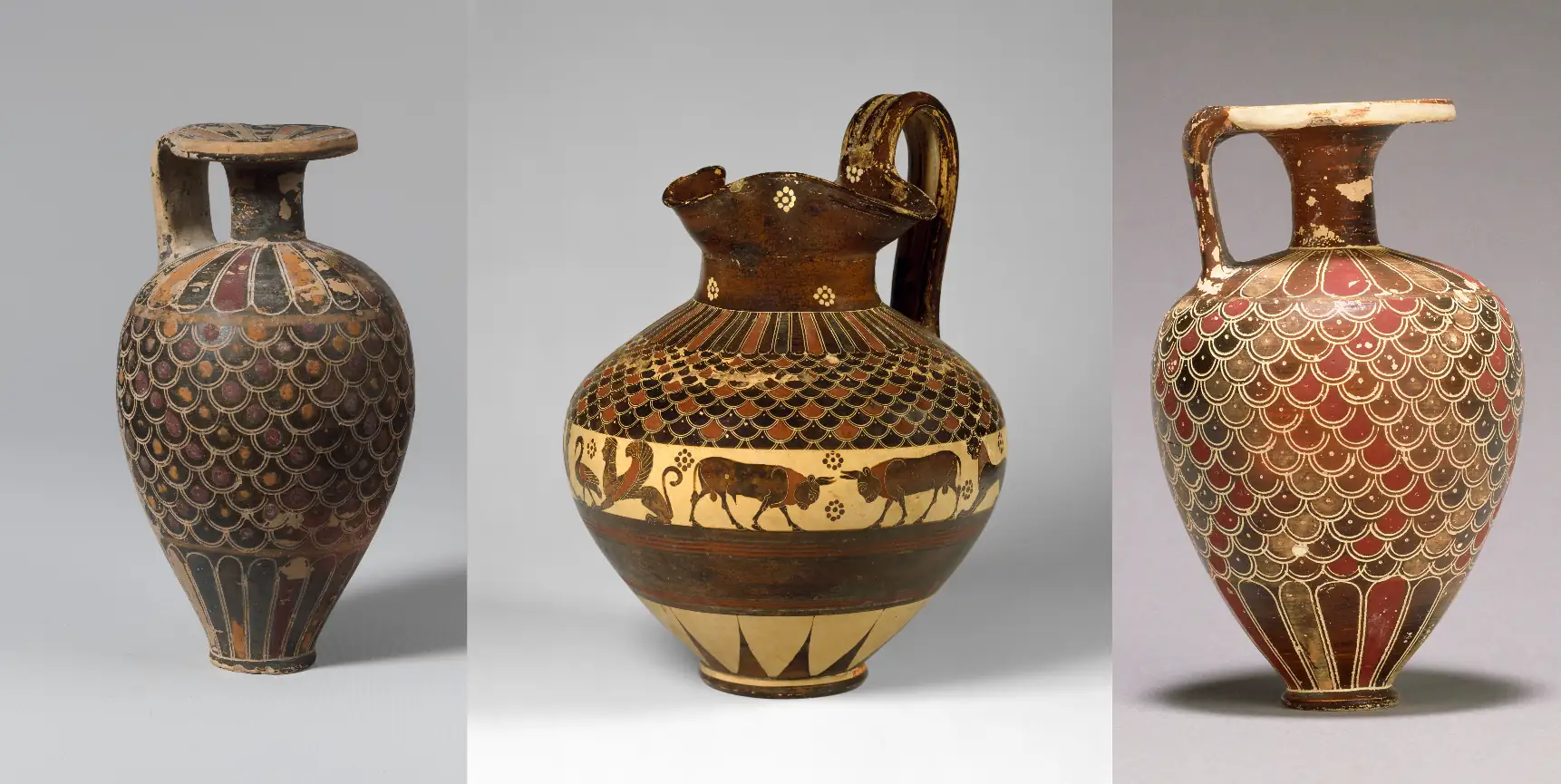
Visible condition report and details assessment
A ready-made condition report.
The overall condition report is given but the curation team itself on the Louvre Museum website.
It roughly translates to: “The vase is not broken; paint is missing on some parts, a few flakes and chips on the beak, tail, and feathers: an overall white veil all over the epidermis”. The text adds there is a “firing accident on the back”, from a gaseous and/or temperature issue inside the kiln rendering a shift in the colours on a specific place.
We can add another description made in a paper by Edmond Pottier in 1908, “La chouette d’Athénée. It is giving us quite an emphatic description as well as some contextualization elements.
There is a reference to 3 other similar pieces on top of the Munich owl that we already know (cf. supra): one at the American School of Classical Studies at Athens as mentioned in the American Journal of Archaeology, Second series, 1906, one found in Megara Hybleaia now part of the Museo archeologico regionale Paolo Orsi and one allegedly in the Cabinet des médailles (French national archives).
I was not able to find definitive photographic evidence of these pieces so far, only etchings. It seems the ASCSA and the Munich owl are similar: the figure head is held high. The Orsi is similar to the Louvre’s, with its head kept low. I don’t know about the “Cabinet des médailles” one. According to the description made by Pottier, I’d say it may look like another example from Munich, simpler in shape and decor in comparison to the others.
Maybe, one of you, dear reader, knows more about these owls ? Do not hesitate to come forward !

To these informed descriptions, I will add the following elements:
- is the figure is the result of a moulding process ? The form is a deceivingly simple body base, onto which it seems is added a separate piece creating the mask of the eyes and beak.
- the geometric design is regular throughout
- there are fallen flakes of slips and probably separated layers on these points
- there are no information on the finding context: the white veil can have numerous causes, from solvents in the soil where it was (if it is an archaeological finding) to a cleaning treatment gone wrong.
Colorimetry referencing: it’s all about iron.
Let’s try a different exercise to emulate the colours interpretation this time.
We have an ally in these troubled coloured waters: a full study about Corinthian’s ceramic colours by researchers from the University of Arizona.
Just as before, the following text will be a little long for non pottery geeks: if you so wish, you can skip to the next part.
First, the study shows the order in which the different layers were applied: “a yellow to red slip that turned black in reduction was applied first, followed by the white, wine red, purple and red slips.”
In our case, this might mean that what was deemed a kiln related issue for the colours on the back might also have triggered be a layer separation issue. That means the slip did not adhere fully to the underlaying strata and eventually separated itself. As we have no finding context for this piece, it could have happened in the kiln or in the span of its lifetime before entering the collection. Therefore, these parts of the motif can be deemed altered, despite the pleasant result they give on the object outlook.
It then gives us insights into the fabrication process of the slip:
“Furthermore, particles are of single to sub-micron in size, which is known to be a prerequisite for the production of a reduced black slip, and demonstrates the high-degree of control in levigation [the act of grinding a solid substance to very fine powder] that Corinthian potters practiced producing these slip layers. Thus, slip thickness and not variable particle size was the cause of the variegation.”
What I get from that is that the shift in values and chroma seems to be more often a matter of slip layer thickness than a pigment composition issue. That can mean that on the same piece, all similar colours were supposed to be the same sort. In our case, this is consistent with the other aryballos of the same kind, among which the Louvre aryballos differs. Granted, the shift can be a voluntary effect but only in chroma and values, not in hues.
For my fellows pottery geeks out there, here are two other nuggets.
The study points out that it still can’t definitely say whether the ceramics were fired in multiple stages or in a single firing with multiple phases (temperatures and oxidations). I think, but I’m not certain, the alterations studies of a bigger corpus might give more insights into the matter. Such a study may already exist. If one of you, dear reader, knows more about it, please do not hesitate to make yourself known.
It then points: “This white slip was applied over the base black slip (Fig. 11), and confirms the initial results obtained by optical microscopy, even though such a layering process seems counter-intuitive”. Indeed.
The conclusion of the study puts forward a few interesting elements in our case, such as the glossiness and the metal-like aspect:
“….the chain operatoire of the surface treatments could be reconstructed. Beginning with a base wash of Corinthian clay, the surface of the Corinthian pot was smoothed to prepare it for the addition of polychrome slips. A base slip of black was then added, and took the form of either a decorative element, such as a figure or rosette, or a uniform surface coating. Red, wine red, purple, and white colours were then added to the surface of this base black slip as accents, and gave these Corinthian styles their character.
Iron was shown to be the key element in the production and character of these Corinthian
slips and pigments. […] As a result, the black slip was concluded to be a product of an iron-containing slip fired under reducing conditions, while the added red was an iron-rich-clay species, different from that of the black, fired in oxidizing conditions. Wine red and purple paint washes required much more complex production methods to produce their distinctive colour, given their iron-oxide nature. Thus, a possible method for the manufacture of this paint wash includes the treatment of smelted iron with acid and grinding the resulting metal species until fine, submicron particles were achieved. This pigment would then be mixed with a clay binder and appropriate fluxes to
facilitate its use as a paint wash. […] The white slip was shown to be an illitic or kaolinitic clay with calcium impurities.[…]Perhaps the greatest example of Corinthian material control is seen in the multi-textured Corinthian pottery. With both red and black matte – gloss banded examples, the production of the higher gloss slip is believed to be a result of greater control over the iron and clay particle sizes used. […]The effort displayed by these craftsmen to produce specific results, on such a large scale, warrants an investigation into the possible motive behind their manufacture. One explanation for the production of these energy inefficient ceramics centers on their visual similarity to metal objects. In this way, Corinthian ceramics acted as skeuomorphs [here, a design on an object made to resemble another material] for metal objects.”
In the case of the object we’re trying to replicate, we can add the inspiration for the owl was most likely Athene noctua, a little owl very common in temperate parts of Europe. You’ll notice there are almost no dramatic colour changes but the white dots.
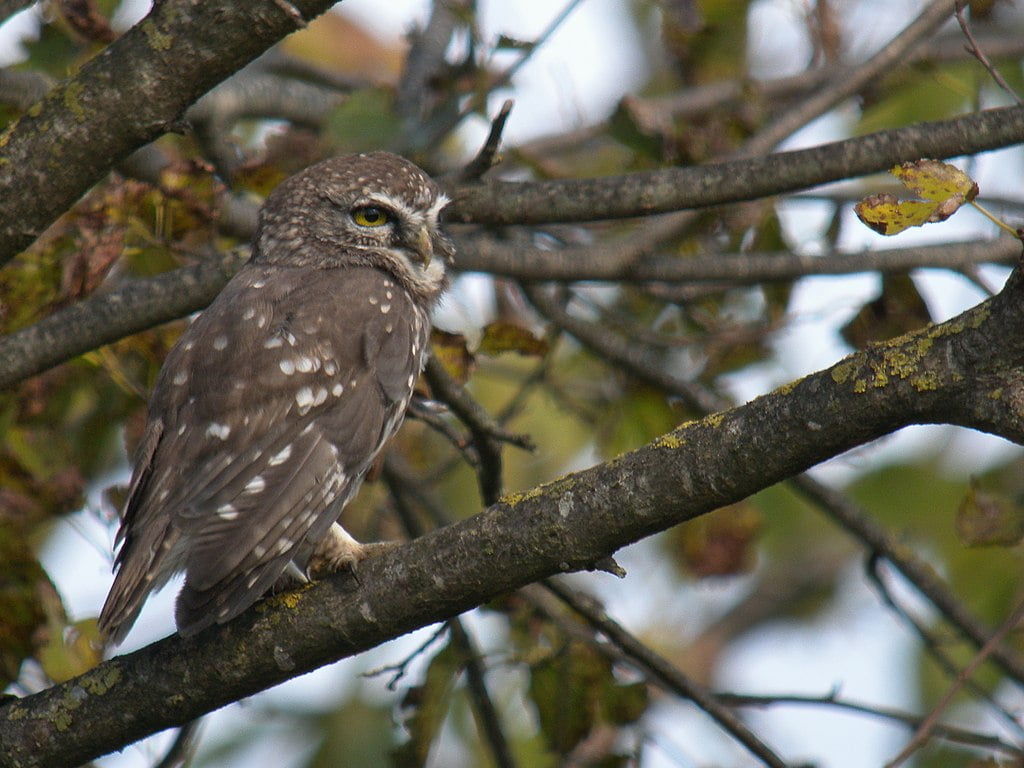
So, with all these information, what do we want to do ? I initially intended this model to be a simple try at modelling a credible digital double. I think we can now try to see what it would look like without the alterations mentioned in its description. Something along the lines of black or very dark red/violet colours with a glossy almost metal like texture ?
Creating a 3D version of the piece : a 3D reconstitution process
Disclaimer : this is an exercise, shown for documentation purposes only
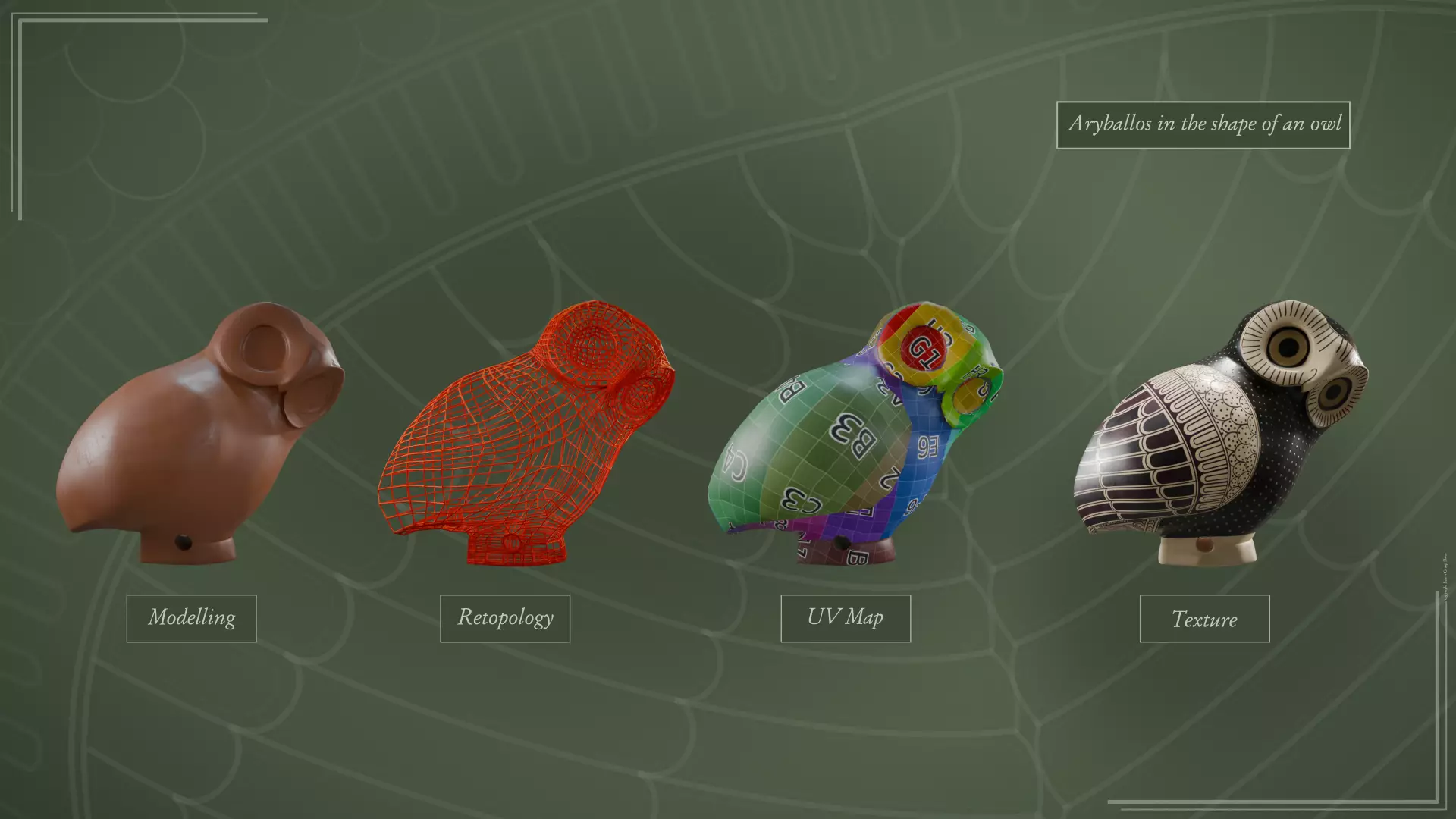
Model the shape
This is a classic process of shape-detail-correct-smooth-repeat. Again. And again. I did many (many!) versions of this particular piece. I lost count of how long it took me to obtain a remotely satisfying piece. Well, you learn something every time, I guess. I now know to be weary of deceptively “simple shapes”. In my experience, they most often turn out to be the most difficult ones. Their beauty lies in the apparent harmony of their shape, and the effect breaks with the slightest mistake. Trying to make a copy of them, without access to the actual piece, is a perilous exercise to say the least. On top of that, motifs do not help to envision the underlaying shape. It tricks the eye into seeing shapes that might not be there. Bottom line is, if you want to try a first model to reproduce, try another one unless you have an efficient mental health support system !
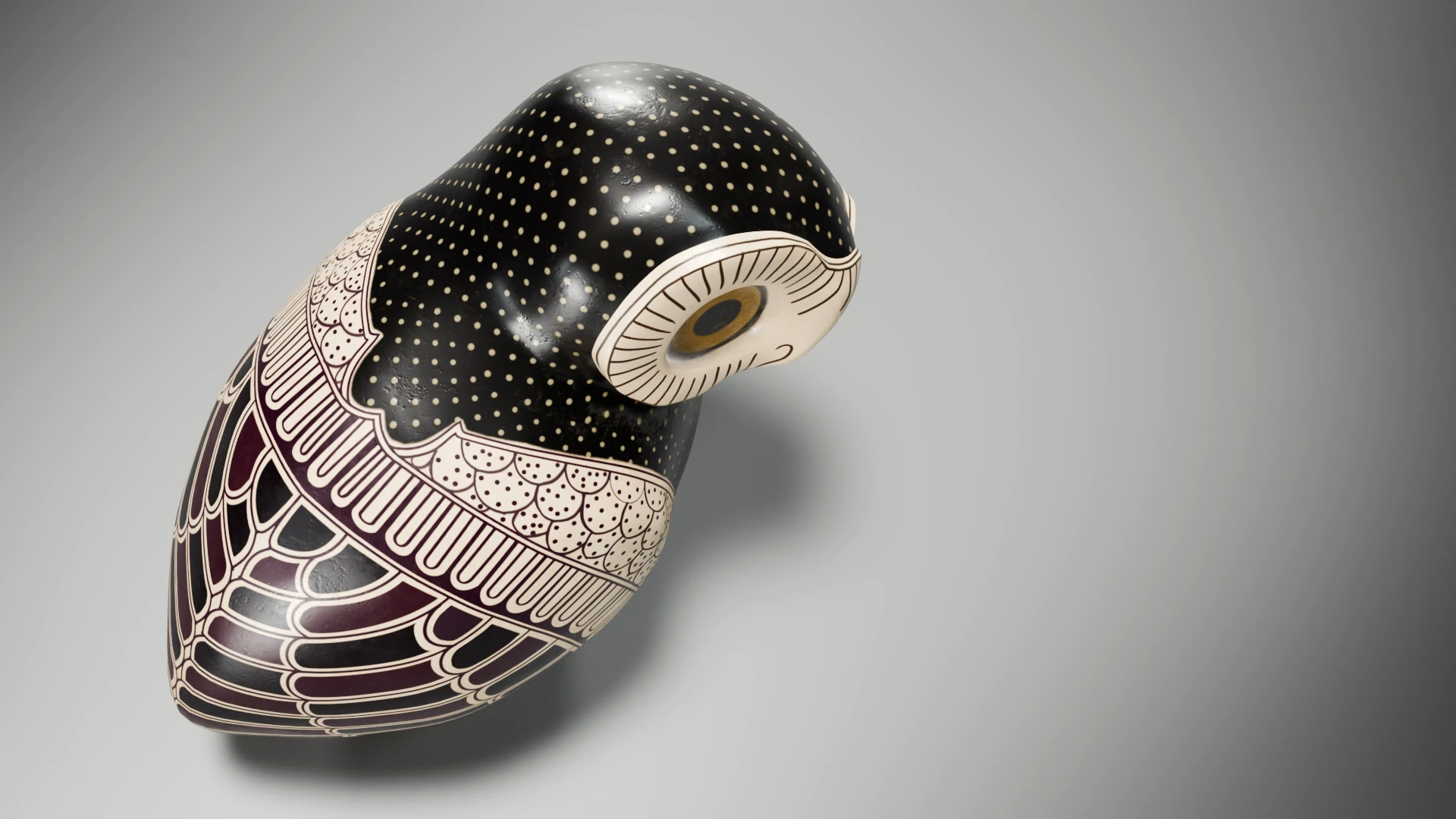
I still have some issues with a few parts of the model. Namely, the beak-eyes part : from memory it might be even more pinched. But as I was not able to find a top view image reference and going to see the piece is not an option: I’m keeping it as is because I think it works with the look of this model. But I’m not saying I won’t revisit it if I can get my hands on new reference material.
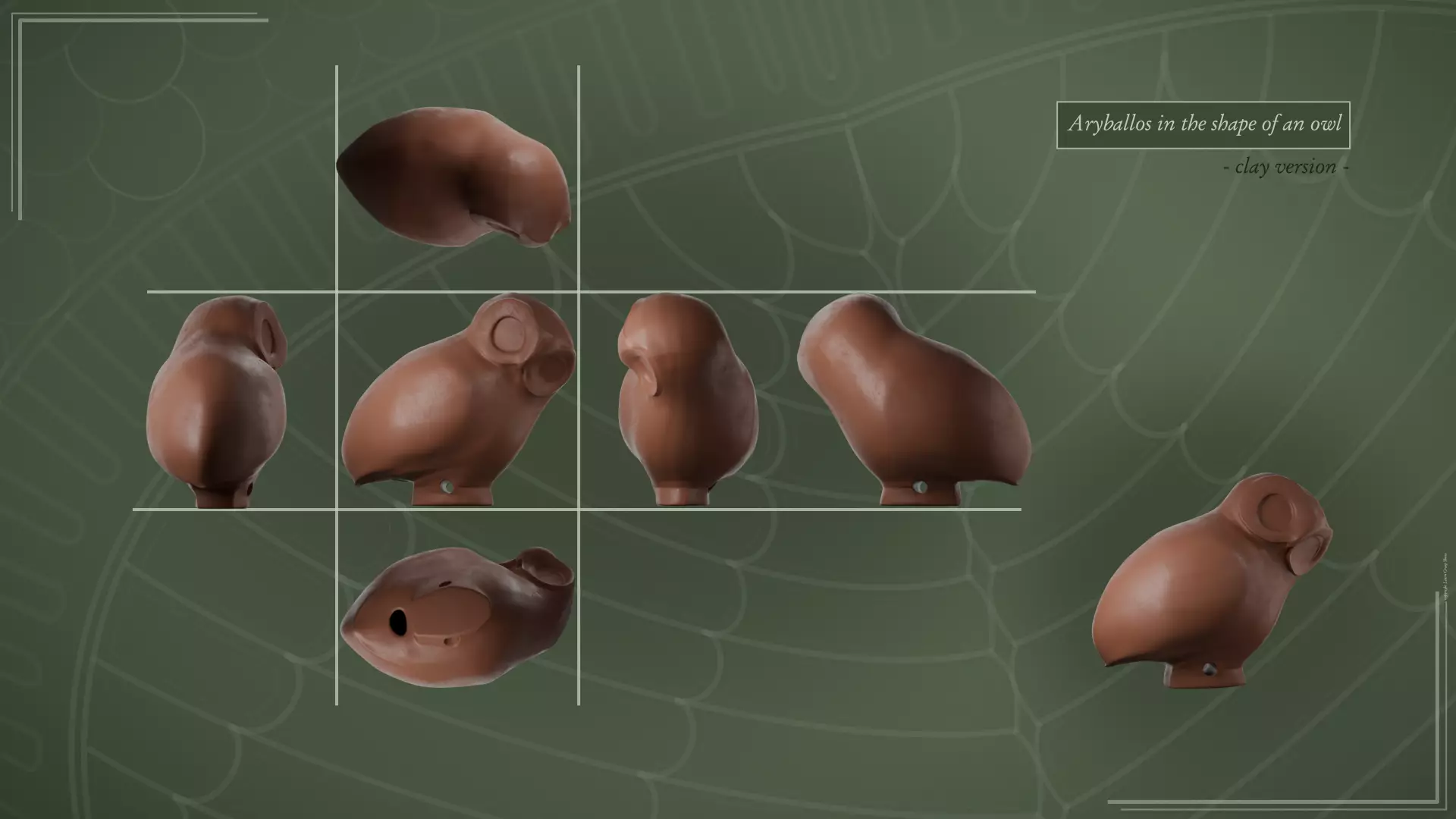
Retopology and texture of the shape
I know, I know. I wrote not a long time ago that I might want to try to texture “something along the lines of black or very dark red/violet colours with a glossy almost metal like texture” in par with what I gathered from the references I found. But should I ?
I’m going to let you in a little secret: these articles are not written in a single take. They are constructed (and heavily edited) along with the model creation and are, more or less, a decipherable version of my -digital- workshop notes. I cut and cut and cut parts to shield you from the numerous try-outs and dead ends.
Enter the painted wings of our little ceramic friend. Or, as I affectionately call them, my personal breaking point. Remember all the talk about the deceptively simple shape from the paragraphs before ? Well, now try to placate a very precise geometric motif on them. There will be tears.
But I’m going ahead of myself.
Let’s take you through all the process so you have a grasp on the situation and why it has an impact on the colour choices.
Putting a triangle on a sphere
At the beginning, the situation is thus: we have a nice rounded shape. On which we have to put different distinct decors, geometric with crisp lines:
- the eye mask (eyes, lines around the eyes and beak)
- the foot ornament (that is partially missing)
- the underside of the tail and the hole for the oil
- the wings with all their precisely drawn feathers.
Because I know the task of projecting on a round surface is never easy, I had the idea to slice the model’s UV map as close to the different decor parts as I could. I had intended this as a way to mask the seams with the change in colours. That means the mesh must first follow these paths.
Let’s try to retopologize with that in mind, then. I am operating under the assumption the original painter used the base shape to guide their hands about where to put the decor.
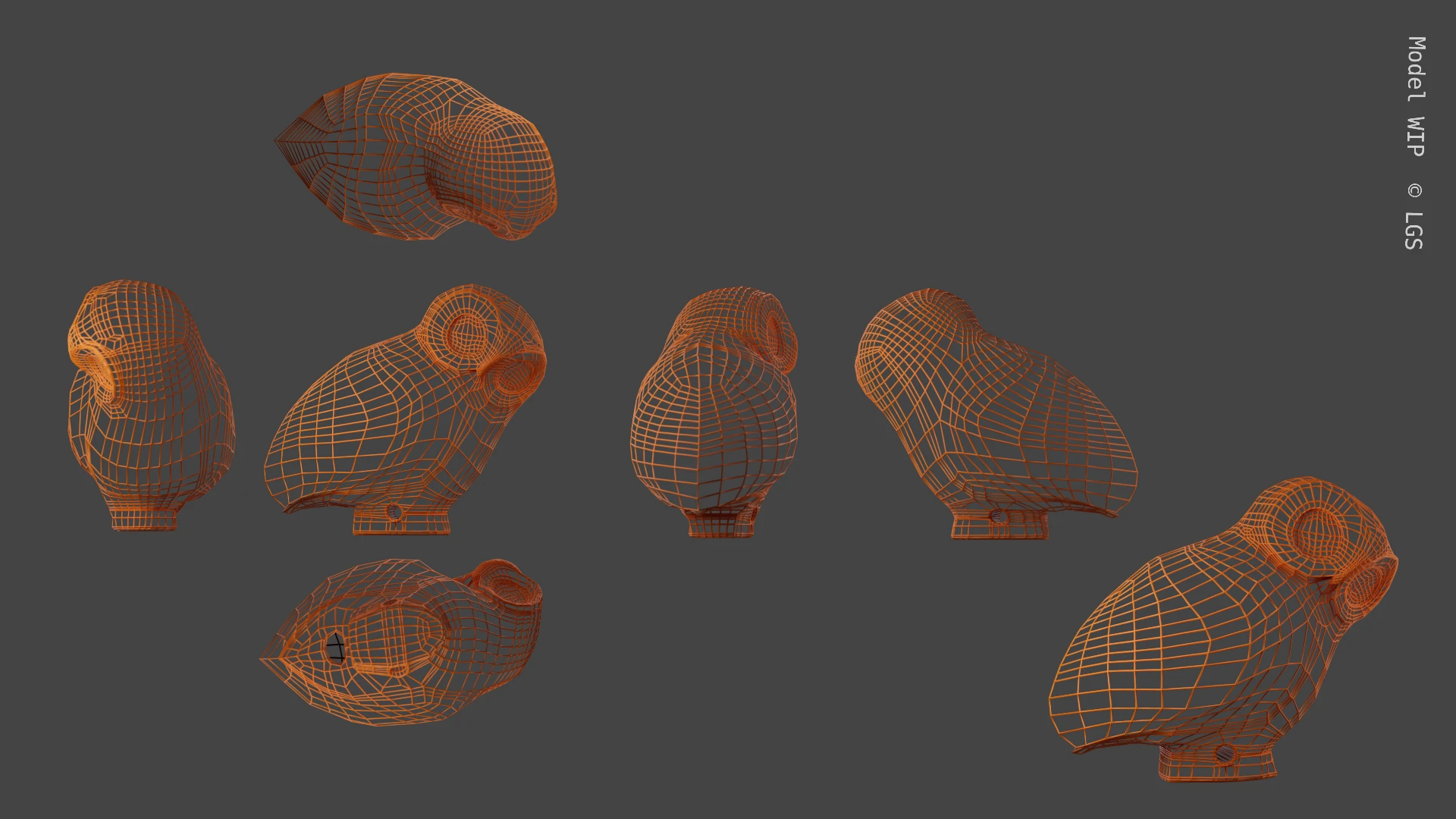
From this I can slice the mesh into different decor islands that I think will help me texture the piece more easily.
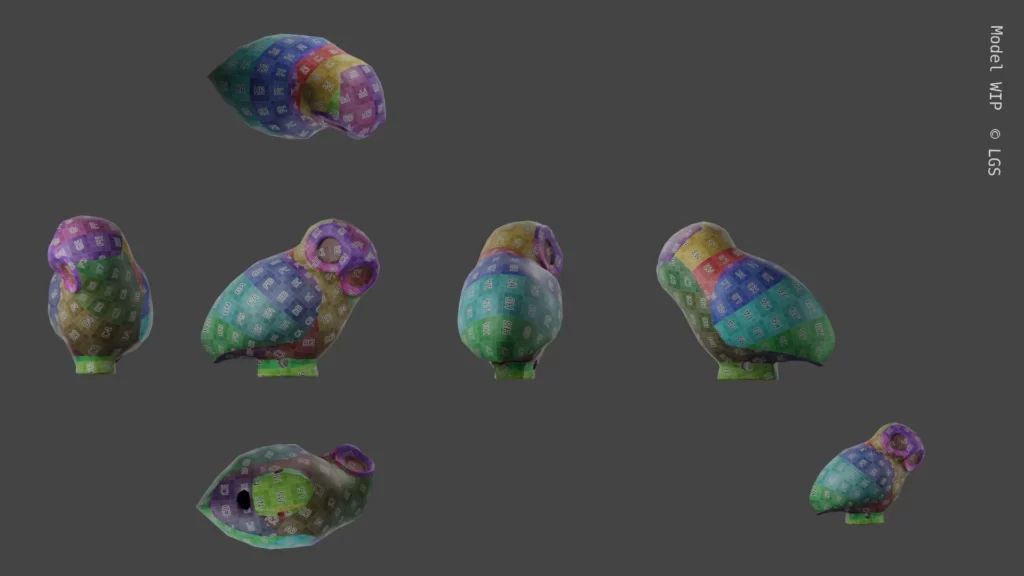
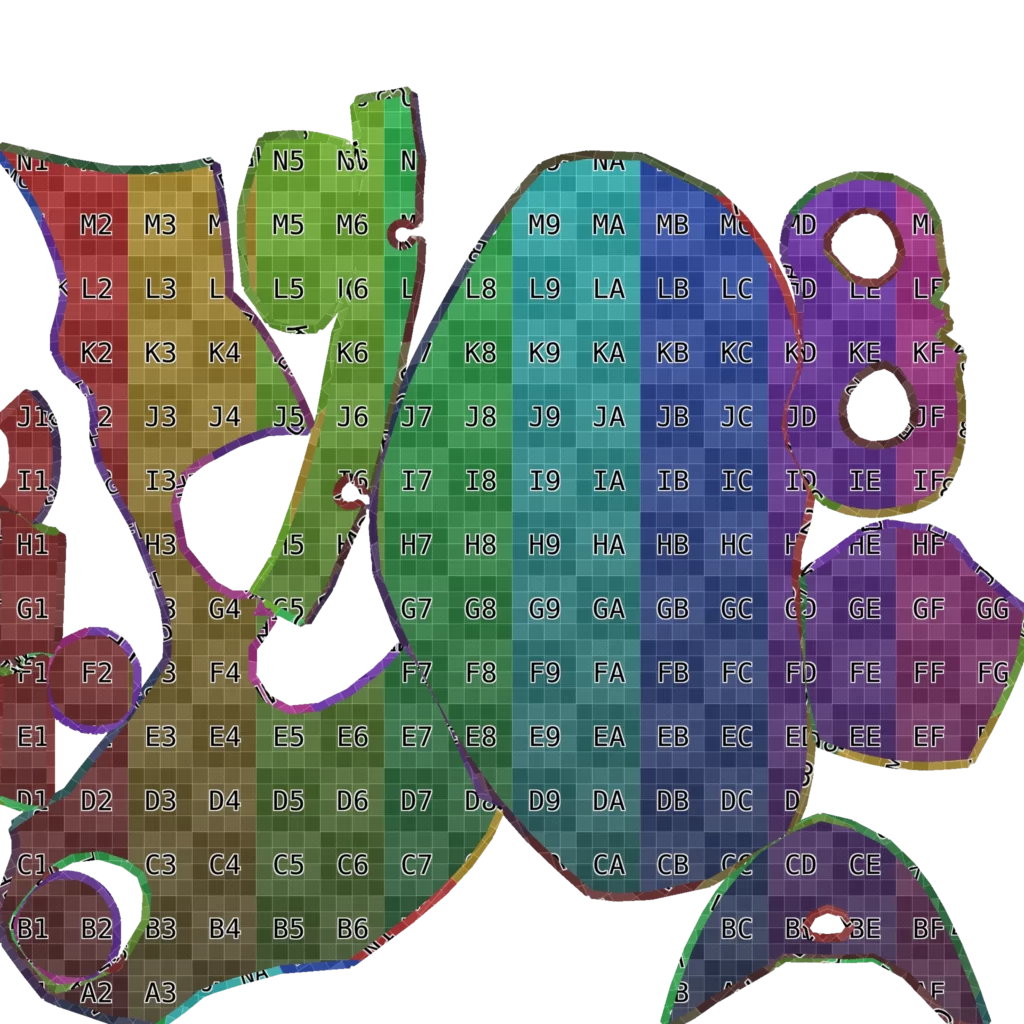
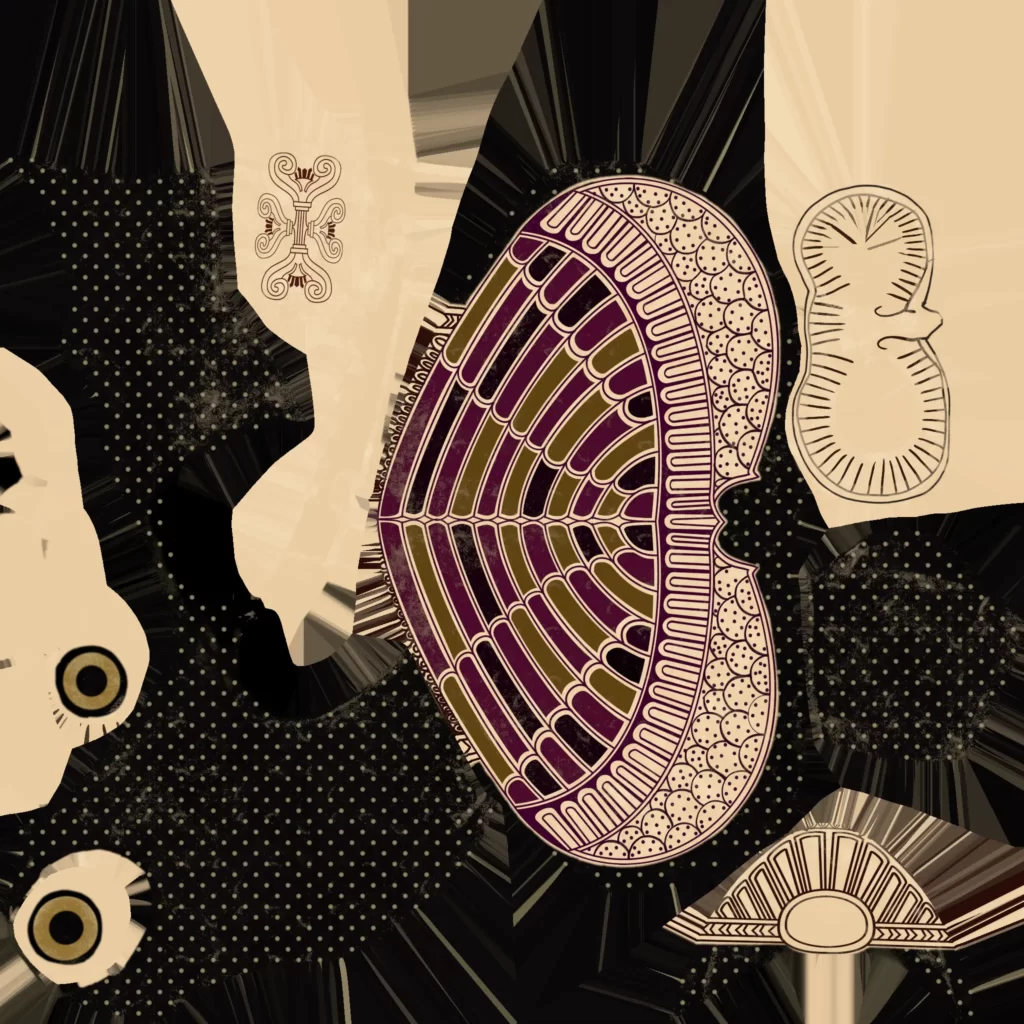
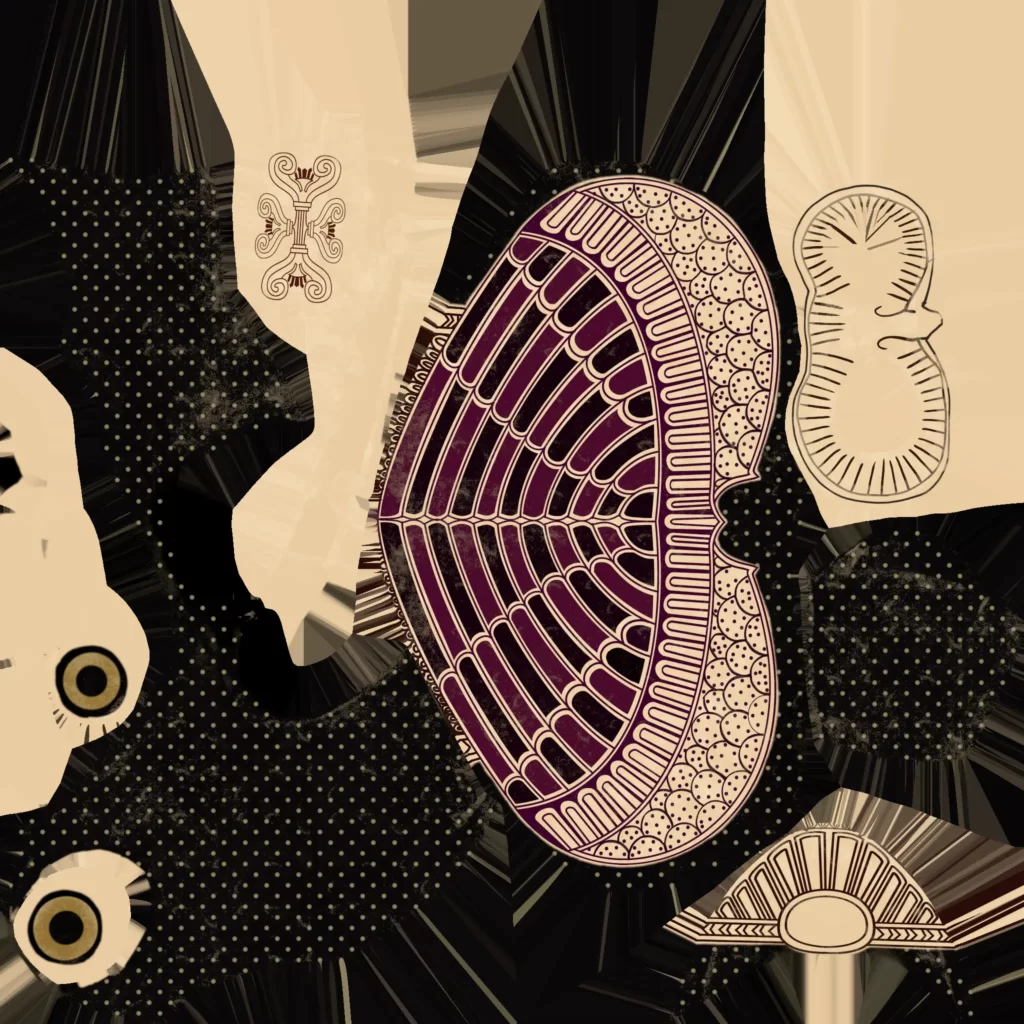
From then on, using the shapes given by the UV islands, it has been a case of trials and errors. To sum up, the most efficient path in order to keep a non-destructive workflow was to use decals. After tracing vectorial versions of them in Inkscape, I could use them in Substance painter to position them precisely. Hand painting over this base gives a cleaner result and the junction between the parts can be mitigated. In the end, I ended up doing the eye and beak mask directly, though, as well as the tiny feathers on the underside of the tail.
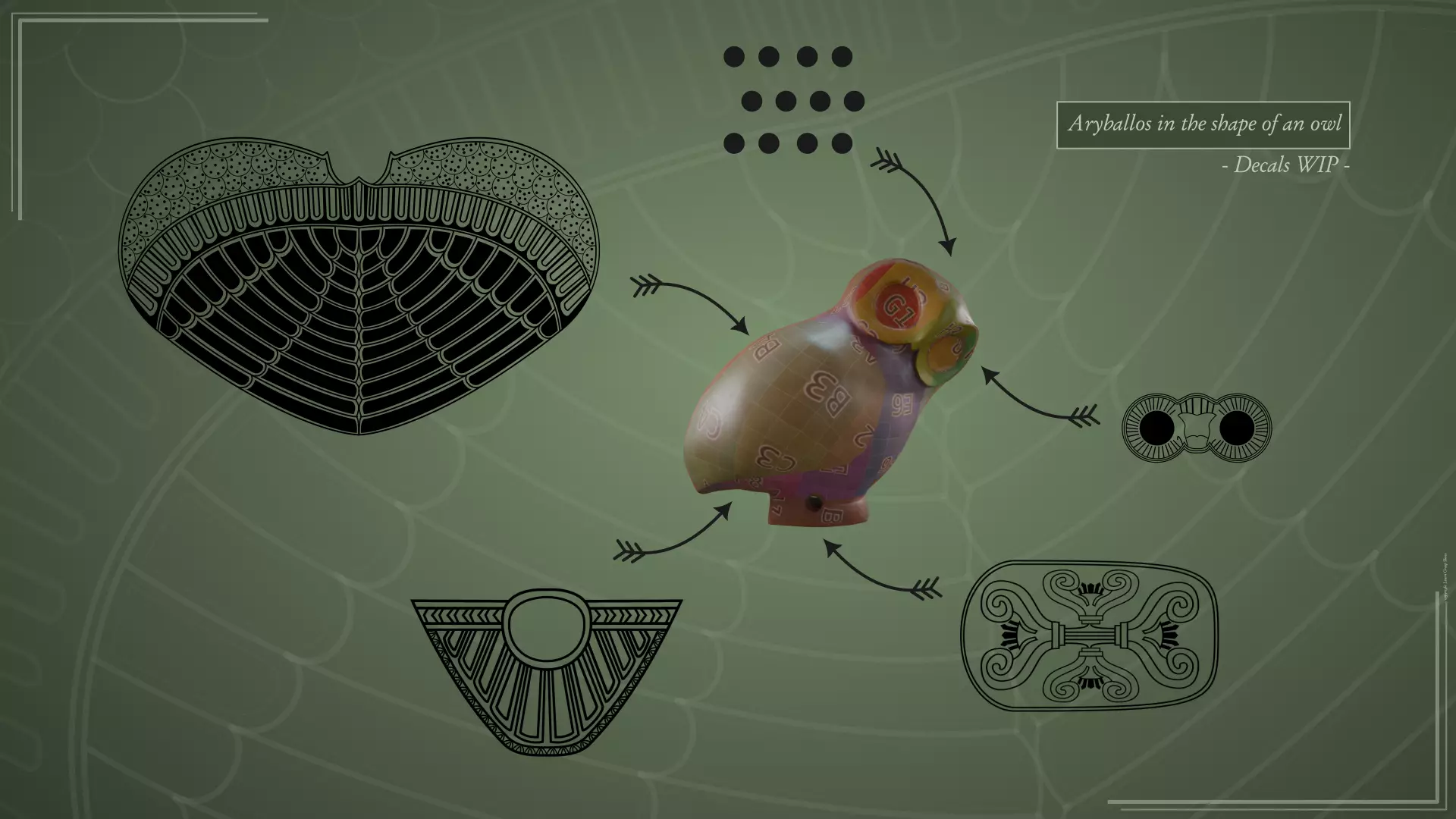
This tedious method has been a saving grace for the wings. I also initially made a design mistake: if you look closely at the only back view of the piece, you’ll notice an inflexion on the top of the shoulders. They do not meet at all: there is a gap between them that I didn’t take into account. I noticed it at the end of the process , and I was glad this method allows for relatively fast modifications ! I am using a plural also because, to date, I made 6 iterations of them, not including the outline tests.
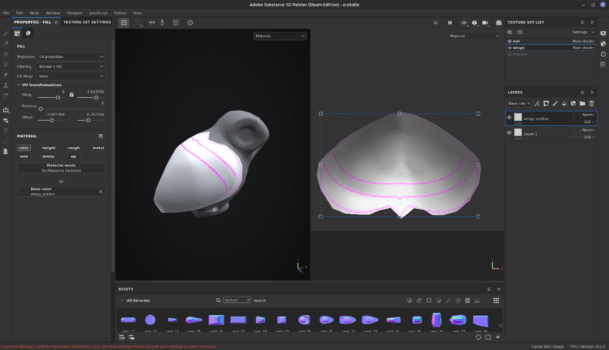
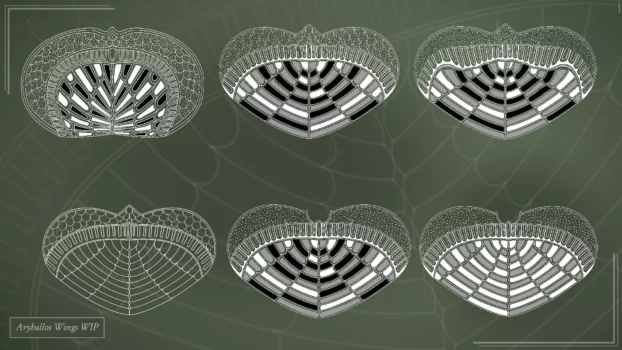
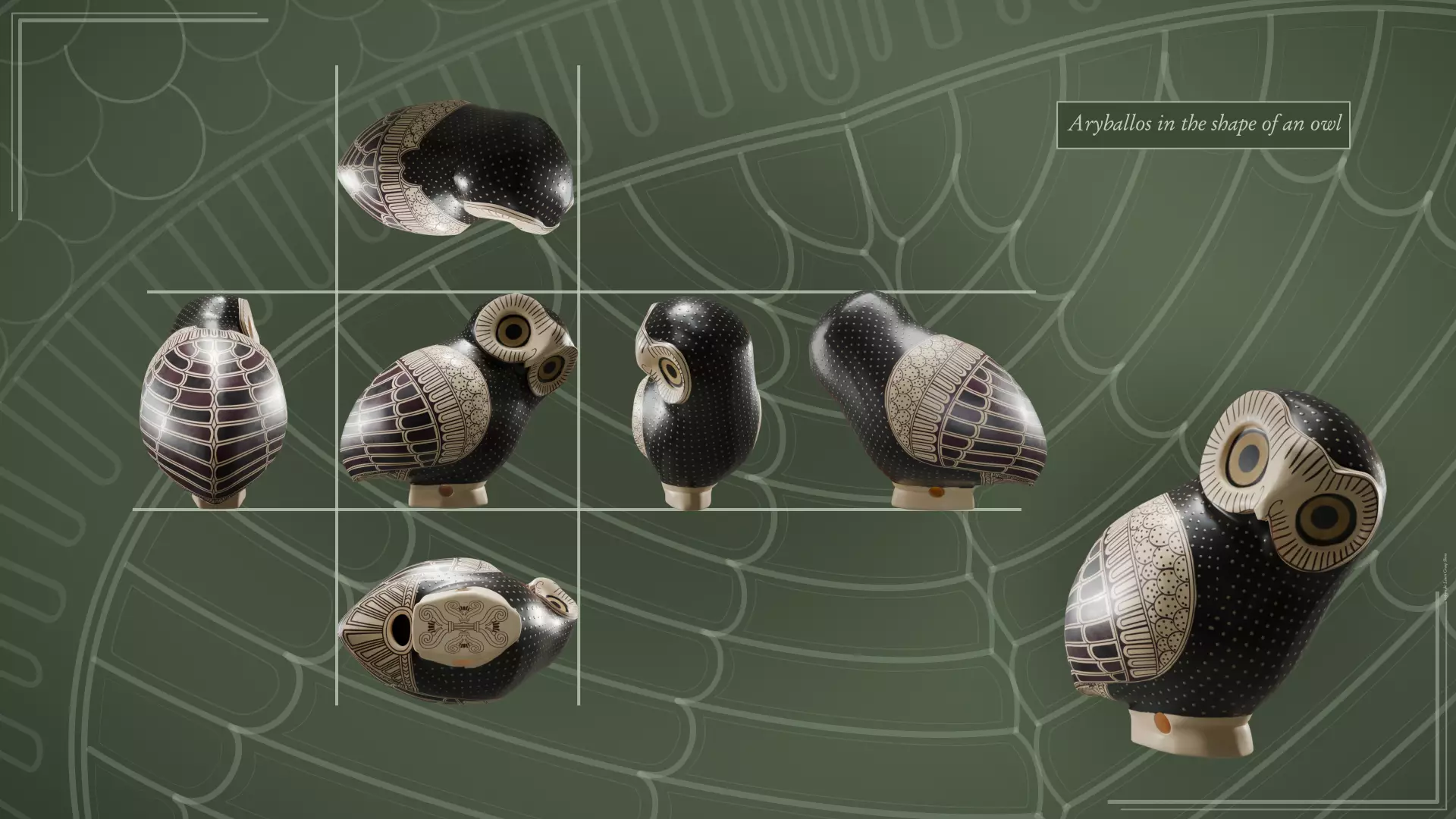
This whole process from the modelling to the texturing has worked great. Yet, the model has issues I am aware about (and lots you will probably find!). For instance, the tail decor is slightly askew from the physical point when it is perfectly aligned in the artefact. The same goes for the under-tail. This stems from the UV slicing: these are frontier parts. Just as well, you might notice lines on the web available model on the head and on the sides, near the shoulders and the chin. I am not certain how to get rid of them yet. All the methods I have tried so far failed, and there is always a point of view that lets them show.
Now that we have a consequent corpus of preparatory works, a workflow, and a texture, you guessed it: changing the colour of the back feathers is not that big a deal. So, do we have to re-interpret the colours or not ?
The idea is scientifically debatable and will only ever be a hypothesis. Because we’ve been cunning -though by a long process of dead ends and errors(!)-, we have digital doubles and base files we can tweak: we can have both !
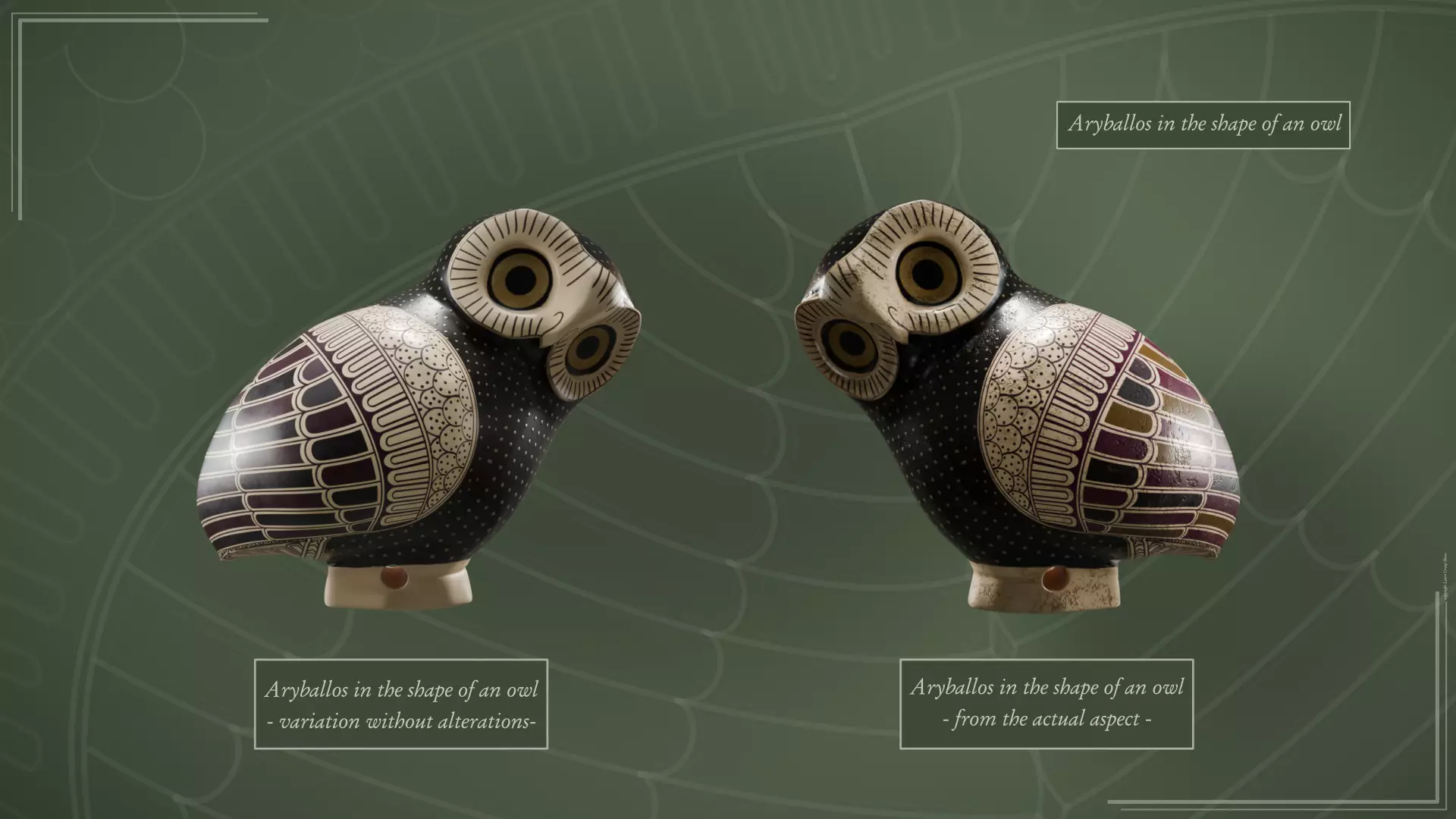
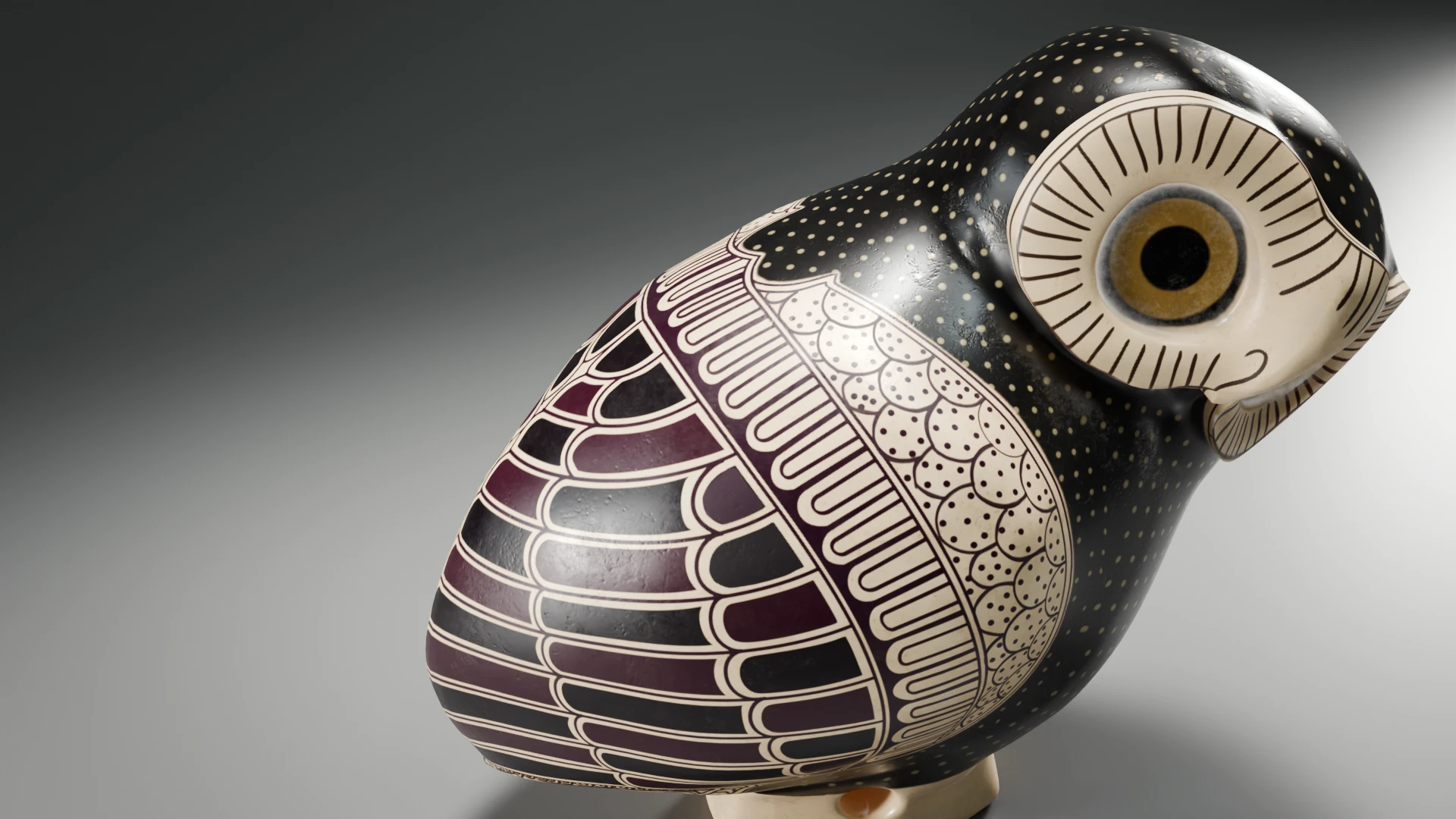
It does not really make sense to try to emulate the original piece. Both because I can’t exactly reference it, took liberties with the shape and the decor and, also, because a scan of the piece would give much more accurate result. I’m choosing to focus more on the “almost alteration free” version for the polished still views. Note that, in that regard, I also lessen the impact of kiln “defects”, that are somehow expected on that kind of ceramics.
I still favour the original colours more, but that is the beauty of this exercise: we can try things !
Don’t worry, you will be able to play with the “other” version in the web viewer below.
Shine a little light: stills renders using Blender
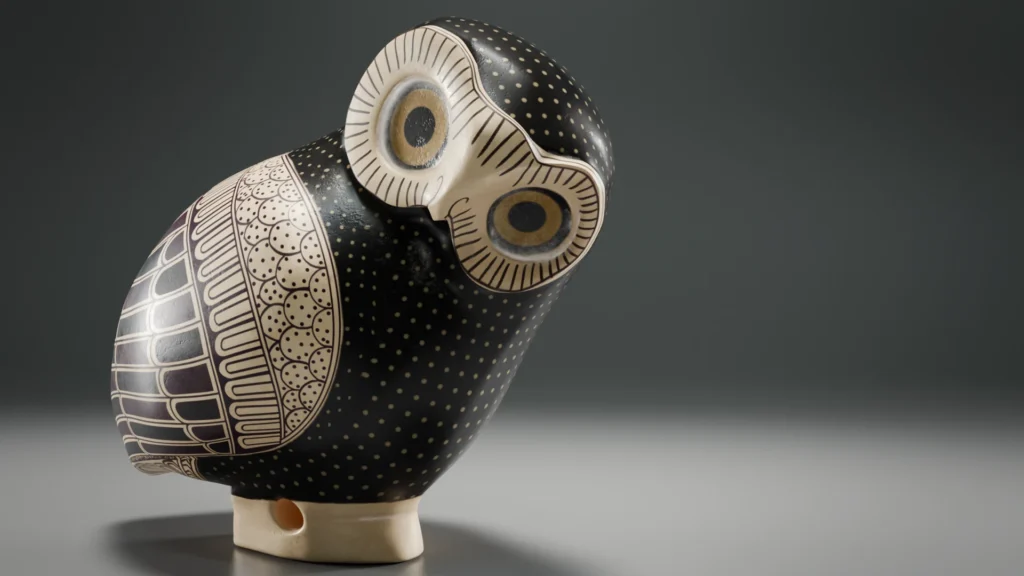
Interactive rendering
All hands on code: making the model web available using Three.js
For once, it is not one but two versions that I’m able to present (mainly to showcase the “we can have it all” idea).
The epidermis texture is not as neat as I hoped, but I’m trying to keep the model size as low as possible for web-browsing.
Code lines for the avid connoisseur
Here are the most relevant lines of code behind the materials of the model in the web viewer. Remember that I’m working with a JSON file to feed the model to the viewer, so the syntax is irrelevant here. Just gather the information you need from it !
The variation between the models is done via using different diffuse map, that’s all. The rest is identical.
"3Dmodel": "./assets/models/owl_aryballe/owl_aryballe_2_3.glb",
"meshes": {
 "name": "owl_aryballe_2_from_ref",
 "textures": {
  "map": "./assets/models/owl_aryballe/Textures/owl_2_diff_2.webp",
  "normalMap": "./assets/models/owl_aryballe/Textures/owl_2_norm.webp",
  "roughnessMap": "./assets/models/owl_aryballe/Textures/owl_2_rough.webp",
  "metalnessMap": "assets/models/owl_aryballe/Textures/owl_2_metal.webp",
  "aoMap": "assets/models/owl_aryballe/Textures/owl_2_disp.webp"
 },
 "values": {
  "aoMapIntensity": 0.85,
  "normalScale": [0.21, 0.21],
  "iridescence": 0.15,
  "roughness": 2.5,
  "metalness": 0.8,
  "envMapIntensity": 3,
  "needsUpdate": true
 },

 "modules": {
  "side": "FrontSide",
  "envMap": "hdrEquirect"
  }
}
3D view
The first version is the hallucinated version I gathered from the references and polished a little.
Disclaimer : technical limitation to material render in web app can let artifacts show, particularly in zoomed views.
See the full screen view (this will open a new tab in your browser).
This version is based on the colours as seen on the artefact.
See the full screen view (this will open a new tab in your browser).
Contextualization (or is it?)
Fun fact: forget about whatever impossible treasures daredevils of all trade have risked their lives for since the beginning of literature.
The one true heroes are the archaeologists that manage to find answers to this crucial question: what was domestic life then ? Because, the further in history one goes, the less one finds suitable answers.
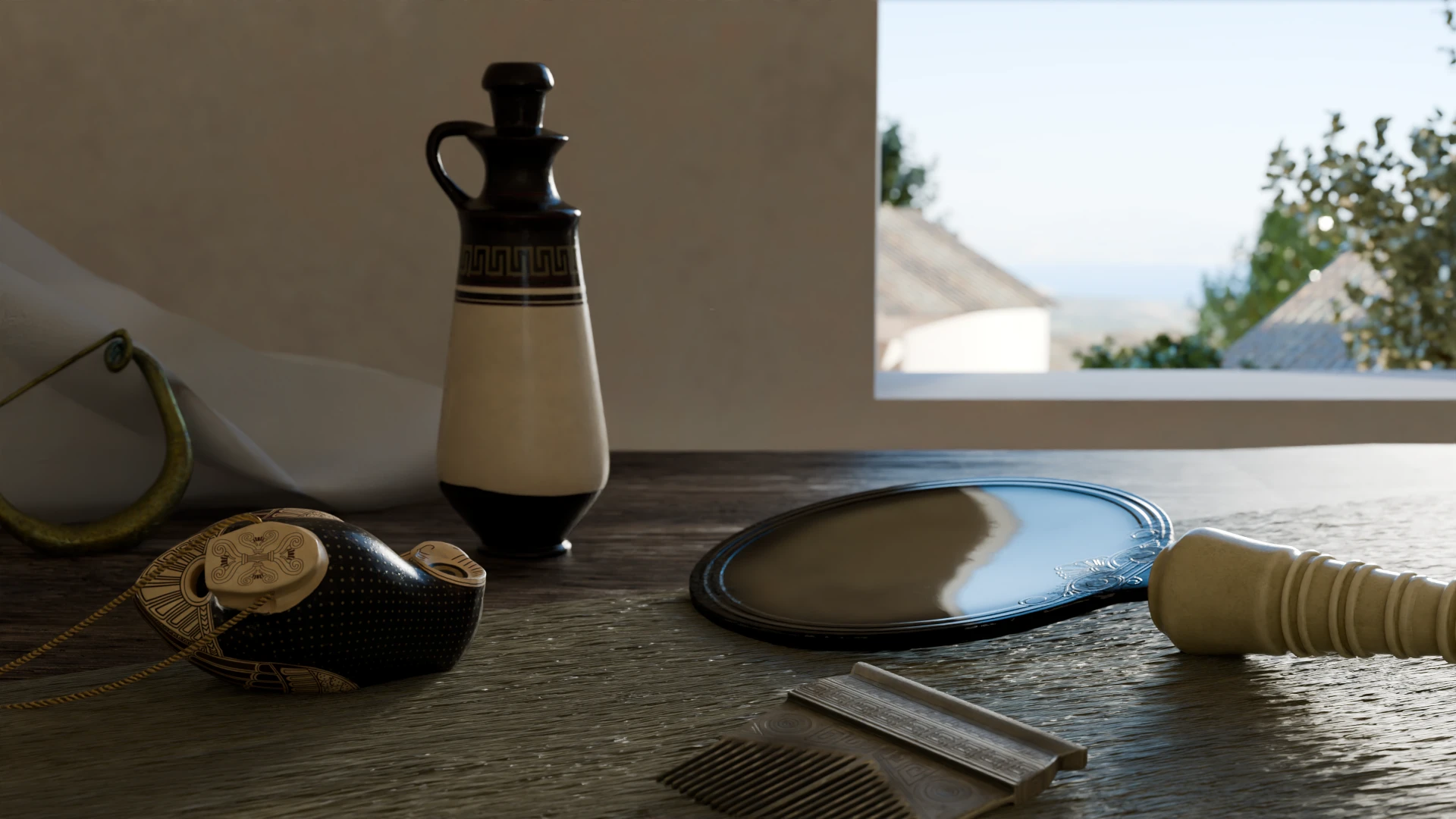
So in order to give myself an idea of how this little perfume owl could have been used, I had to make concessions and not be fully historically correct. For instance, the mirror handle is more recent than the owl. Both it and the inspiration for the comb are Etruscan in origin and the mirror itself is Cypriot, which might be stretching the mark a little. Once again, a back and forth with a specialist scientific team would be incommensurable in the specific endeavour of trying to get a glimpse at how the objects could have been used.
Credits
Images
Unless otherwise mentioned, all images credit to LGS.
Owl (aryballos), Corinth, ca -640 BCE, Musée du Louvre
Detail of the fresco of the “Saffron Gatherers”, 1600-1500 BCE, Akrotiri, bronze age excavation of the minoan town Akrotiri on the island of Santorini, Greece – Building Xeste 3Public domain, via Wikimedia Commons

Terracotta aryballos (oil flask) Globular with decoration in low relief, Greece, 7th century BCE or later, Metropolitan museum
Heron-Shaped Figure Vase (Oil Vessel), c. 580 BCE. Assigned to Robertson’s Group, ceramic, The Cleveland Museum of Art , John L. Severance Fund 1988.65
Painting of a quince fruit and quince tree foliage, Pancrace Bessa(1772-1835), cc0 via Wikimedia Commons

Terracotta aryballos (perfume vase) ca. 620–590 BCE, Metopolitan museum
Owl-shaped protocorinthian aryballos, ca. 630 BCE, Staatliche Antikensammlungen, Public domain, via Wikimedia Commons
Terracotta oinochoe (wine jug) with sphynges and affronted bulls, ca. 625 BCE, Metropolitan museum
Terracotta pointed aryballos (oil flask) with a dark underlayer and coloured points, ca. 640–625 BCE, Metropolitan museum
Late Proto-Corinthian Piriform Aryballos, 650–640 B.C., unknown artist, Getty museum
“Athene noctua, Ambula, Montenegro 1” by Frank Vassen from Brussels, Belgium is licensed under CC BY 2.0.
View of Naupli, Jean Housen, CC BY-SA 4.0, Wikimedia Commons
Context piece inspiration
Mirror, 6th century BCE, Greek, Cypriot, Bronze, Accession Number: 74.51.5424, Metropolitan museum of Art
Bronze mirror with ivory handle, Late Classical, late 4th century BCE, Etruscan, Bronze, ivory, Accession Number: 97.22.17, Metropolitan museum of Art
Comb with Lions and Geometric Designs, Etruscan, 6th-5th century BCE (Archaic-Classical), ivory, CC0, The Walters Art Museum
Lekythos, ca 650 BCE, Camiros, Rhodes, Musée du Louvre
Fibula, Cypriot, Silver, Accession Number: 74.51.3207, Metropolitan museum of Art
Bibliography
Hort, Arthur, “Enquiry into plants and minor works on odours and weather signs, with an English translation” , 1916, Greek text apparent, W.Heinemann, London. p327-390
Nicolas Béatrice, “De la maie à l’alabastre : quelques traces du savoir faire des parfumeurs chez Théophraste”, in “Transmettre les savoirs dans les mondes hellenistique et romain”, dir Frédéric Le Blay, p167-184, Presses universitaire de Rennes, Open book editions, available online.
Robinson, David M. “Ointment-Vases from Corinth.” American Journal of Archaeology, vol. 10, no. 4, 1906, pp. 420–26. JSTOR, https://doi.org/10.2307/496839. Accessed 3 Jan. 2024.
Stephens, Jay & Vandiver, Pamela & Hernandez, Stephen & Killick, David. (2015). The Technological Development of Decorated Corinthian Pottery, 8th to 6th Centuries BCE. MRS Proceedings. 1656. 10.1557/opl.2015.838.