

The undecided zebu
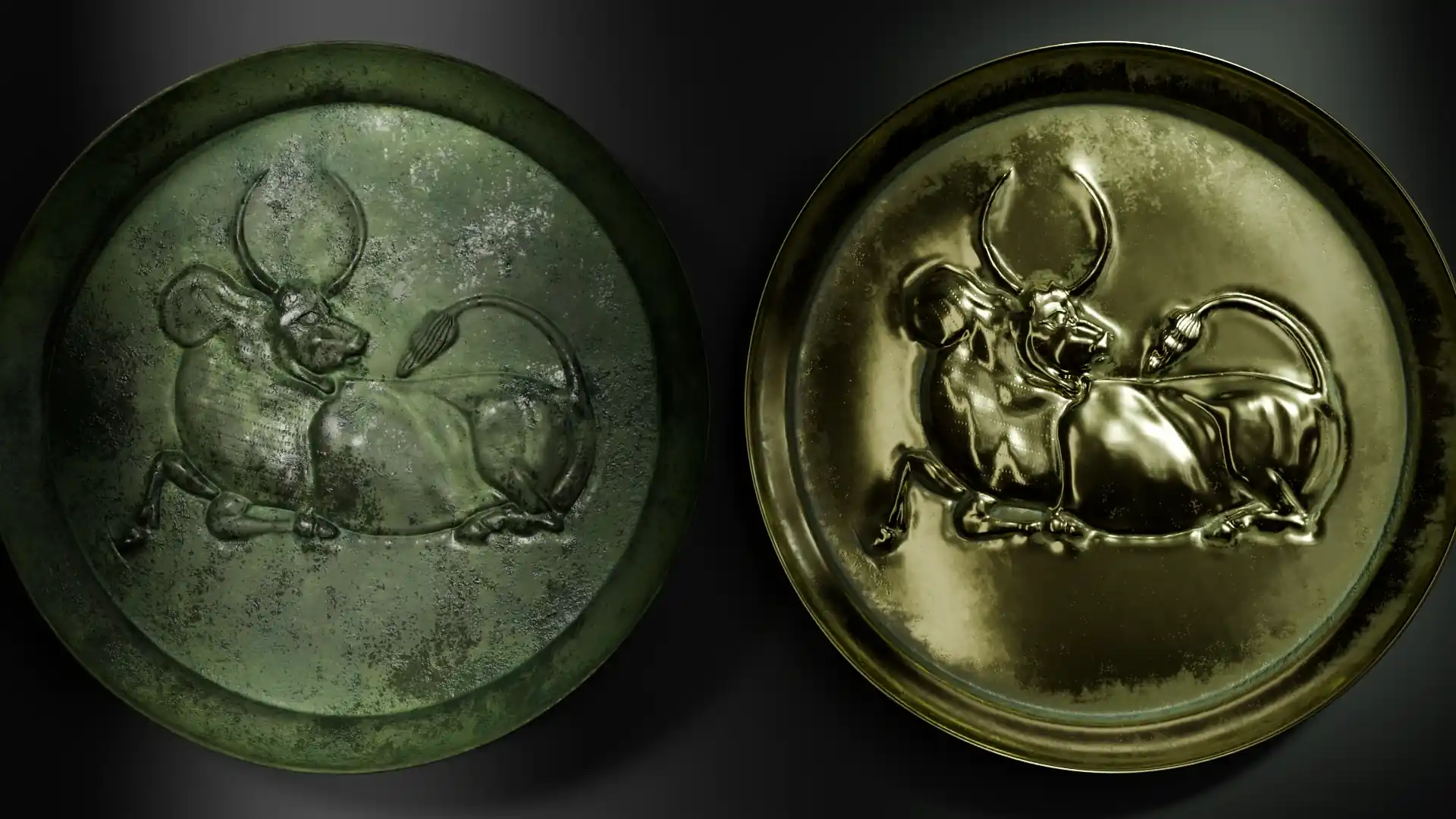
The following texts and images are the results of a training exercise to go from the pictures or the description of an artefact to the creation of a 3D digital double, sometimes restored version of it. If you wish to know more about the process, explanations are in A journey into learning a (3D!) restoration process workflow article.
As I already mentioned, I’m on a 3D modelling never-ending path of training. Some of the books I read consider the copy of reliefs interesting first steps in the matter. The idea is to have fewer sides to consider than on a regular sculpture. On the other side, old masters, like XIXth century Edouard Lanteri, consider the exercise perilous yet formative.
Why not give it a try then and see for myself ?
As I want to focus more on modelling animals, art history gives me numerous pieces to try to copy.
Let’s start with a Bronze Age zebu.
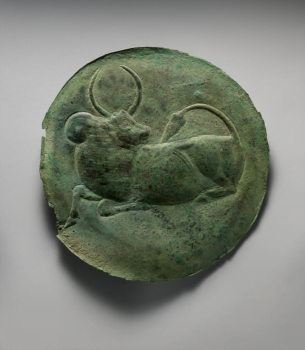
Title: Plate with reclining zebu
Datation: ca. late 3rd–early 2nd millennium BCE
Provenance: Unknown, Eastern Iran?
Dimensions: 22.9cm
Media: Copper alloy
Source image: 2015.789, Metropolitan museum of Art
Historical context: hunting down the plates
This part is unnecessary for this project, but a nerd is a nerd, and I’m the one on the keyboard side. Besides, I have ulterior motives: I would also like to try to create a render of a “restored” piece. Because, let’s face it, it’s a mental disorder at that point.
The Metropolitan museum tells us :
“[the piece is] made from a sheet of copper alloy with a rim that has now broken away, this shallow plate is decorated at the centre with an image of a zebu, a breed of cattle from southwestern Asia. The zebu’s distinctive hump and upraised curved horns are clearly visible as the recumbent animal turns to face its rump and arched tail. Details such as the texture of the fur on the neck and chest and the long tuft of hair at the tip of the tail are incised. The body is formed in low relief, and the modelling of the face is especially delicate, combining the techniques of repoussé and chasing.
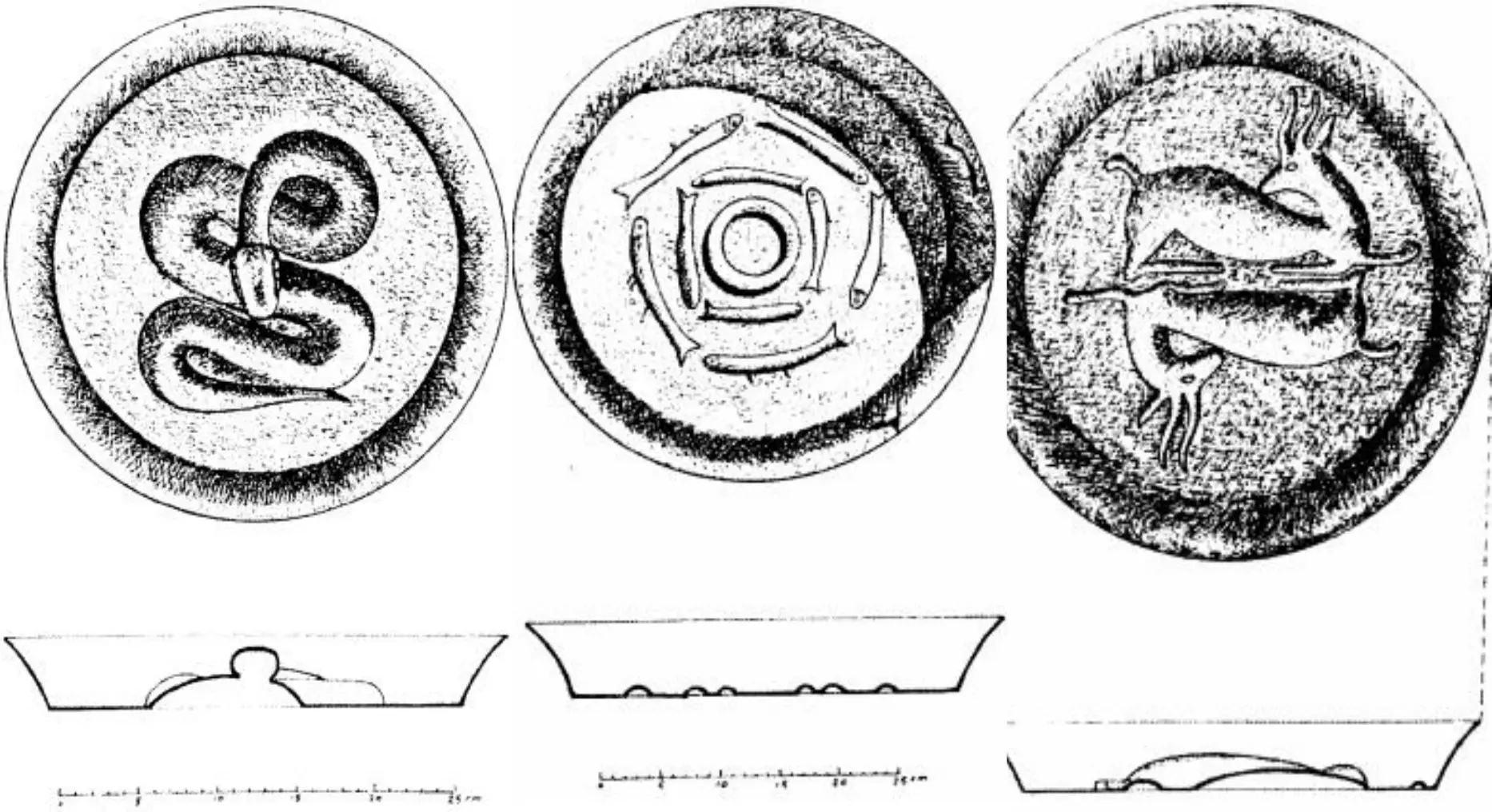
The Bronze Age cemetery at Shahdad, in southeastern Iran, yielded three copper-alloy plates similar to this piece, which were likewise decorated with animals in low relief. Another low-sided copper plate, embellished with a lion attacking a bull, comes from a Bronze Age level at the site of Tepe Hissar, in northwestern Iran. These closely related, excavated examples suggest that The Met’s plate also comes from Iran.”
I managed to find sketches of the pieces from the Shahdad site, though I couldn’t find the actual pieces online. I think one related item might be in the Musée du Louvre (Moorey) and my guess is the others are in Iran National museum (Moorey, mentioned as “Teheran’s archaeological museum”) but the collection is not accessible online.
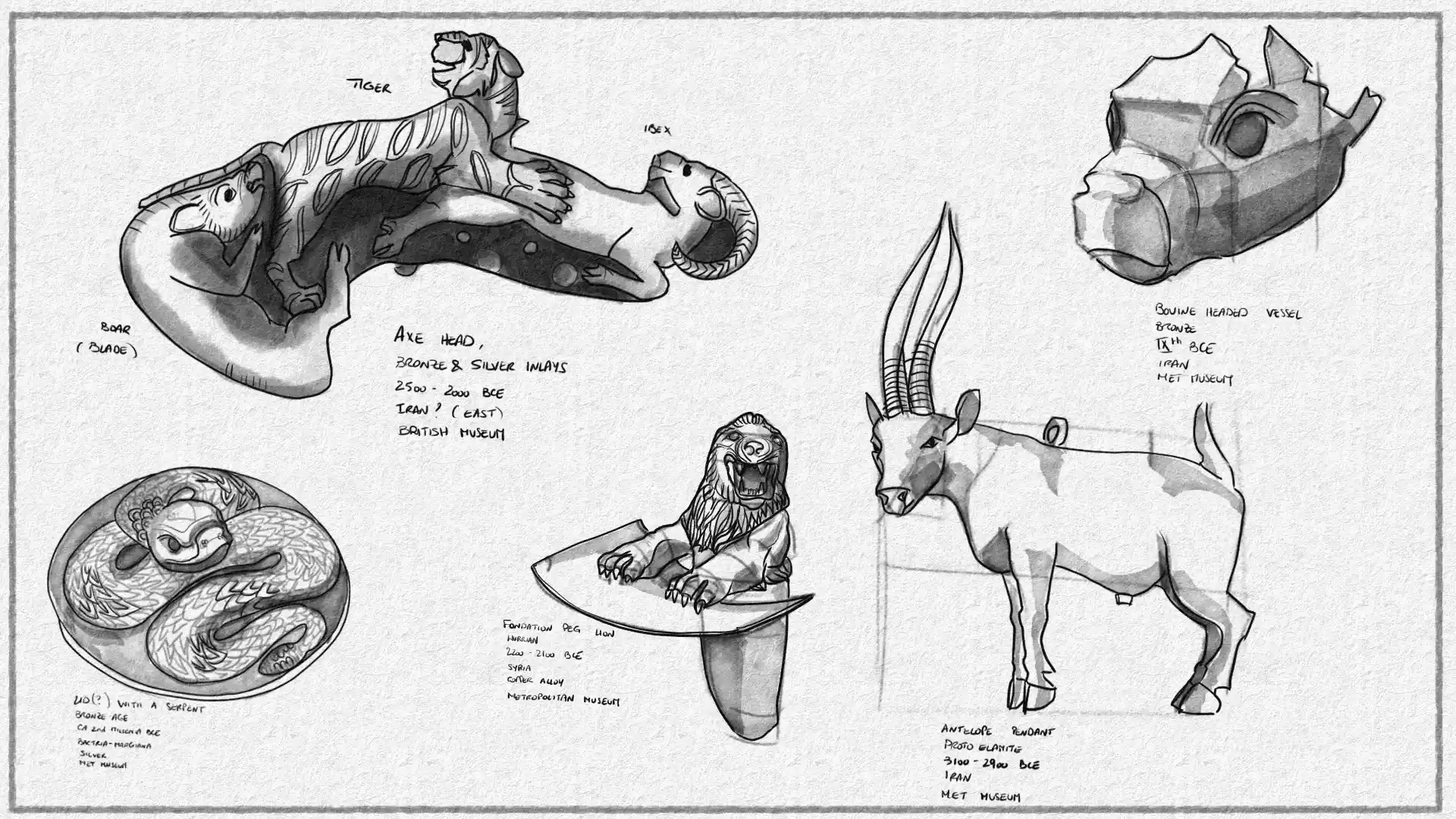
There is however an elamite zebu statue linked to Chogha Zanbil (easterner site) that shows similar delicate and realistic modelling.
For -sort of references-, there are other pieces of roughly the same era that shows the same impressive naturalistic style.
Visual references of Bos taurus sp. and Bos indicus sp.
The reclining animal is looking quite realistic in aspect. I must confess I never looked at a zebu endeavouring to sculpt it before ! So let’s fill this gap in knowledge first.
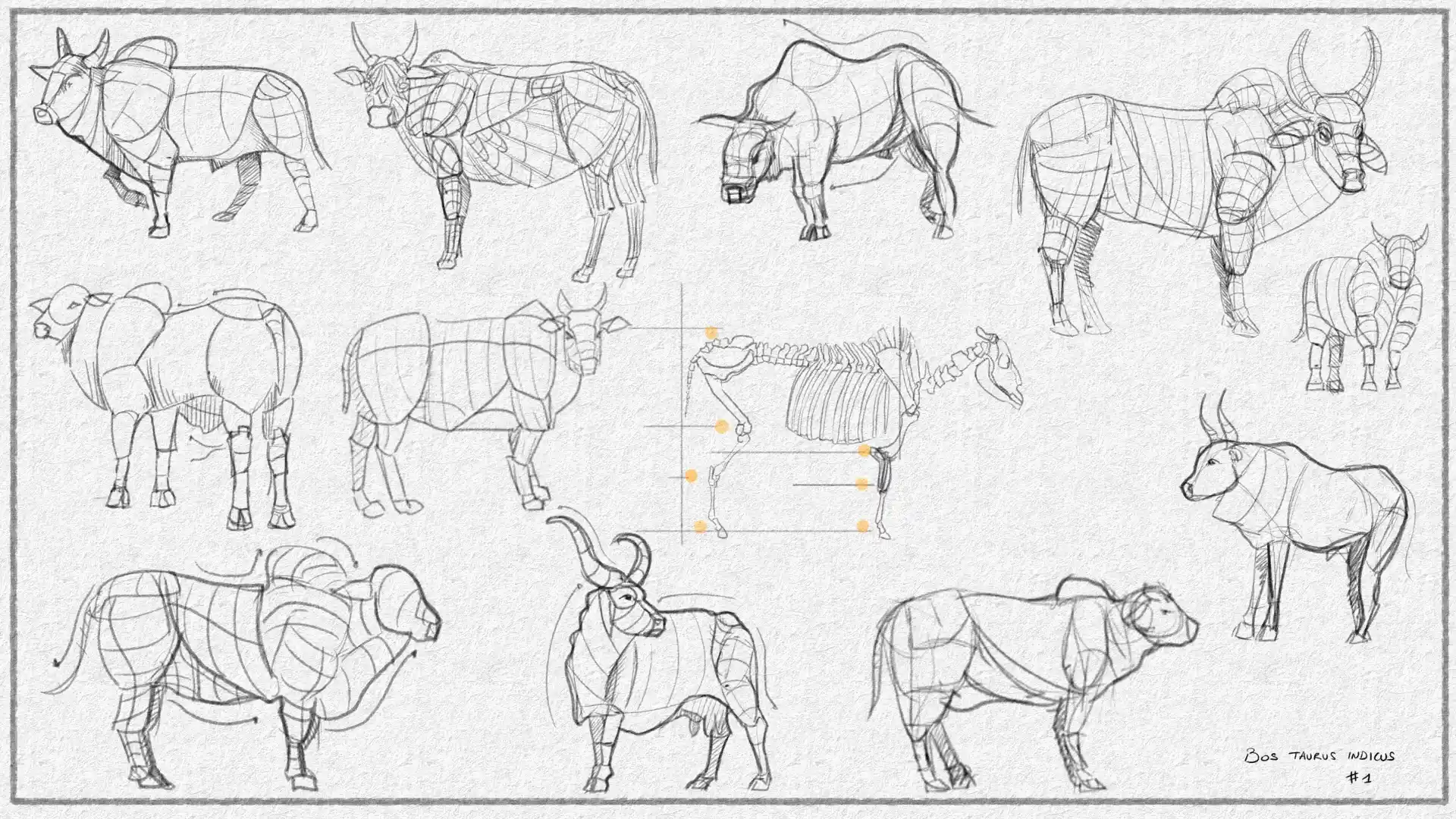
Bos indicus and Bos taurus indicus aka Zebus
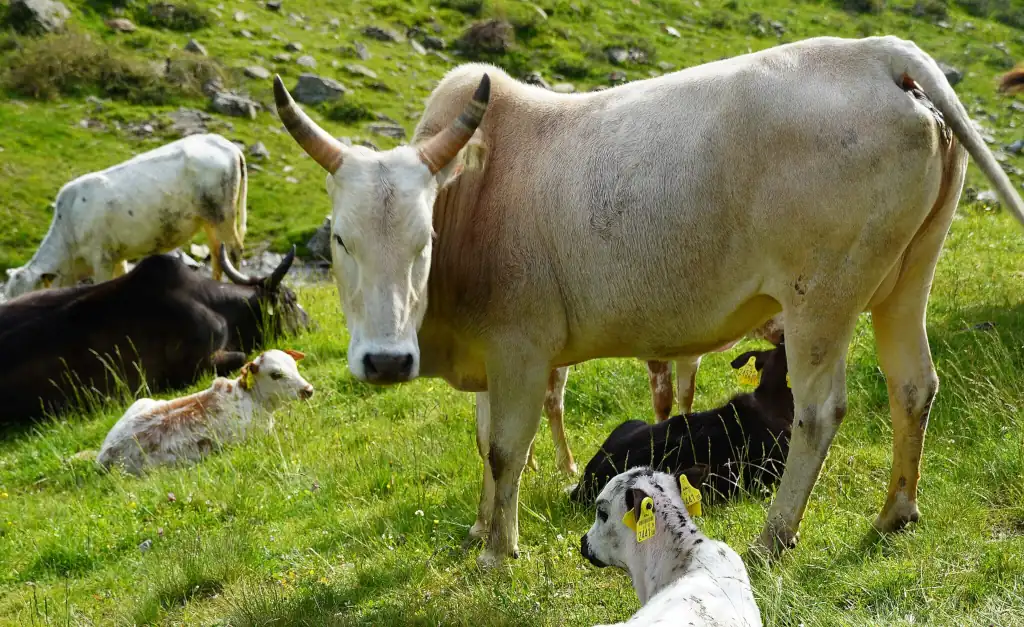
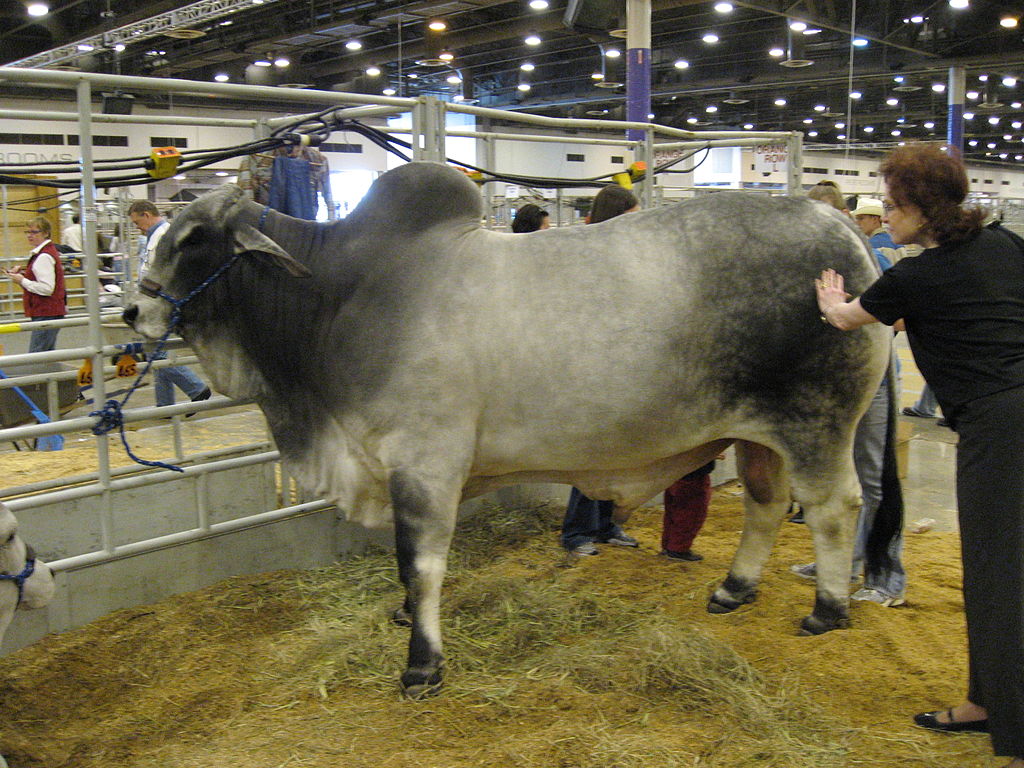
I first did a series of rough sketches and general studies using references, focusing on shapes and volumes (the infamous change of planes and bones landmarks exercise). These drawings are a combination of tracings and free forms. The idea is to get a sense of both the volumes and the flow of the animal’s silhouette.
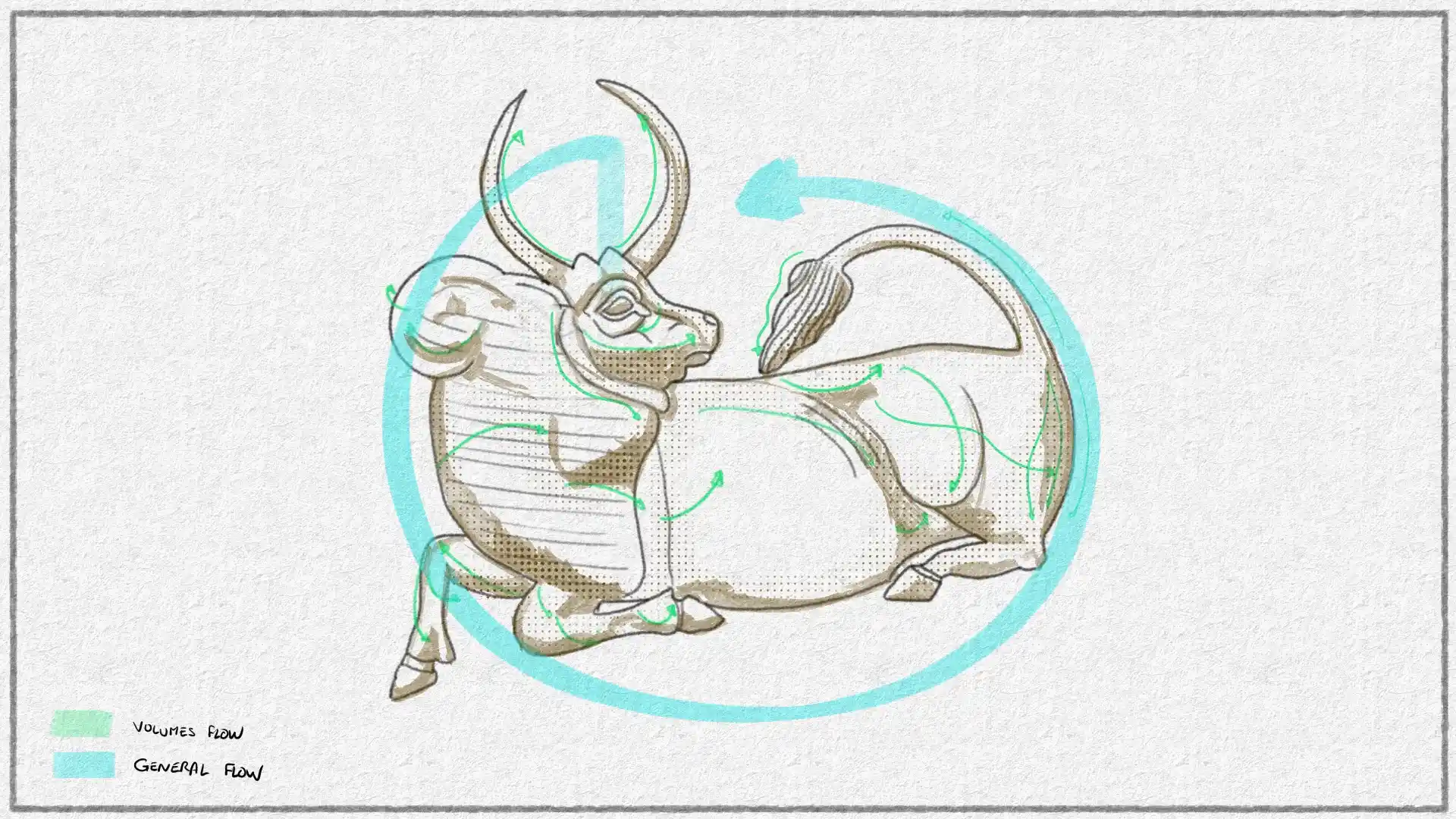
I then focus on the piece itself, doing the same landmark points and plane changes exercise using what I learned from zebu’s anatomy through observation. It was important for me to do it in that order because we only have the one image reference and can only infer as to what the piece’s volumes could be.
What can we extract from this ? The animal’s pose on the piece is weird (though its overall flow works magnificently)!
The reclining pose seems at first hinting at a peaceful scene.
I was thrown off by the head’s position : is the animal looking to its left or to its right ? At first glance, I’d say it looks to its right and eyes the viewer from above its spine.
But then, why does the spine outline meet the head so high up ?
If the animal is looking to its left, then this makes sense and the roll of skin and fat under the chin is more naturally formed. However, this hypothesis is giving us another conundrum: there should be a line joining the back of the chin to, more or less, between the legs. The other muscle masses and delineations are expertly marked, why miss this one ? There is a line, but it is way past the left leg, as if the whole chest mass was poured over the forelimbs. We know it is a single unit because the lines of the decor are consistent and regular there.
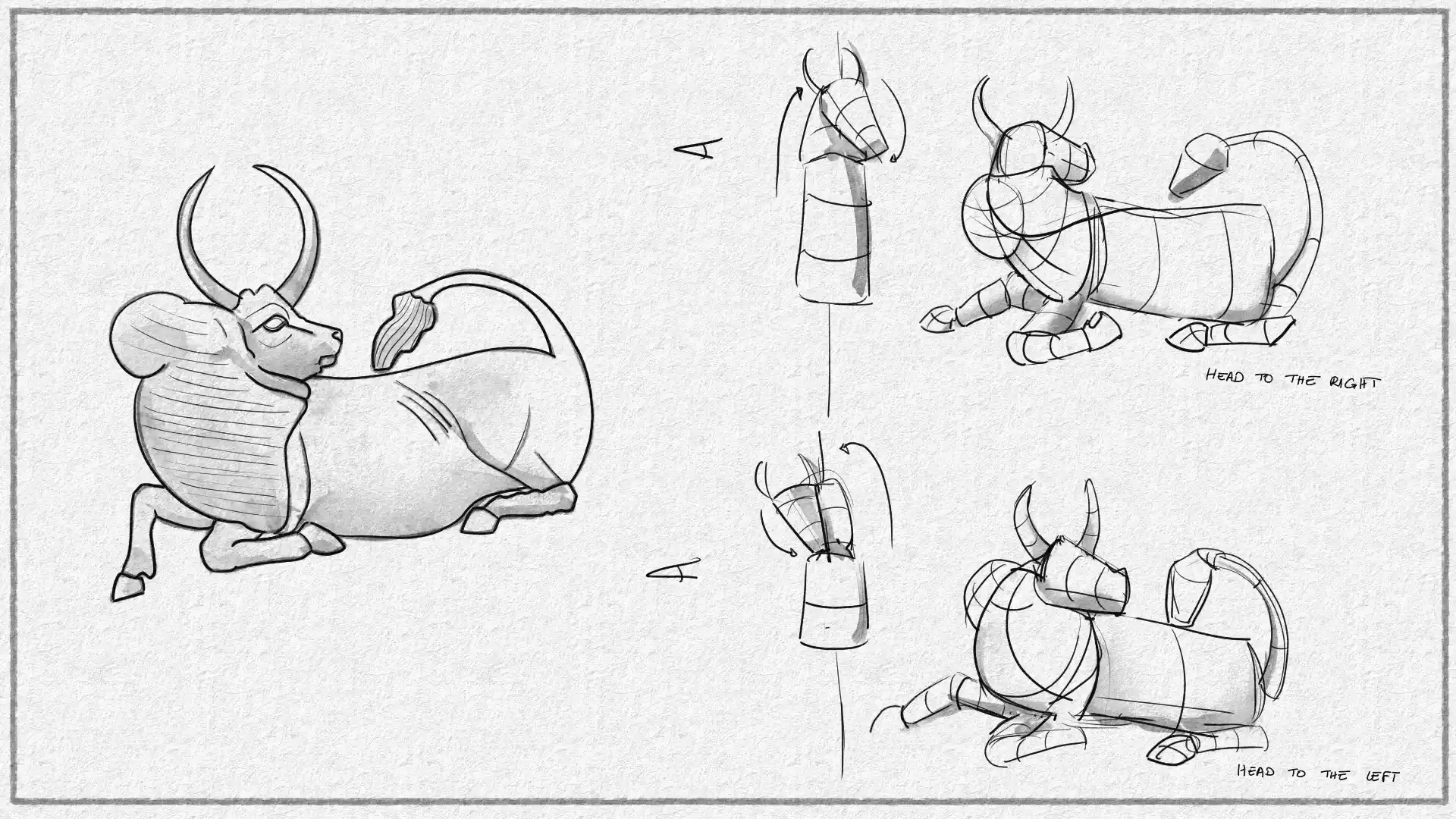
Looking at photos of zebus online (one can seldom find an amicable one in one’s western world cities easily), this reclining position is not uncommon in Bos taurus. The right foreleg semi extended is often seen when the animal needs to stretch or when it is shifting position.
Let’s try to go a step further. I know it’s probably too much but this is an exercise and I need all the training I can get. What would the animal skeleton look like ?
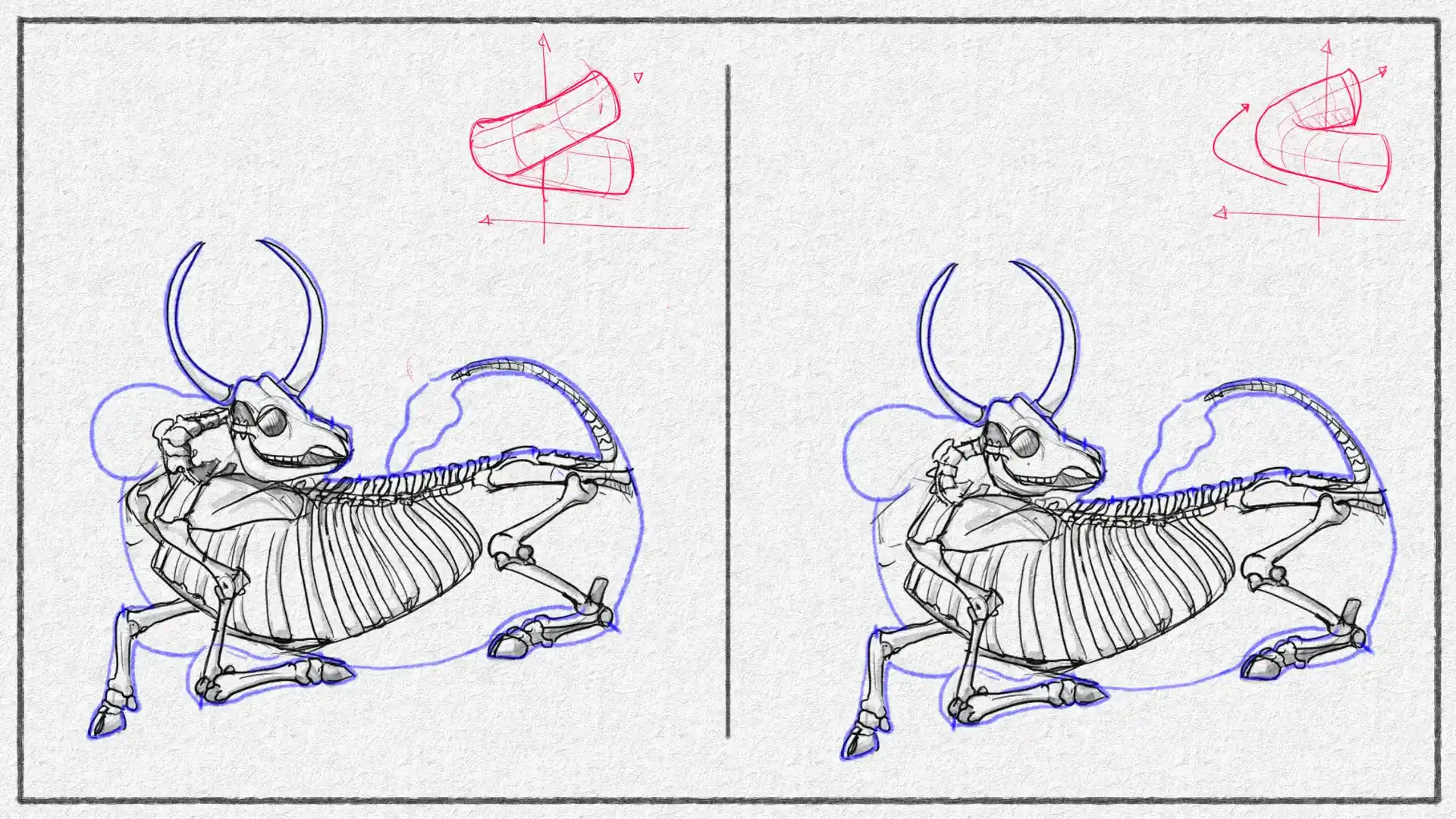
Note the slight movement of the thorax on the left sketch, letting the right clavicle and head of the humerus show. Come to think of it, I should have done a better job at foreshortening the neck on the right one.
So. I’m choosing the version in which the animal turns its head to its left.
Yes, yes, you knew already.
Now for the details. What about the head area ? There are, at least, two pitfalls: the piece important surface alteration and the lighting selected to photograph it. Both will create reliefs or the illusion thereof. As I have no way to go and see the piece myself (I’m not even sure it is on display), let’s keep in the exercise’s spirit and use it as an excuse to learn more about ruminants’ faces histology.
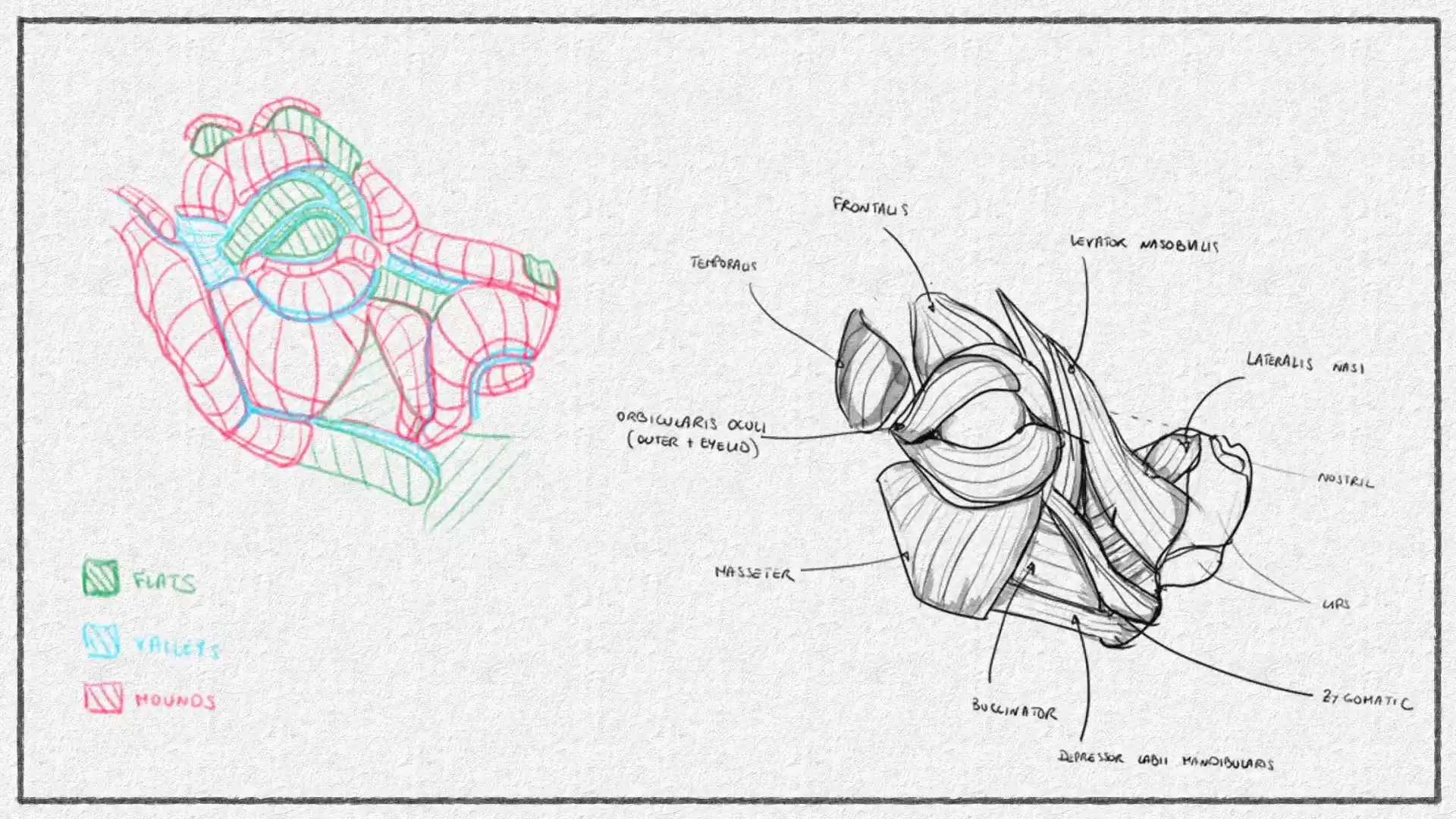
From there, I’m extrapolating parts of the main muscle masses. It’s most likely veterinary heresy. I’m only trying to make sense of what I see. I know there is also some part of artistic licence to take into account. Furthermore, I also know that the old hands artistic abilities are deeply rooted in nature’s precise observation to a degree we can only grasp at.
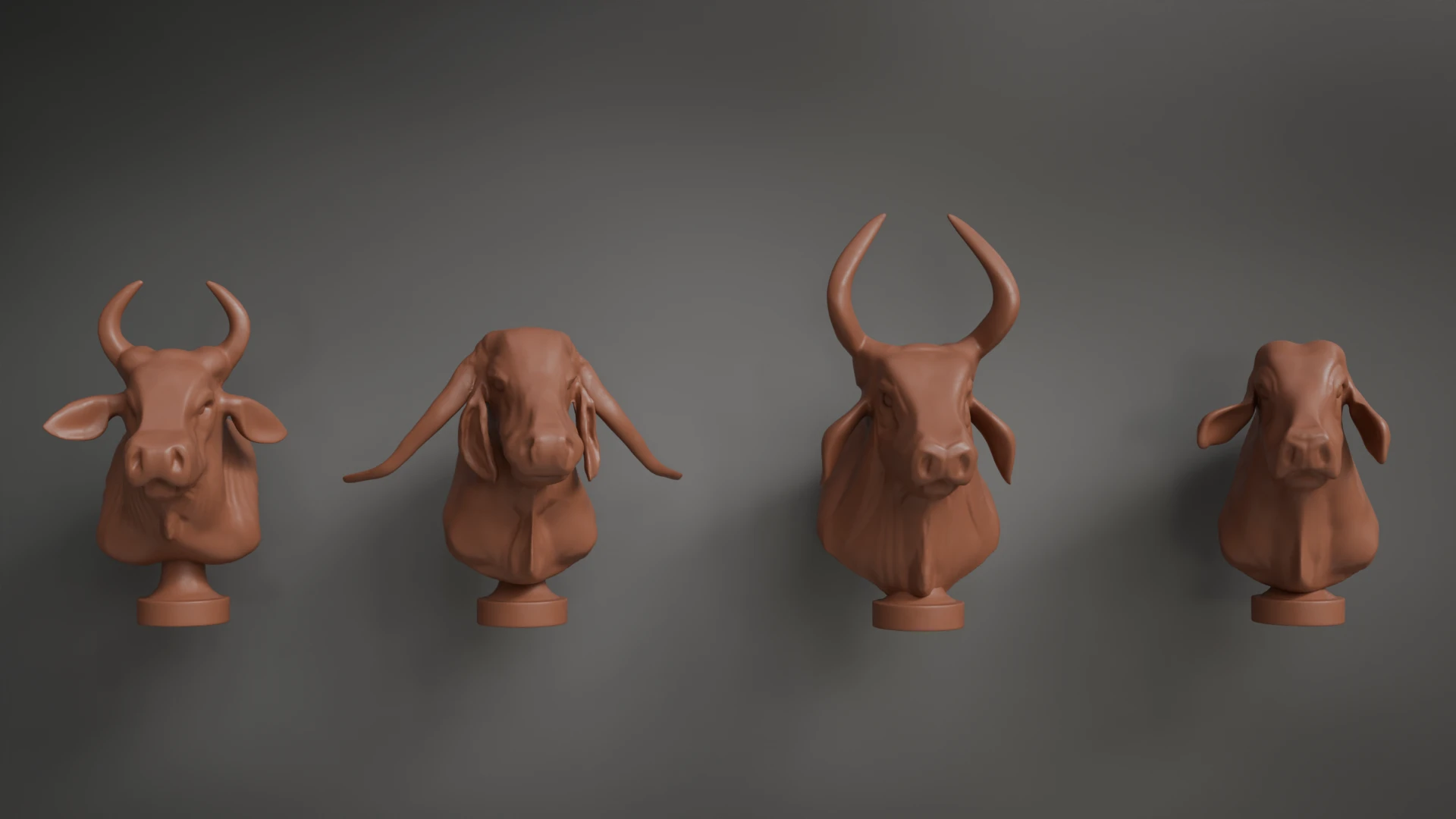
At that moment, I managed to put my finger on something that’s been nagging at the back of my head. Where are the ears ? Using reference images, I noticed there were three types of ear placement on zebus. This is not scientific, just observational. I categorized them as “up”, “droopy” and “floppy”. My guess is our little friend’s model was of the floppy-eared kind, that is: ears going down and being soft. This may or may not concur with the actual genetics of cattle in this part of the world at the time. The world of cattle breeds is immense and complex like you wouldn’t believe.
On a side note, you’ll notice that horns are even more diverse in sizes and implementations, though they are always starting on the top of the ears.
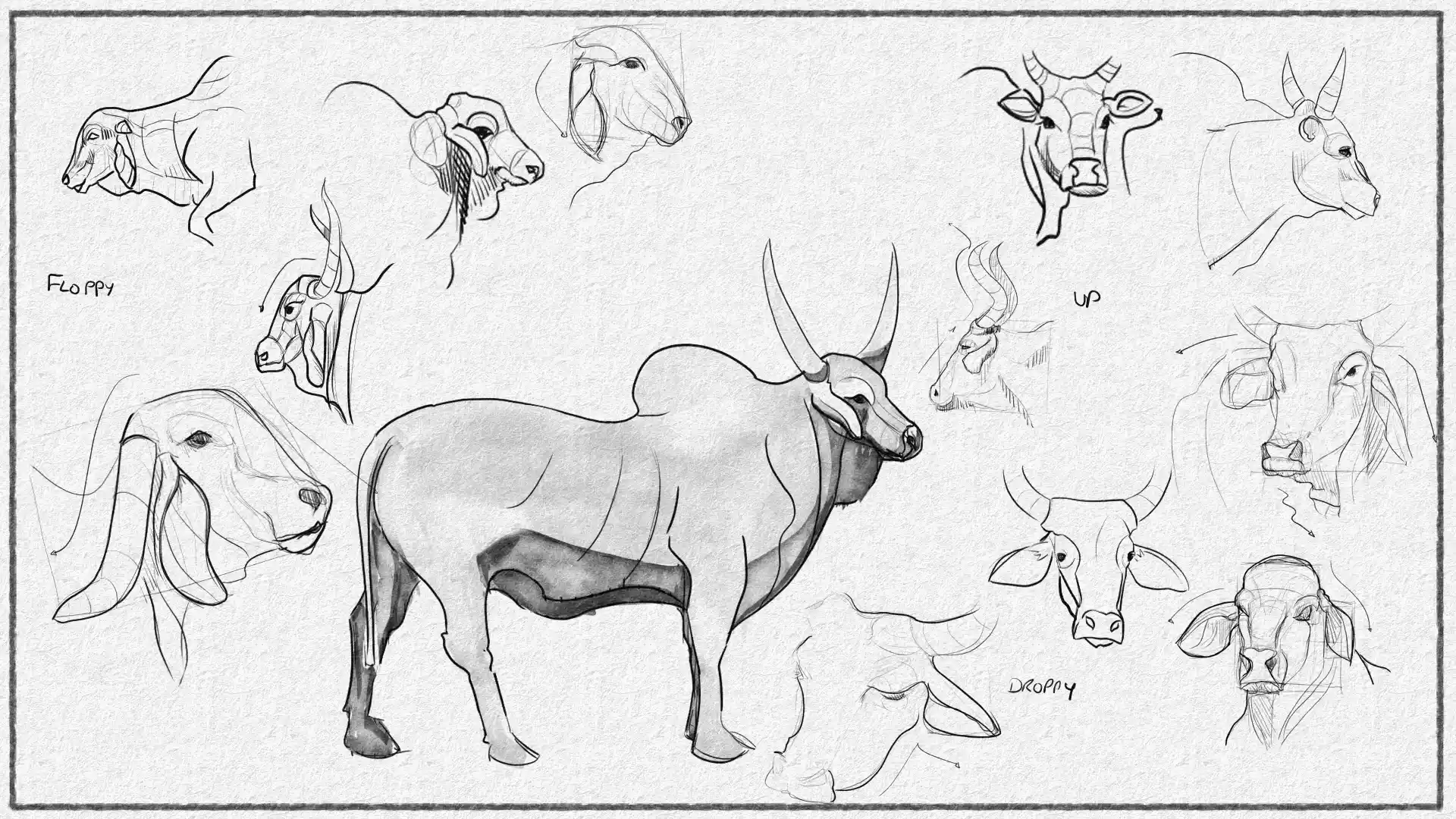
In terms of look, this gives zebus very distinctive features and character. Because this is still an exercise, here’s what this can mean in volume:
3D notes
Disclaimer : this is an exercise, shown for documentation purposes only
Model the shape: Zebus for everyone.
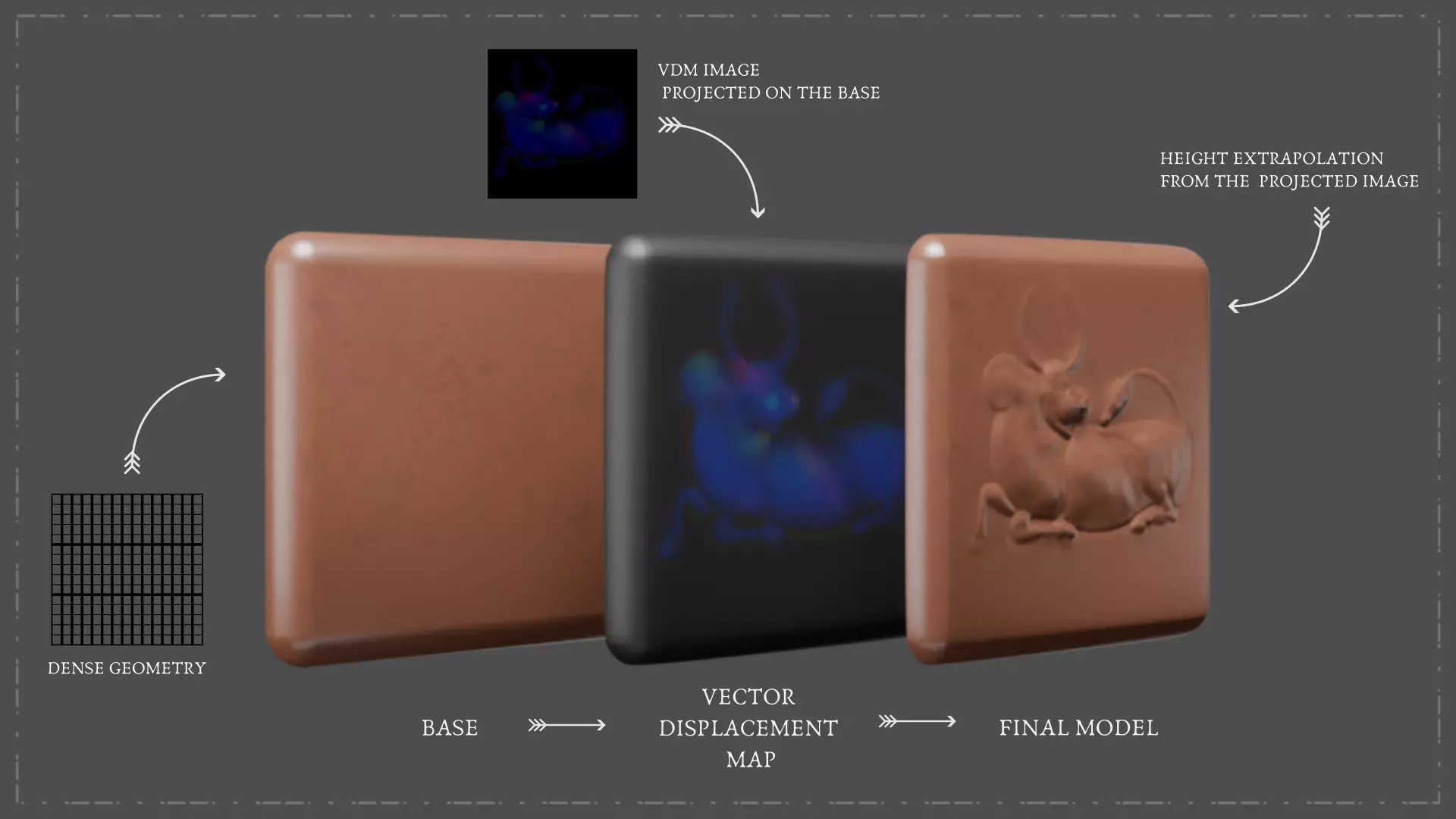
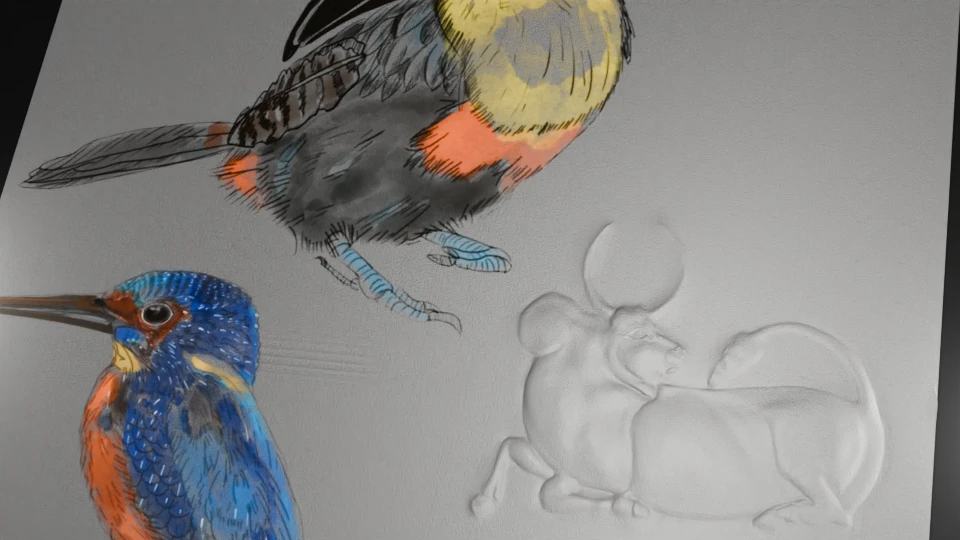
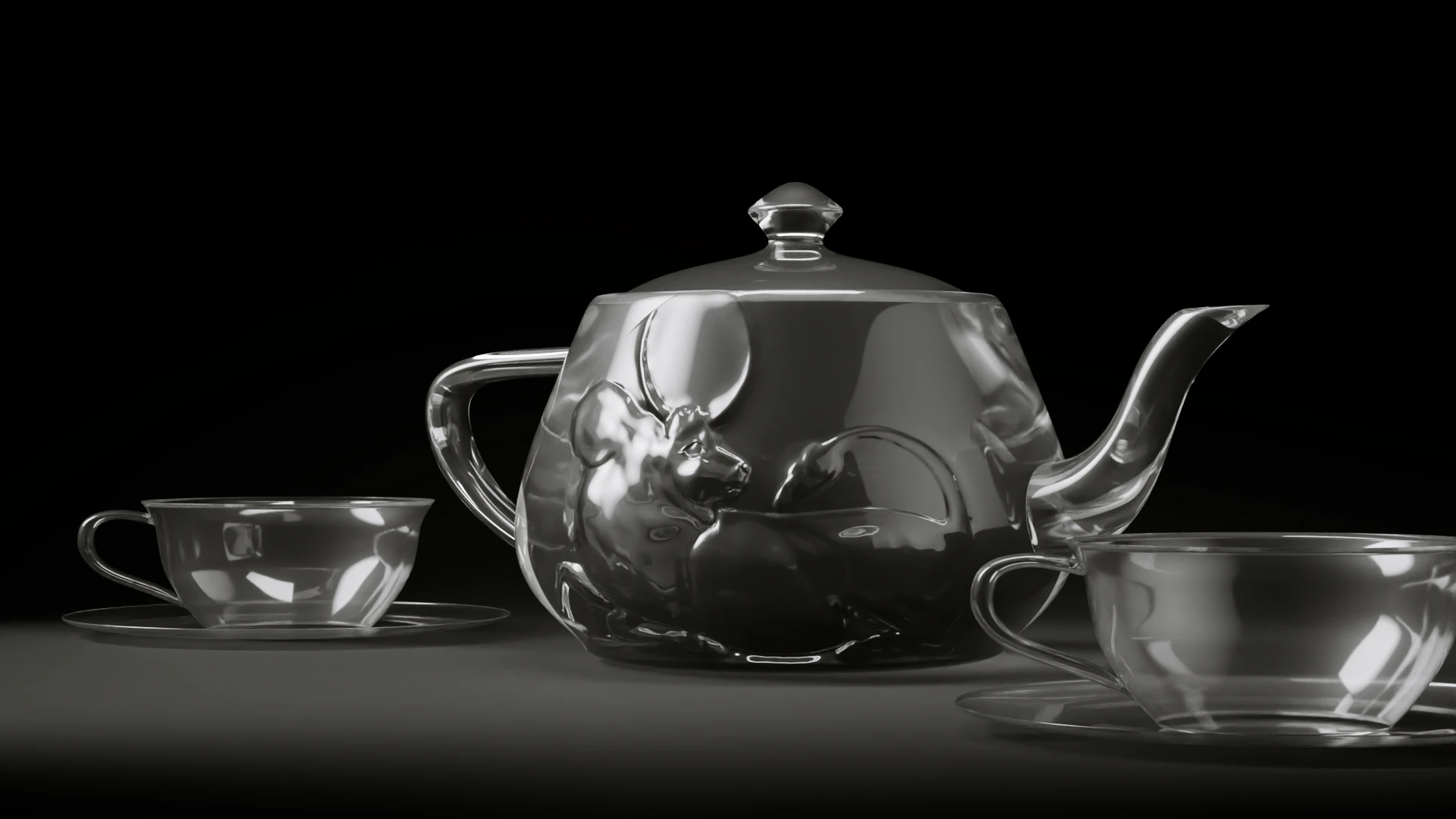
As this is a relief out of a round shape, this is the perfect opportunity to create a vector displacement brush. That way, if any of you want to zebu-ified their creation, you can.
What is a VDM brush ? From what I understood, I like to think of it as a displacement map on steroids. A high dynamic range image is projected on a high density mesh. It is interpreted by the 3D modeller and results in a true vertex displacement. The difference with the regular kind of displacement map is that it uses a Normal map way of doing things. The information are stored in RGB values instead of grays. Therefore, it can store more infos per pixels. It allows for better and more detailed results, as well as dealing with surface changes when they are not perpendicular to the base mesh, as stated in this article about the process in Zbrush.
The sculpting part was fun because it was made easier with the prep work. I knew where to go and how to deal with uncertain parts. Now, scientifically speaking, I know this is also the best way to let an error perdure. Case in point, the ears. I was misled into thinking them as shortened and therefore the “up” kind before researching the “droopy” kind.
I know, I know.
For a long while, the zebu looked like this:
And that changes the whole dynamic of the motif !
After the ears position small research, we’re back to looking closer to the reference piece.
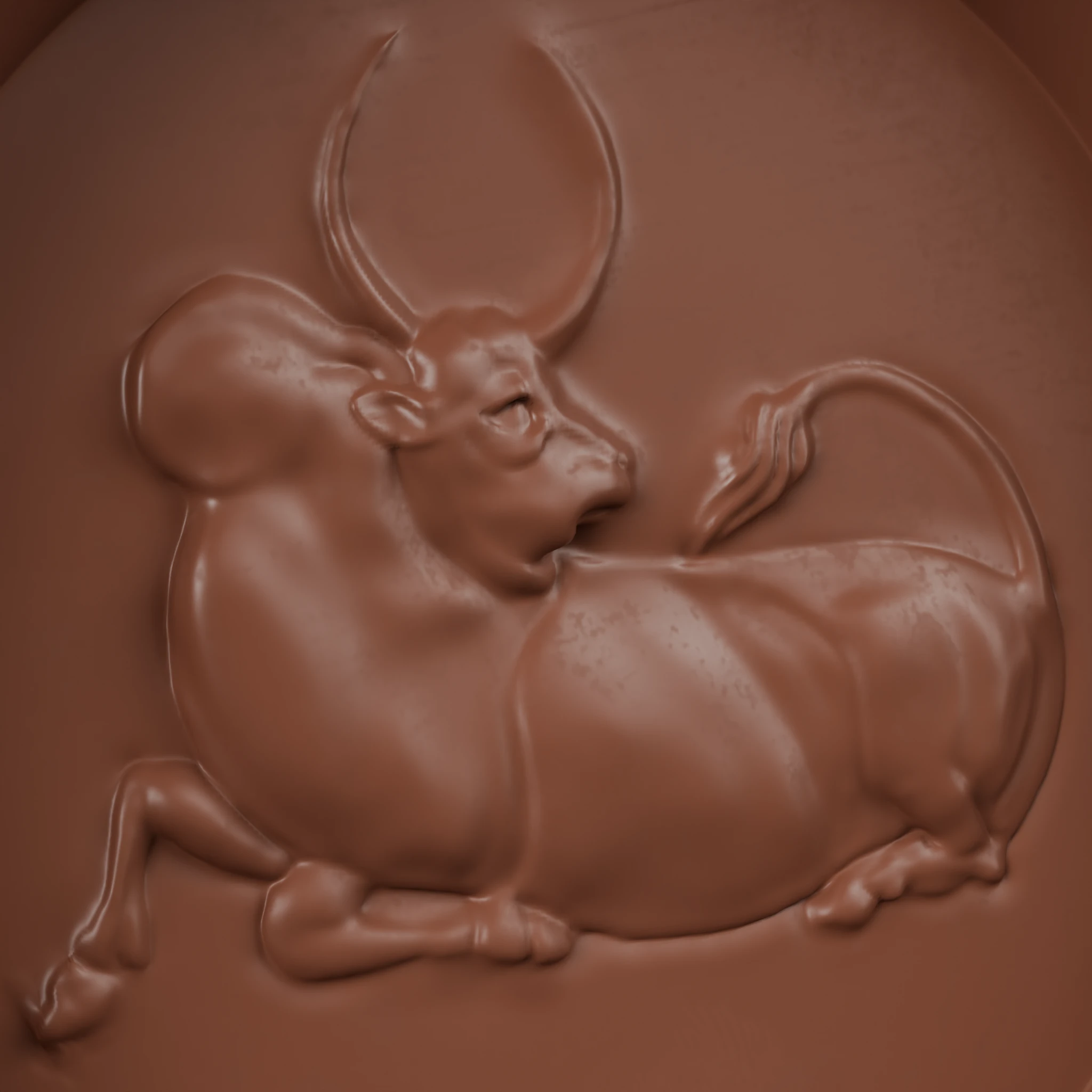
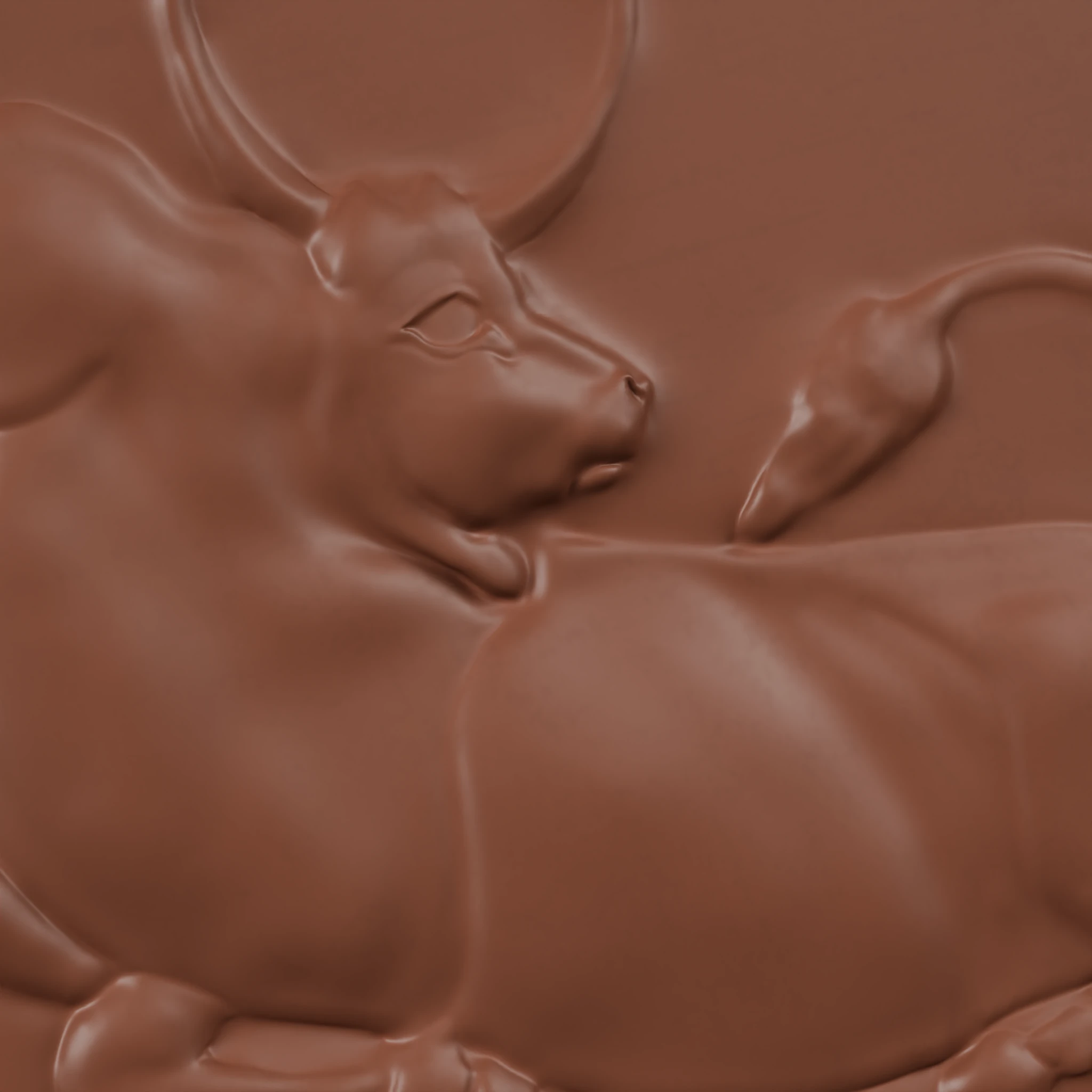
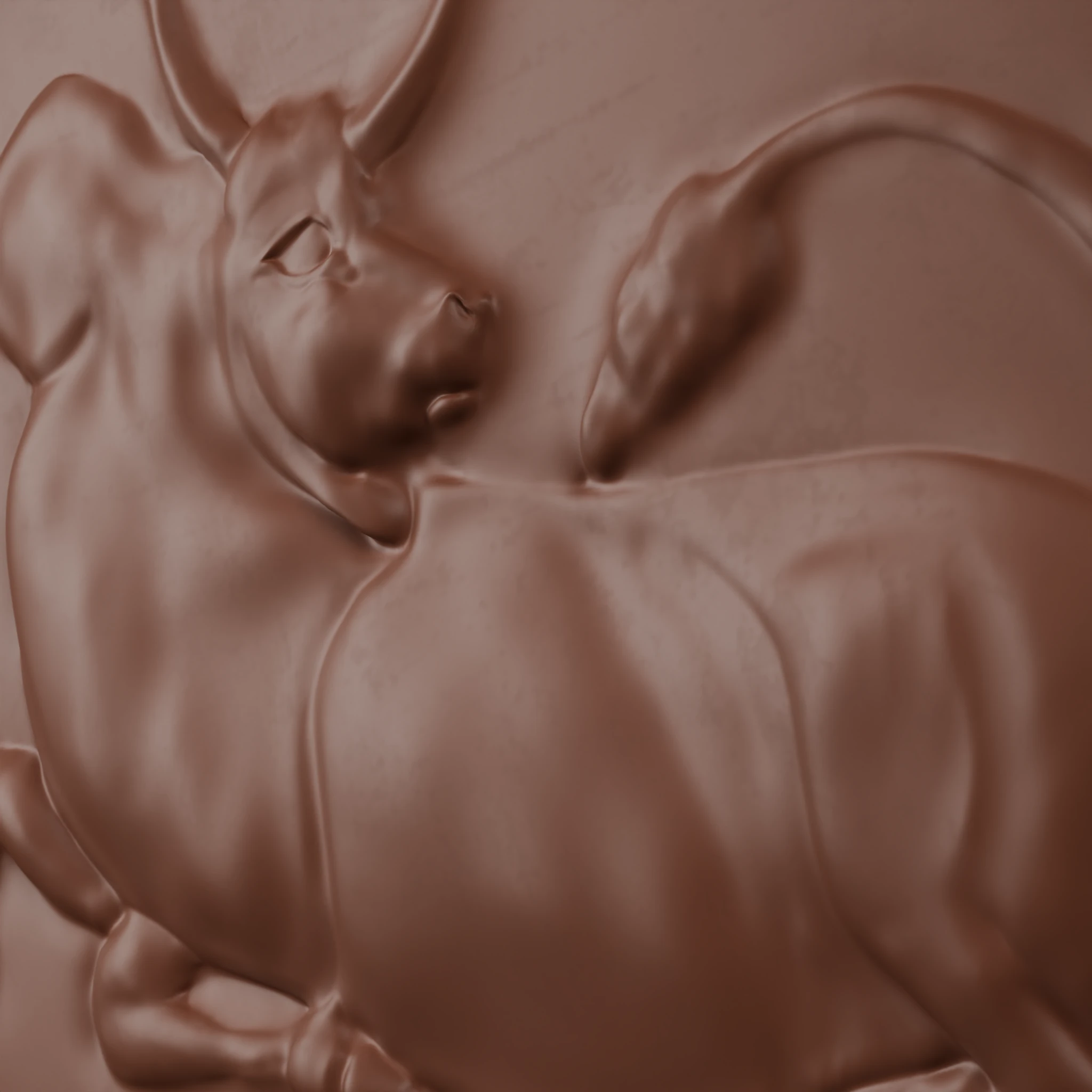
Then, because of the VDM “brush” possibilities, I was able to put it on different shape of plates before settling on this one, trying to closely mimic the Shahdad archaeological sketches.
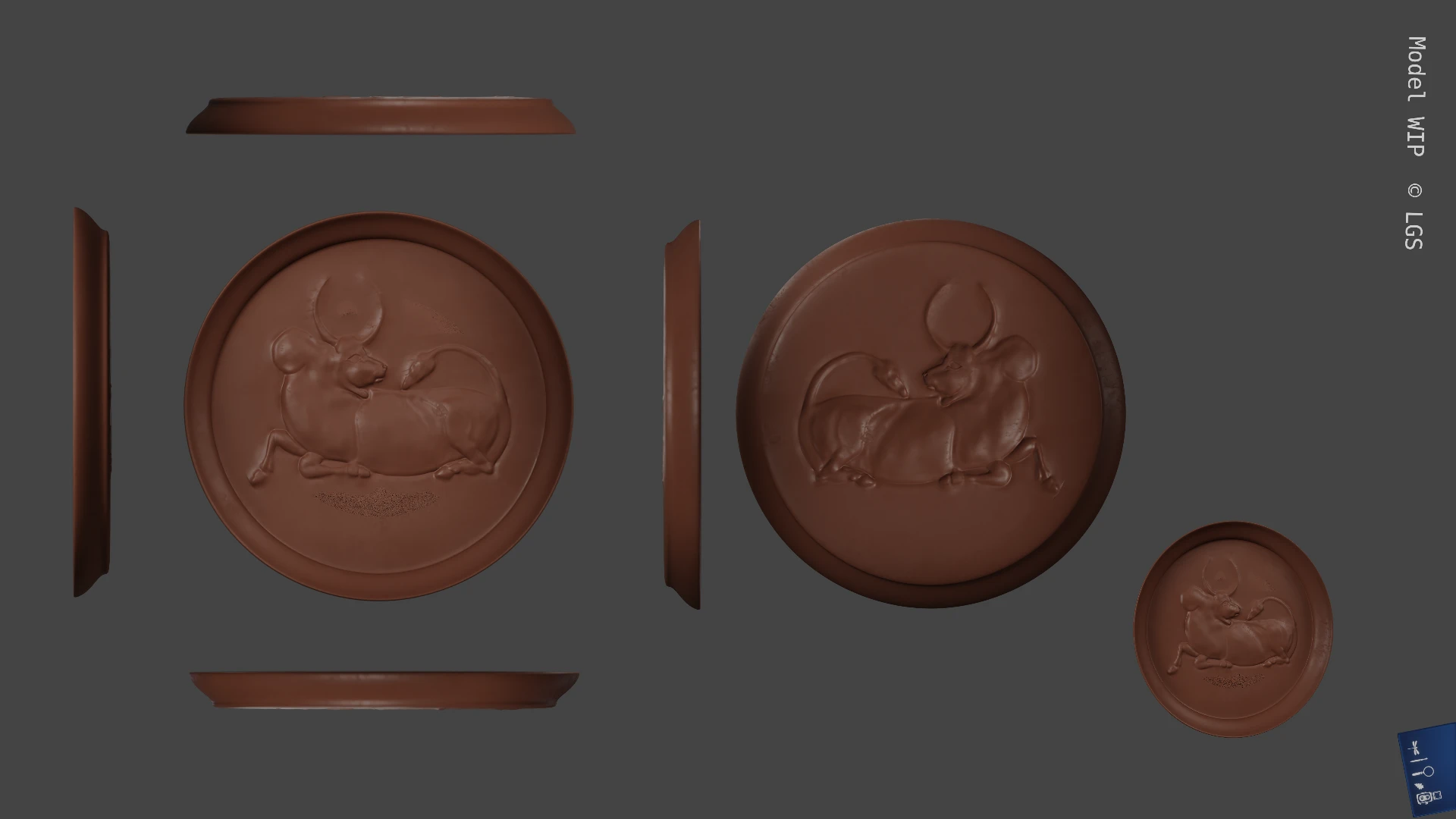
Texture the shape
The museum cartel mentions a copper based alloy as the material. This is an easy one to project on the piece as we have ample references all around. There are details in the decor that I did not include in the sculpting phase, such as the “mane’s” and tail’s incisions. We can tackle them now.
Creating a slightly worn out copper would be relatively straightforward in apps like Substance painter.
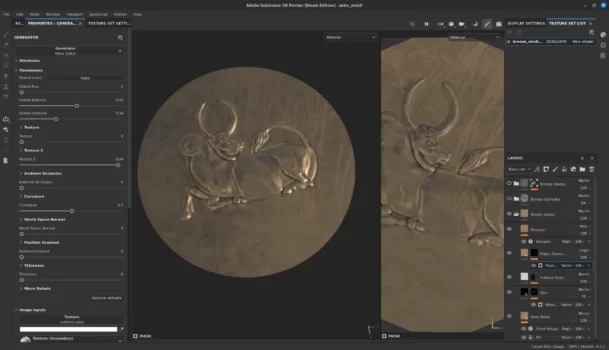
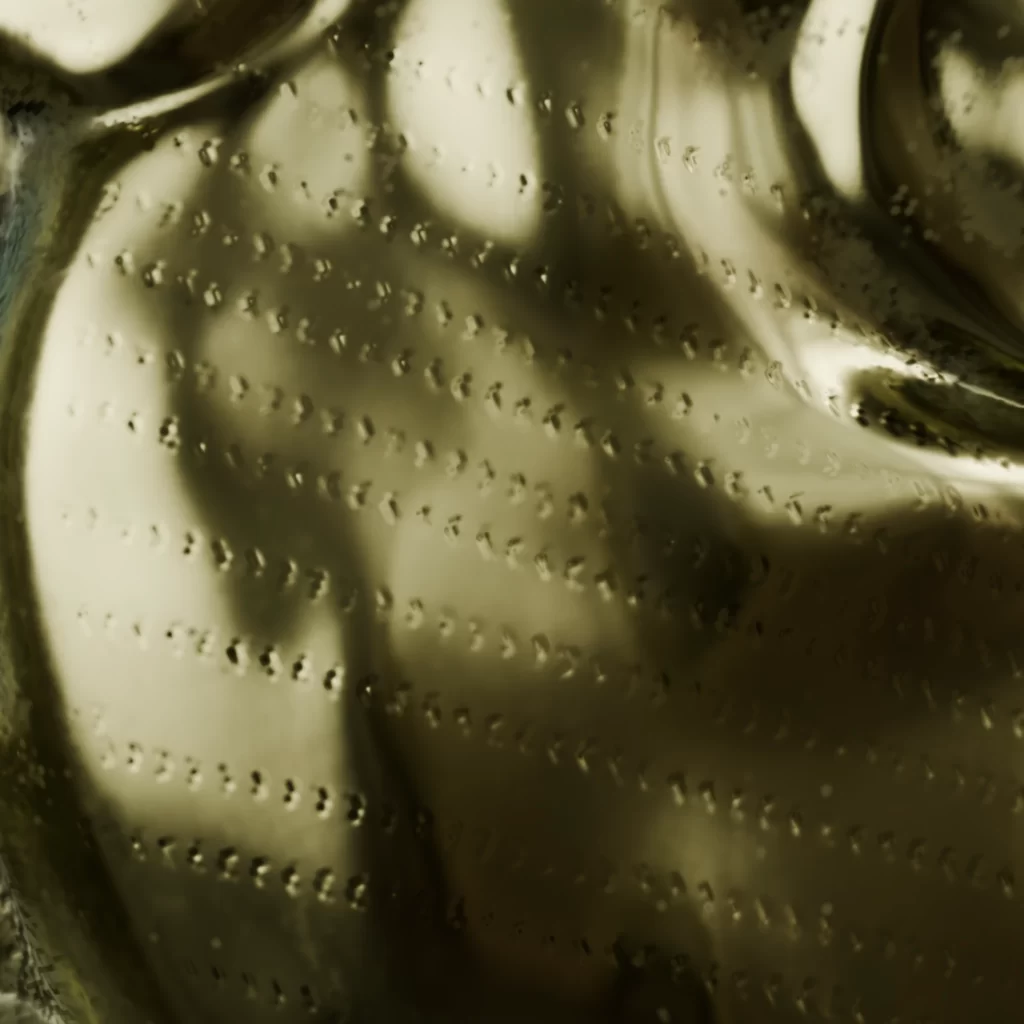
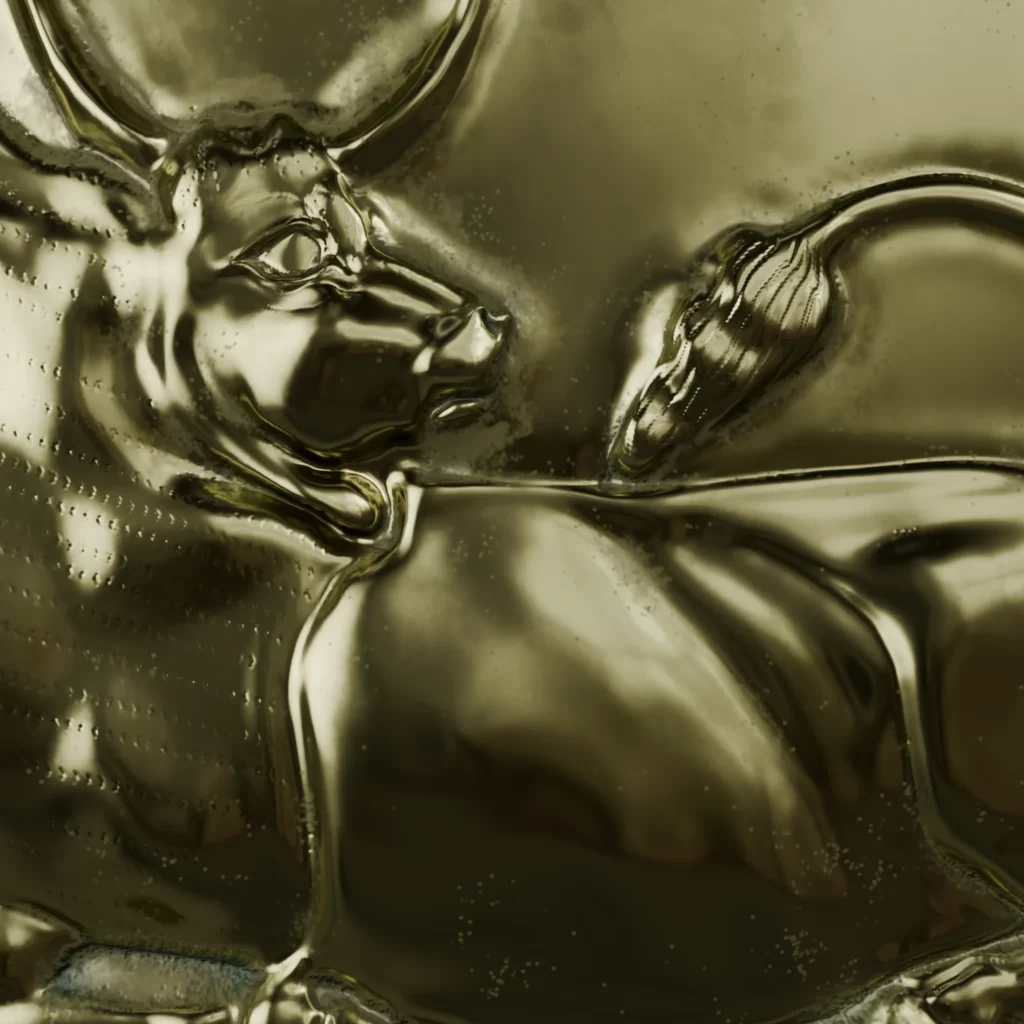
The final result is my own interpretation of what the piece might have looked like prior to its alteration. This is merely an as educated as I could hypothesis.
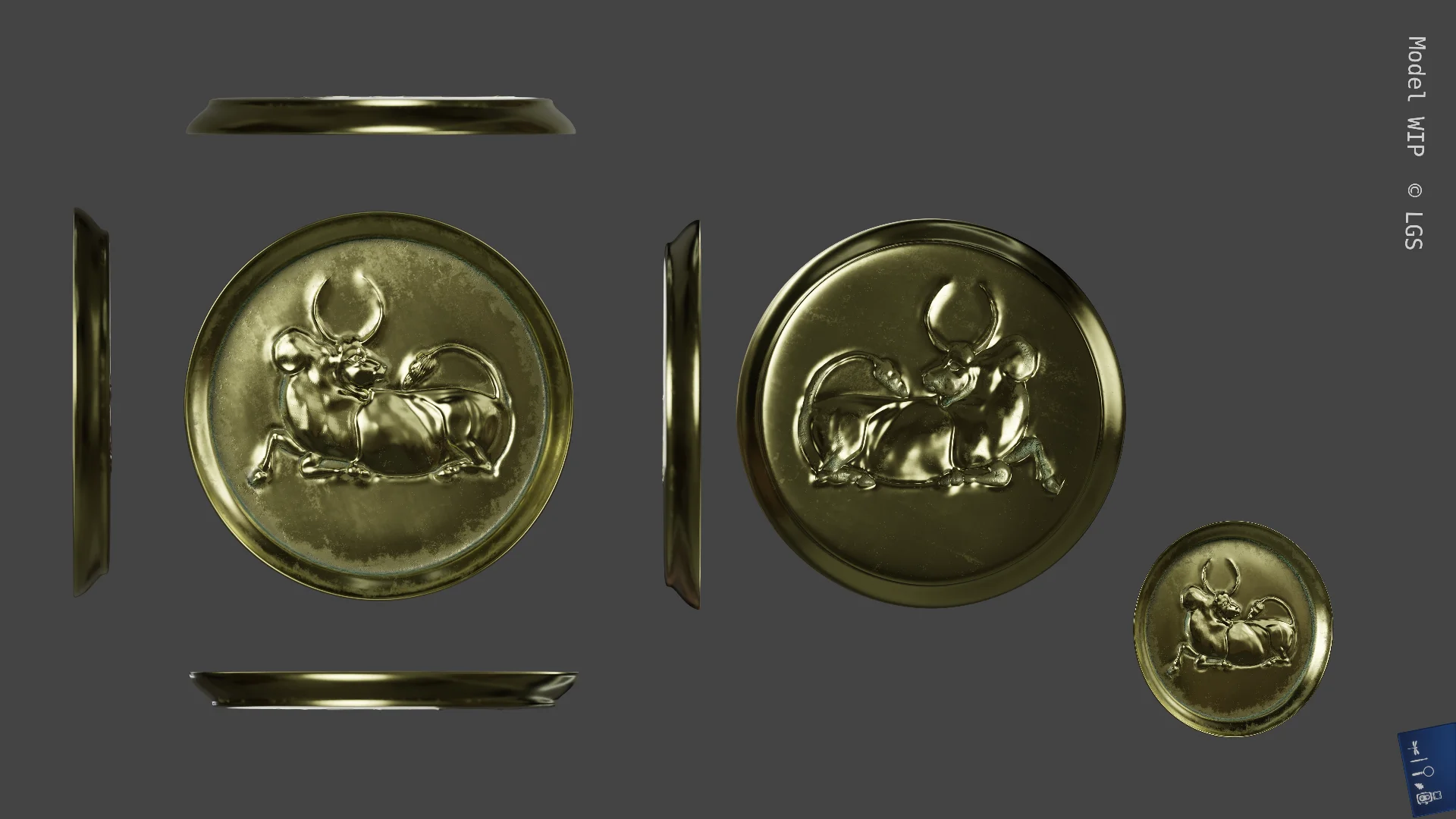
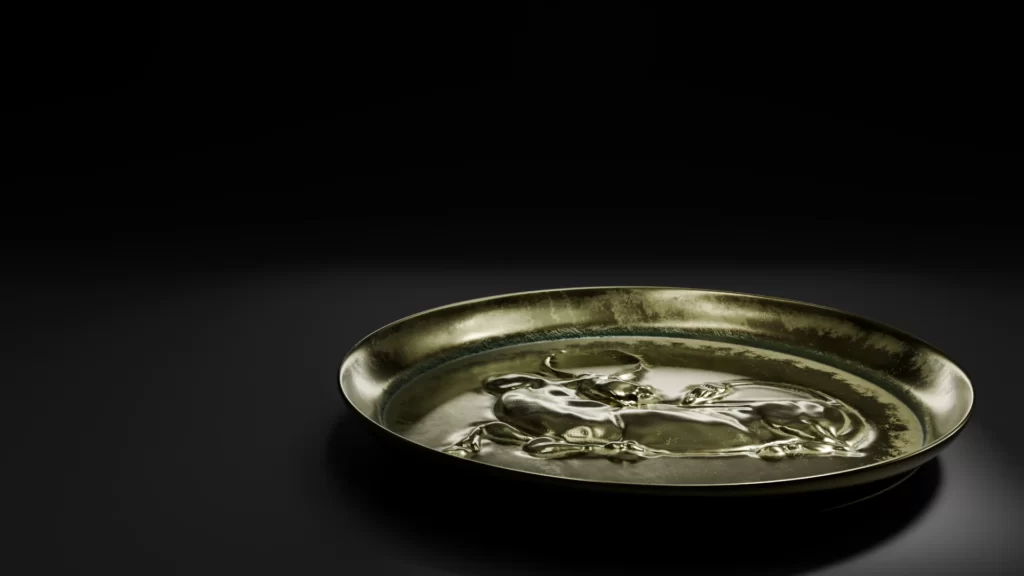
Shine a little light: stills renders using Blender’s Cycles render engine
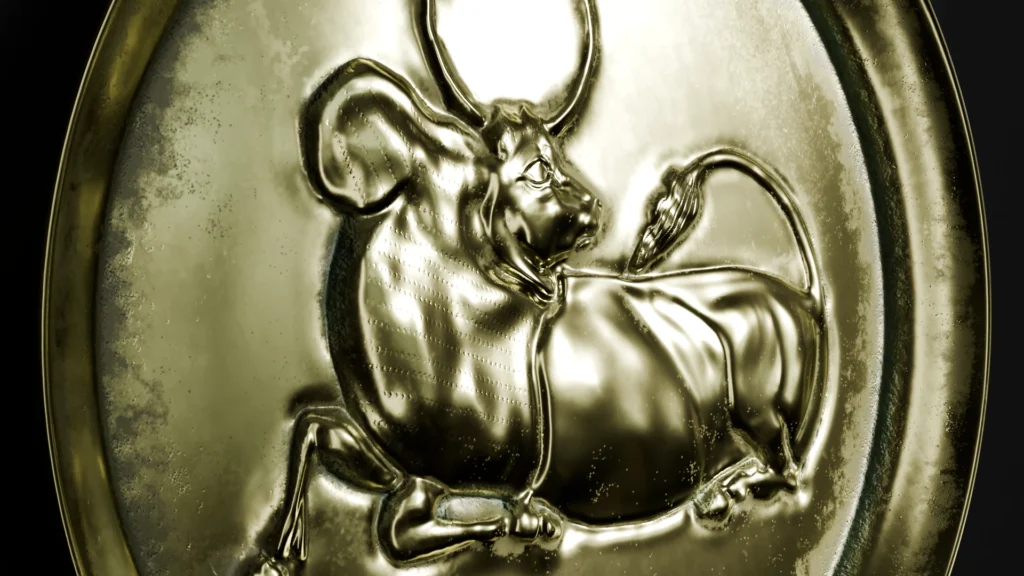
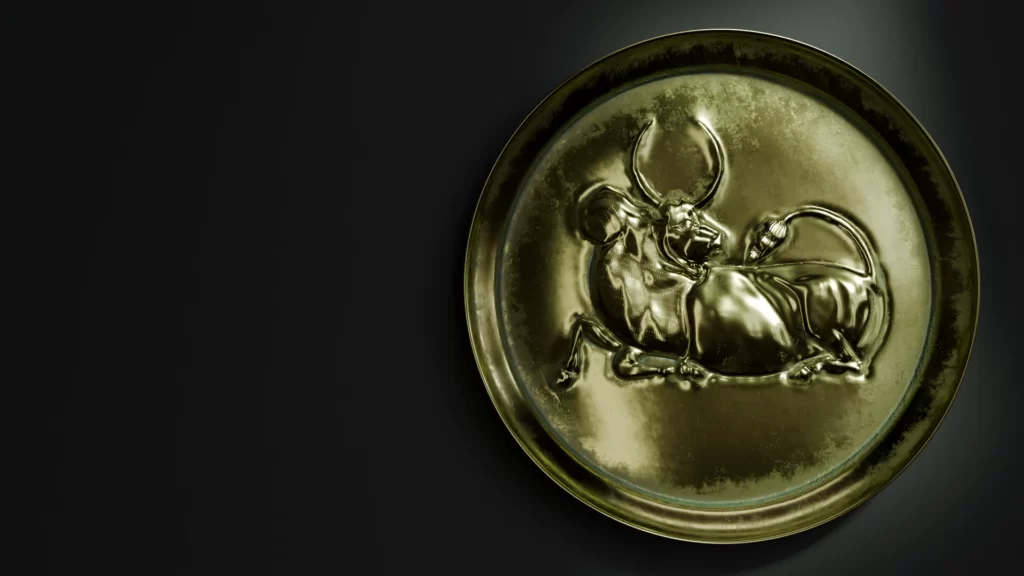
With a little shader trick, we can “almost see” the alteration happening!
3D view
See for yourself in the viewer below !
Disclaimer : technical limitation to material render in web app can let artefacts show, particularly in zoomed views.
See the full screen view (this will open a new tab in your browser).
Cabinet de curiosité
You can now use this VDM brush to zebu-ify your world ! Everybody likes a zebu.
Watch out, this is an .exr file and a heavy one a that (2.5Mo). Download it on google drive, it is released as Reclining zebu © 2024 by LGS and licensed under CC BY-SA 4.0.
Contact
If any of you, dear reader, want to further the conversation, you can do so on Mastodon or Pixelfed.
Credits
Unless otherwise mentioned, all images credit to LGS.
Images
Picture of Brahman cattle from Houston Livestock Show and Rodeo, taken March 3, 2007, Moheroy, Wikimedia commons
A zebu at Twycross Zoo, J147 (geograph.co.uk), 2011, via Wikimedia commons
Bibliography
Hakemi, Ali, 1997, Shahdad, archaeological excavations of a bronze age center in Iran, Reports and Memoirs, Vol. XXVII, IsMEO, Rome. 766 pp, online excerpts
Pittman Holly and Metropolitan Museum of Art (New York N.Y.). 1984. Art of the Bronze Age : Southeastern Iran Western Central Asia and the Indus Valley. New York: Metropolitan Museum of Art. Available online.
MOOREY, P. R. S. “High Relief Decoration on Ancient Iranian Metal Vessels: Development and Influence.” Bulletin of the Asia Institute, vol. 7, 1993, pp. 131–39. JSTOR, http://www.jstor.org/stable/24048435. Accessed 15 Feb. 2024.