

Upside down Mamluk fish
The following texts and images are the results of a training exercise to go from the pictures or the description of an artefact to the creation of a 3D digital double, sometimes restored version of it. If you wish to know more about the process, explanations are in A journey into learning a (3D!) restoration process workflow article.
This particular project is a part of a more global series of textile reconstruction exercises, as described in this summing up article.
Today we’re off to the medieval Egyptian shores of the Nile, as I’m trying to reconstruct a very peculiar yet quite interesting textile, a mash up of decoration techniques and symbolic fauna.
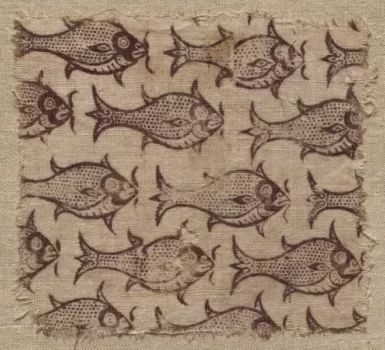
Title: Fish motifs block printed on plain weave cotton ground
Datation: 1200-1300s, Mamluk sultanate (1250-1517)
Provenance: Egypt
Dimensions: 16.5 x 17.8 cm
Media: textile and ink
Source image: INV 1929.845, The Cleveland Museum of Art
Cotton threads and regeneration
Block printing: king-size stamps
This piece of fabric is intriguing on many levels. The obvious part is the decor, and we will get to that shortly. But the technique that created this pattern is not usually put forward despite having been and being almost everywhere. I’m not sure why. In the western world, we are more accustomed to being shown engineering techniques creating complex decors woven in the fabric.
This is not the case here. It’s block printing. Literally, motifs that have been stamped on fabric. This technique is documented in most of all antique civilizations around the world.
The wood blocks are carved with an inverted decor and then inked and pressed against the fabric. It is the same process with paper.
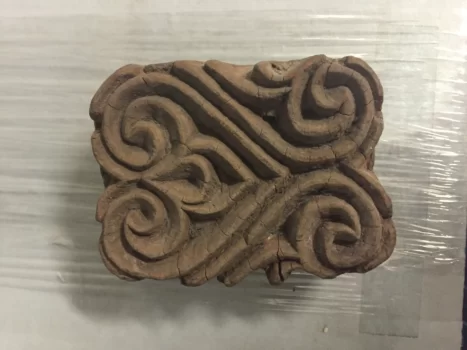
The museum cartel mentions the faulty decor with one of the fishes being sawn in half. I wondered if that could give us a clue we can work with in imagining the block printing shape. If the fish was to be completed with another pass, then the block was made for seamless textures. Maybe part of the exercise here might be to try to make educated guesses and recreate a coherent version of the block too ?
Upside down catfish in a Mamluk world
I was intrigued by the kind of fish that was represented. I initially went for the old Egyptology student reflex of the Nile tilapia (Oreochromis niloticus) but the moustache-like barbels sprouting from the mouth are not present in this species.
My ichthyology knowledge is very limited, and the only fish I know to have that particularity are catfishes. In searching about fauna in the Nile river, I stumbled upon these little guys Synodontis batensoda, also known as the “reverse catfishes”, because of the way they swim, near the surface and upside down.
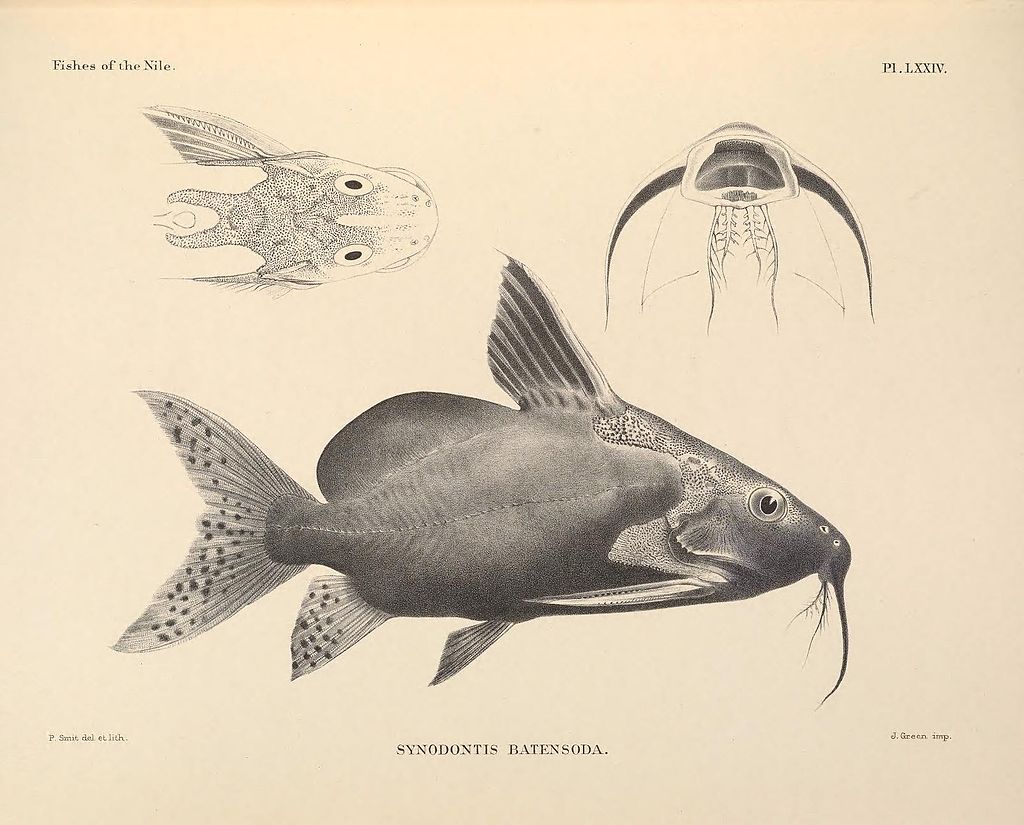

Fishes are commonly worn in the form of amulets in the old Egyptian world as stated in this article from the Metropolitan museum about a 12th dynasty fish pendant representing a realistic upside down catfish present in the National Museums of Scotland institutions collections. The swimming pattern of the species could have given them a regeneration linked power in the ancient world: seemingly dead from above, yet alive and well.
Now, why would a 13th ACE century textile motif reference a 17th BCE practice ? I wouldn’t know…
Well, I can only but suggest you make a mind of your own by investigating mamluk sultanate of Egypt, Levant, and Hejaz and its fascinating history. Besides soldiers, mamluk (literally “free slave soldiers”) societies were fast becoming first and foremost merchants and from there avid art patrons, trading with the whole world and making sure they can be seen as legitimate successors to the Abbasid dynasty. The museum’s notice of the piece mentions the Indian trade where it makes the wood block printing techniques originates. But they had a global impact on a medieval world that still holds memories of its antique history.
Cotton, hand spun and plain.
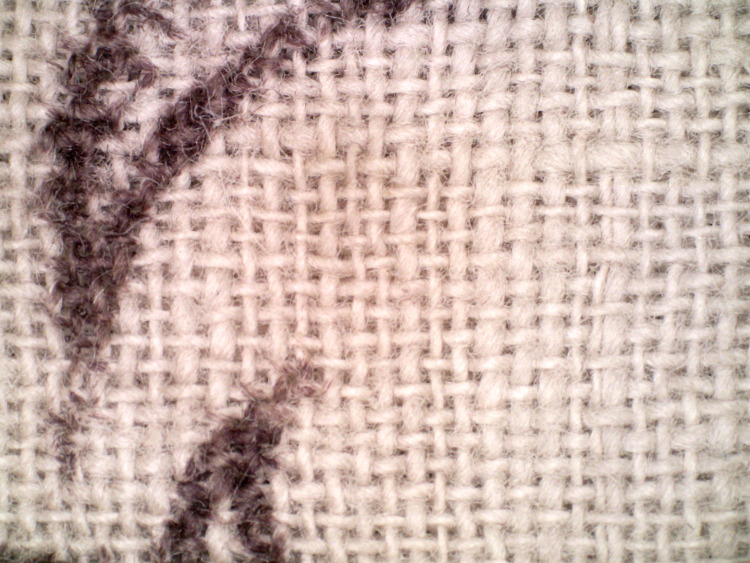
Rejoice, dear reader, because for once we have easy access to the conclusions of a conservation assessment. It is a trend I’m seeing more and more online, directly available on the artefacts pages, and I’m so here for it !
Here’s what the specialists have to say, extracted verbatim :
“Fibre microscopy was performed on this object and, on 1929.907, a very similar fragment that is also from the Mamluk period of Egypt. Its fibre type was originally identified as cotton in museum records but was later changed to linen. Polarized light microscopy is a form of testing that requires a very small sample to be removed from the object for the test to be performed. A polarized light microscope can be used to identify fibres because each fibre type has its own unique structure that is visible under magnification. This textile’s fibres were identified as cotton because of their collapsed, helical structure.”
Because we are aiming for a 3d rendition of this fabric, let’s also add that:
- it’s hand spun or wheel spun: irregularities in thread thicknesses, also, ahem, 13th century -full machine processes are 18th century, booming in the beginning of the 19th-.
- it’s woven using a plain pattern where the warp threads are thicker than the wefts’.
3D notes: a 3D reconstitution process
Disclaimer : this is an exercise, shown for documentation purposes only
An Egyptian cotton summer garment.
I will be using the Blurb to model the fabric structure. But I think we can try to go a step further this time.
This is where I would very much like to insert a render of the fabric used on a mock-up version of whatever it was used for. But, the museum’s notice is moot on that point. I have absolutely no idea nor definitive sources as to how it may have been used. As always, in these cases, we need context and researches to try to make a little more sense of things.
Specialists have a notoriously hard time deciphering the use of Mamluk textiles, mainly because of the early 20th antiquity trade habit of cutting the artefacts down into small squares to maximize profits. This specific artefact is no exception.
In the textile loving Mamluk world, where fabric is a status social marker and a tremendous and very lucrative industry, where silk embroideries would make modern fashionistas collapse, the “humble” block printed cotton is the most inexpensive. It is also the most resistant and therefore most often retrieved in archaeological digs.
Because of the fish symbolism, my first thought was to go towards a shroud. Now, I’m not so sure. I’m not that keen on the idea anyway. My next idea, opposite to that, would be something children related, using the fish motif as an apotropaic protection. As I couldn’t find much on 13th century Egyptian mamluk youth and toddler fashion and infancy beliefs and practices, I’m not sure that this can work.
I think it is best I use a line from Bethany Walker’s work and roll with it : “Mamluk prints are usually made of lightweight, but quality, cotton. It is the most sensible fabric for the warmest months in Egypt and makes comfortable daily wear…”.
I’ll nip the genre question in the bud. Let’s aim for a male version of things, female clothing is architecturally different and more complex for a humble neophyte like myself in the tailor patterning art.
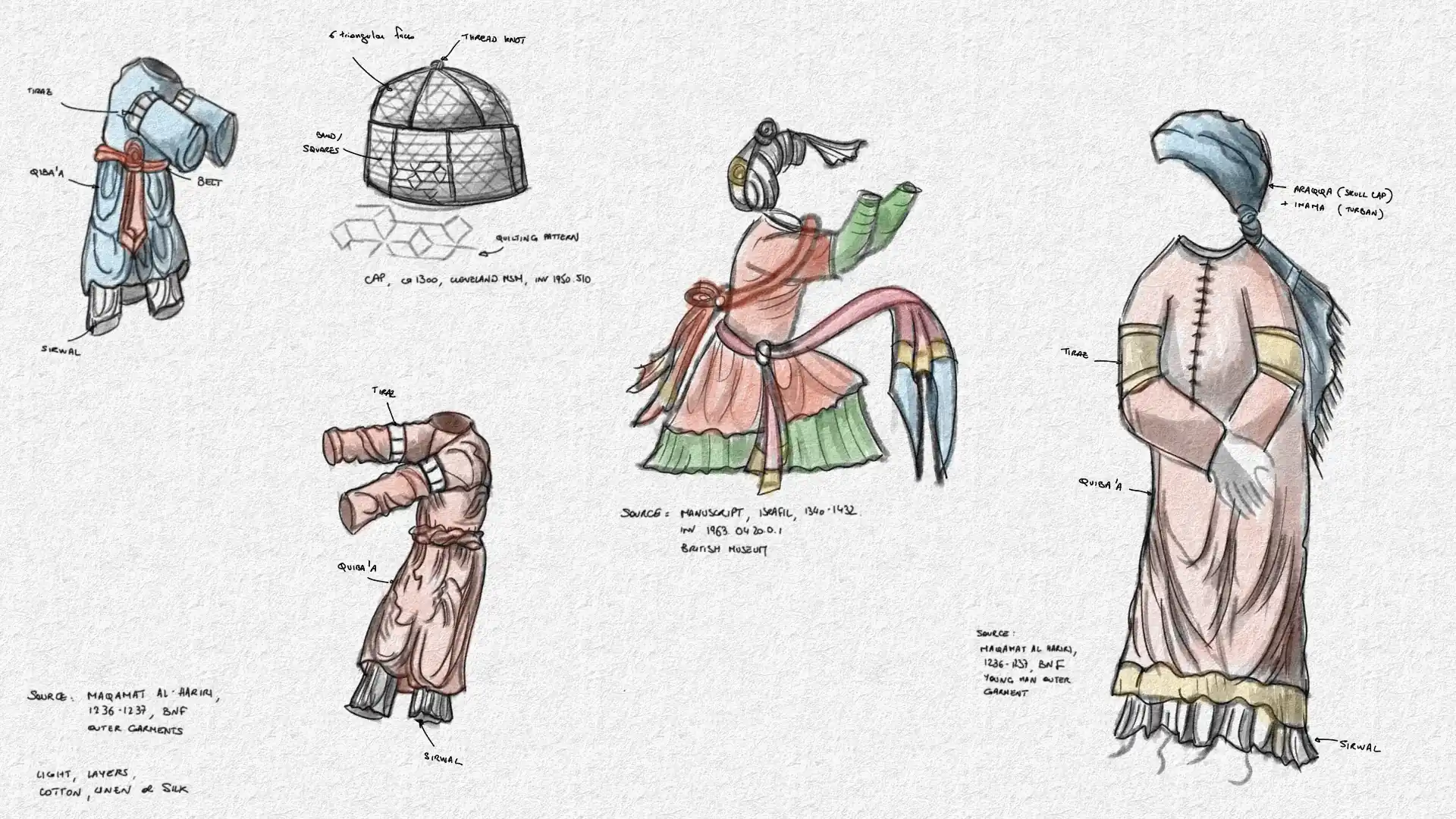
So, now we need to find what a 12th century Egyptian summer garment looked like.
Fun fact: it is extremely hard to find the exact thing ! So, I will go with a mashup of different sources (links available on the iconography section but copyrighted).
I knew there was yet another a catch !
Texture the shape
First pattern test
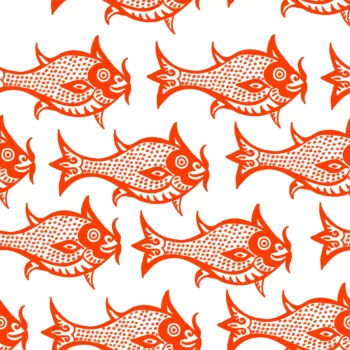
The idea is to get a proof of concept using one of the fish as reference. A little Krita magic later, namely sketches, pasting and correcting in tile mode, and, voilà, we have a first seamless motif. It works well and can be spread and scaled easily.
Note that in order to have a working stamp, there needs to be half fishes whose tails and heads make the joint with the next stamp.
The stamping madness: tiles hypothesis.
Things are about to get nasty, though. Spoiler alert, I’m only showing this part of the process so that those of you intending to do a similar work also have from the start the notion that failure is part of the process. Repeat this three times.
Particularly when we only have a very small sample, making things statistically perilous.
As I have already alluded to, I’m trying to see if I can make out the original stamp from the motif. The half fish are the first indicators of a stamping action. We can also see from remaining stamps that they are rarely nice and neat squares. All bets are off as to their shapes !
My thought process and the hypothesis I worked with were to first try to identify similar motifs and then reconstruct the original stamp. As this is wood printing, motifs from the same stamp will be reproduced slightly differently each time (more or less ink, more or less pressure etc.). Therefore, I identified a few “binary markers”: places where there must be either a mark or left blank. So that means elements like dorsal and ventral fins’ implantation, near or far the eye, lower part of the tail fin curvature, thickness of the face around the eye or the size and scales dots positions.
I can’t fully rely on outlines, particularly on the extremities: they can be impacted by level of ink present and its absorption both in the wood and the fabric, the number of times the stamp was used before re-applying ink or the operator’s pressure on the stamp.
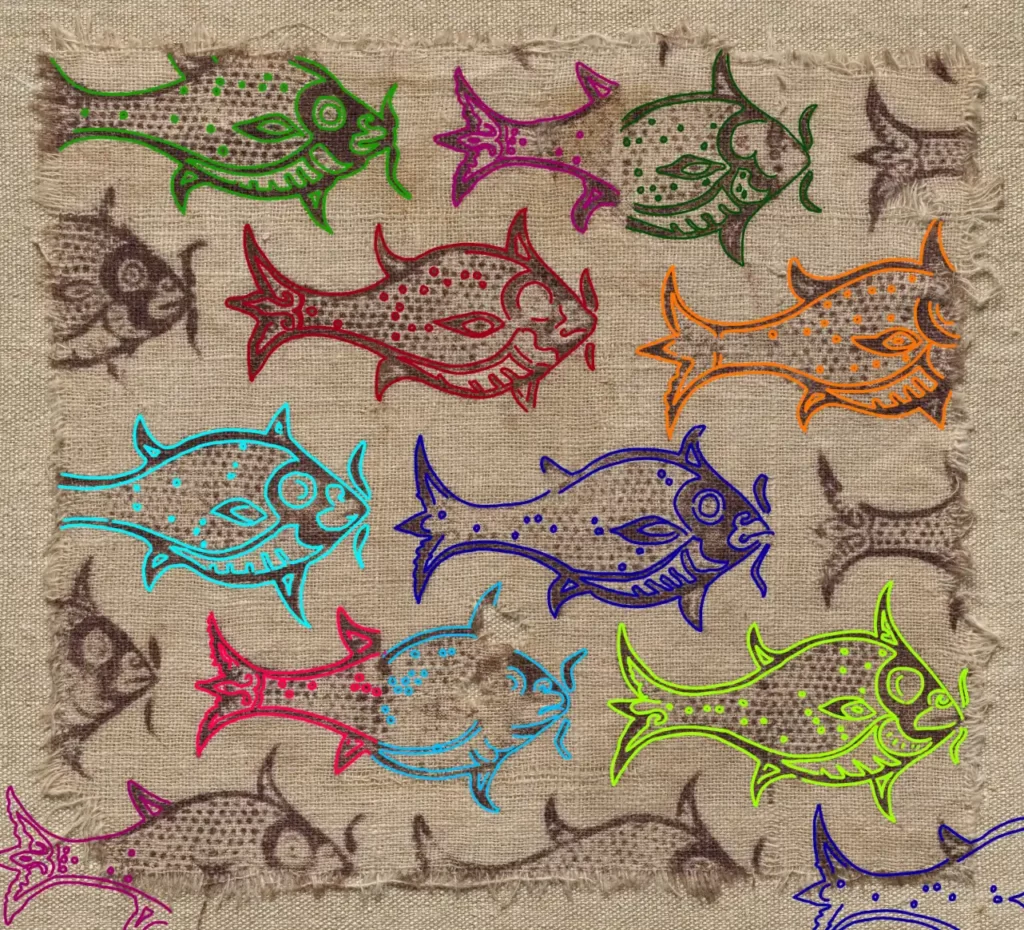
A little sketching and comparing later gives is this variegated drawing. Each colour is a different fish shape. Same colour means fishes were identified as the same. You’ll notice I could identify but two repetitions (dark blue, at the centre and bottom right, and violet, top centre and bottom left).
With this configuration, sadly, I was not able to extract a sensible pattern. To me that looks like there may have been more than one stamp involved. But, maybe one of you, dear reader, can decipher this fish conundrum !
The mix and match approach
As, sadly, I was not able to re-create the original stamp, let’s try to make the most of the information we gathered. The key to making the fabric as interesting as the original is, in my mind, differentiating the fishes as much as possible and as subtle as it is.
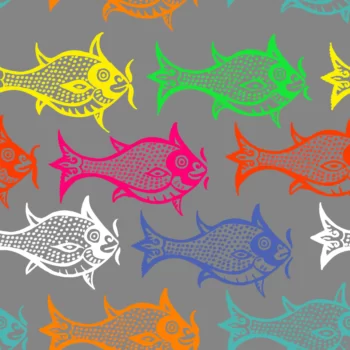
Thankfully, we can use the precedent tests where we already have them individualized (re-plan, re-use, recycle!). A little Krita tiling magic later with a little refining of the shapes, and voilà (again), we have a mask for the motif to be plugged into the shader’s engine.
In order to make sure I can grasp the transformation, I kept the colours as they were in the previous study. Of course, it will be converted to black and white in the shader.
Test, try, test and try again
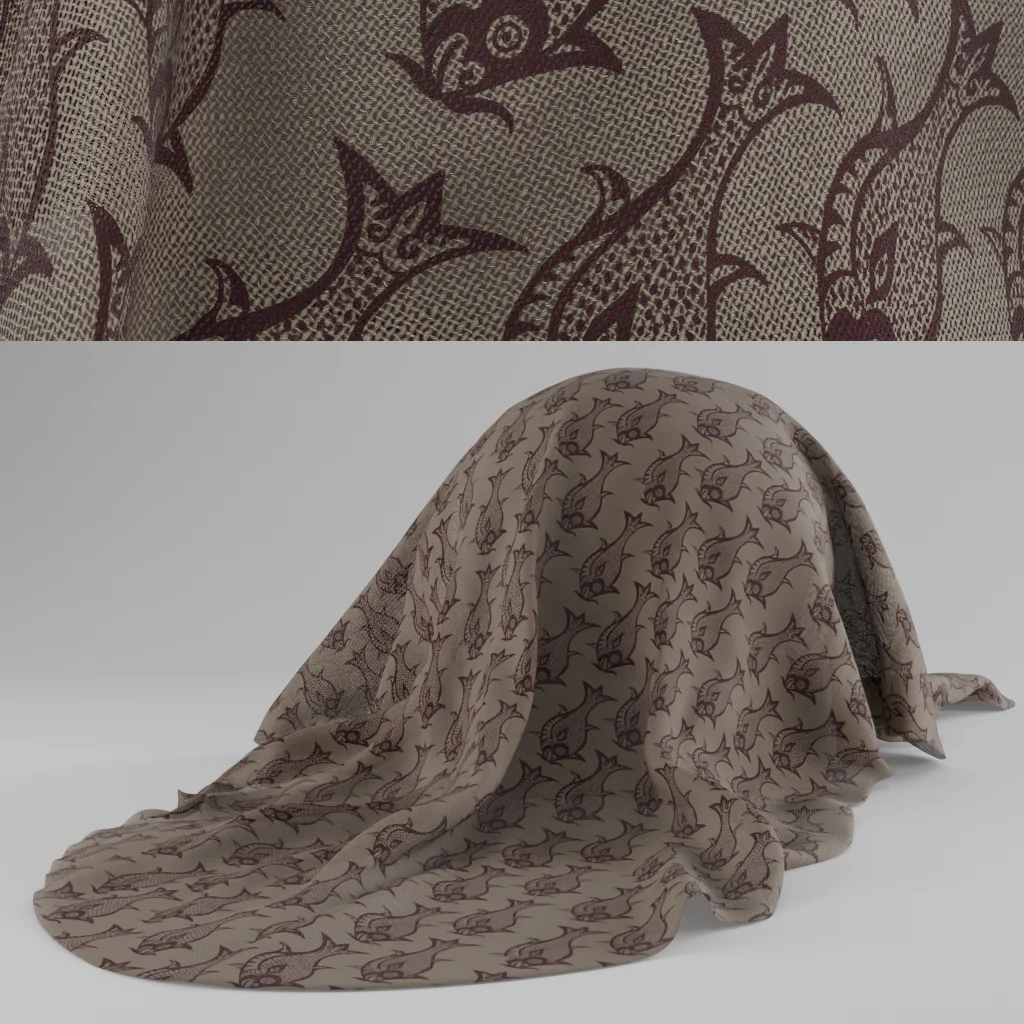
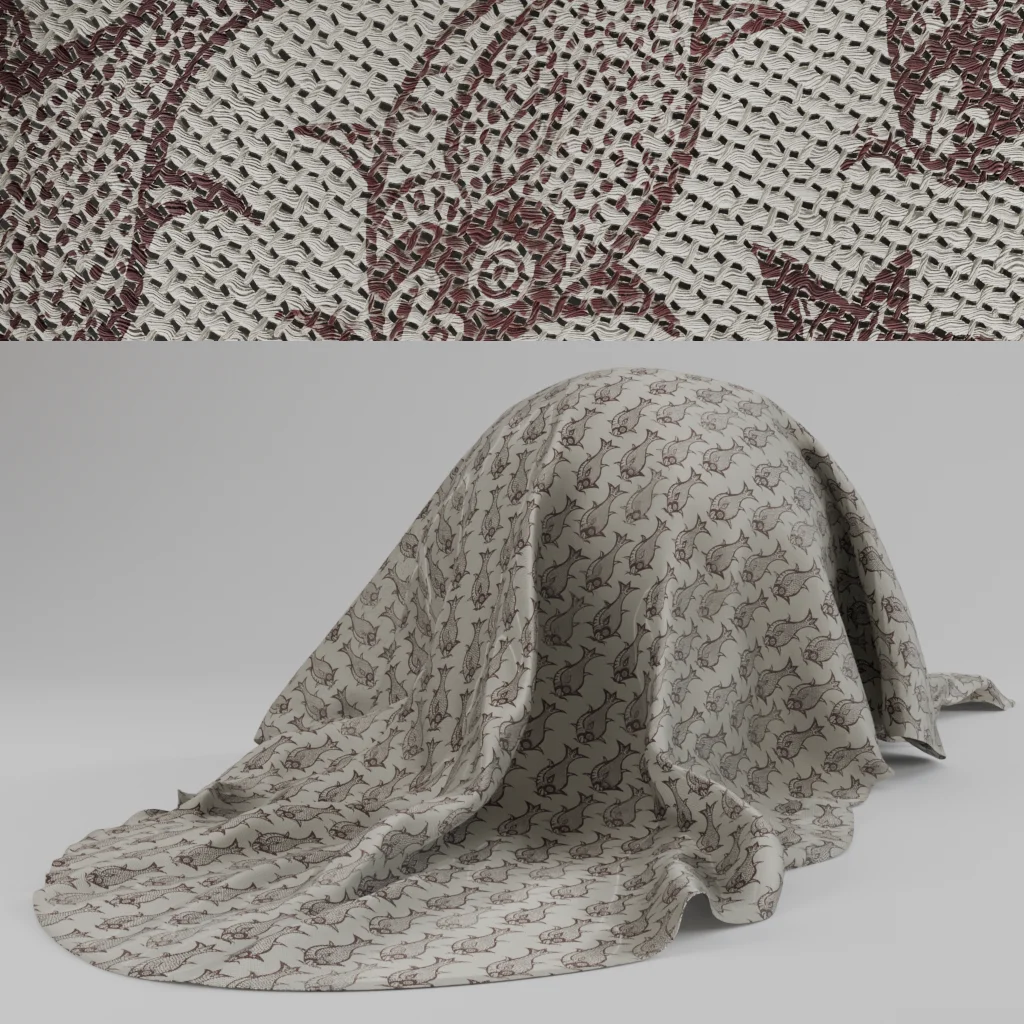
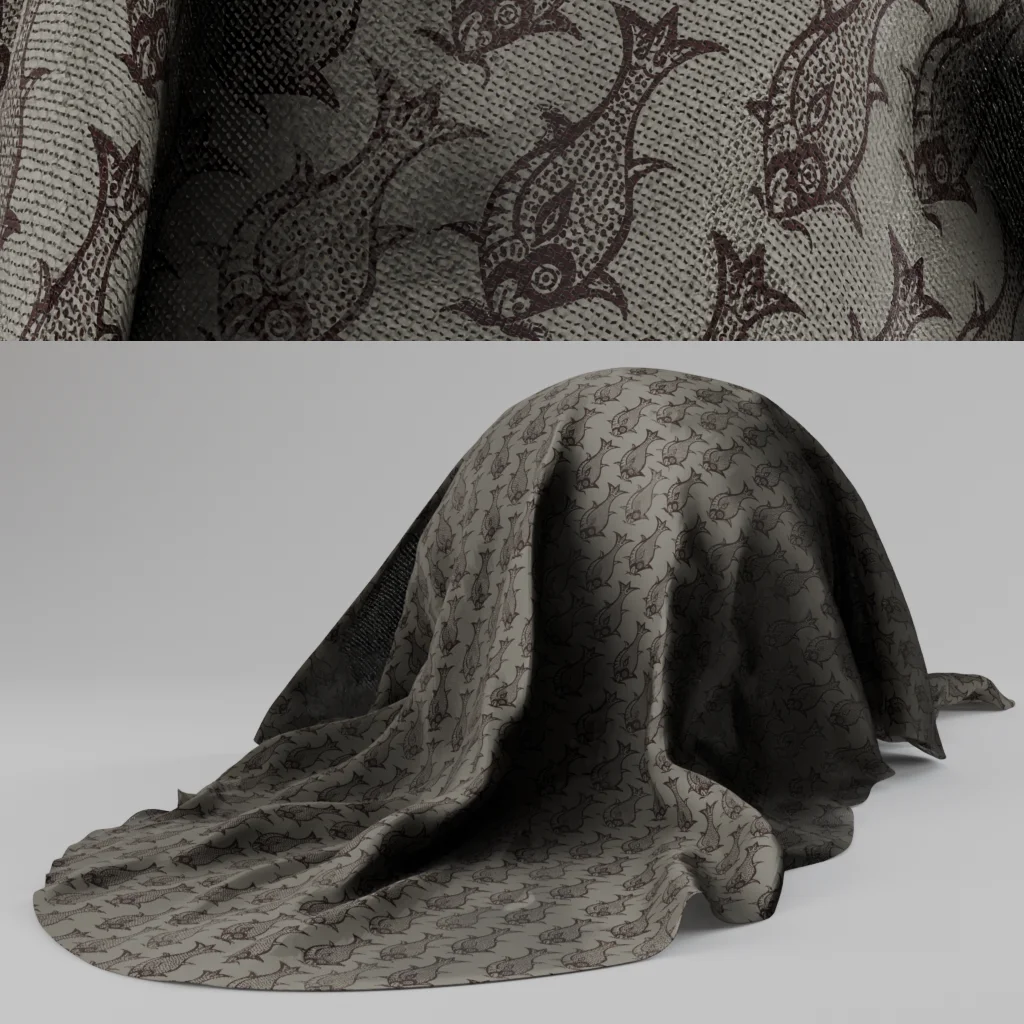
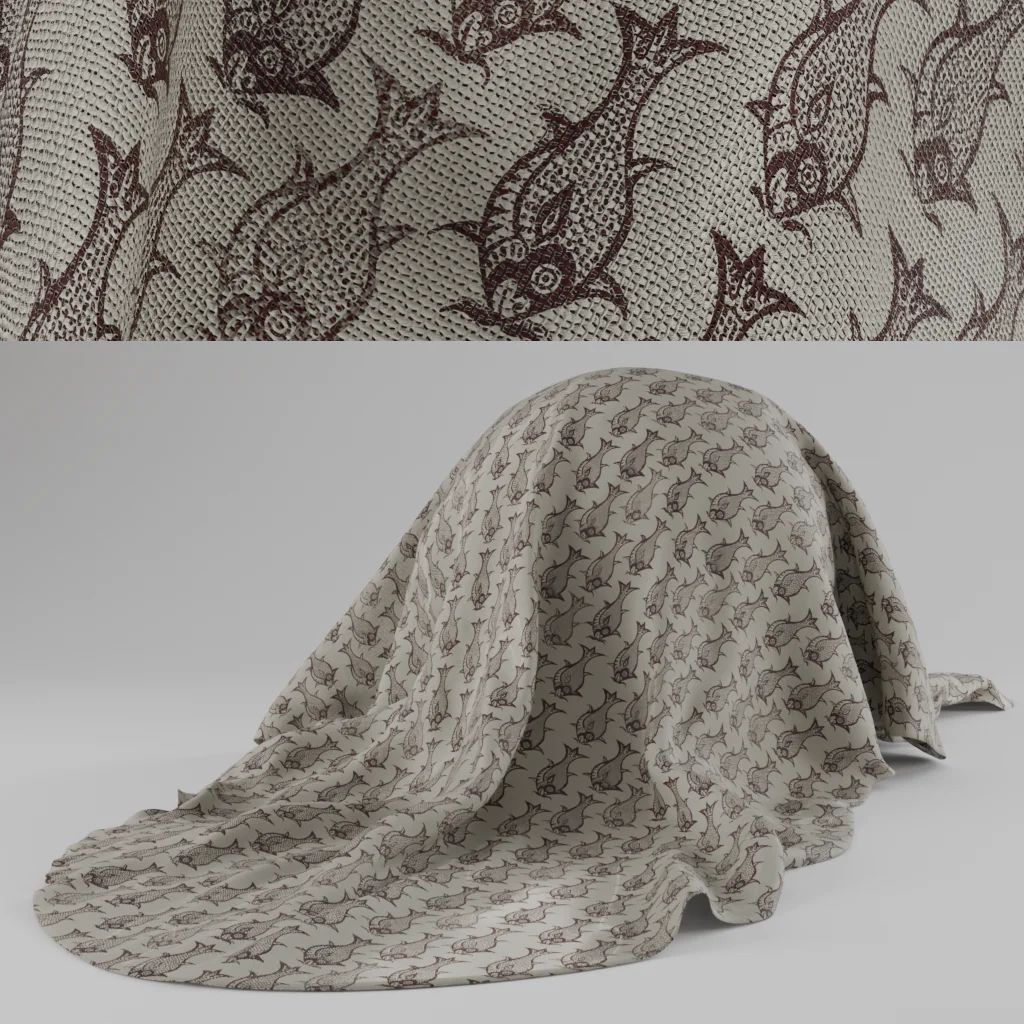
The following images are a (quick!) recap of the different stages of the construction of the texture. Thread pattern, thickness, colours, and sizes were changed to try to approximate a convincing digital rendition of the original piece.
Because the motif is stamped on top of the fabric, we are spared the weaving patterning issue of this piece this time. Phewww !
Clothing hypothesis
Now that we have the texture, let’s see what can be done for the clothing reconstitution hypothesis.
I was not able to track down cloth patterns specific to 13th century Egyptian Mamluk. I can’t say I’m overly surprised. If I understood things correctly from textile conservators colleagues, it is a pain to find even for later eras and one mostly has to do the work oneself from references.
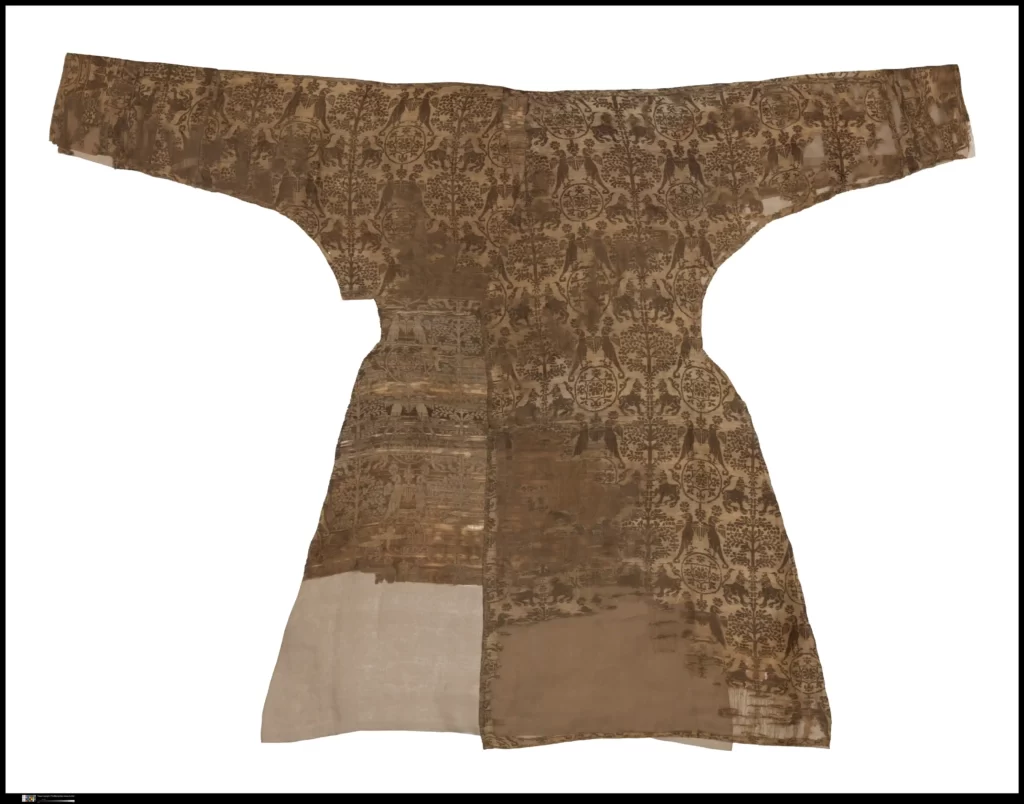
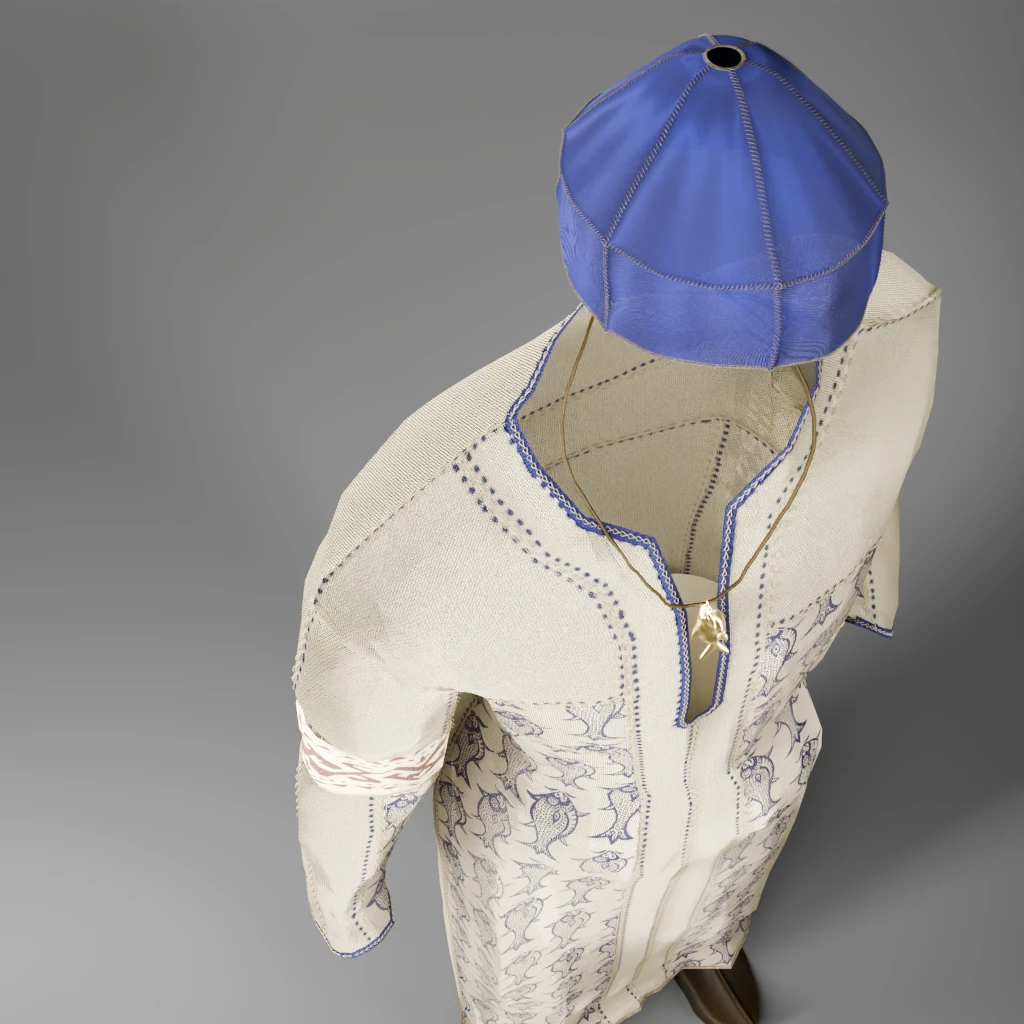
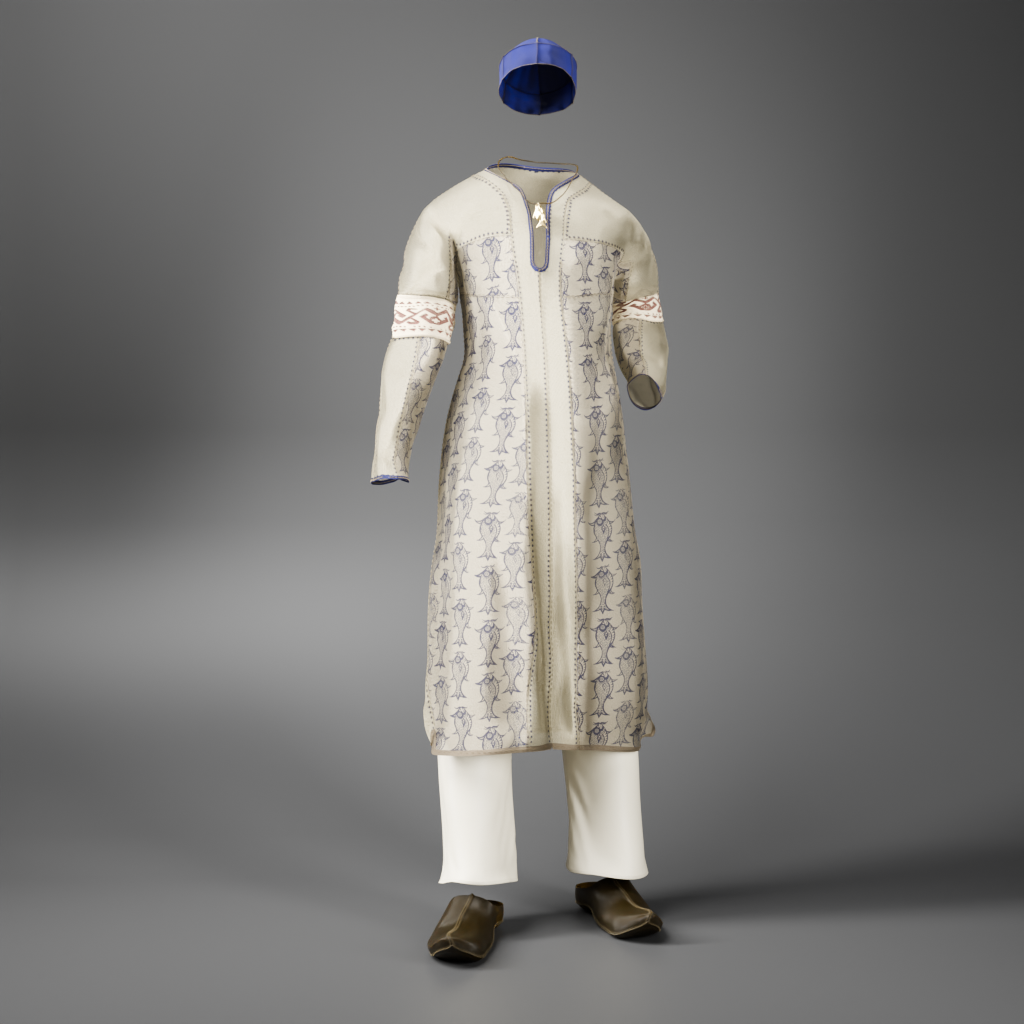
By comparing with museum curated pieces and modern tailor indications, I came up with a simple pattern for the summer garment. I’m absolutely not certain it can withstand a specialist scrutiny (though the exercise of composing the hypothesis with such a person would be great!). But it was interesting to make. I largely based the overall outlook on the few bibliographical resources I had.
Because some of you might be interested in doing so, I will be frank: it was neither a straight nor an easy process. I was lucky to be able to use a powerful Blender add-on, Modeling Cloth v4.x. Its developer has in depth videos about the process and how to use it. Despite all this tremendous help, it was a struggle to keep things in line and to project a convincing garment. I used a male generic mannequin in A-pose as a colliding object then used a rig to find a pose. The add-on makes the cloth mostly follow the movement (with a little help from one’s mouse!).
The seams stitching pattern heavy lifting is done using Alexandre Albisser’s cloth sewing tool box.
Once the pose was settled, I sculpted the details and reshaped what I deemed necessary to showcase the garment in a neutral manner.
Because I found information on them in my researches, I added the hat and shoes. I think they help in setting the context and add a degree of realism. I purposefully understated them in colours: they are accessories, not the main interest.
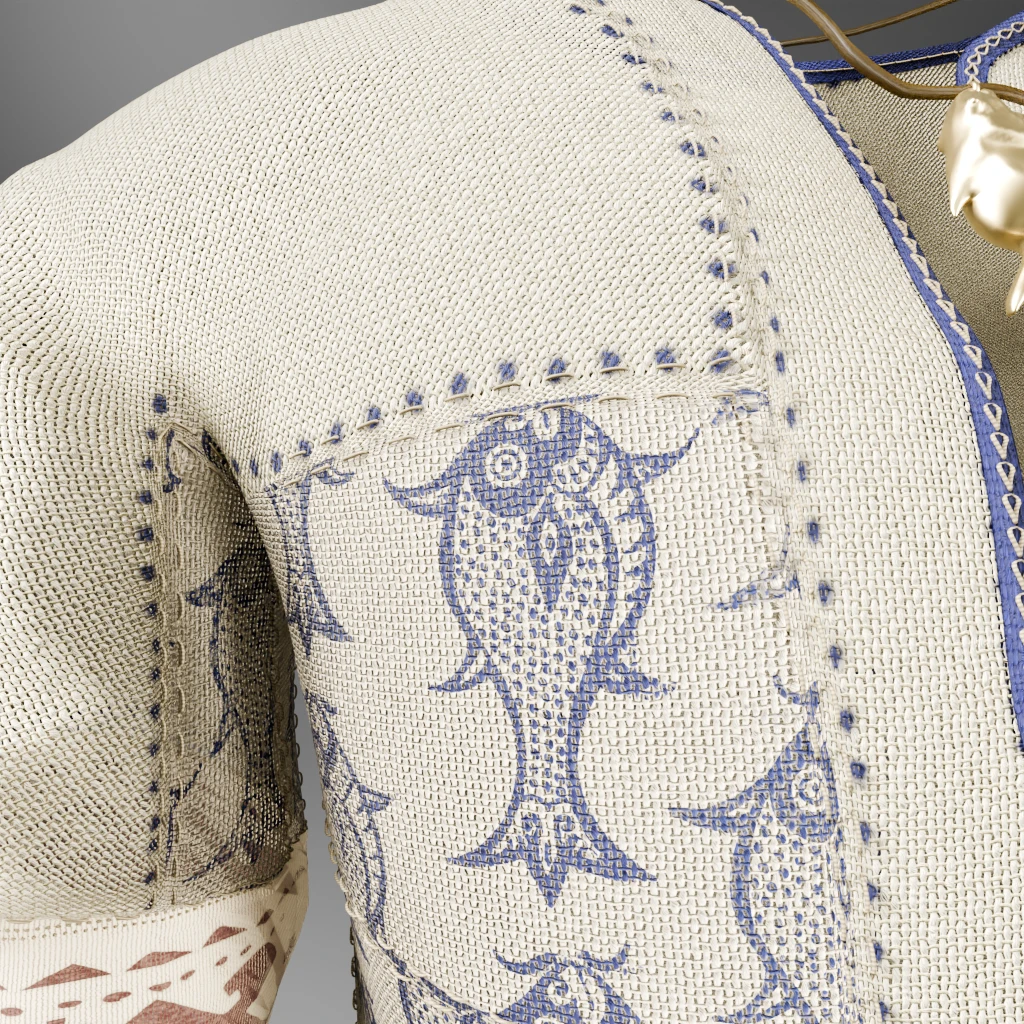
I deliberately coloured the motifs with an indigo tint in order to separate them from the original piece while remaining more or less historically accurate.
Interactive rendering
Contrary to my initial beliefs of mesh size, the issue with this type of assets, whether intended for games or web engines, boils down to how much weight one is willing to accept for the textures. I found the articulating point is trying to balance out the precision of the model (more vertices) and the precision of the texture (more details ultimately means more images weight). As the model itself is not that complex, it can be stripped down to the minimum to be able to allocate more resources to the textures. My pet peeve was the idea that I wanted users to be able to zoom in to see the weaving pattern so they can assess the lightness the fabric gives to the garment. So, basically, I wanted to make sure the level of details was to my liking.
Game engines deal with this aspect in different manners including what mostly resembles what three.js does too. Namely, they allow different models with different sizes (mesh plus textures) to be seen, triggered by the distance from the camera. The closer you get, the more detailed ones are shown. It is more or less seamless from the viewer’s point but is more gentle on the GPU.
Sadly my beloved 3D Viewer does not allow for this yet. It is on the “to-do” list for one of the next versions though. I’m re-assured in thinking the exercise is still a success because I can very well have a textured model up to whatever K one wants (8K is all the rage these days). But I won’t be showcasing it on the web viewer because, dear reader, I would not want your computer to start overheating. Mediating-as-good-as-I-can model it is, then. This will be particularly true for the garments part of the project.
That is why you will notice things have changed a bit from the Cycles renders to the 3D web viewer: the sticthes are removed, as are the hems and trims. I could theoretically have baked them in the differents maps but that would have implied a higher size of images and then defeat the purpose ! Particularly in a context where the LOD cannot be linked to the zoom level.
3D view
Disclaimer : technical limitation to material render in web app can let artifacts show, particularly in zoomed views.
The fabric itself
See the full screen view (this will open a new tab in your browser).
The garment
See the full screen view (this will open a new tab in your browser).
Credits
Unless otherwise mentioned, all images credit to LGS.
Iconography
Block printing on plain weave cotton ground; overall: 16.5 x 17.8 cm (6 1/2 x 7 in.). The Cleveland Museum of Art, INV 1929.845
Textile printing block carved with palmettes and geometric interlaces on both sides, 10th ACE, attributed to Egypt, Wood, inv n°1971.87, Metropolitan museum of Art.
Boulenger Georges, Synodontis batensoda, in “The fishes of the Nile”, pl. LXXIV, 1907, Ed. Rees, London.
Tunique, 1250-1510 (Mamluks), INV. E23518/TC805, Musée du Louvre.
Child’s tunic with bands of Y-shapes, Mamluk period (1250-1517), linen with silk embroidery, stitching in flax, INV: EA184.353, Ashmolean Museum, Yousef Jameel Centre for Islamic and asian art.
Cap with fleur-de-lys, quilted silk, dyed blue, gilded leather appliqué and embroidery, Mamluk period, INV EA1984.368, Ashmolean Museum, Yousef Jameel Centre for Islamic and asian art.
Riding Coat, first half 13th century, Iran ?, Silk; weft-faced compound twill (samite), H. 68 7/8 in. (175 cm), W. across sleeves: 50 3/8 in. (128 cm), W. across skirt: 37 in. (94 cm). Object Number: 2008.346a–c, Metropolitan museum of Art
Folio from a copy of Automata by al-Jazari, Kitab fi ma’arifat al-hiyal al-handasiyya (The book of knowledge of ingenious mechanical devices); Arabic in black naskh script; recto: Mechanical Device for Pouring a Drink; verso: text: fifteen lines, Manuscript, Egypt, Smithsonian musueum.
Bibliography
Abbassid clothing with references. https://richardcullinan.wordpress.com/2016/12/17/an-overview-of-mens-abbasid-9th-10th-century-persian-clothing/
“Indigo in the Arab World”, (1st ed.), Balfour-Paul, J. (1997), Routledge. https://doi.org/10.4324/9780203358436
Prevost Virginie, “Chaussures et parures de pied chez les peuples musulmans”, in ” Chaussures !”, Brussel, Fondation Albert Marinus, 2003, pp. 32-52. available online as of 01/2025.
Sardi M., “Mamluk Textiles”, in Islamic Art, Architecture and Material Culture: New Perspectives, ed. Margaret S. Graves, with a foreword by Robert Hillenbrand (Oxford: British Archaeological Reports International Series 2436) 2012, available online (01/2025)
Vogelsang-Eastwood Gillian, “Turbans and textiles, Mamluk Egyptian clothing”, first published in RAWI’s ISSUE 11, 2021, seen on 01/25.
Walker B., “Rethinking Mamluk textiles”, in Mamluk studies review, Vol. IV, University of Chicago, 2000. Available online, as of 01/25:
article: http://mamluk.uchicago.edu/MSR_IV_2000-Walker.pdf (lower resolution version)
Full volume: http://mamluk.uchicago.edu/MamlukStudiesReview_IV_2000.pdf